Your Ultimate Guide to Pool Maintenance and Cleaning
Keeping a pool in Southwest Florida sparkling clean and safe isn't magic—it's just a matter of consistent care. A good routine is all about balancing the water chemistry, making sure your equipment is running smoothly, and physically clearing out any debris before it can cause problems like algae or equipment failure. For most pool owners here, the sweet spot is a mix of simple DIY tasks and leaning on a pro for the tricky stuff.
Keeping Your SW Florida Pool Flawless Year-Round
There's nothing better than having your own pool in Southwest Florida, but our climate definitely keeps you on your toes. The relentless sun, afternoon downpours, and sticky humidity are a perfect recipe for throwing your water chemistry out of whack and inviting algae to the party. Proper pool maintenance and cleaning is more than just keeping it looking pretty; it’s about protecting your investment and making sure the water is healthy for your family and friends.
Think of this guide as your go-to playbook. We're going to walk through the fundamentals of pool care, which really boil down to just three things:
- Circulation: You need that water moving constantly. This is what helps the filter grab gunk and spreads the chemicals around evenly.
- Filtration: This is the workhorse of your pool, physically pulling dirt, leaves, and other junk out of the water.
- Chemistry: It's all about balance. Getting the sanitizers and other levels right is what keeps the water crystal clear and safe for swimming.
The Value of Professional Expertise
Look, skimming leaves and emptying the skimmer basket? Most people can handle that. But when you start getting into the nitty-gritty of water chemistry and equipment diagnostics, it can get overwhelming fast. That’s where bringing in a professional service really pays off, saving you a ton of time and helping you dodge expensive mistakes.
It's no surprise the demand for good pool care is on the rise. The global pool cleaning market is on track to hit $26.76 billion with a healthy 7.2% growth rate. Here in the U.S., it’s an $8.8 billion industry with nearly 79,000 businesses. For those of us in Southwest Florida, these numbers just confirm what we already know: choosing a reliable local expert like Water Medic is crucial. It’s the best way to avoid the common issues that plague up to 50% of neglected pools every year.
A consistently clean pool isn't just a luxury; it's a critical component of your property's value and appeal. It transforms a simple backyard into a centerpiece for relaxation and entertainment.
Beyond just the cleaning, a pristine pool adds serious value to your property. This is especially true if you’re aiming for the perfect Florida vacation rental with a private pool. Whether you tackle some chores yourself or decide to go with a full-service plan, the goal is always the same: a perfect pool that’s ready whenever you are.
We want you to feel confident in caring for your pool, but also know that expert help is right around the corner. If you're ready for a completely hands-off approach, taking a look at a comprehensive monthly pool maintenance plan is the perfect next step.
The 4 Pillars of Pool Chemistry: A Balancing Act
Let's be honest, the term "pool chemistry" can sound intimidating, maybe even bringing back unpleasant memories of high school science class. But in reality, it's all about keeping four key elements in balance. Think of it less like a complicated chemistry experiment and more like a recipe for perfect, sparkling water. Get these four ingredients right, and you’ve mastered the hardest part of pool care.
This whole process boils down to three core functions working together: circulation to move the water, filtration to clean it, and chemistry to keep it safe.
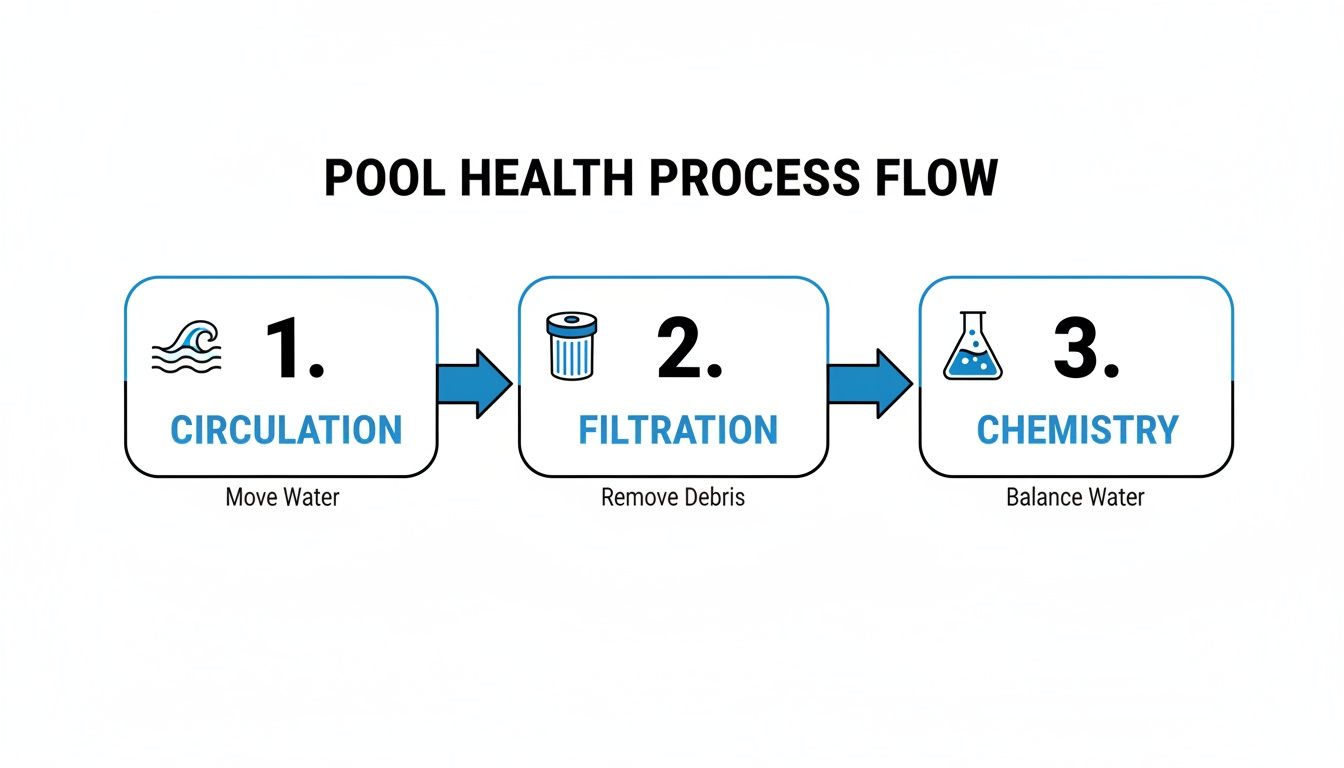
As you can see, they all depend on each other. If one fails, the whole system struggles, and that's when you start seeing problems like cloudy water or the dreaded green tinge of algae.
pH and Total Alkalinity: The Foundation
First, let's talk about pH. This is simply a measure of how acidic or basic your water is. For a swimming pool, the sweet spot is a pH between 7.4 and 7.6. If your pH dips too low, the water becomes acidic, which can start eating away at your pool heater, pump seals, and even irritate your skin and eyes. Too high, and your chlorine loses its sanitizing punch, leading to cloudy water and scale buildup.
Right alongside pH is its partner, Total Alkalinity (TA). Think of TA as the anchor that keeps your pH from bouncing all over the place. It acts as a buffer, soaking up changes that would otherwise cause wild pH swings, especially after a classic SW Florida downpour. We aim for a TA level between 80 and 120 parts per million (ppm). When your TA is stable, your pH is much easier to manage.
Chlorine: Your Sanitizing Superhero
Everyone knows about chlorine. It's the workhorse that neutralizes bacteria, viruses, and other nasty contaminants. The key metric here is Free Chlorine (FC)—the amount of chlorine that's actively available to sanitize your water. In our sunny climate, keeping your FC between 2.0 and 4.0 ppm is crucial for a healthy pool.
But here in Florida, the sun is chlorine’s mortal enemy. Those intense UV rays can obliterate up to 90% of your unstabilized chlorine in just a few hours. That’s where our fourth pillar comes into play.
That strong "chlorine" smell you sometimes notice around pools? It's usually a sign of not enough free chlorine, not too much. It means the chlorine is overworked and struggling to keep up.
Cyanuric Acid: Sunscreen for Your Chlorine
Cyanuric Acid (CYA), or stabilizer, is like sunscreen for your chlorine. It forms a weak bond with the chlorine molecules, protecting them from being zapped away by the sun. Without it, you'd be dumping in chlorine day after day just to maintain a minimal level.
For a pool in Southwest Florida, the ideal CYA range is 30 to 50 ppm. It’s a delicate balance. Too little, and the sun wins. Too much, and the CYA can actually "lock up" the chlorine, making it less effective at its job.
The Synergy—and the Challenge
Understanding these four elements is the first step, but the real art is managing how they interact. They're all connected, and a change in one will always affect the others. That afternoon thunderstorm doesn't just add water; it can dilute your CYA, lower your TA, and send your pH plummeting, making your chlorine less stable and effective.
This constant juggling act is why so many homeowners eventually hand the keys over to a professional. The swimming pool cleaning industry has grown to over 78,817 businesses in the U.S. for a reason—it's a demanding job. In a tough environment like ours, the 25+ years of experience we have at Water Medic of Cape Coral makes all the difference. In fact, consistent professional care can cut down on expensive, chemically-induced equipment repairs by as much as 60%. You can dig into more industry stats in this pool service industry report from IBISWorld.com.
While those home test strips are fine for a quick check, our technicians use professional-grade digital readers to get pinpoint-accurate results. We know exactly how a heatwave or a week of rain will impact your water chemistry and can make precise adjustments to keep your pool perfectly balanced without over-treating it. If you're tired of playing chemist, our team can give you the peace of mind you're looking for.
Optimizing Your Pool's Circulation and Filtration
Think of your pool's chemistry as its immune system. If that’s the case, then your circulation and filtration gear—the pump and filter—are its heart and lungs. This powerful duo works around the clock to keep water moving, clear, and free of all the gunk that finds its way in. Without them running properly, even perfectly balanced chemicals can't do their job, and you’ll quickly end up with cloudy water and the perfect breeding ground for algae.
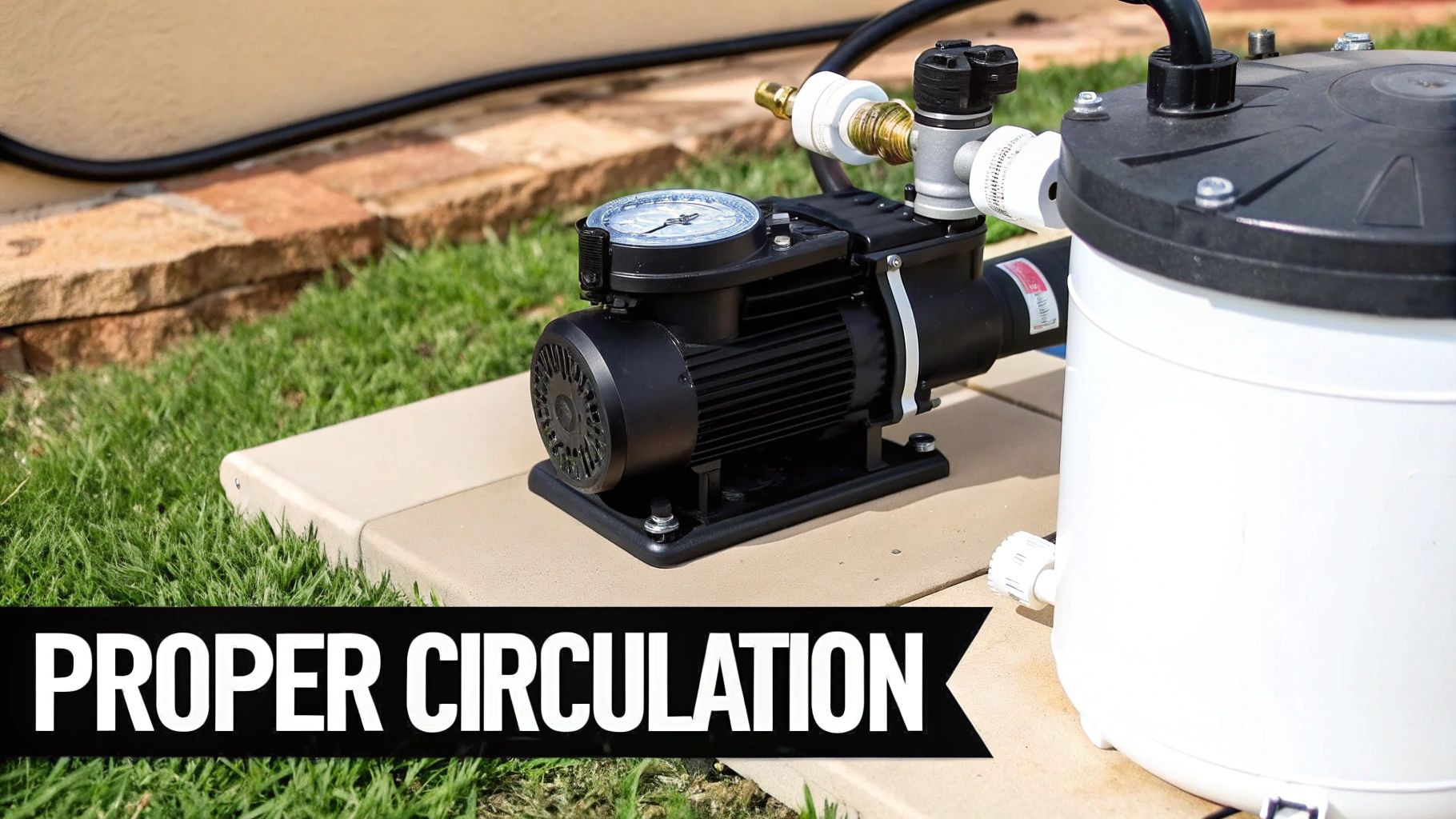
The single most important rule here is to run your pump long enough each day to filter the entire volume of your pool's water. We call this a "turnover." In the middle of a hot Southwest Florida summer, this usually means running the pump for 8 to 12 hours every single day. Trying to save a few bucks on the electric bill by cutting this short is a classic rookie mistake that almost always leads to bigger, more expensive problems later on.
The Role of Your Pool Pump
Your pool pump is the workhorse of the entire system. It pulls water from the pool through the skimmers and main drain, shoves it through the filter to get cleaned, and then pushes that fresh, clean water back out through the return jets.
A simple but crucial weekly task is to empty your skimmer and pump baskets. When these get packed with leaves, palm fronds, and other debris, the water flow gets choked off. This strains the pump motor, reduces filtration, and just makes everything work harder than it needs to.
Keeping this equipment in top shape is non-negotiable. Little issues with a pump can snowball into total failure if you ignore them. If you start hearing strange noises or notice the water isn't moving like it used to, checking into professional pool pump and motor services can help you figure out what's wrong before you're stuck with a costly replacement.
Understanding Your Filter Type
After the pump grabs the water, it sends it through your filter. There are three main types out there, and each has its own cleaning routine.
- Sand Filters: These are the most common and generally the lowest maintenance. They use a special grade of sand to trap debris. You'll know it's time to clean when the pressure gauge on the filter reads 8-10 PSI higher than its normal "clean" pressure. Cleaning is done by "backwashing," which just reverses the water flow and flushes all the trapped dirt out.
- Cartridge Filters: These use a pleated, fabric-like cartridge to screen out particles. Instead of backwashing, you'll need to pull the cartridge out and give it a good, thorough hosing down. Same rule applies: do this when the pressure gauge climbs 8-10 PSI above normal.
- Diatomaceous Earth (D.E.) Filters: These give you the absolute finest filtration using a powder made from fossilized diatoms. They are also cleaned by backwashing, but afterward, you have to add new D.E. powder into the system through the skimmer.
Here's a pro tip: don't backwash or clean your filter too often. Believe it or not, a filter that's just a little bit dirty actually traps smaller particles more effectively than one that's perfectly clean. Let the pressure gauge be your guide.
The Value of Professional Equipment Checks
This is where DIY pool care can get a little tricky. What does it mean if your pressure gauge is always reading high? Is that worn-out o-ring on your pump lid causing an air leak? A messy backwash can ruin a Saturday, and misdiagnosing an equipment issue can be an expensive mistake.
This is the real, hidden value of a weekly professional service. Our technicians at Water Medic don't just test and balance chemicals; we perform a full equipment inspection on every single visit. We're trained to spot the subtle signs of wear and tear—that faint whine from the pump motor, a slight drip from a seal, or a pressure gauge that just isn’t behaving right.
By catching these things early, we can address them before they turn into a weekend-ruining breakdown. Let us handle the hardware so you can just enjoy the water. Our expert team is ready to give you total peace of mind, knowing the heart of your pool is in expert hands.
The Hands-On Work: Skimming, Brushing, and Vacuuming
Beyond the invisible world of water chemistry and the hum of your pump, the physical cleaning is what gives your pool that sparkling, "jump-in-now" look. This is your first line of defense against debris. Getting leaves, pollen, and dirt out quickly stops them from breaking down, eating up your chlorine, and staining your pool’s beautiful finish. Honestly, it’s the most satisfying part of the job—you see the results right away.
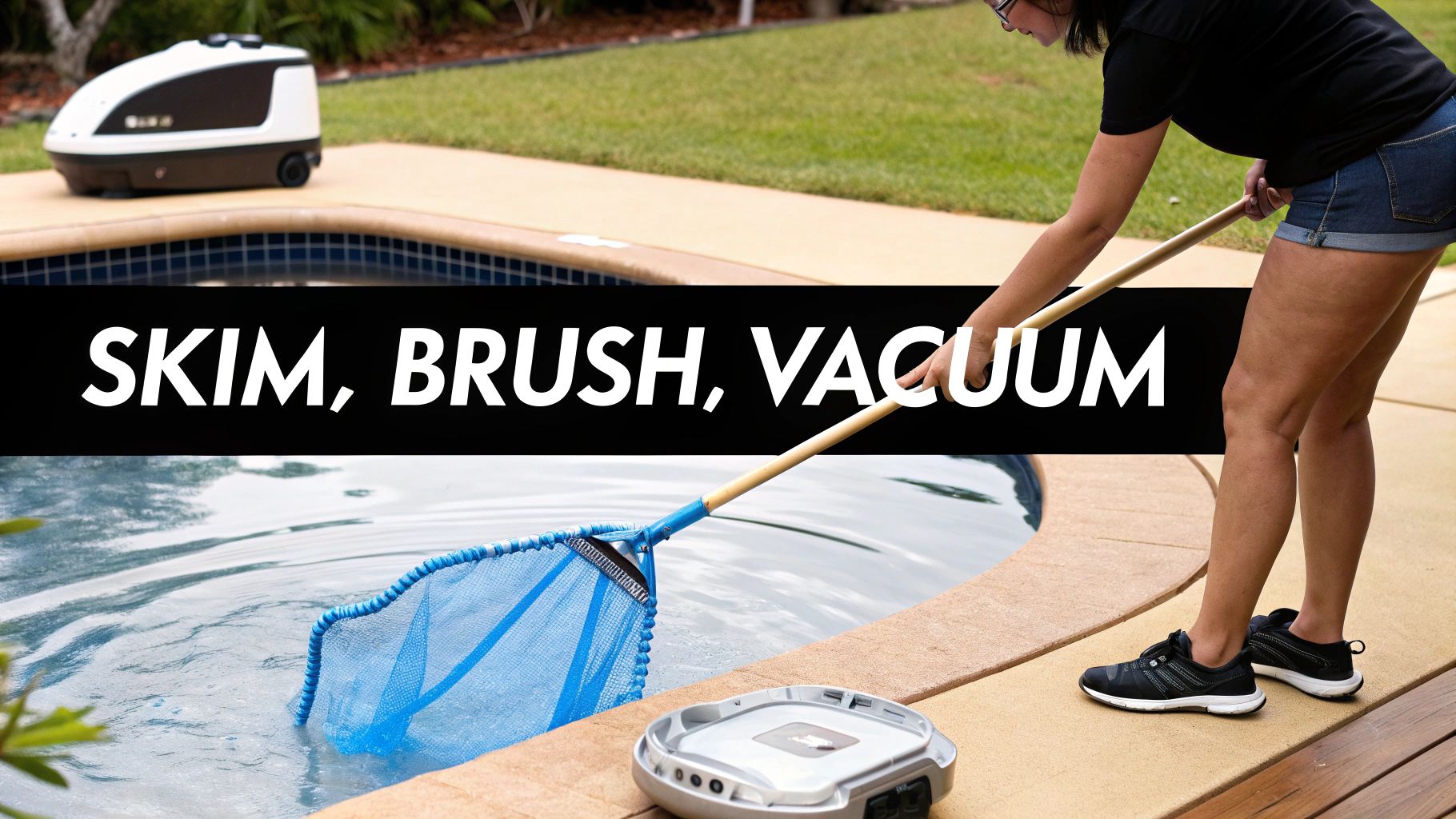
Grabbing a long-handled net and skimming the surface is easily the most frequent task you'll do. Here in Southwest Florida, the assault is constant—oak leaves, palm fronds, grass clippings, you name it. If you can skim them out daily, or at least every other day, you're preventing that organic gunk from sinking to the bottom where it becomes a real pain to remove.
Brushing Away Hidden Threats
Skimming takes care of the floaters, but brushing is all about tackling the invisible threats clinging to your pool's surfaces. You absolutely have to brush the walls, steps, and especially those tricky corners to keep algae from getting a foothold.
Even if your water looks crystal clear, microscopic algae spores are always lurking. They just need a quiet spot with poor circulation—like behind a ladder or along the waterline—to start growing. A good, thorough brushing once a week knocks these spores loose, sending them into the water where your filter and chlorine can destroy them.
- For Plaster/Gunite Pools: A stiff-bristled brush has the muscle you need.
- For Vinyl/Fiberglass Pools: Be gentle. Always use a soft-bristled brush to avoid scratches.
Think of brushing as your best proactive move. It’s the single most effective manual task you can perform to prevent your pool from turning green, saving you the major headache and cost of a full-on algae treatment down the road.
The Great Vacuuming Debate
Once you've brushed everything down, all that loosened debris needs to be vacuumed off the pool floor. This is where you have a choice: do it the old-fashioned way or let a robot take over. Manual vacuuming works—you just hook up a vacuum head and hose to your skimmer. But be prepared for it to chew up an hour or more of your weekend.
The alternative? A robotic pool cleaner. These amazing little machines are completely self-contained, roaming the pool floor (and often climbing the walls) on their own. They scrub as they go and collect debris in an internal filter bag. It’s a genuine set-it-and-forget-it solution that delivers a cleaner pool, more consistently.
There's a reason the market for this kind of gear is booming. The pool equipment industry is now valued at a massive $21.72 billion, with robotic cleaners leading the charge. In fact, these automated helpers are now used in about 40% of professional services and can slash the manual labor for pool cleaning by up to 50%. For a deeper dive into these numbers, you can explore the full pool equipment market report.
While you can certainly handle the physical cleaning yourself, the thoroughness and convenience of a professional service are tough to match. Our Water Medic technicians use professional-grade equipment, including powerful vacuums and robotic cleaners, to make sure no spot is missed. This isn't just about looks; it's about removing the fuel that algae and bacteria need to thrive.
Imagine getting your weekends back, spent enjoying a perfect pool instead of working on it. If that sounds good, our Weekly Pool Service plans are designed to give you exactly that peace of mind.
Troubleshooting Common Florida Pool Problems
Even when you do everything right, the Southwest Florida climate loves to throw a curveball. One day your pool is perfect, and the next, you’re staring at a problem that just wasn't there before. Don’t panic—most of these issues have straightforward explanations. Figuring out what you're up against is the first step to getting that sparkle back.
The number one complaint we get from local pool owners is cloudy water. It’s frustrating because it can literally pop up overnight. More often than not, this is your pool's way of telling you that one of its core systems—chemistry, filtration, or circulation—is out of whack. A sudden chlorine drop after a big rainstorm, a filter that's overdue for a cleaning, or simply not running the pump long enough are all classic culprits.
Then there's the dreaded algae bloom, which can turn a beautiful backyard oasis into a green pond in just a couple of days. This is almost always a chemistry problem. When chlorine levels take a nosedive or your stabilizer (CYA) is out of balance, algae spores jump at the chance to multiply.
Diagnosing and Solving Cloudy Water
When your water starts looking hazy or milky, it's time to play detective. The first place I always tell people to look is their water chemistry. Grab your test kit and check all your levels: pH, chlorine, and alkalinity. If any of them are out of their ideal range, that's your starting point.
A high pH is a very common cause of cloudy water because it makes your chlorine lazy and ineffective. Likewise, low chlorine means there isn't enough sanitizer to zap the microscopic particles that are making the water murky. Start by methodically rebalancing your chemicals to their proper levels.
If the chemistry looks good, your filter is the next suspect. Go take a look at the pressure gauge. Is it reading 8-10 PSI higher than its normal, "clean" pressure? If so, it’s clogged and needs a good backwashing or a deep clean. A dirty filter simply can’t trap fine debris, which just gets pumped right back into the pool, causing that stubborn haze.
While these DIY steps often do the trick, if the cloudiness sticks around for more than a day or two after your adjustments, it’s a sign of a more stubborn issue. This is where a professional can save you a ton of time and money. Our technicians have the tools to run advanced diagnostics and pinpoint the root cause, whether it's an early-stage algae bloom or a filtration hiccup that isn't obvious.
Battling Algae: Green, Black, and Yellow
Seeing green in your pool is the one problem every owner dreads. Algae doesn't just look terrible; it can clog up your filter and even become a safety hazard. While green algae is the most common variety we see around here, you might also run into the more stubborn black or mustard-yellow types.
Your first move against any algae is to shock the pool. This means hitting it with a heavy dose of chlorine to overwhelm and kill the bloom. You’ll also need to put in some elbow grease and vigorously brush every surface—walls, steps, and floor—to break up the algae colonies so the chlorine can penetrate and work its magic. After the shock, you'll need to run your pump continuously and clean your filter several times to get all the dead algae out.
A strong, sharp chlorine smell is one of the most misunderstood pool problems. It's often a sign that there isn't enough free chlorine. The odor comes from chloramines, which are created when chlorine is overworked from fighting contaminants. The solution isn't less chlorine—it's more!
But let's be honest, fighting a serious algae bloom with store-bought chemicals can become a long, expensive, and frustrating battle. For persistent or aggressive algae, our professional 'Green to Clean' service is a much faster and more reliable solution. We use specialized treatments and equipment to wipe out the bloom and restore your water's clarity, often in just a couple of days.
Even with diligent pool care, other environmental issues like mold can pop up in our damp Florida climate. For broader advice on tackling these issues around your pool deck and home, check out these effective mold removal tips.
When you’ve tried the basic fixes and your pool still isn't right, that’s your cue to call in the experts. Don't waste your weekend dumping chemicals into a pool that just isn't getting better. If you're facing a problem you can't solve, it's time to Contact Us for a Professional Pool Assessment. We’ll diagnose the issue correctly the first time and get your pool back to being the beautiful oasis it should be.
Your Pool Maintenance Questions Answered
We get it—pool care can feel like a moving target, especially here in Southwest Florida. We've heard just about every question in the book from homeowners trying to keep their backyard oasis in perfect condition. Here are some straight, practical answers to the questions we hear most often.
How Often Should a Pool Be Serviced in Florida?
Down here in Southwest Florida, weekly service is the non-negotiable gold standard. It's not an upsell; it's a necessity. The intense sun just burns through chlorine at an astonishing rate. Then, you have our famous afternoon rainstorms, which constantly dilute chemicals and throw your water chemistry completely out of whack.
This hot, humid environment is also a perfect breeding ground for algae.
Waiting even two weeks between services is a roll of the dice. A small chemical imbalance that we could fix in five minutes during a weekly visit can quickly explode into a full-blown algae bloom that costs a fortune to clear up. Our weekly service ensures your water is consistently balanced and swim-ready, stopping those big problems before they ever have a chance to start.
Is a Saltwater Pool Really Lower Maintenance?
People often think saltwater pools are "low maintenance," but I'd call it "different maintenance." Instead of you physically adding chlorine, a salt cell generator handles it for you. That sounds great, but it doesn't mean you can just forget about it.
You still have to keep a close eye on the chlorine, pH, and stabilizer levels, just like you would with a traditional pool. On top of that, the salt cell itself needs to be cleaned regularly to prevent calcium buildup, and eventually, it will need to be replaced—which can be a pretty hefty expense.
You're essentially trading one set of chores for another. At Water Medic, our technicians are well-versed in both traditional chlorine and modern saltwater systems, so we know exactly what your specific setup needs.
Choosing a pool system is less about which is 'easier' and more about which maintenance routine fits your lifestyle. Both require consistent oversight to stay healthy, a task perfectly suited for a professional service.
Can I Save Money By Servicing My Own Pool?
Doing it yourself might seem cheaper at first glance, but professional service often saves you money in the long run. The upfront cost of buying all the different chemicals, getting a quality test kit, and investing in good cleaning tools adds up faster than you'd think.
More importantly, one little mistake with the chemicals can have some very expensive consequences. You could accidentally trigger an algae bloom that needs costly shock treatments to fix. Even worse, you could create corrosive water that silently eats away at your pool's surface, pump, and heater.
Our technicians use professional-grade chemicals with precision, preventing waste and spotting potential equipment problems early—saving you from a massive repair bill down the road. When you factor in the value of your own time, our weekly service is a pretty smart investment.
Want to get into the weeds on pool care? You can explore more answers in our comprehensive pool FAQs to build your knowledge.
What Does Your Weekly Pool Service Include?
Our goal is to make your pool completely hands-off for you. When our team shows up each week, we run through a detailed checklist to make sure your pool is in perfect health.
Every single visit includes:
- Testing and balancing all essential chemicals with precision.
- Emptying the skimmer and pump baskets for strong water circulation.
- Skimming all floating leaves and debris from the surface.
- Brushing the pool walls, steps, and tile line thoroughly.
- Vacuuming the pool floor as needed to pick up any settled debris.
- Performing a visual inspection of all your pool equipment.
After we're done, we send you a detailed service report. You’ll always know exactly what we did and that your pool is healthy, safe, and sparkling clean.
Ready to take the guesswork out of pool care and reclaim your weekends? Trust the experts at Water Medic of Cape Coral to keep your pool in pristine condition all year long. https://watermedic.com