How to Shock Saltwater Pool: A Simple Guide for Clear Water
When we talk about "shocking" a saltwater pool, we're essentially giving it a deep clean. It involves adding a powerful dose of an oxidizer—usually a specific type of chlorine—to burn off all the gunk that builds up over time. Think of it as hitting the reset button on your water's sanitation.
Even with a high-tech salt chlorine generator working 24/7, this occasional deep clean is absolutely essential for keeping your water clear, safe, and algae-free.
Why Your Saltwater Pool Still Needs to Be Shocked
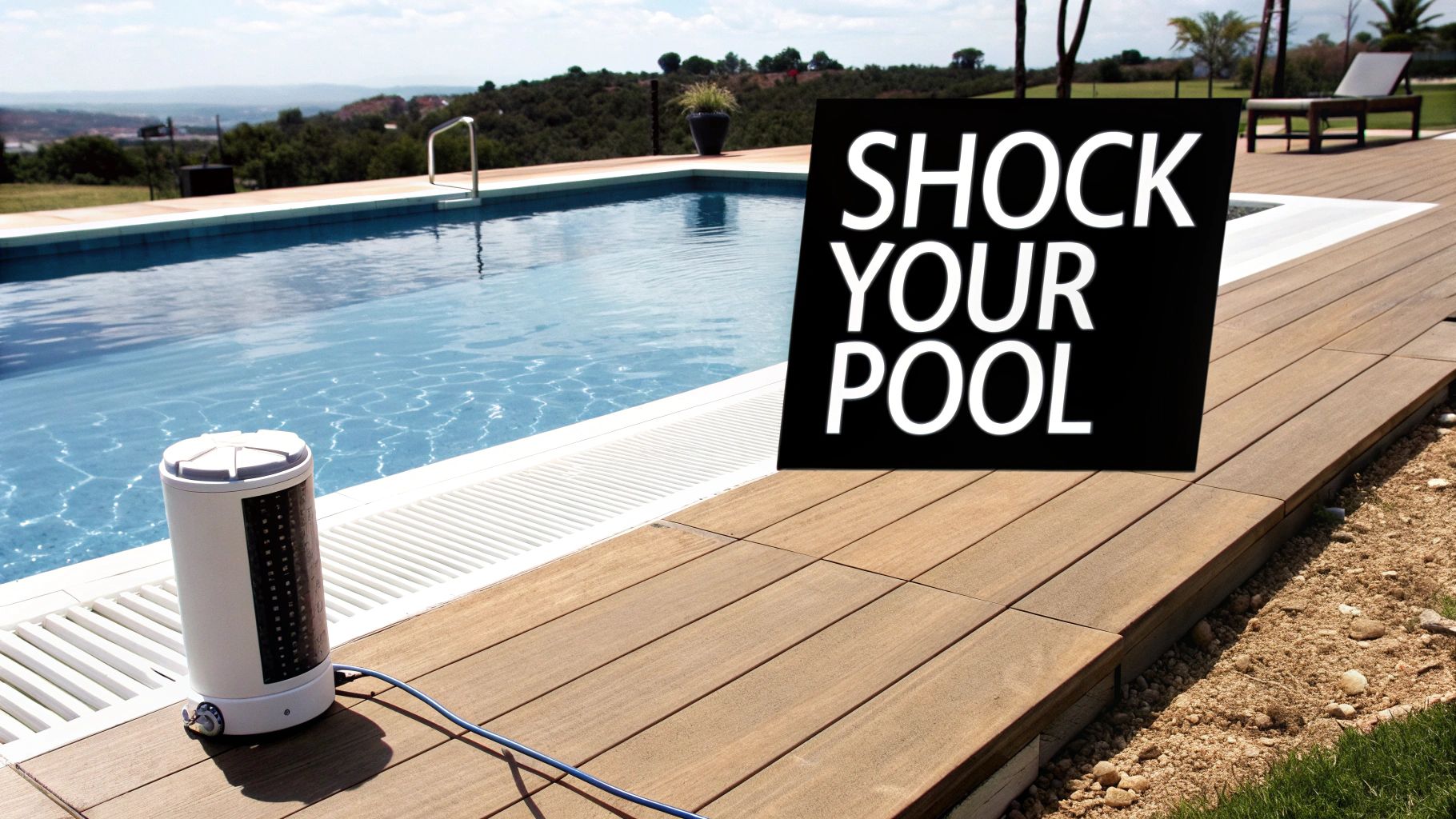
One of the most common misconceptions I hear from pool owners is that saltwater pools are "chemical-free" and take care of themselves. While your salt cell is brilliant at producing a steady stream of chlorine day in and day out, it's just not built to handle major contamination events.
I like to think of a salt system as a marathon runner—it's fantastic at maintaining a consistent, long-term pace. Shocking, however, is the sprinter you call in when you need a massive burst of power to tackle an immediate problem. A big pool party, a week of heavy rain, or the first hint of an algae bloom can easily overwhelm your generator's daily output.
The Limits of "Super Chlorinate" Mode
Most salt systems come with a "super chlorinate" or "boost" button, and it's easy to assume this does the same thing as a manual shock. Unfortunately, that's not quite the case.
This feature is helpful for a minor boost, but it typically only nudges the free chlorine (FC) level up by about 5 to 7 parts per million (ppm). To truly shock a pool and hit what we call "breakpoint chlorination"—the level needed to obliterate stubborn, smelly chloramines—you often need to raise the FC all the way to 30 ppm. That's a huge difference, and it’s why manually shocking is still a critical part of your maintenance routine.
Pro Tip: If your pool has that strong "chlorine" smell, it’s a classic sign that you need to shock it. That odor isn't from too much chlorine; it's from chloramines, which are irritating byproducts that only a proper, powerful shock can eliminate.
Protecting Your Investment
Skipping a regular shock treatment is an invitation for trouble. Sooner or later, you'll start to see the tell-tale signs that your salt system is losing the battle.
Without periodic shocking, you're almost guaranteed to run into:
- Stubborn cloudy water that your filter just can't clear up.
- Frustrating algae blooms, which are a real headache to get rid of.
- That sharp, unpleasant "pool smell" from a buildup of chloramines.
Properly shocking your pool is a simple, proactive step that prevents these bigger, more expensive problems from taking hold. For a deeper dive, it helps in understanding the differences between saltwater and freshwater environments. And if you're a homeowner in Southwest Florida who would rather leave it to the pros, our team providing Pool Maintenance Services is here to keep your pool sparkling and ready to enjoy, no guesswork required.
Getting Your Water Chemistry Right Before You Shock
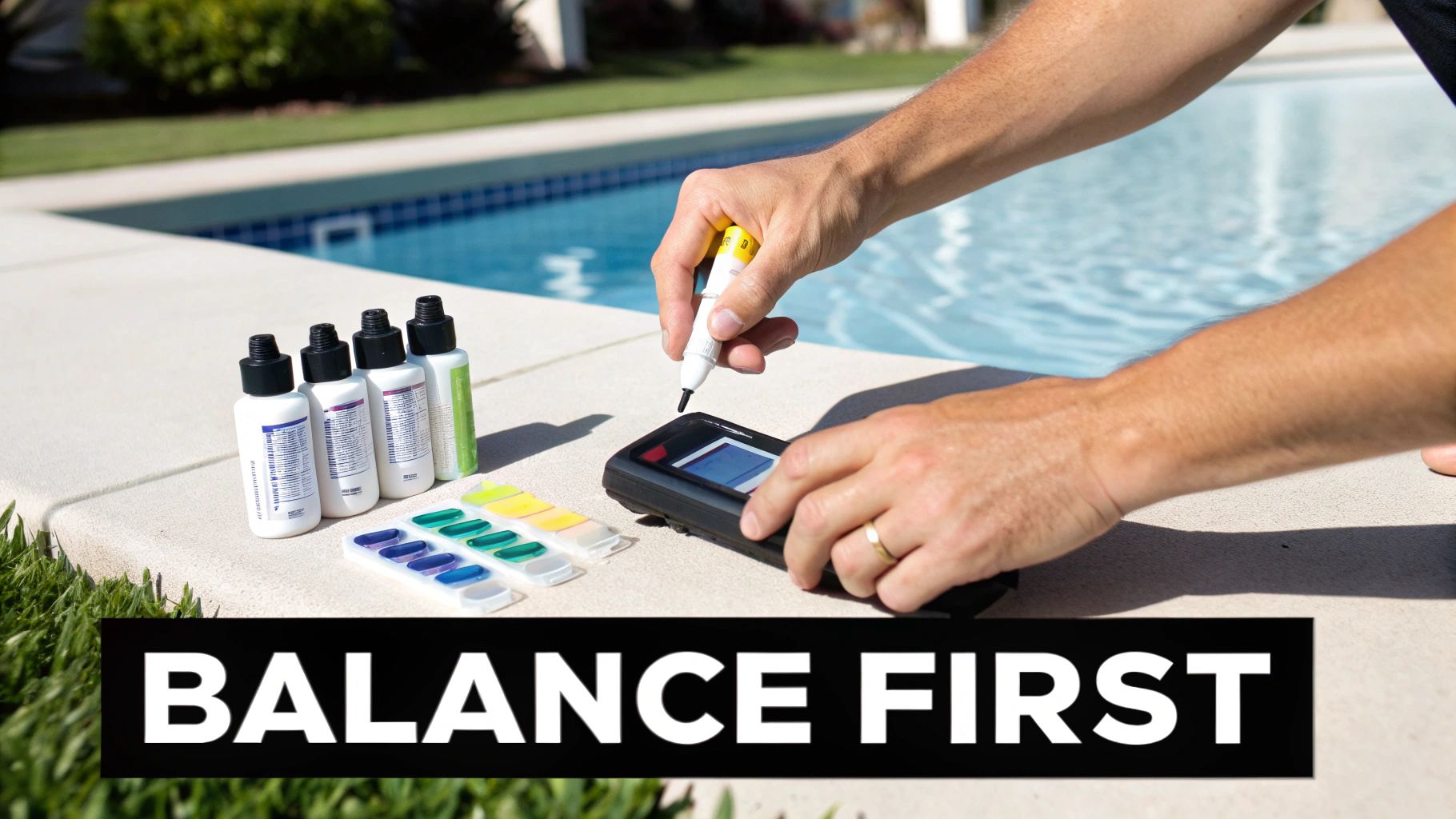
Before you even think about tearing open a bag of shock, let's get one thing straight: shocking an unbalanced pool is just throwing money away. It’s a classic rookie mistake. Pouring powerful shock into water with wacky pH or alkalinity is like trying to put out a fire with a thimble—it’s not going to work.
Getting the water chemistry dialed in is always the first, non-negotiable step our technicians take. It’s what ensures the shock can actually do its job and obliterate all the gunk in your pool. So, grab a reliable test kit and let's see what you're working with.
Your Pre-Shock Water Balance Checklist
Think of your water chemistry as the foundation for the entire shocking process. If that foundation is off, the whole thing crumbles. This is the single biggest reason I hear from homeowners who are frustrated that their pool is still green or cloudy after dumping in a ton of expensive shock.
You have to test and adjust these key levels before you add a single granule of shock.
- pH Level: Honestly, this is the big one. If your pH is too high (anything over 7.8), you can kiss your shock's effectiveness goodbye. We're talking a potential drop of up to 90% in its sanitizing power. You want to be squarely in the 7.2 to 7.6 range for maximum impact.
- Total Alkalinity (TA): This is your pH's bodyguard. TA acts as a buffer, keeping your pH from swinging all over the place. If your alkalinity is out of whack, you'll never get the pH to stay put. Aim for a solid 80 to 120 ppm.
- Cyanuric Acid (CYA): Think of CYA as sunscreen for your chlorine. It protects it from getting torched by the sun's UV rays. For saltwater pools, we typically look for a CYA level between 60 and 80 ppm. Just be careful not to let it creep up too high, as that can actually lock up your chlorine and make it less effective.
Expert Takeaway: Balancing these levels isn't just about making the shock work better. It’s about protecting your expensive equipment. Consistently bad chemistry can lead to nasty scale buildup on your salt cell or even corrode metal parts in your system.
Use this quick-reference guide to ensure your pool's water is perfectly balanced before you add shock. Hitting these targets is key for an effective treatment.
Ideal Water Chemistry Levels Before Shocking
| Chemical Parameter | Ideal Range | Why It Matters for Shocking |
|---|---|---|
| pH | 7.2 – 7.6 | High pH drastically reduces chlorine's sanitizing power, making the shock ineffective. |
| Total Alkalinity | 80 – 120 ppm | Stabilizes pH. Without proper TA, pH will fluctuate, undermining the shock treatment. |
| Cyanuric Acid | 60 – 80 ppm | Protects free chlorine from sunlight, but levels over 100 ppm can hinder shock effectiveness. |
| Calcium Hardness | 200 – 400 ppm | Helps prevent scaling on surfaces and your salt cell, especially in hard water areas. |
Getting these numbers right is the secret to a successful shock every single time.
One Last Check
Once your main levels are looking good, it's smart to glance at your Calcium Hardness. While it doesn't directly mess with the shock's performance, keeping it in the 200-400 ppm range is crucial for preventing long-term scaling, which is a constant battle here in Southwest Florida.
Taking a few minutes to do this prep work might feel like a hassle, but trust me, it’s what separates a crystal-clear pool from a costly, frustrating mess. It's the same methodical approach we use to guarantee results on every pool we service.
Of course, if you'd rather skip the chemistry homework, our monthly maintenance plans handle all the testing and balancing for you. We keep your pool perfect year-round, so when a shock is needed, it works flawlessly the first time.
Choosing the Right Shock for Your Saltwater Pool
Walking into the pool supply store can be intimidating. You're hit with a wall of different buckets and bags, all promising a sparkling, clean pool. But let me give you a piece of advice we share with every saltwater pool owner: not all shock is the same, and grabbing the wrong one can cause some serious headaches down the road.
Picking the right shock isn't just about blasting away contaminants. It’s about protecting the heart of your system—that expensive salt cell. The wrong product can introduce all sorts of things that build up, leading to nasty scaling and making your system work much harder than it needs to.
Comparing Your Shock Options
For saltwater pools, your choice really boils down to three main types: Calcium Hypochlorite (Cal-Hypo), Dichlor, and good old liquid chlorine (Sodium Hypochlorite). Each one affects your water chemistry differently, and knowing the difference is what separates a smart pool owner from one who's always fighting problems.
Here’s the breakdown from a pro’s perspective:
-
Calcium Hypochlorite (Cal-Hypo): This is the most popular granular shock you'll find. It packs a punch, no doubt. The problem? As the name implies, it adds calcium to your water with every dose. If you live somewhere with hard water already, you're just fast-tracking calcium buildup on your salt cell, which can drastically shorten its life.
-
Dichlor: Another common granular shock, but this one is "stabilized," meaning it contains Cyanuric Acid (CYA). A little CYA is necessary to protect your chlorine from the sun, but if you shock with Dichlor every time, your CYA level will creep up and up. Eventually, it gets so high that it actually starts to lock up your chlorine, making it ineffective.
-
Liquid Chlorine (Sodium Hypochlorite): This is our go-to for most saltwater pool maintenance. It’s unstabilized and adds nothing but pure chlorine to the water. That means you're not accidentally jacking up your calcium or CYA levels. You get total control.
A typical maintenance dose might be 1 pound of cal-hypo shock per 10,000 gallons. But for a nasty algae bloom, you could need as much as 4 pounds. You can see how quickly that calcium can add up. For a deeper dive into dosage, the folks at SwimUniversity.com have a great guide on pool shock amounts.
Why We Almost Always Use Liquid Chlorine
When our service techs are out in the field, you'll almost always see them reaching for liquid chlorine to shock a saltwater pool. The reason is simple: it’s the cleanest, most direct way to sanitize without adding junk you don't want. Our top priority is protecting the health and longevity of your salt system, and avoiding calcium buildup is a huge part of that.
Relying on Cal-Hypo means you’ll be dealing with scaling issues much more often. That leads to more frequent, intensive cleaning of your salt cell or, even worse, having to replace a very expensive piece of equipment way too early.
Think of using liquid chlorine as a proactive move—a small choice that helps keep your system running smoothly for years to come. It's one of those little details that makes a big difference in protecting your investment. Of course, if you'd rather leave the chemistry to the experts, our team providing Pool Maintenance Services is always here to handle it for you.
How to Apply Pool Shock Like a Pro
Alright, you've done the prep work. Your water chemistry is balanced, you’ve picked out the right kind of shock for the job, and now it's time for the main event. Getting the application right is just as important as all the steps leading up to it. This is how you ensure the shock does its job effectively without causing any harm to your pool surfaces or your expensive equipment.
Before you even think about opening that bag of shock, there’s one critical step you can't forget: turn off your salt chlorine generator. Hitting an active salt cell with a super-concentrated dose of chlorine is a surefire way to cause irreversible damage to its sensitive coatings. Just flip it off at the power supply or the breaker.
Timing and Technique Make All the Difference
When you shock your pool is a huge factor in its success. Chlorine's biggest enemy is the sun. UV rays will chew through fresh chlorine, drastically reducing its effectiveness. That's why I always tell people to shock their pools at dusk or after the sun has gone down completely. This gives the chlorine a solid 8-10 hours to circulate and sanitize overnight, completely unopposed by the sun.
Next up, let’s talk about protecting your pool's interior. You never, ever want to dump granular shock directly into the water. If those little granules sink to the bottom before they dissolve, they will absolutely bleach and can even corrode vinyl, plaster, or pebble finishes. It’s a costly mistake to make.
The right way is to pre-dissolve it first. Here’s how:
- Grab a clean, five-gallon bucket and fill it about three-quarters full with pool water.
- Slowly pour your measured dose of granular shock into the water. Never add water to the shock—it can create a dangerous chemical reaction.
- Use a wooden or plastic stir stick to gently mix until every last granule is dissolved.
This diagram gives you a quick visual on the common shock types you'll encounter.
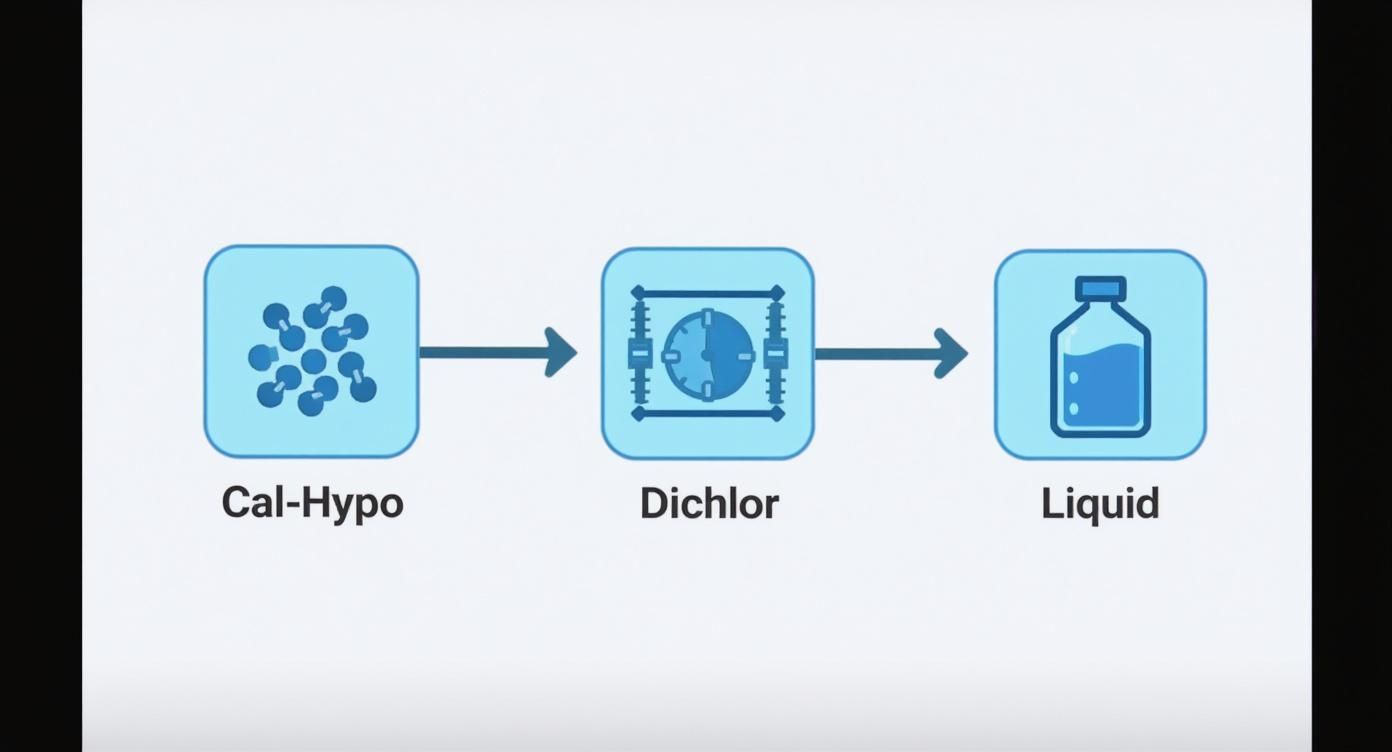
As you can see, whether you're using Cal-Hypo, Dichlor, or liquid chlorine, each has its own considerations for keeping your pool and its components safe.
The Final Steps for a Crystal Clear Pool
Once your shock is fully dissolved (or if you’re using liquid chlorine, which is ready to go), it’s time to add it to the pool. Make sure your pump is running to get the water circulating. This is non-negotiable for getting even coverage.
Begin walking around the edge of your pool, slowly pouring the liquid solution in a steady stream into the water. I like to pour it over the return jets, as the moving water helps mix it in even faster.
Pro Tip: After you've added the shock, you need to let your pump run for a minimum of 8 hours, but running it overnight is even better. This is the only way to guarantee the shock gets fully circulated through every part of the pool, eliminating any dead spots where algae or bacteria might try to hang on.
Following these steps is what separates a proper, effective shock from a haphazard one. It protects your liner, keeps your equipment safe, and gets you the clean, clear water you're after. It's a bit of a process, which is why many pool owners prefer to hand it off. If you’d rather have a perfect result without the guesswork, our Pool Maintenance Services can handle the shock treatment correctly and safely every single time.
What to Do After Shocking Your Pool
The shock is in the water, but your work isn't quite done. What you do next is just as important as the shock itself—it’s what locks in the results and gets your pool from "treated" to truly sparkling and swim-ready.
Think of it this way: you’ve just sent in the shock troops to deal with the contaminants. Now you need to support them and clean up the aftermath.
The first order of business is circulation. You need to run your pump and filter continuously for at least 8 to 12 hours after adding the shock. Don't skip this. This constant circulation is what carries the super-chlorinated water to every nook and cranny of your pool, ensuring there are no "dead zones" where algae or bacteria can hide out and survive the treatment.
Checking Your Chemistry the Morning After
Once the sun is up, it's time to grab your test kit again. This is a non-negotiable step. You need to see how effective the shock was and, more importantly, figure out when it's safe to jump back in. Your main focus will be on Free Chlorine (FC) and Combined Chlorine (CC).
In a perfect world, your Combined Chlorine will now be at or very close to 0 ppm. This is your proof that the shock successfully obliterated all those nasty, irritating chloramines. Your Free Chlorine level, on the other hand, will probably be sky-high.
Safety First: Don't even think about swimming until your Free Chlorine level has dropped back down below 5.0 ppm. High chlorine can be rough on skin and eyes, so a little patience here goes a long way. The good news is that the morning sun will help burn off that excess chlorine naturally.
Bringing Your Salt System Back Online
When your Free Chlorine has settled back into its normal, happy range (usually 1.0 to 3.0 ppm), you can safely flip the switch on your salt chlorine generator again. Firing it up while chlorine levels are still through the roof puts a lot of unnecessary wear and tear on the system.
This waiting period is a lesson many pool owners learned the hard way. Back in the early days of saltwater pools, the "set it and forget it" myth was common. By 2010, industry data showed that up to 30% of saltwater pool owners were battling cloudy water or algae blooms simply because they weren't following proper shocking and post-shock procedures. This led to a huge industry push for better education, like these guidelines for pool shocking.
Troubleshooting Common Post-Shock Problems
See a bit of cloudiness right after you shock? Don't panic. This is often a good sign!
That haze is typically just the aftermath of the battle—millions of dead algae spores and other organic gunk the shock has neutralized. Your filter is designed to handle this. Just keep it running, and the water should clear up over the next 24 hours. If the cloudiness hangs around longer than that, you might have a different issue, like a filter that desperately needs cleaning or another chemical imbalance that needs attention.
Once your pool is crystal clear, it’s a good moment to think about the bigger picture of water quality and explore real solutions to stop water pollution. Taking proper care of your pool doesn't just make for a better swim; it’s a small part of being a responsible steward of our water resources. If you run into a problem you just can't crack, our expert technicians are always here to help you get your water chemistry dialed in perfectly.
Common Questions About Shocking a Saltwater Pool
Even the most seasoned pool owners run into questions, especially when it comes to the finer points of maintenance. When you're learning the ropes of shocking a saltwater pool, it's natural to have a few uncertainties. We've pulled together the most common questions our technicians hear out in the field to give you the clear, expert answers you need.
Can I Just Use the Super Chlorinate Button?
This is probably the number one question we get, and for good reason. Your salt system's "super chlorinate" or "boost" feature seems like an easy fix, but it's crucial to understand its limitations. Think of it as a helpful top-up, not a deep clean.
When you hit that button, you're telling the salt cell to run at 100% capacity for a set time, usually 24 hours. This gives you a nice, mild chlorine increase, which is perfect after a light swim day. The problem is, it almost never generates enough chlorine fast enough to hit breakpoint chlorination. That's the magic level you need to actually destroy stubborn chloramines or knock out an algae bloom.
For the real problem-solving, a manual shock is the only way to guarantee you're getting the job done right.
How Often Should I Shock My Pool?
There’s no magic number here. The right frequency is all about your specific pool and how you use it. Your shocking schedule will need to adapt to what's happening in and around your water.
You'll definitely want to shock more often if you're dealing with:
- Heavy Bather Load: A big pool party means more sunscreen, sweat, and other organic stuff in the water.
- Extreme Heat: That beautiful Florida sun and high temperatures burn through your chlorine reserves fast.
- Heavy Rain: A downpour can dilute your chemicals, throw your pH out of whack, and wash in contaminants from the deck.
As a general starting point, plan on shocking every two to four weeks during the busy swim season. But listen to your pool—and your test kit. We tackle questions like this all the time, and you can find more pro advice in our guide to common pool FAQs.
Why Is My Pool Still Cloudy After Shocking?
It’s one of the most frustrating things to see. You did everything right, but the water is still a hazy, milky mess. When this happens, it almost always comes down to one of a few common culprits that we're trained to spot immediately.
The most likely suspect is that your water chemistry was out of balance before you even opened the shock. If your pH was too high, for example, it basically handcuffed the chlorine, making it almost useless. Another common issue is a dirty filter. Remember, the shock kills the contaminants, but it's your filter's job to clear out the debris. If it's clogged or dirty, all that dead stuff just keeps floating around.
Expert Insight: If the cloudiness just won't clear, you might be dealing with something trickier like high phosphate levels (algae food) or a filter medium that's at the end of its life. Old sand or a worn-out cartridge just can't grab the fine particles anymore. This is where professional diagnostics can save you a ton of time and chemical costs.
These situations really show why shocking is about more than just dumping in a bag of chemicals. It's about understanding the entire pool environment.
Dealing with persistent cloudiness, algae, or confusing water chemistry can take the fun out of pool ownership. Instead of guessing, let the experienced team at Water Medic of Cape Coral handle it. We provide reliable weekly pool maintenance that keeps your saltwater pool pristine and swim-ready all year long. Visit us at https://watermedic.com to schedule your service and enjoy a perfectly clear pool without the hassle.