How to Maintain Above Ground Pool: Florida Guide
Taking care of your above-ground pool doesn't have to be a chore. It really just boils down to a simple, consistent routine: skim, vacuum, test the water, and give your equipment a quick once-over. Sticking to a weekly schedule is the secret sauce to heading off bigger issues like nasty algae blooms or a busted pump. A little bit of regular upkeep keeps your water sparkling, safe, and always ready for a dip. While the DIY approach is commendable, partnering with a professional service ensures your pool remains in pristine condition without you lifting a finger.
Your Essential Above Ground Pool Maintenance Routine
Here’s your no-nonsense guide to keeping that Southwest Florida above-ground pool in perfect condition. After years in the business, I can tell you that consistent care is everything. It's the key to a beautiful, safe pool you can actually use year-round. This isn't about complicated chemistry or spending all weekend working; it's about a practical checklist that focuses on what actually works.
Think of it as a simple wellness plan for your pool. A few minutes of attention each week saves you from massive, expensive headaches later. Your pool is the heart of your backyard, and keeping it in top shape makes your whole outdoor space better. For more ideas on how to enhance your entire outdoor living space, nothing beats a crystal-clear pool as the centerpiece.
The Foundation of a Healthy Pool
Let's get down to the basics. Skimming out debris, vacuuming the floor, testing the water, and checking your equipment are the non-negotiables. Honestly, skipping these steps is the fastest way to run into trouble.
These are the cornerstones of your weekly routine:
- Skim and Brush: Get those leaves, bugs, and other floaties out with a skimmer net—daily if you can swing it. Once a week, give the pool walls a good brushing to knock off any stubborn dirt or algae spores trying to get a foothold.
- Vacuum the Floor: At least once a week, vacuum the pool floor. This sucks up all the fine dirt and sediment that settles at the bottom and keeps your water from getting cloudy.
- Test Your Water: You need to know what’s going on with your water chemistry. Test it 2-3 times per week to make sure the chlorine and pH levels are right where they need to be for safe, comfortable swimming.
- Check Your Equipment: Take a peek at your pump and filter every week. Clean out the skimmer basket and the pump basket to keep water flowing strong. A clogged basket puts a huge strain on your pump motor.
This proactive mindset does more than just keep the water looking good; it actually extends the life of your pool liner and equipment. It’s no surprise that the global pool equipment and maintenance market was valued at a massive USD 21.72 billion in 2024 and is only getting bigger. You can read more about the growing pool maintenance market on marketdataforecast.com to see just how important this is.
To make it even easier, here’s a quick checklist you can follow. It breaks down the weekly essentials for your SWFL pool, helping you stay on track without having to guess what's next.
Weekly Above Ground Pool Care Checklist
| Task | Frequency | Key Benefit |
|---|---|---|
| Skim the Surface | Daily or every 2-3 days | Removes leaves and debris before they sink and decay. |
| Brush Walls & Steps | 1x per week | Prevents algae buildup and dislodges stubborn dirt. |
| Vacuum the Floor | 1x per week | Clears away settled dirt and sediment for crystal-clear water. |
| Test Water Chemistry | 2-3x per week | Keeps chlorine and pH balanced for swimmer safety and comfort. |
| Check & Clean Baskets | 1-2x per week | Ensures proper water circulation and protects the pump motor. |
| Inspect Filter Pressure | 1x per week | Tells you when it’s time to clean or backwash your filter. |
Following this simple table will help you build a routine that quickly becomes second nature, leaving you with more time to actually swim.
If you'd rather spend your time enjoying the water than working on it, our team is here to help. Our professional pool maintenance services can handle every detail for you, ensuring a pristine pool without the effort. Explore our affordable monthly maintenance plans for complete peace of mind.
Mastering Pool Chemistry for Crystal Clear Water
If you want crystal clear water, getting the chemistry right is everything. I can't stress this enough. It’s the single most important part of maintaining your above-ground pool. It might seem like a delicate balancing act at first, but once you get a feel for the key players, it just becomes part of your routine. Think of it this way: proper chemistry is your best defense against algae, it stops that annoying skin and eye irritation, and it even protects your pool liner from getting damaged.
This simple breakdown gives you a great visual of the core tasks, and you'll notice testing is right there in the middle of it all.
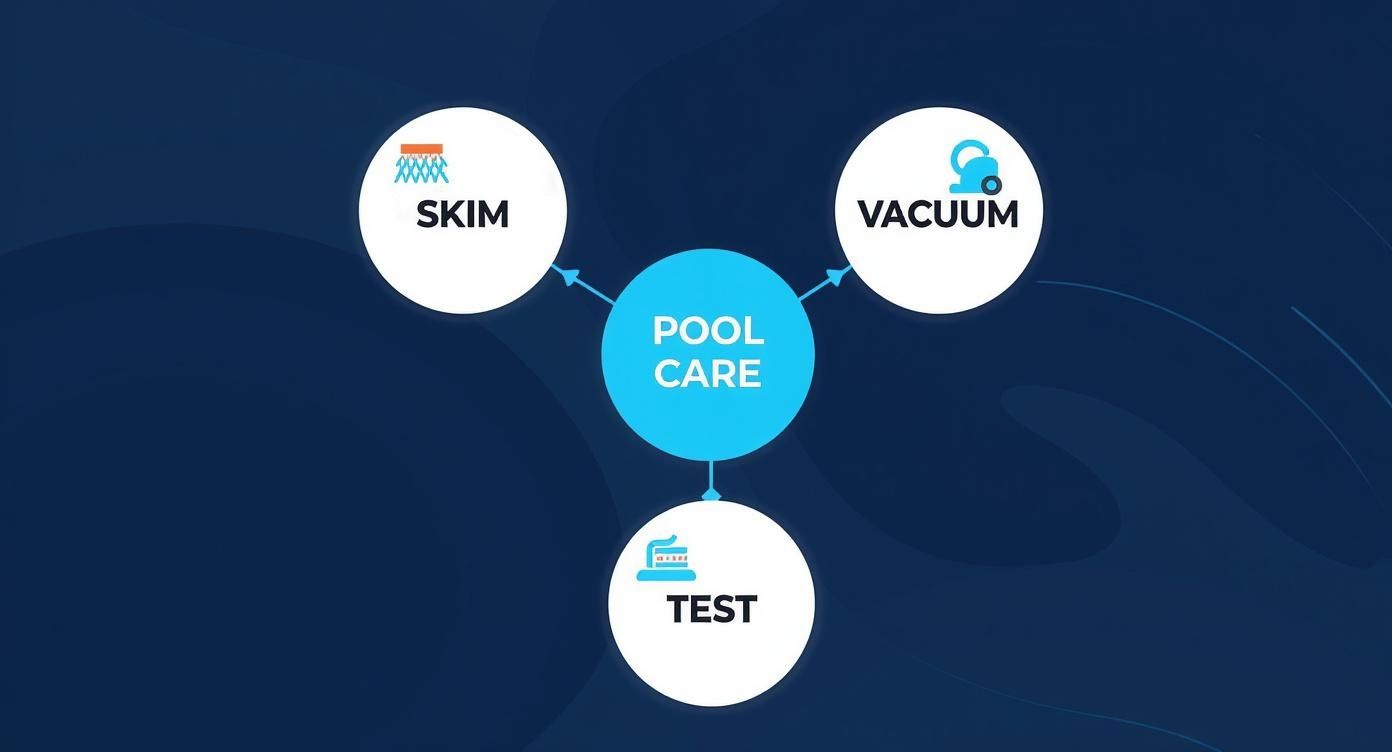
Just like the infographic shows, testing your water is every bit as crucial as skimming leaves or vacuuming up dirt. Your chemicals are like an invisible cleaning crew, working around the clock to keep things safe and inviting.
The Core Four of Pool Chemistry
To really get a handle on your water quality, you just need to focus on four main components. Each one has a specific job, and they all affect each other. Keeping them in their sweet spot is the real secret to that pristine, sparkling water we all want.
- Chlorine: This is your sanitizer. Its job is to kill off bacteria, viruses, and all the other nasty stuff you don't want in your pool. You're aiming for a free chlorine level between 1-3 parts per million (ppm).
- pH: This is just a measure of how acidic or basic your water is. A proper pH level (between 7.2-7.6) is what makes the water comfortable for swimmers and, just as importantly, allows your chlorine to actually do its job.
- Total Alkalinity: I like to call this the pH buffer. It's what stops your pH from swinging wildly all over the place. Keep your alkalinity dialed in between 80-120 ppm.
- Cyanuric Acid (CYA): Think of this as sunscreen for your chlorine. It stabilizes the chlorine and stops that intense Florida sun from burning it off in a matter of hours. The ideal range here is 30-50 ppm.
Don't let all the numbers and chemical names intimidate you. The big takeaway is that these chemicals are a team. If one is out of whack, it's going to throw the others off. That’s why consistent testing is the foundation of good above ground pool maintenance.
Testing and Adjusting Your Water
Testing your water 2-3 times per week is non-negotiable, especially during the peak of a Southwest Florida summer. A sudden afternoon downpour can throw your levels off in an instant, and a few days of relentless sun can eat through your chlorine faster than you'd believe.
When you get your test results back, it’s important to adjust your chemicals in a specific order for the best results.
- Start with Alkalinity: Since alkalinity is the stabilizer for your pH, you have to get it right first. Use an alkalinity increaser or decreaser to bring it into range.
- Move on to pH: With your alkalinity now stable, you can adjust the pH. Use a pH increaser or reducer to hit that 7.2-7.6 target.
- Finish with Chlorine: Now that the water is properly balanced, you can add your sanitizer. This ensures the chlorine you add will be as effective as possible.
A word of advice: always add chemicals according to the instructions on the package. The best practice is usually to pre-dissolve them in a bucket of pool water first, then pour the solution slowly around the edge of the pool while the pump is running. This helps it mix in evenly and prevents concentrated chemicals from sitting on your liner and causing damage.
If you’re tired of playing a constant guessing game with test strips and dosing, let our team handle it. We specialize in keeping pool chemistry perfectly balanced so your water is always safe and ready for a swim. Check out our weekly service plans and take the hassle out of having a crystal-clear pool.
Keeping Your Filtration System in Peak Condition
Think of your pool's filtration system—the pump and filter—as its heart. It's the workhorse that runs for hours every day, circulating water to keep it sparkling clean. Just like any engine, it needs regular check-ups to perform at its best, especially under the relentless Southwest Florida sun.
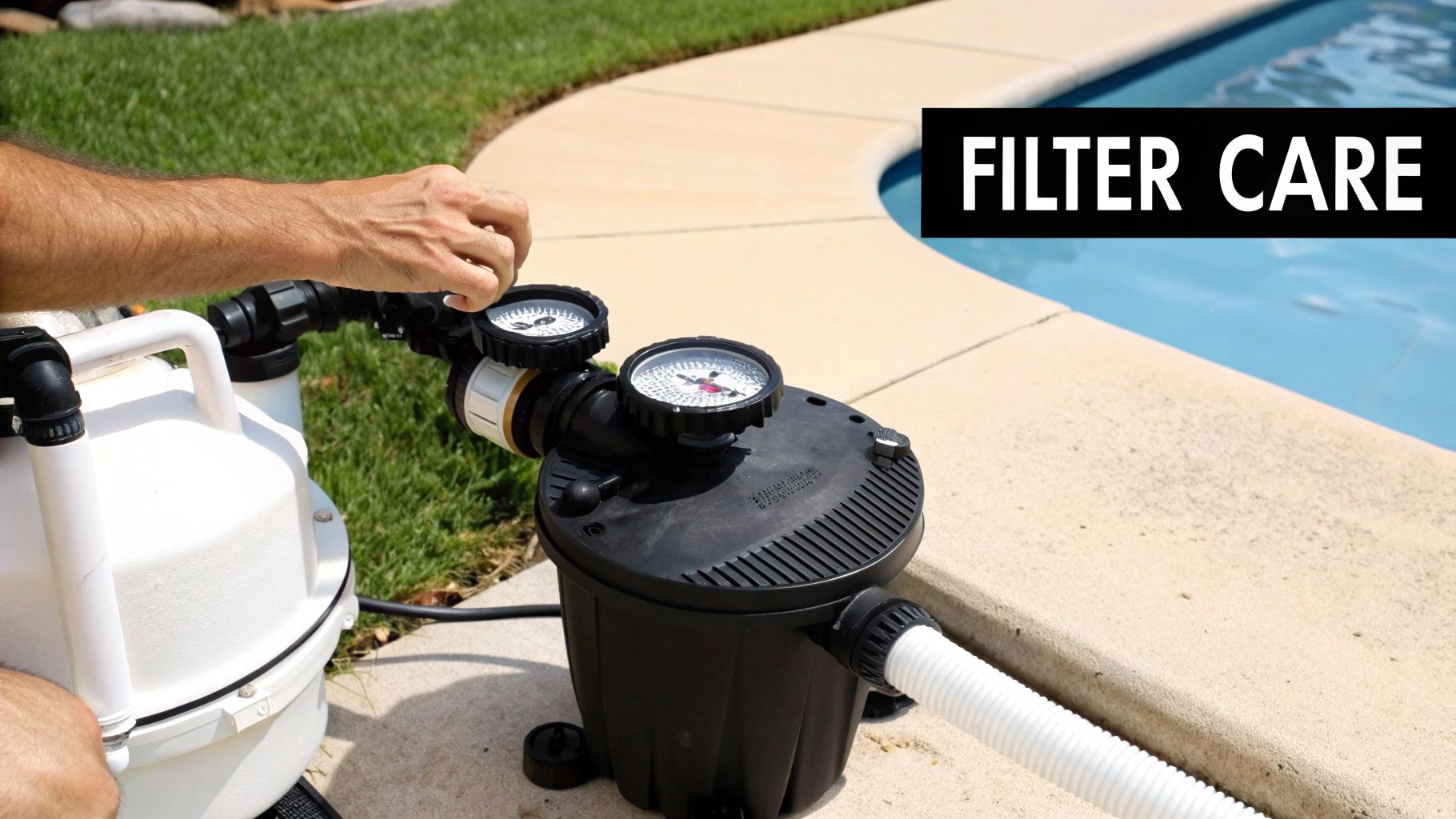
Letting this system go is one of the quickest routes to cloudy, uninviting water. A well-maintained filter doesn't just catch leaves and bugs; it also makes your chemicals far more effective. Nailing this simple care routine is a huge part of learning how to maintain an above ground pool successfully.
Your Pump: The Engine of Your Pool
The pump is what drives the whole circulation process. Your main job here is to make sure it can breathe. That means checking and cleaning the pump's strainer basket at least once a week—more often if you’ve got messy oak or palm trees nearby.
A clogged basket makes the pump strain, which jacks up your energy bill and can burn out the motor way too soon. While you're at it, just listen. Any weird noises? A loud hum, a grinding sound, or a high-pitched whine is a red flag. It’s your pool's way of telling you something's wrong, and you need to look into it before it becomes a much bigger, more expensive headache.
Mastering Your Filter Maintenance
Your filter is the final defense, grabbing all the tiny particles that make your water look dull and murky. Whether you have a sand or cartridge filter, the trick is knowing when to clean it. Your best friend here is the pressure gauge on the filter tank.
When the filter is freshly cleaned, take a note of the pressure reading—that's your baseline. Once the gauge climbs 8-10 PSI above that "clean" number, it's time for a little maintenance.
- For Sand Filters: That pressure spike is your cue to backwash. This process simply reverses the water flow, flushing all the trapped gunk out to waste. It's a quick job, usually done in just a few minutes.
- For Cartridge Filters: You’ll need to pull the cartridge out and give it a good, strong hosing down. Every so often, oils and lotions will build up, so you'll want to use a specialized filter cleaning solution to get it truly clean.
Pro Tip: Don't go overboard with cleaning. Believe it or not, a filter that's just a little bit dirty is actually more efficient at trapping super-fine particles than a perfectly clean one. Let the pressure gauge be your guide.
This hands-on care is more important than ever, as basic maintenance is a major hurdle for many pool owners. With the above-ground pool market projected to hit USD 52.61 billion by 2032, homeowners are searching for reliable ways to simplify pool care. You can read more about the rise of the above ground pool market on databridgemarketresearch.com and the innovations helping to solve these exact problems.
While most routine cleaning is straightforward, some pump and filter issues are best left to a pro. If you’re fighting with constant low pressure, pesky leaks, or those strange motor noises won't go away, it’s time to call for backup. Our team has the right diagnostic tools and years of experience to figure out complex equipment problems fast. For those tougher jobs, our pump and filter services team is ready to help.
Effective Cleaning Routines to Prevent Algae
Perfectly balanced water is a huge part of keeping your pool clear, but it’s only half the battle. Think of your chemicals as your pool's immune system; they can fight off invaders, but you still need to actively keep the environment clean. Here in the Southwest Florida heat, physical cleaning is your most powerful weapon against algae.
A consistent routine—skimming, brushing, vacuuming—is what stops dirt, debris, and stubborn algae spores from getting a foothold in the first place.
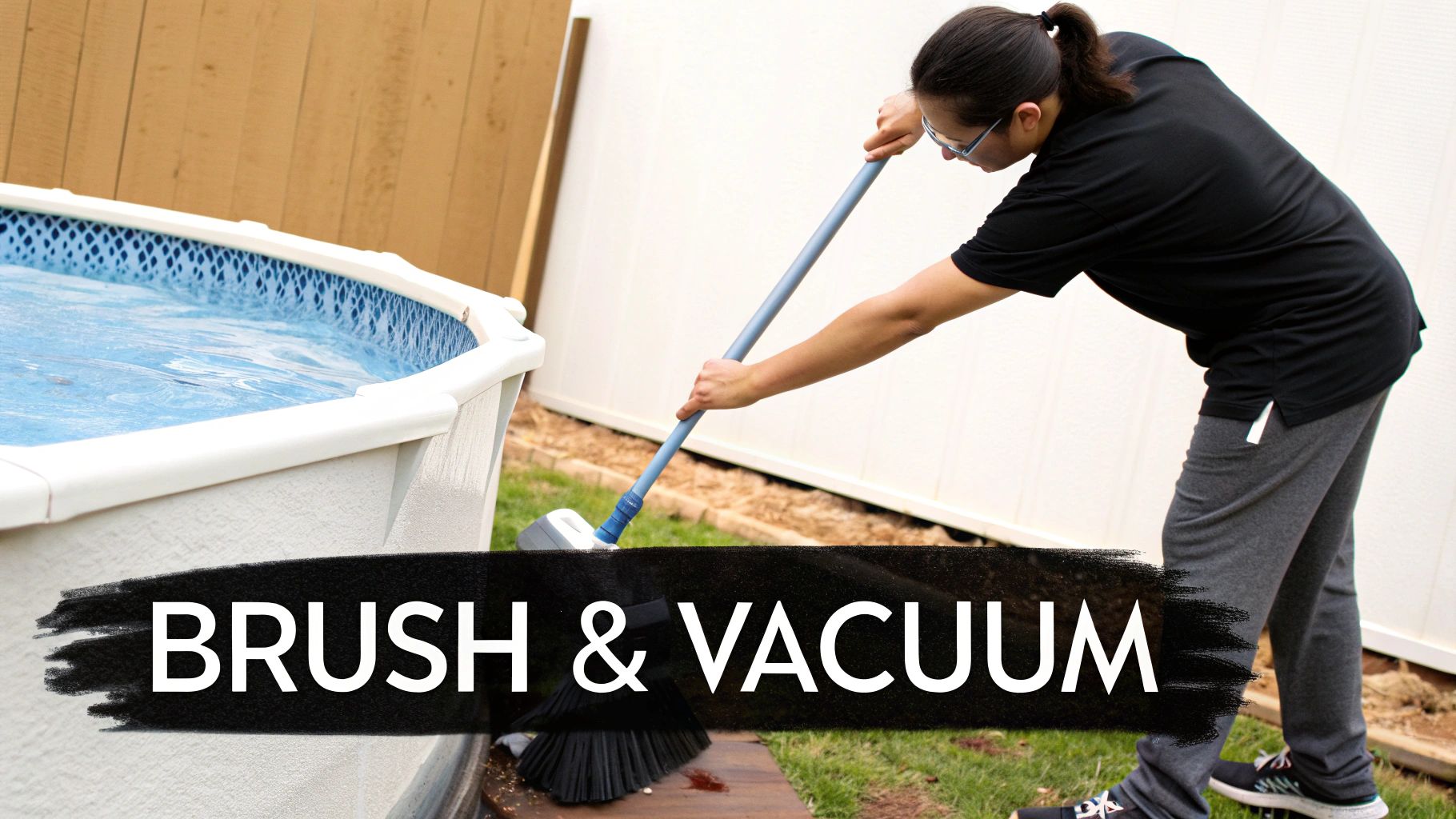
This is a non-negotiable part of learning how to maintain an above ground pool. When you actively remove contaminants before they can decay and turn into algae fuel, you’re playing offense, not just defense.
The Power of Brushing and Skimming
You need to brush your pool's walls and floor at least once a week. This simple chore loosens up any invisible algae spores that are trying to cling to the surfaces, preventing them from blooming into a green headache.
Make sure to give extra attention to the waterline, steps, and any seams or corners. These are the spots where water circulation is often weakest, making them prime real estate for algae.
Skimming the surface daily (or at least every other day) is just as important. It gets rid of leaves, bugs, and pollen before they have a chance to sink, break down, and feed the very algae you're trying to prevent. A clean surface means your sanitizer and filter have less work to do.
Your cleaning routine is your best early warning system. While brushing, you might feel a slick or slimy spot on the liner. That's often the very first sign of an impending algae bloom, giving you a chance to act before it becomes a visible problem.
Choosing Your Vacuuming Method
Brushing kicks everything up, and vacuuming is what removes it for good. You've got a couple of options here, and the best one really comes down to your budget and how you want to spend your time.
- Manual Vacuuming: This is the old-school, hands-on method. You connect a vacuum head and hose to a telescopic pole and your skimmer, guiding it across the pool floor yourself. It’s cost-effective and lets you really focus on problem areas.
- Automatic Cleaners: These are the little robots that do the work for you. Whether they're suction-side or true robotic cleaners, they represent a bigger upfront investment. The trade-off? They save you a ton of time and can run on a set schedule, keeping the pool floor consistently clean.
Whichever path you take, a clean pool floor is critical for algae prevention.
Let’s be honest, though—sometimes you'd rather spend your weekend in the pool, not cleaning it. If that sounds like you, our team offers comprehensive cleaning services to keep your pool spotless. You get all the fun without any of the work.
Navigating Florida Weather and Seasonal Pool Care
Owning a pool in Southwest Florida is incredible, but our unique climate definitely keeps you on your toes. You're not just maintaining a pool; you're battling intense sun, sudden torrential downpours, and the annual threat of hurricanes.
Learning to adapt your maintenance routine to this wild weather isn't just about keeping the water looking good—it’s about protecting your investment and making sure it's always safe for a swim.
Preparing for Hurricane Season
When a storm is brewing on the horizon, having a solid plan is non-negotiable. Your primary goal is to minimize damage from high winds and flying debris, both of which can destroy a pool liner or wreck your expensive equipment in an instant.
Here’s your game plan for storm prep:
- Never, ever drain your pool. This is the biggest mistake I see people make. The weight of that water is what holds your liner down and gives the whole structure stability against powerful wind gusts. An empty pool is a vulnerable pool.
- Clear the deck. Anything that isn't bolted down needs to be stored. Pool toys, patio furniture, skimmers, brushes—all of it can become a dangerous projectile.
- Kill the power. Head to your circuit breaker and shut off all power to your pool equipment. This single step can save you from costly electrical damage due to power surges or flooding.
- Protect your equipment. If you can, disconnect your pump and filter system. Move it to a secure, dry place like a garage or a sturdy shed until the storm passes.
Managing Rain and "Winterizing"
Those classic Florida afternoon downpours can completely throw your water chemistry out of whack. A heavy rain dilutes chlorine levels and can send your pH plummeting, creating a perfect breeding ground for algae.
After any significant rainfall, get out there and test your water. You'll almost certainly need to rebalance the chemicals, and you might even need to shock the pool to get ahead of an algae bloom.
And what about "winterizing"? Here in Florida, that term has a totally different meaning. We don't close our pools. We just adjust. During the cooler, drier months, you can usually dial back your pump's run time to about 4-6 hours per day. You'll also find you need less chlorine because the sun isn't as intense and isn't burning it off so quickly.
Seasonal care is a constant responsibility. It’s a huge reason the U.S. pool maintenance and cleaning services market hit a staggering USD 8.08 billion in 2023, as many homeowners turn to pros for year-round peace of mind. You can discover more insights about the above-ground pool market on maximizemarketresearch.com.
Keeping up with SWFL weather can feel like a part-time job. Our seasonal maintenance packages are built specifically for our local climate, taking everything from hurricane prep to post-storm chemical balancing off your plate.
When to Call a Professional for Pool Service
While rolling up your sleeves and handling regular pool maintenance is rewarding, there are times when you absolutely need to call in an expert. Being able to tell the difference between a simple DIY fix and a problem that needs a professional eye is crucial—it can save you from major headaches, costly repairs, and even serious safety risks.
Sometimes, your pool sends you clear signals. Are you fighting a losing battle with cloudy water, no matter what you try? Does algae keep reappearing just a few days after you shock the pool? These are classic signs that a deeper issue is at play. Listen to your equipment, too. Any grinding, whining, or rattling sounds from your pump are red flags. Don't ignore them. A strange noise is often the first warning before a small problem turns into a complete system breakdown. Our team is great at diagnosing these issues and can perform an expert pump and filter services to get everything back in working order.
Issues Best Left to the Pros
Knowing your limits is a key part of smart homeownership, whether it's for your pool or deciding when to call a professional service for other specialized tasks. When it comes to your pool, some jobs are simply not for the weekend warrior.
Here are a few situations where you should always call a certified pro:
- Leak Detection and Repair: Finding a tiny leak in a pool liner is like finding a needle in a haystack without the right equipment. A botched patch job can easily make the tear worse, leading to significant water loss and ground damage.
- Major Liner Repairs or Replacement: A new liner has to be installed perfectly. If it's not fitted just right, you'll get wrinkles and stretching, which can drastically shorten its lifespan.
- All Electrical Work: This one is non-negotiable. The combination of water and electricity is incredibly dangerous. Never try to fix your pool pump’s motor or mess with any of the wiring yourself. Always leave that to a licensed professional.
Trying to tackle these complex jobs on your own often ends up costing you more in the long run. Our experienced technicians have the specialized tools and know-how to solve any pool problem safely and efficiently. Let us take the stress out of pool ownership.
Your Top Above Ground Pool Questions, Answered
When it comes to keeping an above ground pool in top shape here in Southwest Florida, a few questions pop up time and time again. Let's tackle some of the most common ones I hear from pool owners.
How Long Should I Run My Pool Pump in Florida?
In the thick of a blazing Southwest Florida summer, you really need to run that pump for a good 8 to 12 hours every single day. Anything less and you're not turning over the water enough, which is an open invitation for algae.
Once things cool down a bit in the off-season, you can comfortably dial it back to 4 to 6 hours a day. This will keep your water clean while giving your electric bill a little break.
What Are the Most Important Pool Chemicals?
If you're going to focus on just a few things, make it these three: your sanitizer (chlorine), pH, and total alkalinity. Think of them as the three-legged stool of pool chemistry.
Chlorine is your workhorse—it kills all the nasty stuff. The pH level dictates how comfortable the water is and, just as importantly, how effective your chlorine can be. Finally, alkalinity is the unsung hero that keeps your pH from bouncing all over the place. Nail these three, and you've won half the battle.
A common question is whether you can use a robotic cleaner in an above ground pool. The answer is a definite yes! Many of today's robotic, suction-side, and pressure-side cleaners are built specifically for them. Just make sure the model you pick is safe for your liner and works with your pump system.
Have more questions? I’ve probably answered them over on our detailed pool FAQs page.
When you'd rather spend your time swimming than skimming, let the pros at Water Medic of Cape Coral take care of the details. We provide reliable, expert pool service so your backyard oasis is always ready when you are. Contact us today for a free consultation!