Pre Filter for RO System: Types, Sizing and Upkeep
A reverse osmosis membrane can lose most of its production in a few hours if grit and chemistry reach it untreated. In the U.S. Environmental Protection Agency history of early wastewater trials, cellulose-acetate membranes with nominal flux of 30–60 gallons per square foot per day became unstable after only a few hours and declined toward the 10–20 gallon range, even while some tests still removed more than 95% of total dissolved solids and chemical oxygen demand at 750 and 1,500 psig.
That drop is why a pre filter for RO system design is membrane protection, not a taste upgrade you buy on a calendar. On a whole-house reverse osmosis system fed by a Cape Coral or Lee County well, the stages ahead of the membrane decide how long it lasts and how much water the house gets.
Pre-Filter Types, Micron Ratings and Stage Roles
A pre-filter protects the reverse osmosis membrane from particles and chlorine before they reach it. The membrane is a thin-film composite sheet with small flow passages: sand, rust, and silt can obstruct water flow, while free chlorine can oxidize the polyamide layer. Choosing the stages by the water's measured conditions helps protect the membrane without adding cartridges that the supply does not need.
A residential pre-filter is a membrane-protection stage, not just a taste-and-odor cartridge. DuPont's FilmTec technical manual states that residual chlorine must be removed upstream because polyamide membranes are vulnerable to oxidative damage. Activated carbon or a reducing chemical such as sodium metabisulfite can remove chlorine. Sediment media capture particles, and carbon removes free chlorine before it reaches the membrane.
What a micron actually means
One micron is one-thousandth of a millimeter. A human hair is roughly 50 to 70 microns across, so a 5 micron cartridge captures particles much smaller than beach sand. A coarse 5 micron sediment stage is commonly placed first for sand and silt, followed by a 1 micron polishing stage. On a sandy supply, this step-down helps keep the finer cartridge from loading quickly.
Carbon block is a dense molded cartridge that can remove free chlorine, taste and odor compounds, and fine particles. It is often sold with a 5 micron nominal rating. Granular activated carbon is a larger contact bed, not rated in microns in the same way. Its performance depends on flow and contact time. Check whether a cartridge's rating is nominal, meaning an approximate average, or absolute, meaning it holds a stated percentage of particles at that size. A nominal 5 micron cartridge may still pass finer grit.
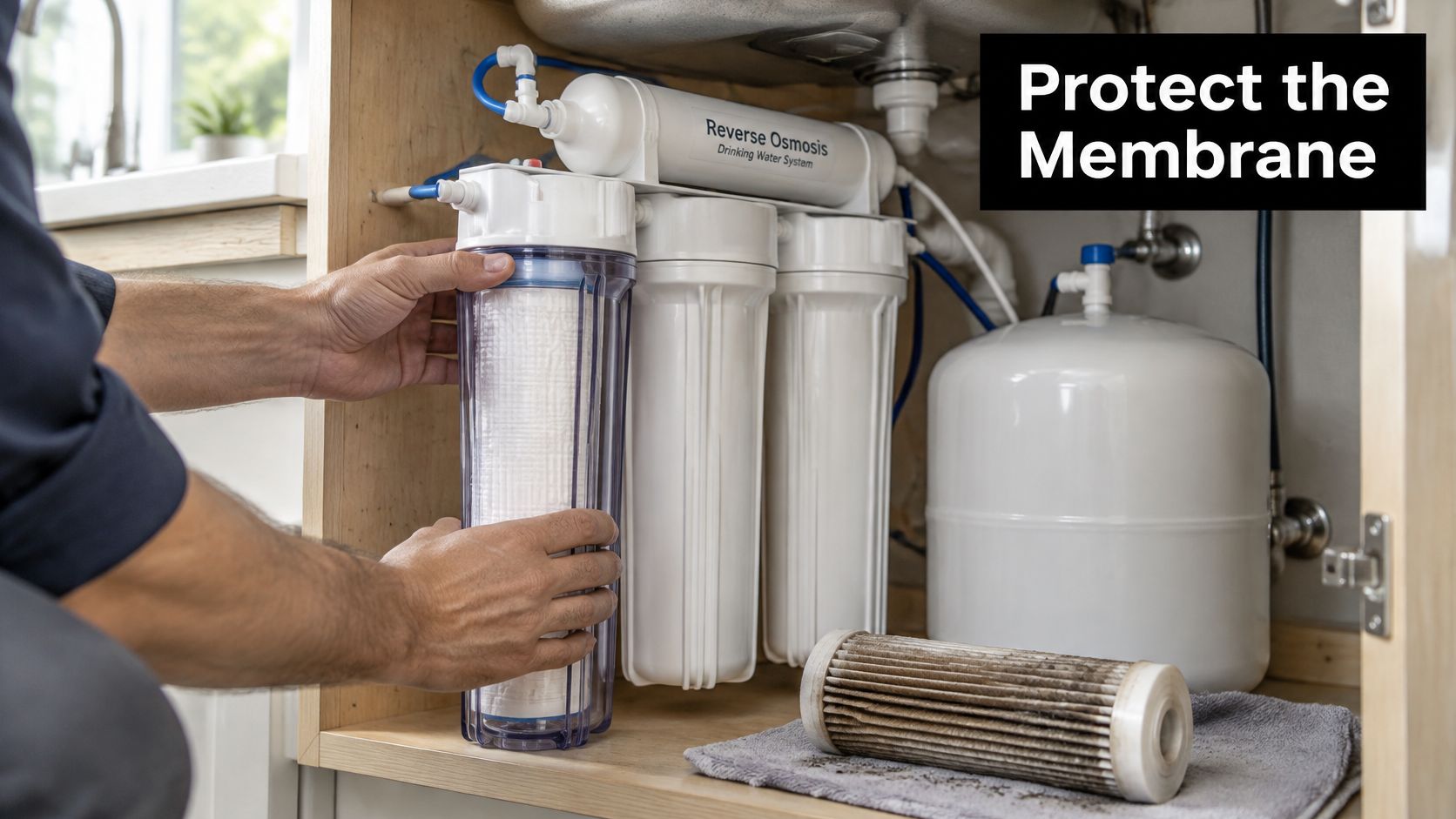
The manual describes a typical under-sink layout with one sediment cartridge and two carbon prefilters before the membrane, followed by a postfilter. That sequence removes rust, sand, and chlorine that can reduce membrane efficiency and service life. Whole-house equipment applies the same basic treatment roles at higher flow. Carbon filters provide a chlorine-removal stage, but do not replace the membrane.
Stage by stage
| Stage Type | Removes | Typical Micron Rating | Protects Against |
|---|---|---|---|
| Sediment cartridge | Sand, silt, rust particles | 5 micron (coarse); 1 micron (polishing) | Membrane plugging and flow loss |
| Carbon block | Free chlorine, taste and odor compounds, fine particles | 5 micron nominal | Chlorine damage to polyamide membranes |
| Granular activated carbon | Free chlorine, organics, taste and odor | Not rated in microns; sized by contact time and flow | Chlorine damage at higher flow |
| Sediment then carbon (two-stage) | Particles and chlorine in sequence | Coarse sediment first, finer carbon after | Full pretreatment before the membrane |
Practical rule: Sediment protects flow. Carbon protects the membrane. Use both when the water test and chlorine measurements show they are needed.
For private well water, visible sediment or iron particles point to the need for a sediment stage, while chlorinated water needs verified dechlorination. Measure free chlorine immediately before the membrane to confirm the carbon stage is removing it. A clean-looking housing does not prove the cartridge is working: exhaustion, channeling, excessive flow, or an undersized cartridge can allow chlorine through. Combine chlorine readings with changes in flow and sediment loading when deciding whether a stage needs attention.
Whole-House Pre-Filter Trains Compared With Under-Sink Units
An under-sink reverse osmosis unit is built for one tap. The usual order is a sediment cartridge, two carbon cartridges, the membrane, and a small postfilter. That layout is fine for a drinking faucet. It is not a model for the water that fills every fixture in the house.
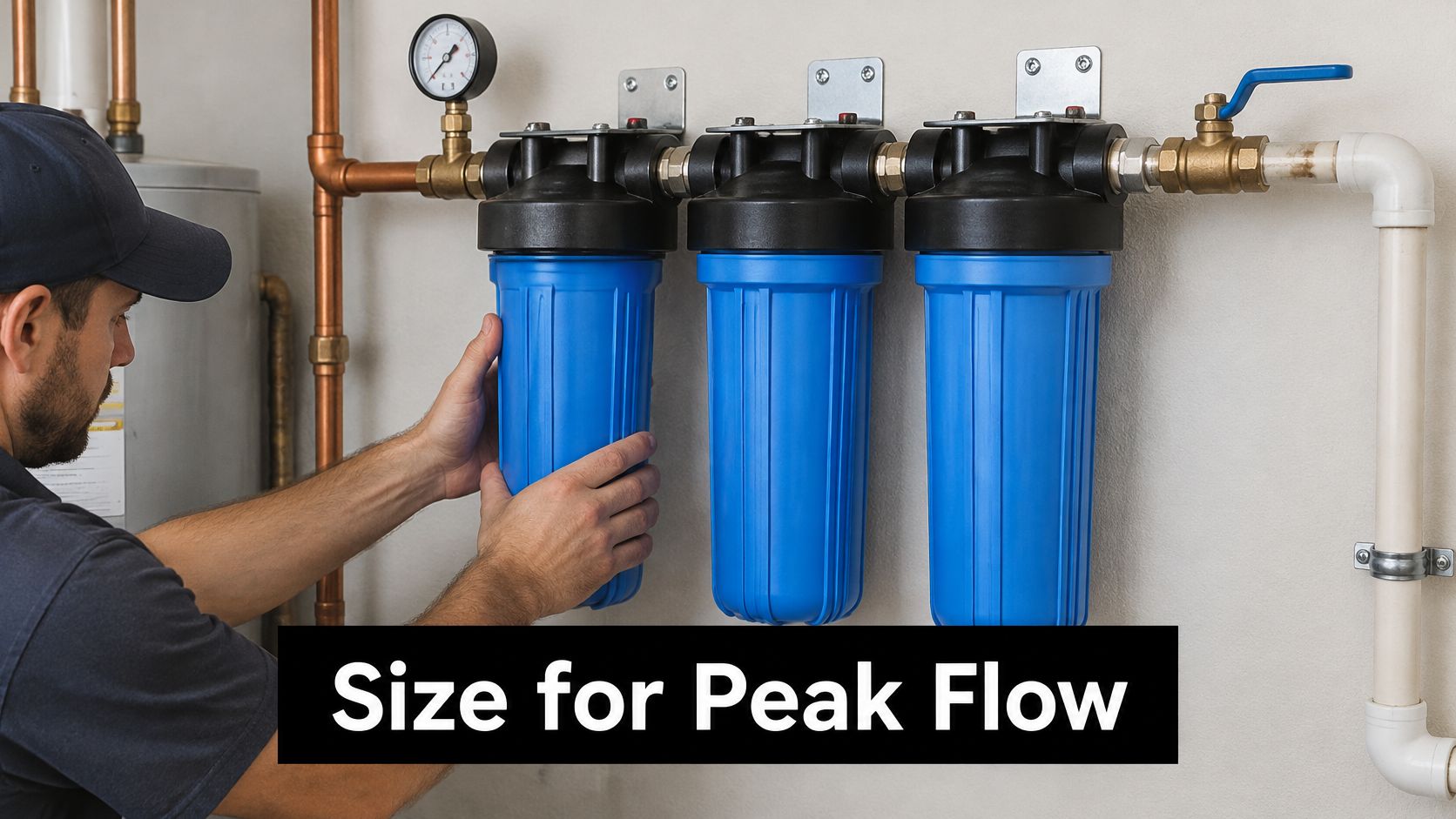
A whole-house train uses the same logic at the main supply, with larger housings and cartridges rated for peak demand.
- Sediment at the main. A coarse 5 micron stage comes first, then 1 micron polishing, so grit does not choke flow through the rest of the equipment.
- Carbon sized to peak flow. The bed has to keep free chlorine off the membrane during a shower, a laundry cycle, and irrigation demand at the same time. An undersized carbon stage can break through while the media still looks dark and unused.
- Iron, manganese, or softening only when the well test calls for it. Those are separate pieces of equipment, placed ahead of the membrane. They are not extra sediment cartridges.
- Membrane and storage after every upstream stage. The membrane should never be the first thing the raw water touches.
A whole-house pre-filter train asks more of every housing because the flow is the whole house, not a single faucet. Stage count comes from the well test, not from how many taps you have.
What does not work is copying a three-cartridge under-sink kit onto a two-inch main and hoping the ratings scale. Peak gallons per minute, not the number of bathrooms on the plans, sets the housing size.
Matching Pre-Filters to Your Well Water Test
Buy the pre-filter from a lab report, not from a default cartridge bundle. The tests that change the design are turbidity and visible sediment, free chlorine, iron, manganese, hardness, hydrogen sulfide, total dissolved solids, nitrate, and bacteria.
Sediment and carbon handle particles and chlorine. Hardness, iron, manganese, hydrogen sulfide, tannins, and microbes do not yield to those two cartridges. Connecticut's Department of Public Health recommends testing untreated and treated water after installation, then annually, or quarterly to semi-annually when contaminant levels are high, because performance and replacement needs follow the raw water.
Two wells, two trains
Say a Cape Coral well throws visible sand in the first morning draw and the chlorine residual is zero. That house needs a sediment stage and a hardness check, not a carbon block chosen because the neighbor has one. A clear, chlorinated supply is the opposite problem. The water looks fine and still needs verified carbon dechlorination before a polyamide membrane.
A sulfur odor or a positive bacteria result is a different treatment job before the membrane. A pre-filter cannot fix every well issue. Retest after startup and on a schedule. Seasons and the water table move the chemistry even when the equipment has not changed.
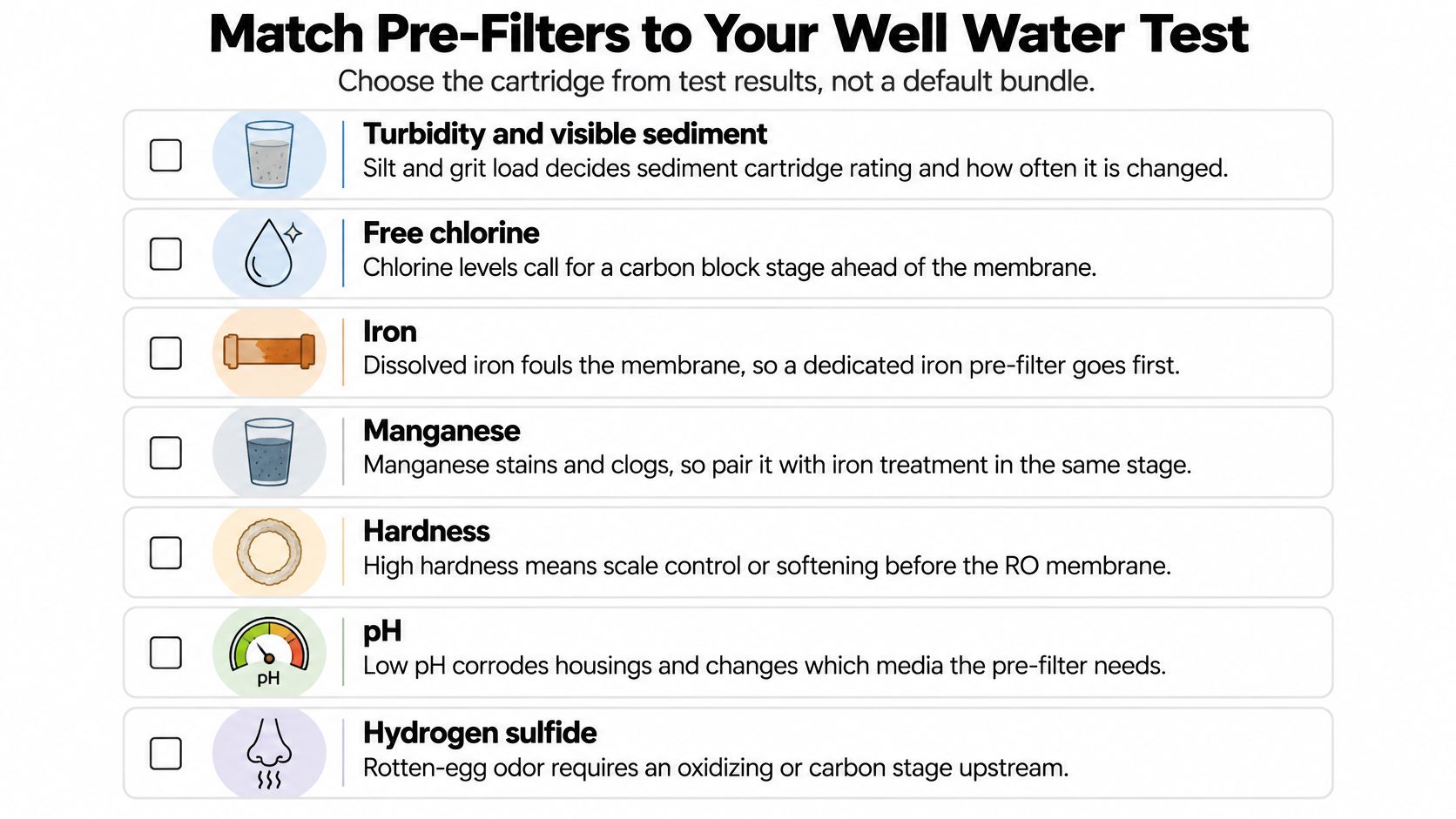
| Test Finding | Stage Needed | Why It Matters |
|---|---|---|
| Visible sand, silt or turbidity | Sediment cartridge | Particles plug membrane flow passages |
| Free chlorine above zero | Carbon block or granular carbon | Chlorine oxidizes polyamide membranes |
| Iron or manganese | Oxidation and filtration ahead of RO | Metals foul the membrane and stain fixtures |
| High hardness | Softener ahead of RO | Hardness causes scale on the membrane |
| Hydrogen sulfide odor | Specialized treatment ahead of RO | Standard sediment and carbon cartridges do not address it reliably |
| Bacteria present | Disinfection before RO | Biological load fouls the membrane; a cartridge does not replace disinfection |
Test first, name the contaminant, then assign the stage. If the report shows iron, sulfur, or a failing well component, well water repair and the right pretreatment belong in the same plan as the membrane. I would not order housings until those results are in hand.
Choosing Pre-Filter Stages for Whole-House Flow
Size in the order a technician checks the job. Peak household flow comes first, not average daily use. Then the rated flow of each cartridge, the housing diameter, and how many stages the chemistry requires. A restricted or fouled stage drops pressure at the membrane and cuts production. Pre-filter choice changes output, not only water quality.
In an EPA field evaluation of an arsenic-treatment RO system, water passed either a sediment prefilter or a carbon-block prefilter before the membrane. Average net driving pressure was 83 psi with the carbon block and 102 psi with sediment. The membranes in that system were not chlorine-tolerant, so carbon pretreatment was recommended on a chlorinated source. That gap does not crown one media as always easier on pressure. Chemistry, filter condition, flow, and equipment design all move the number. It does show that stage selection changes hydraulics as well as protection.
What to require on the spec sheet
The same EPA WaterSense work says certified point-of-use RO systems must show at least 75% reduction of an influent total-dissolved-solids challenge, and makers must identify replacement parts, including prefilters, and the recommended change frequency. NSF/ANSI 58 requires a verified total-dissolved-solids reduction claim and sets procedures for optional claims such as arsenic, nitrate, lead, and fluoride.
- Micron ratings: Which absolute or nominal rating is specified for each sediment stage.
- Chlorine tolerance: Whether this membrane can see any free chlorine. Most polyamide elements cannot.
- Peak demand: How each stage was sized for the highest simultaneous flow, not a quiet afternoon.
- Documented interval: Which replacement frequency the manufacturer prints for these exact cartridges.
WaterSense covers point-of-use equipment. For a whole-house buy, ask for the NSF/ANSI 58 data that shows the verified TDS claim and which optional contaminants are certified. Undersized stages save money on install day and spend it later in membrane life.
Replacement Intervals and Failure Signs
Use about six months as a starting interval for a prefilter, and one to five years for a membrane, depending on local conditions, as described in EPA materials cited in a public-health treatment guide. Actual replacement timing depends on water volume, water quality, and contaminant concentration. Heavy sediment loads or a strong chlorine residual can shorten these intervals; a clearer, lighter-load supply may allow longer service. A clogged membrane reduces flow, but the calendar alone cannot show whether a cartridge is exhausted.
Keep a maintenance log with installation dates, cartridge changes, pressure readings before and after the prefilter, and lab or meter results. Check the gauges monthly. A rising pressure drop can identify a loading sediment cartridge before reduced flow is mistaken for a failed membrane.
Why a clogged pre-filter lies about water quality
Federal guidance on fouled prefilters explains that fouling causes pressure loss and reduces RO production. It can also raise dissolved-solids concentration in product water because less water is produced while dissolved-solids flux stays relatively constant. Exhausted carbon can let chlorine reach a chlorine-sensitive polyamide membrane, where it can cause deterioration. The guidance also points to monitoring raw-water and treated-water TDS, so test results help determine whether filters or membranes need replacement.
A carbon cartridge can look clean and still let chlorine through. Channeling and high flow can contribute to breakthrough, so returning taste is a late warning rather than a reliable test.
Measurements, in the order to take them
- Compare pressure at the inlet and outlet of the prefilter housing. A growing pressure drop indicates that the sediment stage is loading.
- Compare RO outlet flow with the output recorded when the system was new.
- Measure free chlorine immediately before the membrane when carbon is installed. Any residual indicates breakthrough.
- Compare raw-water TDS with product-water TDS. Rising product TDS alongside falling flow can point to a fouled prefilter or membrane wear.
- Identify the failing component before replacing parts. A blocked sediment cartridge, exhausted carbon stage, worn membrane, and storage-tank problem require different fixes.
Slow tank refill can signal a clogged sediment cartridge. Returning chlorine taste suggests carbon breakthrough, while rising product TDS calls for checking both pretreatment and membrane condition. Replace the stage indicated by the measurements, then record the pressure readings, chlorine result, and TDS comparison.
| Stage | Typical Interval | Replace Sooner When |
|---|---|---|
| Sediment cartridge | About 6 months | Pressure drop across the housing rises or water runs visibly cloudy |
| Carbon stage | About 6 months | Chlorine breaks through or the carbon has run for a long period |
| RO membrane | 1 to 5 years | Product flow falls or product TDS rises |
Inline pH, turbidity, and TDS meters can support maintenance decisions by showing changes over time. They do not replace contaminant-specific laboratory tests for iron, bacteria, or nitrate.
Schedule a Whole-House RO Pre-Filter Review
Four moves set a whole-house pre filter for RO system that protects the membrane. Test the water. Match each contaminant to a stage. Size those stages for peak household flow. Set a replacement and monitoring schedule you can keep.
Water Medic of Cape Coral sells and installs whole-house reverse osmosis systems and provides monthly maintenance for them. Systems for well water are built to each well's test results, which is the only honest way to pick sediment, carbon, iron treatment, or softening. A monthly reverse osmosis maintenance plan keeps cartridge changes, pressure checks, and TDS comparisons on a schedule instead of waiting for a dry faucet.
Gather the newest well report. Note visible sediment, any chlorine residual, and any odor. Ask for a pre-filter review that covers stage selection, sizing against peak flow, and the replacement log. The result you want is a membrane that only sees water the upstream stages were chosen to treat, and a schedule you can follow without guessing.
Water Medic of Cape Coral designs whole-house reverse osmosis pretreatment around your well test, then keeps those stages on a maintenance plan so sediment and carbon are changed from measurements, not from a guess. If you are in Cape Coral or Lee County and want the membrane protected before you buy another cartridge, start with your latest water report. Visit Water Medic of Cape Coral to schedule a pre-filter review.