
Back Porch Cover Options for Southwest Florida Homes
A mid-size attached back porch cover in Southwest Florida usually lands around $12,000 to $16,000, and that's the number I'd use if you want a realistic budget before you call anyone out. If you want premium finishes, the project can climb well past $20,000, so the right question isn't whether a cover is cheap, it's whether the structure will hold up in salt air and storm season.
In Cape Coral, a back porch cover isn't a decoration. It's the difference between a space you can use in July and a feature that turns into a maintenance headache after the first hard summer. Afternoon sun, wind-driven rain, and salty air punish weak framing fast, so the right design has to solve shade, drainage, and wind resistance at the same time.
The other thing homeowners get wrong is calling everything a “lanai” or “patio cover” when they mean different builds. A roofed back porch, a pergola, an awning, and a screened enclosure all do different jobs, and they don't carry the same cost, durability, or code burden. In Lee County, that distinction matters because your lot coverage, permit path, and wind rating all change with the type you choose.
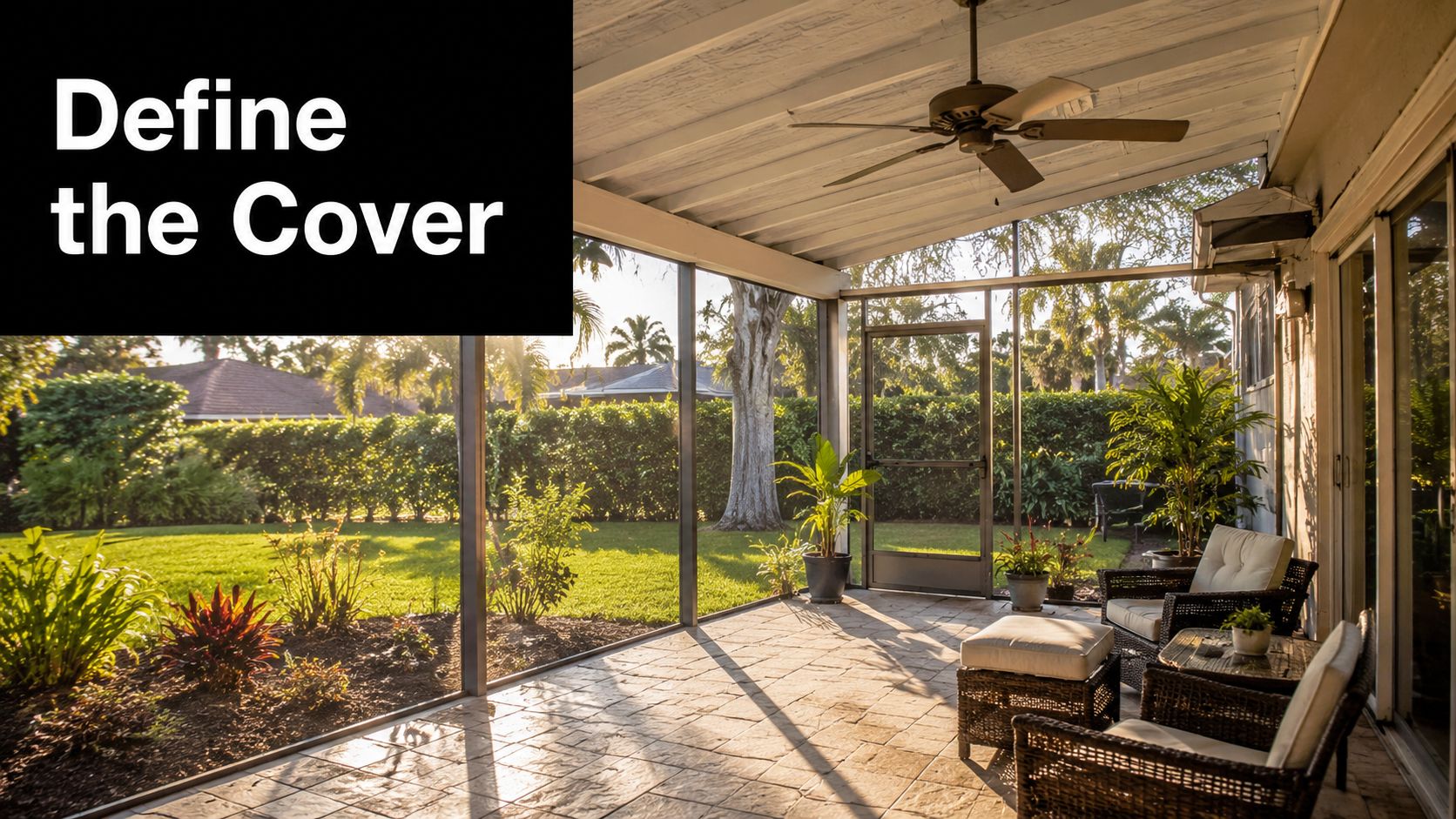
What a Back Porch Cover Actually Does in a Southwest Florida Backyard
A good back porch cover does three jobs at once. It blocks the harshest sun, gives you a dry spot when a storm blows through, and protects the furniture, flooring, and screen components under it from constant weather abuse. In a Cape Coral backyard, that matters more than style. A pretty cover that can't handle water or wind is just an expensive liability.
Start with the space, not the product name
If the structure is attached to the house and tied into the roofline, you're talking about a real roofed addition, not a light shade accessory. If it stands off the house, it's closer to a freestanding patio cover. A pergola gives partial shade and usually leaves you exposed to rain. A fixed awning gives better sun relief, but it's still a lighter-duty solution than a solid roof.
A screened lanai enclosure is different again. It wraps the space in screen walls, so it changes how the area feels, how insects are kept out, and how wind moves through the structure. That's why homeowners who only say “I want to cover the back porch” often get the wrong quote the first time.
Budget tells you what game you're playing
A realistic price band for a standard covered back porch is broad because the build quality swings wildly. A typical project often falls around $12,000 to $16,000 for a mid-size structure, while more premium builds can exceed $20,000 HomeGuide cost guide. That range is useful because it separates a true structural cover from a cheap shade fix.
Practical rule: If you want something that survives Southwest Florida weather, budget for structure first and appearance second.
The decision in this market isn't whether you need shade. You do. The decision is whether you want a structure that looks finished, or one that's engineered to stay put when the weather turns ugly. In coastal Florida, those are not the same thing.
Comparing the Main Types of Back Porch Covers
Homeowners usually narrow the field to four options, and each one solves a different problem. If you compare them carefully, the choice gets simpler fast.
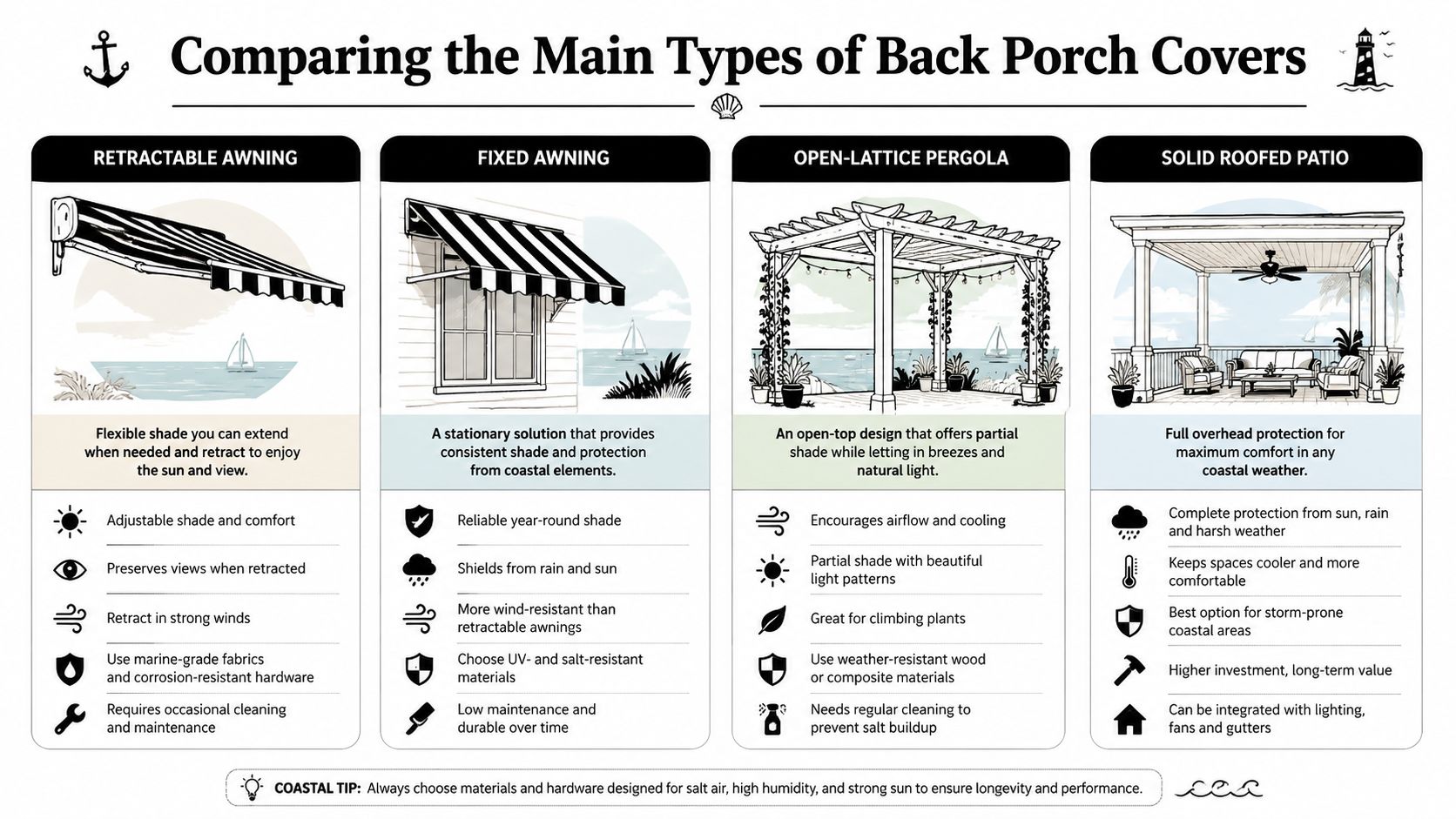
The comparison that actually matters
| Cover Type | Shade | Rain Protection | Wind Rating | Salt-Air Durability | Typical Cost |
|---|---|---|---|---|---|
| Retractable Awning | Good when extended | Limited | Lower, must be stowed in bad weather | Moderate if hardware is protected | Lower upfront |
| Fixed Awning | Good | Limited to moderate | Better than retractable, still lighter-duty | Moderate | Lower to moderate |
| Open-Lattice Pergola | Partial | Minimal | Depends on anchoring | Good if material is right | Moderate |
| Solid Roofed Patio | Excellent | Strong | Best when engineered and flashed correctly | Strong with proper materials | Highest upfront |
A retractable awning makes sense if you want flexibility and you're disciplined about stowing it before storms. A fixed awning is a more permanent shade solution, but it still isn't the same as a real roof. An open-lattice pergola looks clean and creates filtered shade, yet it won't give you the rain protection most Southwest Florida homeowners want. A solid roofed patio cover is the workhorse. It's the option many individuals ultimately choose because it gives dependable shade and far better weather protection.
The cost ladder follows the same logic. Fabric and light-duty awning systems are the cheapest to buy, but they give the least protection. Pergolas sit in the middle. Solid roofed covers cost more because they're doing real structural work, and that's exactly why they last better in a coastal market.
If you want a space for daily use, choose a solid roof. If you only want occasional shade, a lighter cover can work. If you want the cheapest route, know that you're buying compromises.
For homeowners in Lee County, I'd narrow it this way. Maximum shade and rain protection points to a solid roof. Lowest upfront cost points to an awning. Best visual openness points to a pergola. A screened enclosure is for people who want the porch to feel like a protected room without giving up airflow.
Choosing Materials That Hold Up to Salt Air and Sun
In Cape Coral and Lee County, material choice comes down to one thing: what still performs after years of UV, humidity, and salt exposure. The glossy brochure answer usually fails first. The weak spots are the fasteners, ledger attachments, and flashing details, not the finish people notice from the yard.
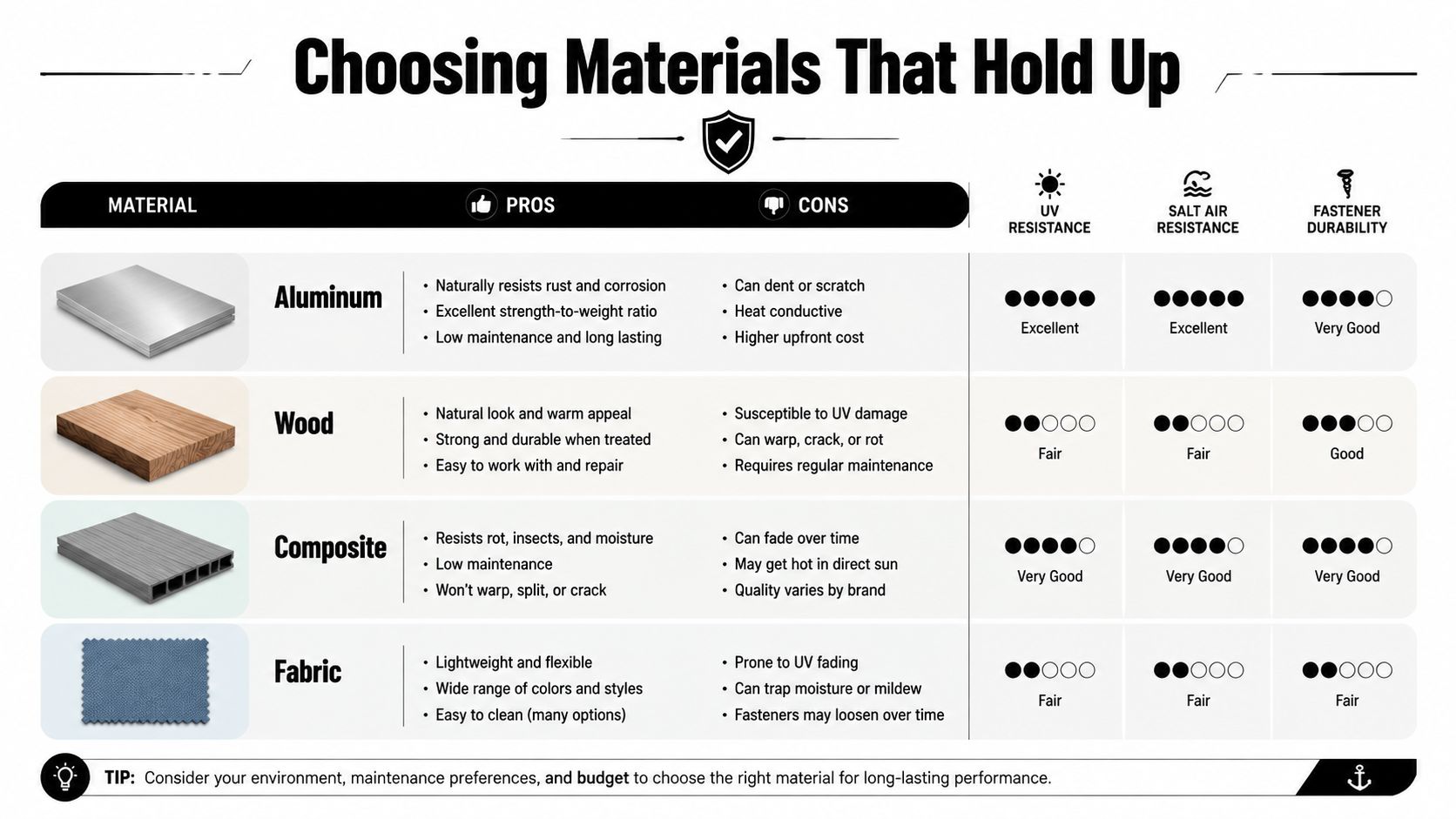
What I trust on the coast
Aluminum is my first choice for most covered porch builds in coastal Florida. It stays light, resists rot, and does not demand the repaint cycle that wood does. The catch is straightforward, aluminum only holds up when the fasteners and connectors are the right grade. Cheap hardware turns the whole assembly into a maintenance headache.
Wood still belongs in the conversation, especially for homeowners who want a more traditional look. It can work, but the upkeep is not optional in salt air. I have seen wood covers start strong, then slide downhill because nobody kept up with sealing, inspection, and small repairs before the weather got into the joints.
Composite can be a smart middle ground if the structure is designed to carry it. It resists rot better than wood, but heat and span limits punish underbuilt framing. That means the material choice has to be tied to the framing plan, not picked as a standalone finish.
Fabric is shade-only. It can be fine for an awning, but it is not a real structural back porch cover. In full Florida sun, it is the least durable option and the most likely to become a replacement cycle instead of a lasting improvement.
Best contractor habit: Spend money on the hidden structure before you spend money on the visible finish. Good framing, good flashing, and good fasteners outlast cosmetic upgrades every time.
If you need the practical filter, keep it simple. Choose aluminum for low maintenance and strong performance. Choose wood only if you accept ongoing upkeep. Choose composite when you want a balanced look and you are paying for proper support. Choose fabric only when you understand you are buying sun relief, not a real roof.
For homeowners who care about long-term exterior durability in coastal conditions, the same logic applies to salt exposure throughout the home, including salt service planning. Coastal materials fail when the hidden hardware is cheap.
Permits, Wind Loads and Lee County Code Reality
If you want a back porch cover to survive in Cape Coral or anywhere in Lee County, start with the permit path. Skip it, and you are gambling with your money, your insurance file, and the part of the project that has to hold up under hurricane-force winds. Local building departments care about drawings, wind loads, attachments, and the way the cover ties into the house because that structure has to be built for Southwest Florida, not just for a clean install photo.
What the building department wants to see
A permit set usually has to show the site plan and the foundation and framing plans, along with the documents that prove the structure is designed for the loads it will see. In plain terms, the office wants to know where the cover sits on the lot, how it connects, and whether the framing and foundation can handle the wind that pushes on it. That is the level of paperwork you should expect before anyone starts cutting material.
San Diego's residential patio cover guidance is a clean example of the kind of paperwork cities ask for. It calls for a site plan plus foundation and framing plans, and it says applicants must provide either the relevant bulletin or an ICC-ES/IAPMO evaluation report or an approved supplier plan for the patio foundation and framing design San Diego Development Services bulletin. That is not a Lee County rule, but it shows how detailed a real permit submittal can get.
Sacramento County is just as direct. Its patio cover submittal list requires drawings to be drawn to scale and fully dimensioned, the site plan must show the location of all other structures on the parcel, including swimming pools, and a stamped and signed structural plan is required when the design does not conform to conventional light-frame construction Sacramento County submittal list. Laguna Hills also requires a lot coverage calculation and wants the actual calculation work shown, not just the final percentage Laguna Hills residential patio cover guide.
What trips up homeowners in Southwest Florida
The mistakes are usually the same. Homeowners underestimate the permit work, tie into an existing roofline without a proper flashing strategy, and ignore lot coverage until the plans are already drawn. They also assume a screened enclosure gets treated the same way as a simple shade structure, which is how delays start and revisions pile up.
Lee County and Cape Coral do not care how good the cover looks on day one if the submittal does not show the structure can handle wind. The permit office wants the attachment detail, the framing layout, and the wind-load design documented before approval. If the cover changes the roofline or connects to the house, expect that detail to matter a lot.
Minnesota permit guidance makes one rule especially clear, any covered patio structure requires a building permit, while an uncovered ground-level patio under 30 inches above grade is generally exempt Minnesota permit guidance. The same guidance also says patio cover post footings must extend below the local frost line. That frost-line detail is climate-specific, but the point carries over. The structure has to be designed for the place where it stands, and in Southwest Florida that means salt-air exposure, wind loads, and a permit set that proves the cover belongs on the lot.
If you are hiring locally, pick a contractor who knows the Lee County process, knows the wind requirements, and knows how to document the attachment without guessing. If you want a quick pre-build checklist for upkeep and inspection, use a monthly maintenance guide before you assume the work is done. The permit fee is not the expensive part. The expensive part is rebuilding a cover that never should have been approved in the first place.
Maintenance That Actually Works in a Coastal Climate
A back porch cover in Southwest Florida doesn't fail all at once. It fails in small places first. Salt film sits on the surface, fasteners start to discolor, debris collects at the wall connection, and then the next storm turns a minor issue into a repair.
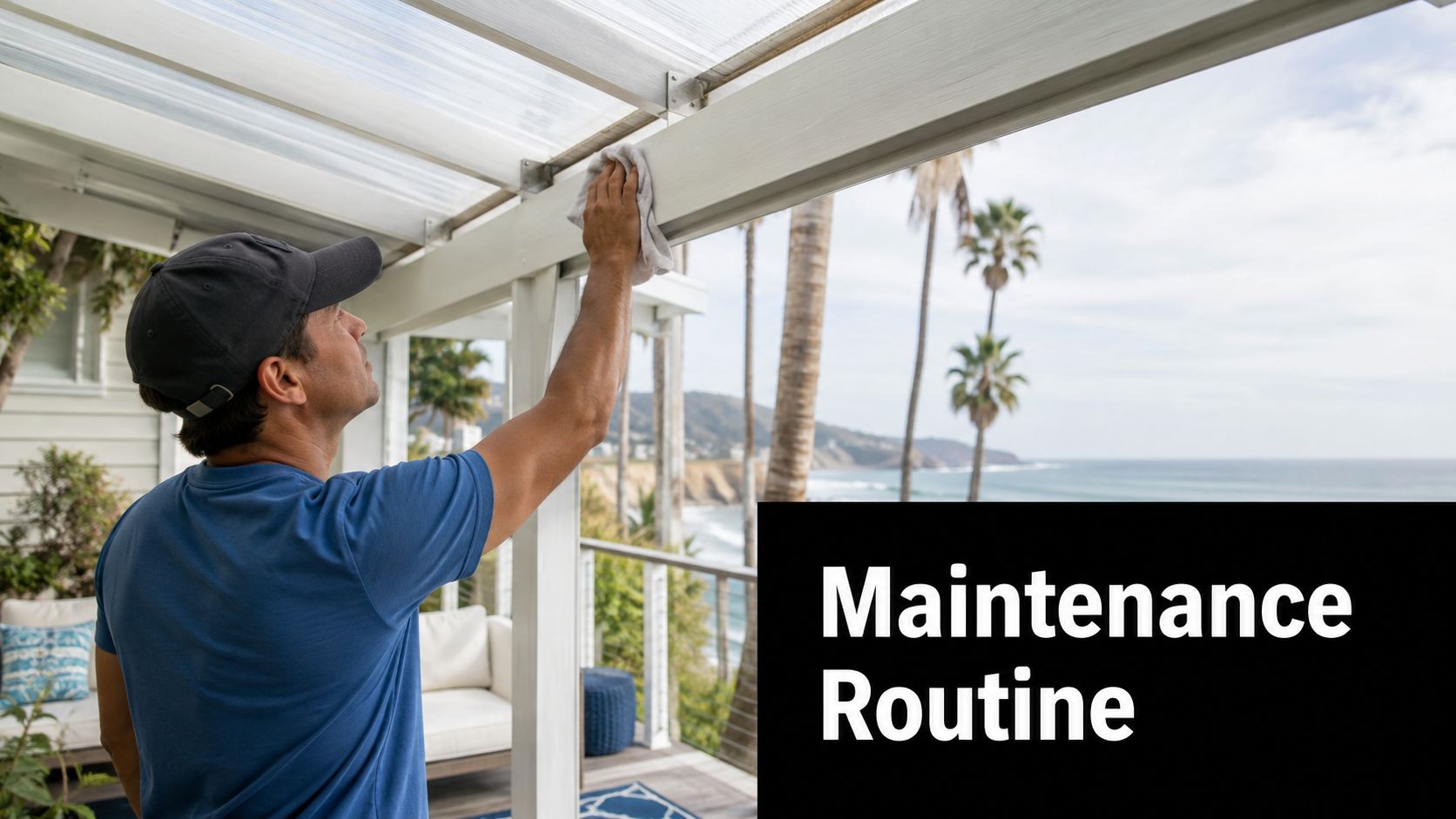
The routine I'd actually follow
- Monthly rinse: Wash salt off aluminum, trim, and hardware before it bakes on. A garden hose is enough for routine rinsing, and you want to do this before buildup starts to stain.
- Seasonal fastener check: Look for white corrosion around screws, brackets, and connector points. That white residue is a warning sign, not a cosmetic issue.
- After-storm inspection: Check the roof-to-wall seam, screen corners, and panel edges after strong wind or heavy rain. If debris is packed into the flashing line, clear it.
- Annual wood care: Re-seal wood components on a regular schedule if you chose wood. Skip this, and the material starts aging fast.
- Screen review: Inspect mesh for tears after a named storm, especially where the screen frame takes direct wind.
The detail that matters most is the seam where the new cover meets the house. That's the spot most likely to need attention over time, because water always finds the weakest break in the path. If you keep that area clean and intact, you avoid a lot of grief later.
Warning sign: Sagging panels, rust-streaked screws, and water staining on the inside wall are not “wait and see” issues. They're repair-now issues.
For broader exterior upkeep habits that fit a Southwest Florida property, the same disciplined approach shows up in monthly maintenance planning. The point is simple. Short, regular attention beats expensive catch-up work every time.
DIY Versus Hiring a Local Southwest Florida Contractor
I'm blunt on this one. A small freestanding kit on a flat concrete pad can be a reasonable DIY job for a capable homeowner. Attaching a cover to an existing roofline in a storm-prone coastal market is a different animal, and that's where most DIY projects go sideways.
Where DIY still makes sense
If the project is light, ground-level, and not tied into the house structure, DIY can save money. A basic freestanding cover with straightforward anchoring is the kind of job a detail-oriented homeowner can manage if they already understand layout, fasteners, and basic carpentry. Once the project starts touching roof framing, flashing, or wind load assumptions, the savings disappear.
That's also where resale value and inspection questions start to matter. A cleanly built, permitted structure reads as an improvement. A questionable attachment reads as a problem.
What to demand from a contractor
Before you hire anyone, ask for the basics in writing. Check license and insurance, ask for three recent Lee County references, confirm who pulls the permit, and ask for a written wind-load statement. If they dodge those questions, walk.
For anyone comparing remodel or exterior-service crews, it helps to work with a company that's comfortable handling full-service project support rather than just sending a salesman. You want a team that knows how to coordinate the job instead of improvising on your property.
Hire for the failure points, not the sales pitch. If a contractor can't explain flashing, fastening, and wind load in plain English, keep looking.
My advice is simple. DIY only the easy, freestanding, low-risk version. Anything attached, engineered, or tied to the house should go to a licensed local contractor who knows Southwest Florida code reality. The money you think you're saving on labor gets eaten fast by mistakes, delay, and rework.
Your Pre-Installation Checklist Before You Sign Anything
A contract starts long before the paperwork. In Cape Coral and Lee County, the first meeting should tell you whether the contractor understands wind loads, salt air, permits, and lot-coverage limits, or whether they are just selling a pretty roof line. If they evade straight questions, keep shopping.
Bring this to the first meeting
- Cost Bands: Ensure the quote fits the typical range for your scope, from lower-cost shade options to the $12,000 to $16,000 mid-size attached cover range and higher-end builds above $20,000.
- Material Cautions: Ask exactly what the hidden structure, fasteners, and flashing are made of. If the answer is vague, that is a warning sign.
- Permit Triggers: Confirm who pulls the permit, what drawings are included, and whether the design affects lot coverage or attachment details.
- Maintenance Plan: Get a written handoff for cleaning, inspection, and resealing intervals so you are not guessing later.
Also ask to see the flashing detail drawing. For an attached cover, that page matters because it shows how the cover ties into the house and how water is pushed away from the wall. If the builder will not show it, that tells you plenty.
Confirm the fastener spec too. In a salt-air market, the wrong screw choice can cut the life of the whole project short. Then lock down a payment schedule tied to inspection milestones, not just a big deposit and a promise.
The cheapest bid is rarely the best value in an HVHZ-style climate. A better-built cover gives you more usable days, less heat pounding the house, and a cleaner resale story when it is time to sell.
If you want a back porch cover that fits Southwest Florida conditions, talk to a team that understands coastal durability and practical maintenance, not just pretty drawings. Visit Water Medic of Cape Coral to see how their Cape Coral crew can help you plan the right exterior improvement with the same level of care they bring to the rest of your home.