What Causes That Well Water Smell and How Do You Fix It
That weird smell coming from your faucet isn't just a nuisance—it's your well's way of sending up a flare. It’s signaling that something in its natural chemistry is out of whack. A strange well water smell is a clear sign that you need professional help.
The good news? The cause is almost always something harmless, like naturally occurring minerals and bacteria. Sulfur is the most frequent offender, and with a proper diagnosis and the right treatment from Water Medic, it's a completely solvable problem. Our team specializes in diagnosing and eliminating these issues for good.
Why Your Well Water Smells and What It Means
Think of your private well as a direct tap into the groundwater flowing through Southwest Florida's unique geology. It’s a delicate underground ecosystem. When certain elements in that ecosystem—like specific types of bacteria or minerals—start to take over, you'll notice the effects at your sink.
Those smells, whether it's the classic rotten egg aroma or a musty, swamp-like odor, are more than just unpleasant. They're a sign that your water's balance has shifted. Left unaddressed, this can do more than just make you hold your nose; it can ruin the taste of your coffee, stain your laundry and fixtures, and sometimes, signal an environment where more serious contaminants could start to grow. Ignoring a well water smell can lead to costly damage down the line.
Common Causes of Well Water Odors
So, what's actually causing the funk? The problem usually traces back to one of a few common culprits that absolutely thrive in groundwater. Getting to know them is the first step toward getting rid of them with a professional water treatment solution.
- Hydrogen Sulfide Gas: This is the big one. If your water smells like rotten eggs, hydrogen sulfide is almost certainly why. The smell is produced by harmless sulfur-reducing bacteria that live in groundwater and feed on sulfates.
- Iron Bacteria: These are tiny microorganisms that, as the name suggests, feed on iron. They leave behind a slimy residue that can clog pipes and produce a range of smells, from musty or earthy to genuinely swamp-like.
- Decaying Organic Matter: Sometimes, the simplest answer is the right one. Leaves, soil, and other bits of nature can get into a well, and as they decompose, they release an earthy or even fishy odor.
Your well water is a direct reflection of the local environment. Here in Southwest Florida, our limestone aquifers and high mineral content create the perfect breeding ground for the bacteria that produce these distinct smells. That's why having a local expert who truly understands our water is so crucial.
The Southwest Florida Factor
It’s a familiar story here. You turn on the tap in your Southwest Florida home, and that unmistakable rotten egg stench hits you. That isn't just a local quirk—it's hydrogen sulfide (H2S) gas, a common issue in wells all over, but especially here where our groundwater flows through sulfur-rich soil and rock formations. You can discover more about the science behind well water smells and why testing is critical.
At Water Medic of Cape Coral, our 25+ years of local experience mean we've seen it all. We know the specific geology and environmental conditions that cause well water problems in our area. We don't just put a bandage on the symptom; we get to the root of the problem for a solution that lasts.
If you're done holding your nose every time you run the water, it's time to find out what's really going on down in your well. Contact us for a free water analysis to identify the source of your well water smell.
Decoding the Different Types of Well Water Odors
That odd scent coming from your tap is more than just a nuisance—it's a message straight from your well. If you can learn to identify the specific smell, you're one step closer to figuring out what's going on with your water's chemistry. Think of it as your well telling you exactly what’s wrong.
This simple infographic is a great place to start.
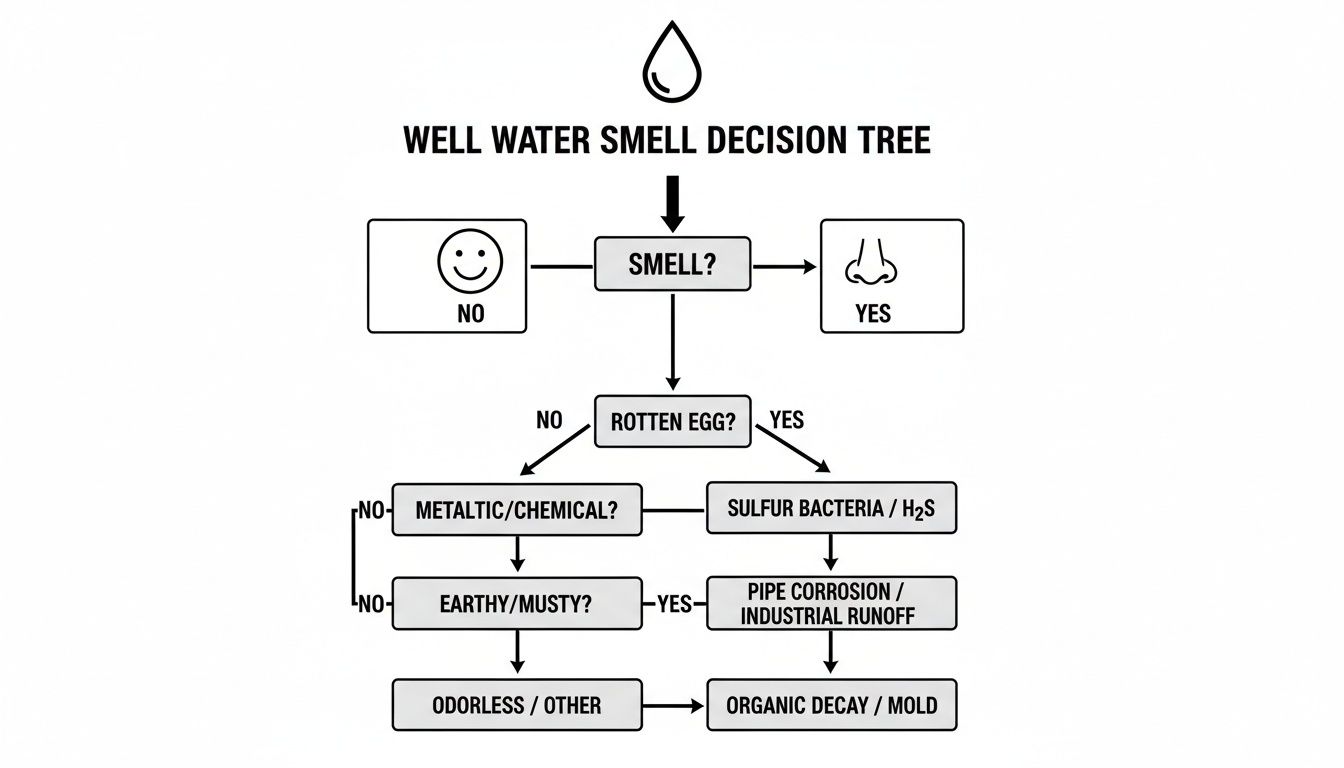
As you can see, once you've noticed a smell, the key is to pinpoint its character. That's what leads you to the cause. Our expert team can confirm the source and recommend the perfect solution.
The Unmistakable Rotten Egg Smell
If your water gives off a strong rotten egg or sewage odor, you're dealing with hydrogen sulfide (H2S) gas. This is, without a doubt, the most common complaint we hear from homeowners in Southwest Florida.
So, where does it come from? The gas is created by sulfur-reducing bacteria that love oxygen-poor environments like wells and groundwater. These tiny organisms feed on naturally occurring sulfates in the soil and, especially here in Florida, our limestone aquifers. As they chow down, they produce H2S gas as a byproduct.
While the levels in residential wells aren't typically dangerous, this gas can be corrosive to your plumbing and appliances over time. A professional check-up from Water Medic can tell you if an advanced Air Injection System is the right call to get rid of the gas and protect your home's pipes.
Earthy, Musty, or Swampy Odors
Does your water smell like a damp basement, fresh dirt, or even a swamp? These smells usually point to one of two related issues. The first common culprit is iron bacteria.
These organisms literally feed on the iron in your water, creating a gross, reddish-brown slime that clogs everything—pipes, fixtures, you name it. It's this slimy buildup that gives off that musty, earthy smell. The second cause is simply decaying organic stuff, like leaves or soil, that has managed to get into your well.
A musty odor is a clear indicator of biological activity in your well. Ignoring it allows the problem to grow, potentially leading to costly plumbing repairs and appliance failures down the road.
Getting an expert diagnosis is key here to make sure you're treating the right problem. Our well water filtration systems are designed to eliminate these biological contaminants.
A Sharp Metallic Scent
When your well water has a metallic smell or taste, the answer is usually straightforward: high concentrations of metals, typically iron or manganese. While these minerals don't pose a health risk, they are a major headache.
High iron is notorious for leaving those stubborn reddish-brown stains on sinks, toilets, and laundry. Manganese does the same, but leaves behind darker, blackish stains. Eventually, these minerals build up inside your pipes, which kills your water pressure and wreaks havoc on appliances. Our team can test for the specific mineral levels and pinpoint the right filtration system to get them out for good.
Critical Chemical or Fuel Odors
This is the one you absolutely cannot ignore. If your water smells anything like gasoline, turpentine, or other chemicals, you could be facing a serious contamination problem.
This could come from a leaking underground fuel tank, industrial runoff, or agricultural chemicals seeping into the groundwater. It’s rare, but it’s an urgent situation that puts your family's health at risk.
If you smell chemicals:
- Do not drink the water.
- Do not use it for bathing or cooking.
- Contact Water Medic immediately.
Our emergency response team can provide immediate testing to figure out what the contaminant is and guide you on the next steps. Your safety is our top priority, and a chemical smell demands professional attention right away.
Why Professional Water Testing Is a Must
Relying on a quick sniff test to figure out your well water smell is a bit like diagnosing a car problem just by the sound it makes. You might get lucky and guess right, but you could easily miss a much bigger issue lurking under the hood. When it comes to the water your family uses every day, taking a guess just isn’t a risk worth taking.
A professional water analysis from Water Medic is the only way to get the full story. It goes way beyond just identifying the source of an odor; it uncovers the invisible problems your nose simply can't detect. Think of it as a complete diagnostic check-up for your well, giving you the hard data needed to choose the right fix.
What a Professional Test Actually Looks For
That "rotten egg" smell is a dead giveaway for hydrogen sulfide, but it doesn't tell you everything. Our professional testing at Water Medic is designed to pinpoint not only the obvious culprits but also the hidden troublemakers that can cause long-term damage or even pose health risks.
Here’s a glimpse of what our analysis reveals:
- Precise Hydrogen Sulfide (H2S) Levels: We don't just say, "Yep, it's H2S." We measure the exact concentration, which is critical for choosing the most effective and efficient treatment system.
- Bacteria Types and Counts: Our tests can tell the difference between nuisance bacteria (like the kind that stains your fixtures) and more harmful contaminants, ensuring the solution fits the specific problem.
- Mineral Content: We screen for high levels of iron, manganese, and other minerals that are notorious for causing stubborn stains and slowly destroying your plumbing.
- Overall Water Chemistry: We also measure crucial factors like pH and total dissolved solids (TDS). These numbers impact everything from how your water tastes to how quickly it corrodes your pipes.
This detailed report is the blueprint for a real solution. Without it, you might invest in a system that only partially fixes the well water smell or, worse, completely misses a more serious, unseen issue.
The Problem with What You Can't Smell
Perhaps the biggest reason for professional testing is its ability to find contaminants that have no taste, color, or odor. Things like nitrates, arsenic, or lead can quietly find their way into groundwater without raising any red flags your senses would pick up on.
Peace of mind doesn’t come from masking an odor. It comes from knowing exactly what's in your water. A thorough test from our certified technicians ensures your water isn't just odor-free but genuinely safe for your family.
That awful rotten egg smell from your tap is more than just an annoyance—it's a clear signal. Hydrogen sulfide is a global issue, with groundwater concentrations often reaching 1-5 ppm in many areas. Here in the U.S., where private wells serve water to about 43 million people, H2S is a common complaint, especially in places like Southwest Florida where our unique geology contributes to the problem. The CDC has extensive findings on hydrogen sulfide that you can explore.
DIY Smell Test vs Professional Water Analysis
It's tempting to rely on your own senses, but a home smell test and a professional lab analysis are worlds apart. One gives you a hint, while the other gives you the complete picture.
Here’s a quick breakdown of the difference:
| Feature | DIY Smell Test | Water Medic Professional Test |
|---|---|---|
| Scope | Identifies obvious odors like sulfur or chlorine. | Detects a wide range of contaminants, including odorless ones like lead, nitrates, and arsenic. |
| Accuracy | Subjective and varies from person to person. Can't measure concentrations. | Provides precise, quantitative data (e.g., H2S at 3.2 ppm, iron at 1.5 ppm). |
| Diagnosis | A simple guess. "Smells like rotten eggs." | A definitive diagnosis of the root causes and their severity. |
| Outcome | Leads to trial-and-error solutions that may or may not work. | Enables a targeted, effective treatment plan guaranteed to solve the problem. |
While a DIY test can confirm that something is wrong, only a professional analysis can tell you exactly what it is, how bad it is, and how to fix it for good.
For any homeowner in Southwest Florida with a private well, getting your water tested professionally isn't an expense—it's an essential investment in your family's health and your home's value. Getting an accurate diagnosis from Water Medic of Cape Coral is the first step toward a permanent solution and the clean, safe water you deserve.
Choosing the Right Well Water Treatment System
Once your water test results are in and you know exactly what’s causing that funky smell, it's time to move from diagnosis to a permanent fix. Picking the right treatment system isn’t about grabbing a generic filter off the shelf. It’s about installing a solution specifically designed to tackle your unique water problem. Here at Water Medic, that’s what we do—we implement long-term fixes to make sure the water in your home is clean, clear, and odor-free for good.
This isn't just a Cape Coral problem, either. Millions of people around the world deal with similar issues. The WHO reported in 2022 that 296 million people get their water from unprotected wells, which are prime real estate for the kind of bacteria that create nasty odors. And our noses are incredibly sensitive to some of these compounds. Take geosmin, for instance—it can be detected at levels as low as 0.006 micrograms per liter, which explains why even a tiny issue can create a huge earthy or musty smell. To get rid of these stubborn odors, you'll need to look at various home water treatment solutions that match your water's specific chemistry.
Targeting the Rotten Egg Smell with Aeration
If that rotten egg aroma is coming from hydrogen sulfide (H2S) gas in your water, the game plan is simple: get the gas out before it ever hits your tap. The best way to do this is through oxidation, a process that changes the dissolved H2S into harmless particles that are easy to filter away.
Our go-to solution is an Aeration or Air Injection System. You can think of it as letting your water breathe. The system forces a bubble of air into a dedicated tank, which allows the trapped hydrogen sulfide gas to escape from the water. The gas is then safely vented out, neutralizing the odor at its source. For really tough H2S problems, a Chemical Feed System can use a tiny, controlled dose of chlorine to oxidize the gas, offering another powerful line of defense. You can learn more about how our Air Injection Systems work to get rid of sulfur smells once and for all right here: https://watermedic.com/air-injection/
Removing Metallic Smells and Stains
Is your water smelling a bit like old pennies? Seeing reddish-brown or black stains on your fixtures? That’s the classic calling card of high iron or manganese levels. These minerals are famous for ruining laundry, staining sinks, and slowly clogging your pipes, which eventually kills your water pressure.
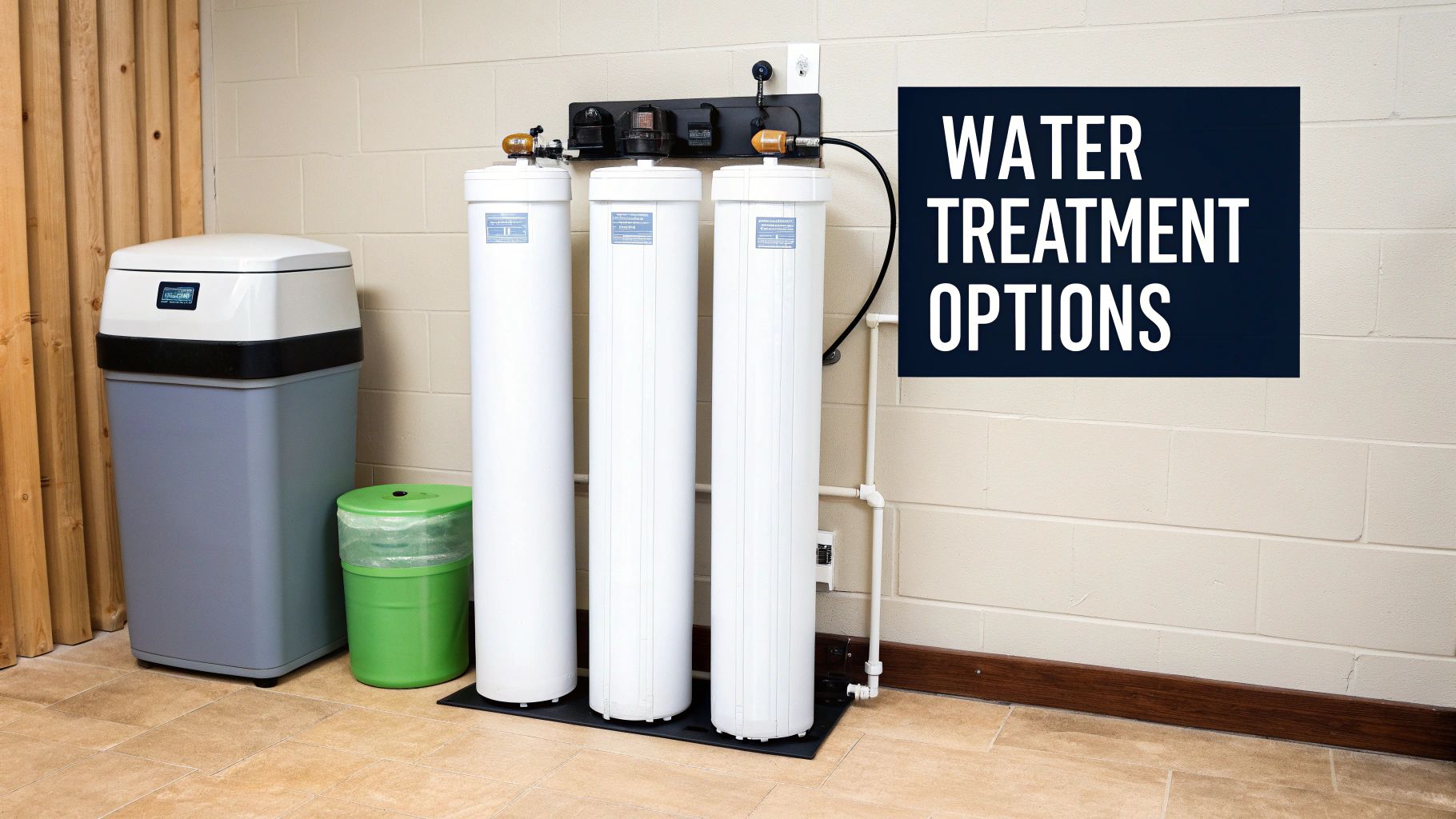
A basic water softener might handle very low levels of iron, but for the concentrations we see in Southwest Florida wells, you need something more robust. A dedicated Iron Filter is almost always the answer. These systems contain special media that acts like a magnet for iron and manganese, grabbing and trapping the particles to physically pull them out of your water. When you pair an iron filter with a custom water softener, you get water that not only smells clean but also feels soft on your skin and protects your appliances from damaging mineral scale. Our team can help you select the ideal water softener system for your home.
Installing the right system isn't just about eliminating a bad smell. It's about protecting your entire home's plumbing infrastructure, from your pipes and water heater to your dishwasher and washing machine.
Eliminating Bacteria with Chlorination
For those musty, earthy, or swampy smells that point to iron bacteria or other tiny organisms, you need to treat the biological growth itself. A one-time "shock chlorination" might clear things up for a little while, but a continuous Chlorination System is the permanent solution.
This setup injects a very small, precisely controlled amount of chlorine into your water as it enters the house, killing bacteria and stopping slime and odors from forming in the first place. A carbon filter installed after it then removes any leftover chlorine taste or smell. The result? Water that's both biologically safe and tastes great—it’s the same reliable technology that municipal water suppliers have trusted for decades.
The Ultimate Solution: Whole House Reverse Osmosis
For homeowners who simply want the best water quality possible, a Whole House Reverse Osmosis (RO) System is the top-of-the-line answer. This isn't just about targeting one specific smell; it's about purifying every single drop of water that comes into your home.
An RO system uses a special membrane to push water through at the molecular level, removing up to 99% of all dissolved solids. This includes the minerals that bacteria feed on, heavy metals, salts, and just about every other contaminant you can think of. It effectively knocks out every potential cause of a well water smell before it can even get started. This technology delivers true bottled-water quality from every faucet, showerhead, and spigot, giving you complete peace of mind. We offer professional Reverse Osmosis system installations to provide your family with the purest water possible.
Stay Ahead of Smells with Proactive Well Maintenance
Getting rid of that nasty well water smell is a huge relief, but the real win is making sure it never comes back. The secret to consistently clean, fresh-smelling water isn't a one-time fix; it’s all about proactive maintenance. It’s a lot like taking care of your car—if you skip the regular oil changes, you’re eventually going to face a much bigger, more expensive problem down the line.
Keeping your well system in good shape does more than just stop bad odors. It’s about safeguarding your entire home's water infrastructure, from the well pump itself to every pipe and appliance that depends on clean water. This kind of preventative care is truly the bedrock of a healthy, reliable water supply you don't have to worry about.
Your Annual Well System Checkup
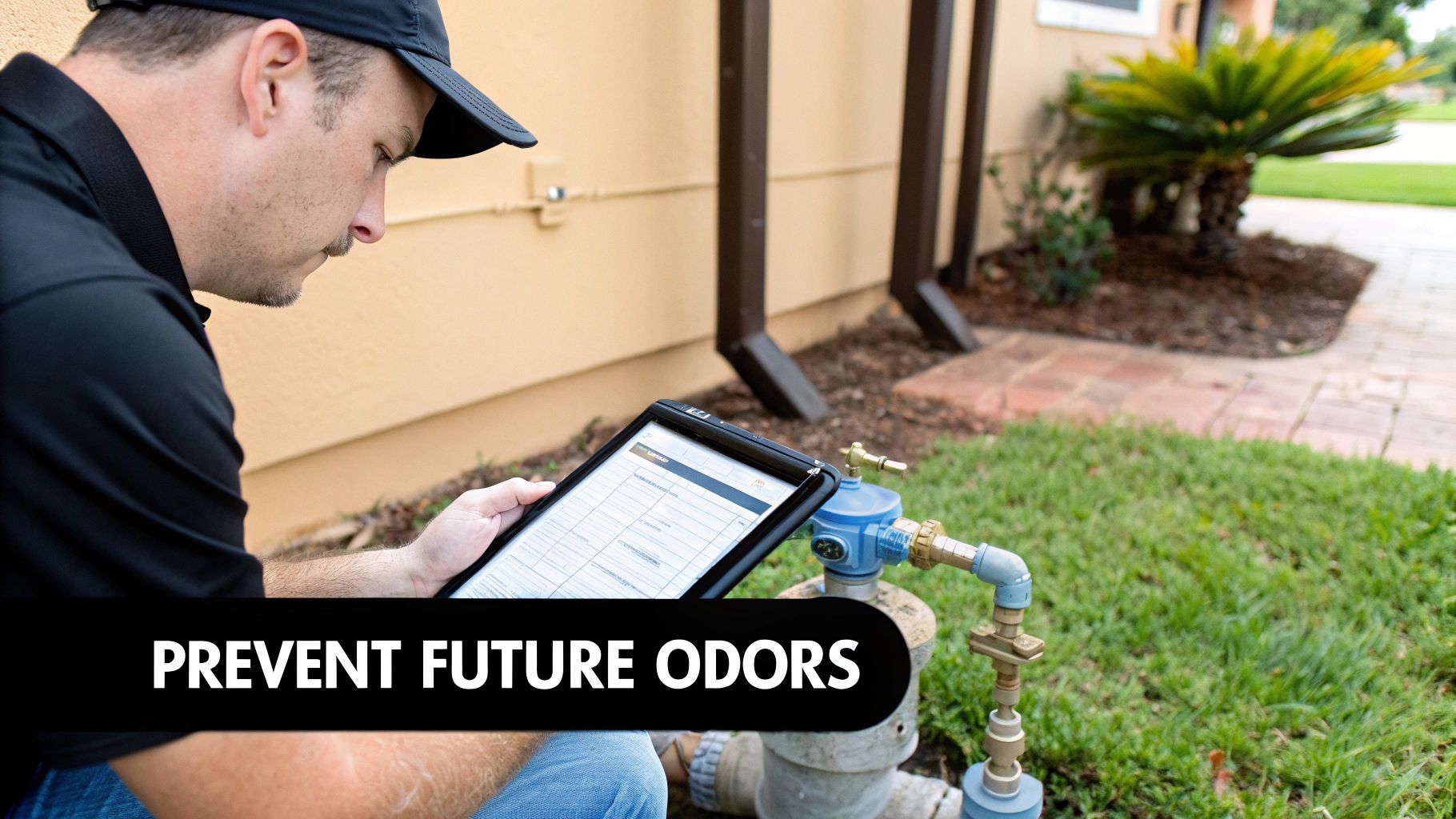
Especially here in Southwest Florida, scheduling an annual maintenance visit is the smartest move a well owner can make. Our local geology and warm climate can be a breeding ground for odor-causing bacteria if a well isn't regularly looked after. A yearly inspection from Water Medic lets us spot and fix tiny issues before they spiral into major headaches.
Our maintenance plan is built to keep your system running like a well-oiled machine. This isn’t just a quick glance; we conduct a thorough, bumper-to-bumper inspection of your well's overall health and performance.
A proactive service plan is one of the smartest investments a well owner can make. It protects your well pump, extends the life of your appliances, and guarantees consistent, high-quality water for your family year-round.
Key Maintenance Tasks for Odor Prevention
So, what exactly happens during one of these preventative maintenance visits? We zero in on the exact components and conditions that typically cause well water smells, making sure every part of your system is clean and working as it should.
Here’s a quick look at what our technicians focus on:
- Well Cap and Casing Inspection: We start at the source, making sure the well cap has a perfect seal and the casing is free of any cracks. This is your number one defense against surface contaminants like decaying leaves or runoff that lead to those musty, earthy smells.
- Pressure Tank and Switch Check: Next, we check your pressure tank to ensure it’s functioning properly. A tank that isn't working right can mess with water flow, creating dead spots where sediment and bacteria can build up.
- Preventative Shock Chlorination: For wells that are just naturally prone to bacterial growth, a scheduled "shock" chlorination can wipe out any new colonies of iron or sulfur bacteria before they ever get a chance to produce that rotten egg smell.
- Water Quality Screening: We also run a quick on-site water test to see if there have been any changes in mineral levels or pH that might point to a developing problem.
These straightforward steps are incredibly effective because they break the cycle of bacterial growth and mineral buildup that cause most odor issues. By staying ahead of problems, you avoid the hassle and cost of an emergency call. Regular maintenance and timely repairs are crucial for the health of your system. To see how we tackle both urgent problems and long-term care, you can explore our expert well water repair services.
A consistent maintenance schedule is your best defense against the return of that unpleasant well water smell, ensuring your water is fresh, clean, and ready to use, every single day.
Your Questions About Well Water Smells, Answered
Let's cut to the chase. You have questions about why your well water stinks, and you need clear, straightforward answers. We've heard them all, and we're here to help you figure out what to do next.
Is the Rotten Egg Smell in My Well Water Dangerous?
This is usually the first question on everyone's mind. The hydrogen sulfide gas causing that awful smell isn't typically toxic at the low levels found in well water, but that doesn't mean you should ignore it.
The real troublemakers are often the sulfur-reducing bacteria that produce the gas. These bacteria create a nasty slime that can corrode and clog your plumbing. More importantly, if these bacteria are thriving, it’s a sign that other, more harmful types could be in there too. The only way to know for sure what's in your water is with a professional test from Water Medic.
How Much Will It Cost to Fix My Smelly Well Water?
There’s no one-size-fits-all price tag, because the cost depends entirely on what’s causing the odor in the first place.
If it's a simple, isolated bacterial problem, a one-time shock chlorination service might be all you need. But for something more persistent, like high levels of hydrogen sulfide coming straight from the aquifer, you’ll probably need a dedicated filtration system to solve it for good. We offer a free water analysis to pinpoint the exact problem and give you a clear, no-obligation quote.
A lot of people think a simple pitcher filter will do the trick. While it might make a single glass of water taste a little better, it does absolutely nothing to fix the core problem festering in your well, pipes, and hot water heater.
How Quickly Can You Fix My Smelly Water?
Our goal is to get you back to clean, fresh water as fast as possible. It starts with a quick phone call to schedule a home visit for a complete water test.
Once we have the results—often on the same day—we can usually diagnose the issue and lay out your options right then and there. If a new system is needed, installation is typically done in a single day. The quickest way to get relief is to give us a call. For more information, you can find answers to other well water questions on our FAQ page.
Don't put up with a well water smell any longer. The expert team at Water Medic of Cape Coral is ready to deliver a permanent fix. Contact us today for your free water analysis and take the first step toward clean, safe, and great-smelling water. Visit us online at https://watermedic.com to schedule your appointment.