A Practical Guide to Cleaning Above Ground Pools
Before you can even think about chemicals, getting your pool physically clean is job number one. This all starts with having the right tools on hand. For those of us in Southwest Florida, this isn't just about a simple net and brush; it's about being prepared for everything from daily pollen dustings to post-storm leaf invasions. At Water Medic of Cape Coral, we know that the right equipment is the foundation of an effective pool cleaning service.
Think of it this way: having the right gear makes the difference between a quick, satisfying clean-up and a frustrating, all-day chore.
Gathering Your Essential Pool Cleaning Gear
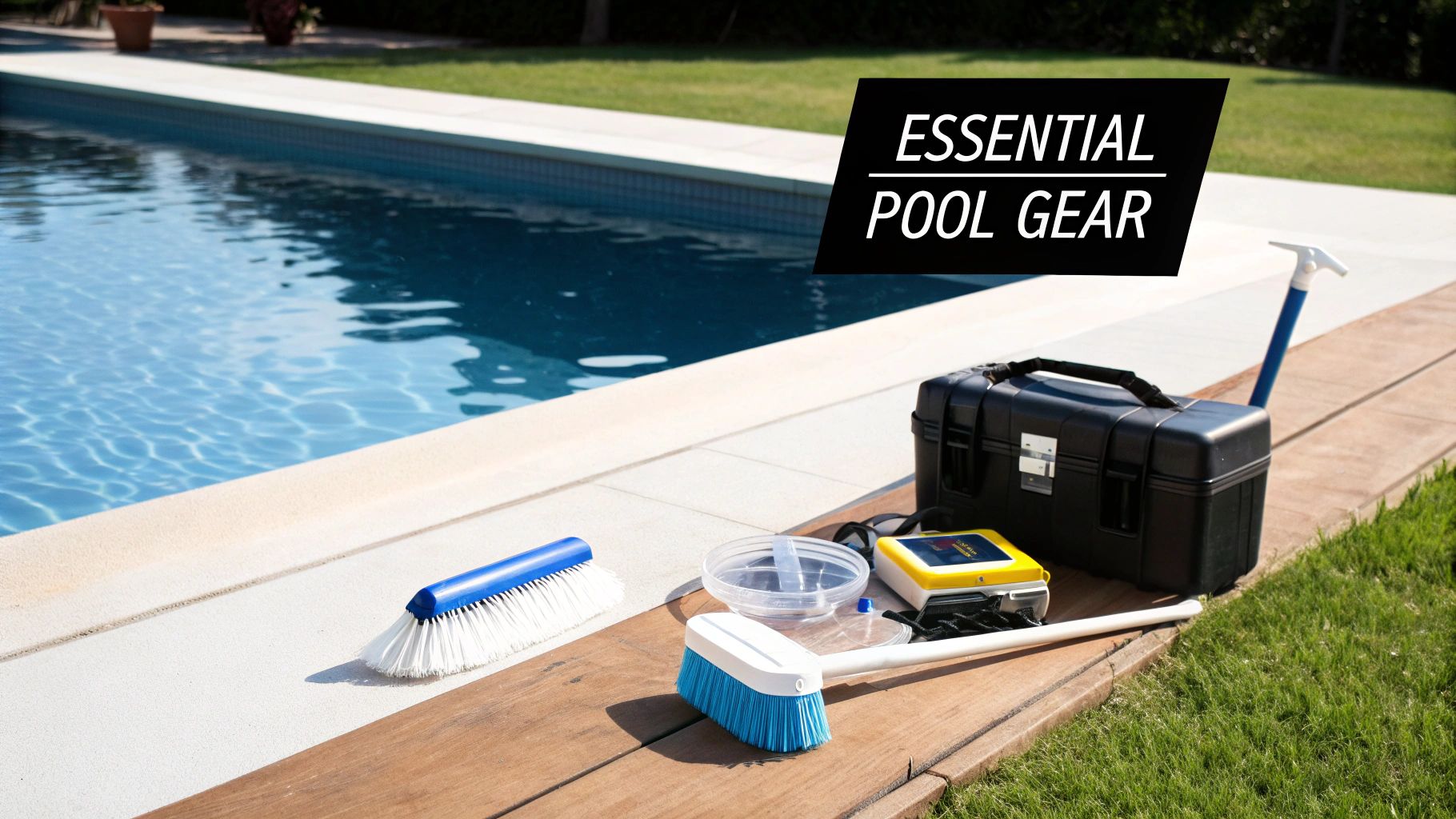
Keeping an above-ground pool pristine in our part of the world is a unique challenge. The intense sun, afternoon downpours, and constant barrage of pollen mean your cleaning arsenal needs to be up to the task.
Each tool in your kit has a specific job. Your skimmer tackles the surface, the brush handles the walls, and the vacuum takes care of the floor. Investing in quality equipment from the start not only makes your life easier but also helps protect your pool's vinyl liner and keeps your pump and filter running smoothly for years to come. Our technicians use only the best professional-grade equipment to ensure a perfect clean every time.
The Non-Negotiable Cleaning Tools
These are the essentials, the tools you'll be using almost every time you service your pool.
- Telescopic Pole: This is your multi-tool. It’s the handle for your skimmer, brush, and vacuum head, letting you reach every inch of your pool without breaking a sweat.
- Fine-Mesh Skimmer Net: Don’t just grab any net. A fine-mesh one is critical for snagging not just leaves and bugs, but also that fine yellow pollen that blankets everything in Florida. Get the gunk out before it sinks and turns into sludge.
- Vinyl-Liner-Safe Wall Brush: This is a big one. You need a brush with soft bristles designed specifically for vinyl. It's tough enough to scrub away biofilm and algae spores but gentle enough that it won't scratch or tear your liner.
A huge mistake I see all the time is people using a standard, stiff-bristled brush meant for a concrete gunite pool. That will absolutely chew up a vinyl liner, leading to leaks and a very expensive replacement. Always double-check that your brush is marked "vinyl-safe."
Choosing Your Pool Vacuum
After you've brushed the walls and liner, all that loosened debris settles on the bottom. Now you need to get it out. You’ve basically got two paths to go down here.
First is the manual vacuum. This involves a vacuum head that clicks onto your telescopic pole and a hose that connects to your pool's skimmer line, using your filter system for suction. It gives you fantastic control for getting into tight corners and spot-cleaning specific areas.
The other option is an automatic or robotic pool cleaner. These little guys roam the pool floor on their own, doing the work for you. It’s a bigger investment upfront, but the time it saves is a game-changer for many pool owners.
Of course, the ultimate hands-off approach is letting a pro handle it. Our weekly pool maintenance service takes care of all the skimming, brushing, and vacuuming, so you can just come home to a perfectly clean pool.
Your Weekly Routine for a Flawless Pool
Keeping an above-ground pool pristine in Southwest Florida really comes down to one thing: consistency. A simple weekly cleaning routine is your best defense against the constant barrage of sun, rain, and pollen. It’s what stops a few floating leaves from morphing into a cloudy, algae-filled mess that nobody wants to swim in.
Think of it as a three-part playbook: skimming, brushing, and vacuuming. Each step builds on the last, and skipping one can easily undo all your hard work. In our warm, humid climate, algae can take hold in what feels like the blink of an eye, so staying on top of these tasks is non-negotiable.
Skimming The Surface
Your first line of attack is always skimming. Grab your fine-mesh net and gently glide it across the top of the water to scoop up leaves, bugs, grass clippings, and anything else floating around. I tell homeowners to try and do this every day if possible, but at a minimum, every other day.
Why so often? Because that stuff doesn't float forever. Once it gets waterlogged and sinks, it starts to break down. Decomposing leaves release tannins that can stain your liner and phosphates that are basically a five-star meal for algae. A few minutes of skimming saves you a massive chemical headache later.
Brushing Walls And Floors
Once the surface is clear, it's time to brush. With a brush made specifically for vinyl liners, give the walls and floor a good scrub. You'll want to pay extra close attention to the spots where water circulation is a bit weak—think behind the ladder, around the steps, and in any corners.
This isn't just about what you can see. Brushing dislodges the invisible stuff, like early-stage algae and biofilm that love to cling to the liner. By knocking them loose, you send them floating into the water where your filter can grab them and your chlorine can zap them. When establishing your weekly pool routine, it's essential to not only remove visible debris but also to grasp the fundamental differences in maintaining water purity by delving into understanding the distinction between cleaning and sanitizing.
The Art of Vacuuming
Now for the final step: vacuuming up all that debris you just brushed to the pool floor. Whether you're using a manual vacuum head or an automatic cleaner, the key is to move slowly and methodically. If you go too fast, you’ll just stir everything up, defeating the whole purpose.
This is what gives you that crystal-clear water and makes the pool truly feel clean. If you're looking to save time, the technology here has come a long way. The global automatic pool cleaner market was valued at USD 2.54 billion in 2025 and is projected to hit USD 5.65 billion by 2033. It's no surprise robotic cleaners are becoming so popular—they're incredibly efficient.
To help you stay on track, here's a simple checklist that breaks down the core tasks.
Weekly Above Ground Pool Cleaning Checklist
| Task | Frequency | Why It's Important in SWFL |
|---|---|---|
| Skim Surface | Daily, or at least 3-4 times a week | Prevents organic debris from sinking and feeding algae. |
| Brush Walls & Floor | 1-2 times a week | Dislodges invisible algae spores and biofilm from the liner. |
| Vacuum Pool Floor | At least once a week | Removes settled dirt and debris for ultimate water clarity. |
| Check Pump & Filter | At least once a week | Ensures proper water circulation and filtration is happening. |
| Test Water Chemistry | 2-3 times a week | Catches chemical imbalances before they lead to bigger problems. |
Following this checklist will make your routine second nature and keep your pool in fantastic shape all year round.
A consistent weekly routine is the single most effective way to keep your pool sparkling. But we understand life gets busy. If you'd rather spend your weekends enjoying the water than working on it, our professional monthly maintenance services offer the perfect solution. We handle the hard work so you don't have to.
Balancing Water Chemistry Like a Pro
Getting the leaves and bugs out is one thing, but the real secret to a crystal-clear pool lies in the water chemistry. This is the invisible part of pool care, and frankly, it's where most people get tripped up. Especially here in Southwest Florida, the intense sun and sudden rainstorms can throw your water's balance into a tailspin.
Think of it this way: your pool water is its own little ecosystem. If one chemical level is off, it starts a chain reaction. For example, if your pH is out of whack, your chlorine basically stops working, no matter how many tablets you toss in. This is why a "set it and forget it" approach usually ends in cloudy, green water and a lot of frustration.
The Core Four of Pool Chemistry
To get that perfect sparkle, you really only need to focus on four main things. Get these right, and you’ve won most of the battle.
- Chlorine: This is your sanitizer, the workhorse that kills bacteria, algae, and all the other gunk you don't want in your water. You're aiming for a level of 1-3 parts per million (ppm).
- pH: This simply measures how acidic or alkaline your water is. Keeping it in the sweet spot of 7.4 to 7.6 not only makes it comfortable for swimmers but also maximizes your chlorine's effectiveness.
- Total Alkalinity: Think of this as the anchor for your pH. It prevents the pH level from bouncing all over the place. The ideal range is 80-120 ppm.
- Cyanuric Acid (CYA): This is basically sunscreen for your chlorine. Without it, our brutal Florida sun would burn off your chlorine in a matter of hours. Keep it between 30-50 ppm.
Here’s a classic Southwest Florida scenario I see all the time: a massive afternoon thunderstorm rolls through. That downpour of rainwater can seriously dilute your pool's chemicals, causing your chlorine, pH, and alkalinity to plummet. If you don't test and rebalance the water soon after, you’ve just rolled out the welcome mat for an algae bloom.
This quick visual guide shows how your physical cleaning routine directly supports all the chemical balancing work you're doing.
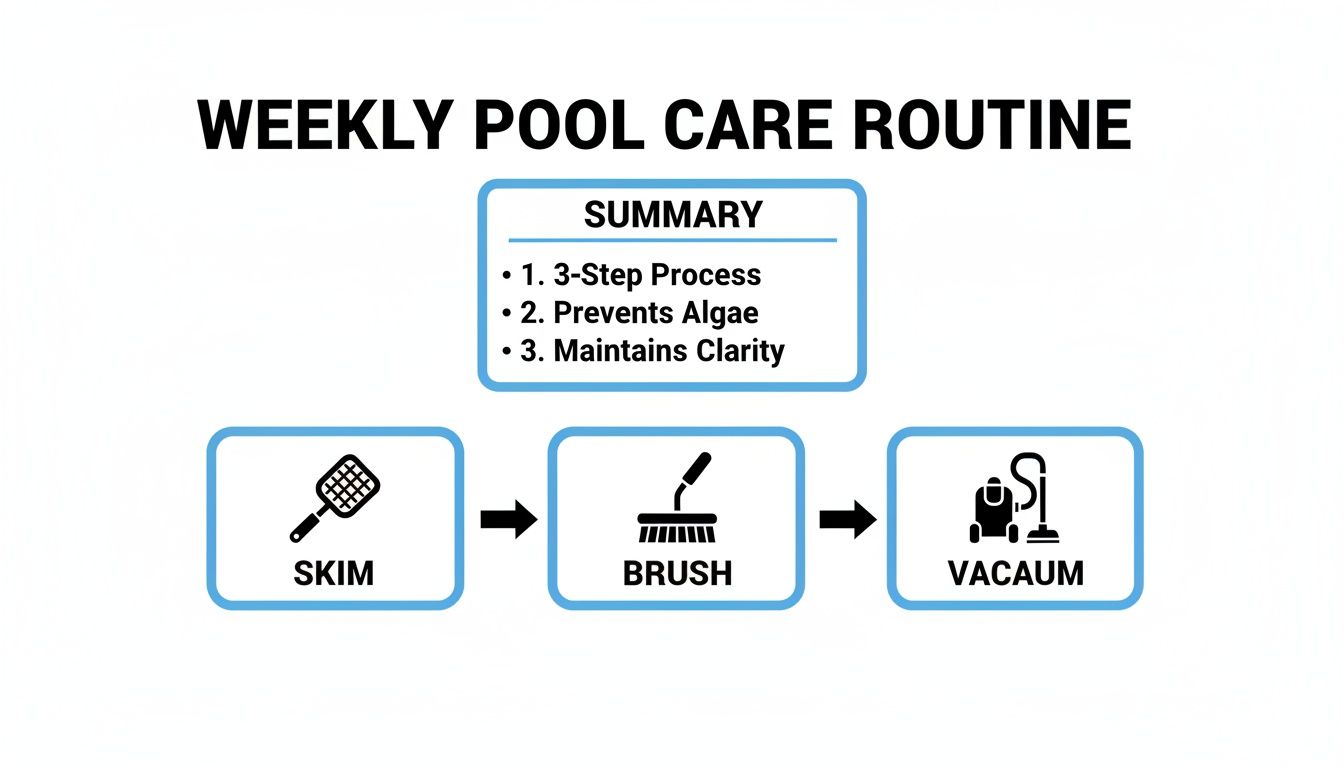
Skimming, brushing, and vacuuming are non-negotiable. They remove the organic debris that would otherwise eat up your chlorine and throw your whole chemical balance off.
Testing and Adjusting Your Water
You can't manage what you don't measure. Get yourself a quality liquid test kit or some reliable test strips and plan on testing at least two or three times a week—and always after a heavy rain or a big pool party.
When you adjust, go slow. Add one chemical at a time, let the pump run for a few hours to circulate it, and then test again before adding anything else. It takes a little patience, but it prevents overcorrecting.
It's no surprise that so many homeowners are learning this on the fly. The global market for above-ground pools was recently valued at around USD 3.26 billion and is growing fast, with North America leading the way. More and more families are investing in their backyards, and you can explore more data on this market growth to see just how big the trend is.
Trying to juggle all these chemicals can feel like a part-time job. While these tips will absolutely help with day-to-day maintenance, getting that perfect, stable balance is where a pro can make a world of difference. At Water Medic of Cape Coral, our technicians use professional-grade equipment and expertise in pool chemical balancing to take all the guesswork out of it. We make sure your pool is not just clean, but perfectly balanced and safe, so all you have to do is enjoy it.
Keeping Your Pool's Filter and Pump System in Fighting Shape
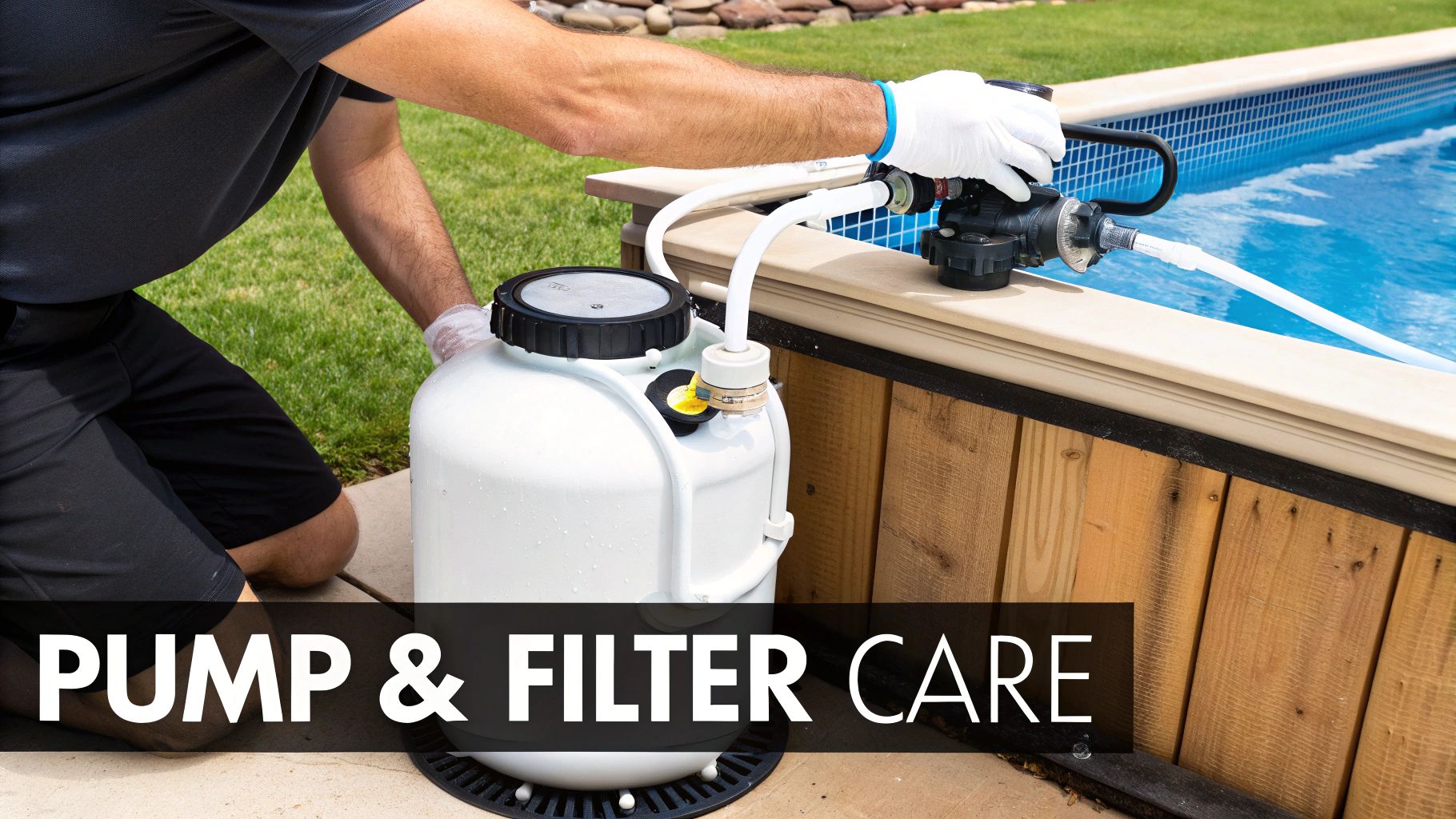
Think of your pool as the main attraction, but the filter and pump system are the heart and lungs working tirelessly backstage. This equipment is what keeps the water moving, catches all the gunk, and makes sure your chemicals are actually circulating to do their job. If you let the system go, even the most diligent cleaning and chemical balancing won't save you.
Taking care of your pump and filter is non-negotiable for keeping your pool clean. It's your first line of defense against cloudy water and algae. A healthy system also runs more efficiently, which means lower electricity bills and a longer lifespan for your equipment. A little maintenance here saves you from big, expensive headaches later on.
Get to Know Your Filter's Pressure Gauge
Your filter's pressure gauge is the single best indicator of its health. The first thing you should do after installing a new, clean filter is to run the system and write down the pressure reading. This is your "clean" baseline, usually somewhere in the 10-15 PSI range.
As the filter does its job trapping dirt, pollen, and other debris, that pressure will start to climb. The rule of thumb I always tell homeowners is to clean the filter once the gauge reads 8-10 PSI higher than your clean baseline. So, if your starting pressure was 12 PSI, it's time for a cleaning when you see it hitting 20-22 PSI.
Letting that pressure creep up too high puts a ton of unnecessary strain on the whole system—from the pump motor right down to the hoses and fittings. It's one of the most common—and completely preventable—reasons for early equipment failure.
How to Clean Cartridge and Sand Filters
Most above-ground pools in Florida use either a cartridge or a sand filter. The cleaning process is a bit different for each.
- Cartridge Filters: These are the most straightforward. Just turn off the pump, release the pressure in the tank, and pull the cartridge out. Give it a good, thorough rinse with a garden hose. The trick is to get the spray deep between each of the pleats to knock out all the trapped gunk. If you've got a buildup of sunscreen or body oils, you might need to use a dedicated filter cleaner soak every few months to really deep-clean it.
- Sand Filters: With a sand filter, you'll be doing a backwash. This process cleverly reverses the water flow, flushing all that trapped debris out through a waste line. It’s a fast job, typically just a few minutes, but it’s absolutely essential for keeping your water flowing properly.
Simple Pump Maintenance
Your pool pump is the workhorse of the entire operation. Keeping it happy is surprisingly simple but so important. Your main job is to regularly clean out the pump's strainer basket. This little basket is a lifesaver, catching bigger debris like leaves and twigs before they can get into the pump and clog up the impeller.
Now, if you hear weird grinding noises, spot a leak, or the pump just refuses to turn on, don't try to be a hero. That's your cue to call in a professional. Tinkering with complex pump issues often makes things worse. Our technicians are pros at diagnosing these problems fast, and you can learn more about our pool equipment repair services to get your system back in perfect working order.
When to Partner with Pool Care Professionals
Look, keeping up with weekly cleaning and chemical checks is doable for most homeowners. But let's be honest—there are times when DIY just isn't going to cut it, especially here in Southwest Florida.
Your above-ground pool should be a backyard oasis, not another chore on your weekend to-do list. Knowing when to wave the white flag and call for backup is the secret to preventing a small headache from turning into a costly nightmare. Sometimes, you just need a professional touch and the commercial-grade gear to match.
Signs It's Time to Call an Expert
Some pool problems are more than just a nuisance; they're symptoms of a bigger issue brewing beneath the surface. If you see any of these red flags, it’s probably time to bring in a pro like Water Medic of Cape Coral.
- Stubborn Cloudy Water: You’ve balanced the chemicals and cleaned the filter, but the water still looks like diluted milk. When your pool stays stubbornly hazy, it often points to a deeper problem—microscopic particles your filter can’t trap or an algae bloom just waiting to explode.
- Persistent Algae Blooms: You shock the pool, you scrub the liner, and a few days later, that nasty green, yellow, or even black stuff is back. This is a classic sign that algae has found a home in places you can’t reach, like deep inside your filter or plumbing lines. It needs a professional knockout punch to be gone for good.
- Equipment Failures: Is your pump making a weird grinding noise? Is the filter leaking water? Or has the water circulation just stopped altogether? Don't start taking things apart. Trying to fix complex pool equipment without the right experience can cause more damage and can even be dangerous.
For any cleaning job that feels out of your league, whether it's your pool or another part of your home, it's smart to get an expert opinion. This article has some great advice on knowing when to call a professional cleaning company, and the same logic applies here.
The Ultimate Solution for Busy Homeowners
Beyond just fixing problems, maybe you just want to enjoy a perfect pool without all the weekly work. I get it. This is where a professional maintenance plan is a game-changer.
With over 25 years of experience, our team at Water Medic takes care of everything for you. We handle the chemical balancing, the skimming and vacuuming, and the equipment checks. We give you total peace of mind and a guarantee that your pool is pristine and ready for a swim whenever you are.
More and more homeowners are choosing to go this route. The global pool cleaning market was recently valued at a whopping USD 25.52 billion and is projected to hit USD 45.49 billion by 2032. That’s because people want quality and reliability. You can read the full analysis on this market trend if you're curious.
Let us give you back your weekends.
Common Questions About Cleaning Above Ground Pools
Even the most diligent pool owners run into questions. It’s just part of the deal. Here at Water Medic of Cape Coral, we’ve pretty much heard it all, so we’ve put together a few answers to the most common questions we get from homeowners right here in Southwest Florida.
How Often Should I Clean My Pool in Florida?
This is, without a doubt, the number one question people ask. The simple answer? More often than you think, especially here. Our intense sun and pop-up rainstorms are a recipe for pool problems.
For a sparkling clean and safe pool, this is the schedule we live by:
- Skim the surface daily. Seriously. Getting leaves, pollen, and bugs out before they sink makes a huge difference. Decaying debris eats up your chlorine and is basically food for algae.
- Brush and vacuum at least once a week. This is non-negotiable for knocking biofilm off the walls and getting fine dirt off the bottom that skimmers miss.
- Test your water 2-3 times per week. A heavy downpour or a few scorching hot days can throw your chemistry completely out of whack in a surprisingly short time.
Keeping up with that can feel like a part-time job. It’s exactly why so many of your neighbors trust us to handle their weekly service—they get a perfect pool without ever touching a test strip.
What Is the Best Way to Fix Cloudy Water?
Milky, hazy water is a real headache. It usually boils down to one of three things: your chemical balance is off, your filter isn't doing its job, or you have tiny particles floating around.
Always start with a water test. Check your pH and chlorine first and get them back in range. If that doesn't clear it up after a few hours, look at your filter. Is the pressure gauge reading 8-10 PSI higher than its normal "clean" pressure? If so, it’s time to backwash or clean the cartridge.
Still cloudy? You're probably fighting microscopic debris that’s too fine for your filter to grab. You could go down the rabbit hole of buying different clarifiers from the pool store, or you can just give us a call. We can diagnose the root cause in minutes and fix it fast.
A quick tip from the field: Don't ignore cloudy water. It's often the first warning sign of an algae bloom getting ready to take over. Acting fast will save you a much bigger, greener problem later on.
Can I Use the Same Chemicals for My Above Ground Pool?
Yes and no. The actual chemicals—chlorine, pH balancers, algaecides—are the same ones used in in-ground pools. The critical difference is the dosage.
Your above-ground pool holds a lot less water, so you absolutely must know its exact volume before adding anything. Overdosing is a fast way to bleach your liner or corrode your equipment. Under-dosing just invites bacteria and algae to move in.
We see this mistake constantly. Someone will follow the instructions on a bottle meant for a 30,000-gallon concrete pool and dump it into their 10,000-gallon above-ground pool. It never ends well. For more in-depth answers, check out our comprehensive pool FAQs page.
Tired of the guesswork and constant upkeep? Let the experts at Water Medic of Cape Coral give you a perfectly maintained pool and your weekends back. Visit us online at https://watermedic.com to schedule your professional pool service today.