A Homeowner’s Guide: well water purification systems for home
That glass of water from your tap might look perfectly clear, but what’s really in it? This is the fundamental question every single homeowner with a private well has to ask. The fantastic news is that with the right well water purification systems for home, your well can provide some of the purest, safest water your family will ever drink.
Is Your Well Water Truly Safe to Drink?
Just because your water comes straight from the ground doesn't automatically make it pure. It's a common misconception. Unlike city water, which goes through a treatment plant before ever reaching your home, the quality of your well water is entirely up to you.
It can easily pick up invisible contaminants that mess with its taste, smell, and, most importantly, its safety. This is a big deal for homeowners, especially here in Southwest Florida, where the groundwater is known for having specific minerals and bacteria.

Think of this guide as your roadmap. We're going to pull back the curtain on those hidden risks and walk you through how to choose the perfect purification shield for your home.
The Growing Need for Home Water Treatment
More and more, homeowners are deciding to take their water quality into their own hands. It’s no surprise that the global water treatment systems market is expected to hit a staggering USD 96.75 billion by 2035—that’s more than double its USD 44.4 billion valuation in 2025.
This huge jump shows just how much people are waking up to water safety concerns and choosing to install their own home purification systems. It really drives home a crucial point: being proactive about your water is a direct investment in your family's health.
The responsibility for well water quality falls entirely on the homeowner. Without the government oversight that municipal systems have, you become the guardian of your family's water supply.
Why Local Expertise Matters
Water quality is a key piece of the puzzle, especially when you're looking at a new property. There's a lot of helpful information on what to know before buying a house in Florida, and understanding the water source should be at the top of your list. Local water conditions can be wildly different from one area to the next, presenting unique challenges that only a local expert can solve.
That’s where we come in. At Water Medic of Cape Coral, we live and breathe this stuff. We know the specific contaminants that show up in Southwest Florida wells like the back of our hand. Our job is simple: give you a precise diagnosis of what's in your water and set you up with the most effective solution. We want to make sure every single drop you and your family drink is clean, healthy, and completely safe.
What's Really Lurking in Your Well Water?
Before you can even think about choosing the right well water purification system for your home, you have to know exactly what you're up against. Your well taps into a natural water source, but that water has traveled through a lot of ground to get to you, picking up a whole host of invisible passengers along the way. Figuring out who these passengers are is the single most important first step.
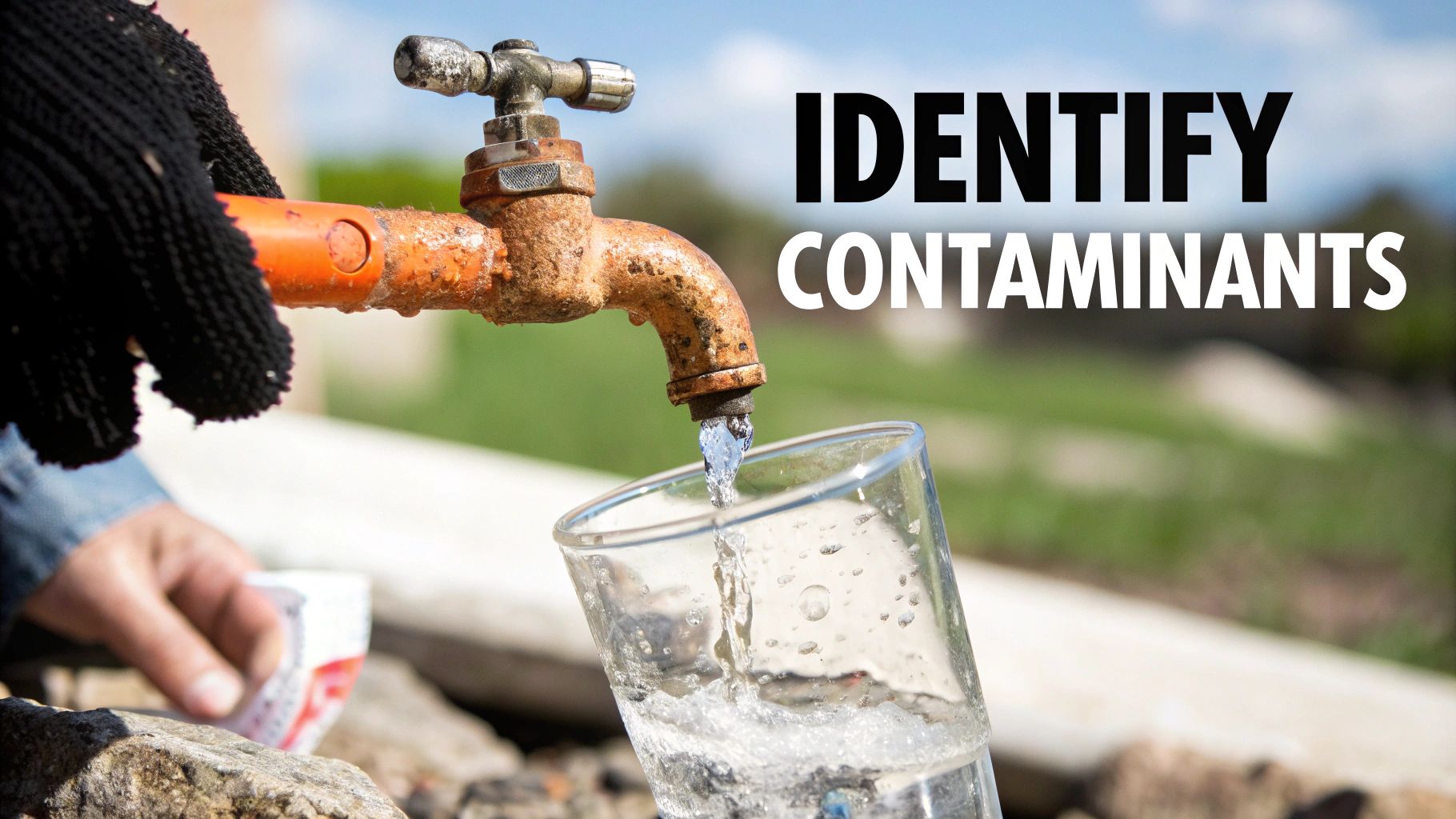
Many homeowners are shocked when they see the results of a real water test. The water coming out of the tap might look crystal clear, but unseen contaminants can impact everything from your family's health to the lifespan of your pipes and appliances. This is particularly true here in Southwest Florida, where our unique geology creates specific water quality challenges.
The Most Common Culprits in Well Water
Let's pull back the curtain on some of the most common issues we find in local wells. Each one leaves its own calling card, and learning to spot them is the first step in taking back control of your water.
- Microbiological Contaminants: This is the stuff you can't see, like bacteria (E. coli is a common one), viruses, and other microorganisms. They often find their way into wells from surface runoff or a nearby septic system and can cause some pretty nasty gastrointestinal illnesses.
- Hardness Minerals: Ever see that chalky white film on your shower door or faucets? That’s the work of calcium and magnesium, the two minerals that cause "hard water." Over time, they build up inside your pipes and appliances, choking off water flow and forcing everything to work harder until it eventually breaks down.
- Iron: If you're fighting ugly, reddish-brown stains in your sinks, toilets, and laundry, you've got an iron problem. It not only looks terrible but can also give your water a metallic taste and encourage the growth of slimy iron bacteria in your plumbing.
- Sulfur: That unmistakable "rotten egg" smell is a dead giveaway for hydrogen sulfide gas. While it's usually not a health hazard in the concentrations found in well water, it makes your water smell and taste awful and can corrode your plumbing.
Knowing what's in your water isn't just a good idea—it's everything. Without an accurate diagnosis, you're just throwing solutions at the wall to see what sticks, which is an expensive and ineffective way to protect your home.
This is exactly why a professional analysis is the only way to begin. Guesswork has no place when it comes to your family's water.
Why You Can't Trust Your Senses Alone
While orange stains and bad smells are obvious red flags, many of the most dangerous contaminants are completely invisible. Things like arsenic, nitrates, pesticides, and certain bacteria are colorless, odorless, and have no taste, but they can pose serious long-term health risks.
It's easy to assume your water is fine because it looks and tastes normal, but these hidden threats could be present without you ever knowing. This is the biggest reason why a simple DIY test strip from the hardware store just doesn't cut it. You need real data to make a sound decision.
The Essential First Step: A Professional Water Test
The only way to get a true picture of your water's chemistry is with a comprehensive lab analysis. This is where our expertise comes in. Our professional water testing services give you a detailed report that becomes the blueprint for fixing your water problems for good.
We don't just tell you if a contaminant is present; we tell you how much is there. This precision is what allows us to recommend a solution that targets your specific issues, ensuring you get the protection you actually need without overpaying for a system you don't. A professional test takes all the guesswork out of the equation and puts you on the right path to clean, safe water.
Choosing Your Shield with Different Purification Systems
Now that we've covered the usual suspects lurking in well water, it's time to talk about your defense. Picking the right well water purification systems for home is a bit like choosing the right tool for a job—you need a specific solution for each specific problem. There’s really no magic bullet. Instead, the best strategy is almost always a layered one, combining different systems that work together to create a complete shield.
This multi-layered approach ensures that every potential issue, from the hard minerals that clog your pipes to the invisible bacteria that can make you sick, is handled before the water ever gets to your tap. And it's clear homeowners are catching on. The global market for home water filtration systems hit over USD 20.5 billion in 2021 and is expected to climb past USD 25.3 billion by 2025. This isn't just a fleeting trend; it shows that people are getting serious about investing in their health by taking control of their water quality. You can read more about these market trends and their drivers.
Here at Water Medic, designing and installing these customized shields is what we do day in and day out, making sure your home is protected from every angle.
Water Softeners: The Hardness Busters
If your water test shows high levels of calcium and magnesium, you’ve got “hard water.” Think of it as liquid rock flowing through your home. Over time, it leaves behind a chalky, white buildup called scale that slowly chokes your plumbing, kills your water heater, and makes it impossible to get a good lather from soap.
A water softener is the specialized tool built to solve this exact problem.
- How It Works: It uses a clever process called ion exchange. Your water flows through a tank full of resin beads that act like tiny magnets, grabbing the "hard" calcium and magnesium ions and swapping them for "soft" sodium ions.
- The Result: No more scale buildup. Your appliances will thank you with a longer lifespan, your skin and hair will feel noticeably softer, and you’ll use way less soap and detergent.
For many homeowners in Southwest Florida, a softener is the foundational piece of their water treatment system, protecting their entire plumbing network from the inside out.
Iron and Sulfur Filters: The Stain and Odor Eliminators
Tired of those ugly, reddish-brown stains in your sinks, tubs, and toilets? Or that unmistakable "rotten egg" smell that greets you every time you turn on a faucet? Those are the classic calling cards of iron and hydrogen sulfide gas, two of the most common complaints we hear about local well water.
An iron and sulfur filter is designed to knock out these nuisance contaminants. It uses an oxidation process to turn the dissolved iron and sulfur into solid particles, which are then easily filtered out. This targeted approach brings back your water's clarity and gets rid of those embarrassing stains and smells for good.
UV Purifiers: The Microbe Bodyguard
Of course, some of the most dangerous troublemakers are completely invisible. Bacteria like E. coli, viruses, and other nasty microorganisms can find their way into your well, posing a serious health risk to your family. This is where a UV purifier comes in—it’s your silent, chemical-free bodyguard against these biological threats.
Think of a UV purifier as a light-based security checkpoint for your water. As water flows through its stainless steel chamber, it's zapped with a powerful ultraviolet lamp. This UV light instantly scrambles the DNA of any microorganisms, making them completely harmless.
It's an incredibly effective process that adds nothing to your water. No chemicals, no aftertaste, just pure peace of mind. For anyone on a well, a UV system is often the non-negotiable final line of defense. But remember, a UV light is a specialist—it's a powerhouse against germs but doesn't remove sediment or chemicals. That’s why we often pair it with other filters, like the specialized carbon filters that effectively remove chemicals like pesticides and chlorine, to create a truly comprehensive solution.
Whole House Reverse Osmosis: The Ultimate Fortress
For homeowners who want the absolute best—water that’s as pure as it gets—a Whole House Reverse Osmosis (RO) system is the ultimate answer. This isn't just another filter; it’s a complete purification fortress for your entire home. It’s the gold standard in water treatment, and it’s a system we specialize in here at Water Medic.
RO systems work by using pressure to force water through an incredibly fine membrane. The pores in this membrane are so microscopic that they block an amazing 99% of all total dissolved solids (TDS). This includes a huge range of contaminants:
- Heavy metals like lead and arsenic
- Nitrates and sulfates
- Chlorine and fluoride
- Viruses and bacteria
- Hardness minerals and salts
The water that makes it through is exceptionally clean and safe from nearly anything you can throw at it. While you might have seen small RO units that fit under a kitchen sink, a whole-house system treats every drop of water entering your home. From the water you drink to the water in your shower, it's all purified to the highest standard. It's the most complete shield you can get, offering unmatched protection and confidence in your water.
How to Select the Right System for Your Home
Now that you know the different types of well water purification systems for home, how do you pick the right one? It’s not a one-size-fits-all situation. The perfect system for your neighbor down the street might be completely wrong for your house.
Your starting point is always your water test. Think of that professional report as a detailed map, pointing directly to the specific contaminants you need to go after. It’s no use installing a system that excels at removing iron if bacteria is your real problem. Matching the treatment to the trouble is the most critical step.
Sizing Your System for Optimal Performance
Beyond what’s in your water, you have to consider how much of it you actually use every day. This is where your family's size and daily routines really matter. Getting the right fit means balancing capacity, flow rate, and long-term performance.
A key number to understand is the flow rate, which is measured in gallons per minute (GPM). This tells you how much treated water the system can produce at any given moment.
Think of your home’s plumbing like a highway. A properly sized system is a wide-open expressway, letting all the water your family needs flow freely. But an undersized system? That’s like a single-lane road during rush hour. It creates a bottleneck, leading to frustratingly low water pressure and poor performance.
At Water Medic, we calculate your home's peak water demand—that moment when the dishwasher is running, someone's in the shower, and the laundry is going. We make sure your system can handle it all without skipping a beat.
This decision tree gives you a great visual for matching common well water issues with the right type of system.
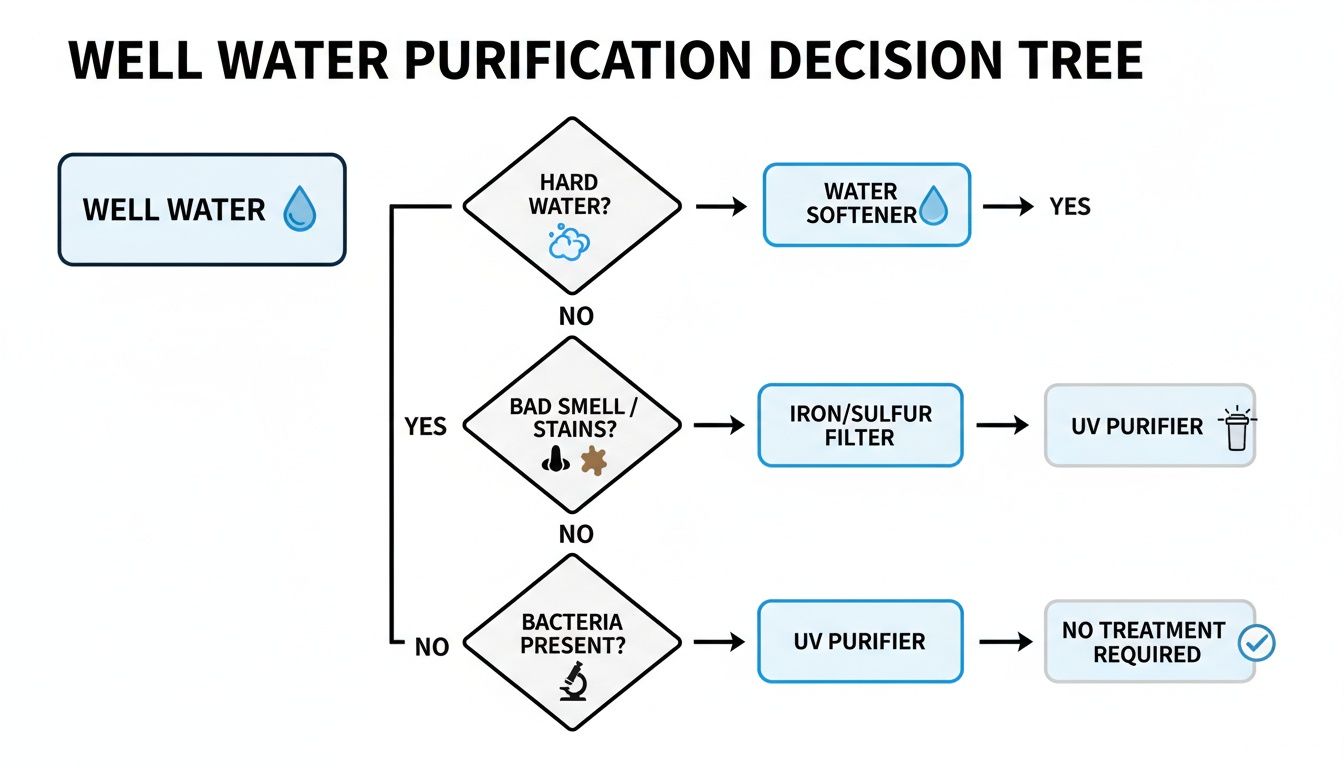
As you can see, specific symptoms like hard water scale or that "rotten egg" smell point directly toward specialized solutions, whether it's a water softener or an iron filter.
Balancing Cost and Long-Term Value
It’s easy to get fixated on the initial price tag when you're shopping for a system. But be careful—cheaper options often come with hidden long-term costs. You could be looking at more frequent repairs, higher maintenance bills, and the nagging worry that your family is still exposed to contaminants.
Investing in a high-quality, properly sized system simply makes more sense in the long run.
The technology is always getting better, too. With the North American market for ultrapure water treatment expected to grow by 4.6% annually, the trend is clearly toward more effective and reliable home systems.
A solid system doesn't just give you better water. It also protects your pipes and appliances from scale and corrosion, saving you a fortune on replacing faucets, water heaters, and dishwashers. For homeowners who want the ultimate defense against impurities, a whole house reverse osmosis system offers a comprehensive solution that can remove up to 99% of all contaminants.
Trying to figure all this out can feel overwhelming, but it doesn't have to be. The best way to find the perfect fit is to talk to an expert. When you schedule a free consultation with Water Medic, we bring our experience right to your door. We’ll go over your water test, assess your home's specific needs, and give you a clear, personalized recommendation for a system that will give you total peace of mind.
Maintaining Your System for Lasting Performance
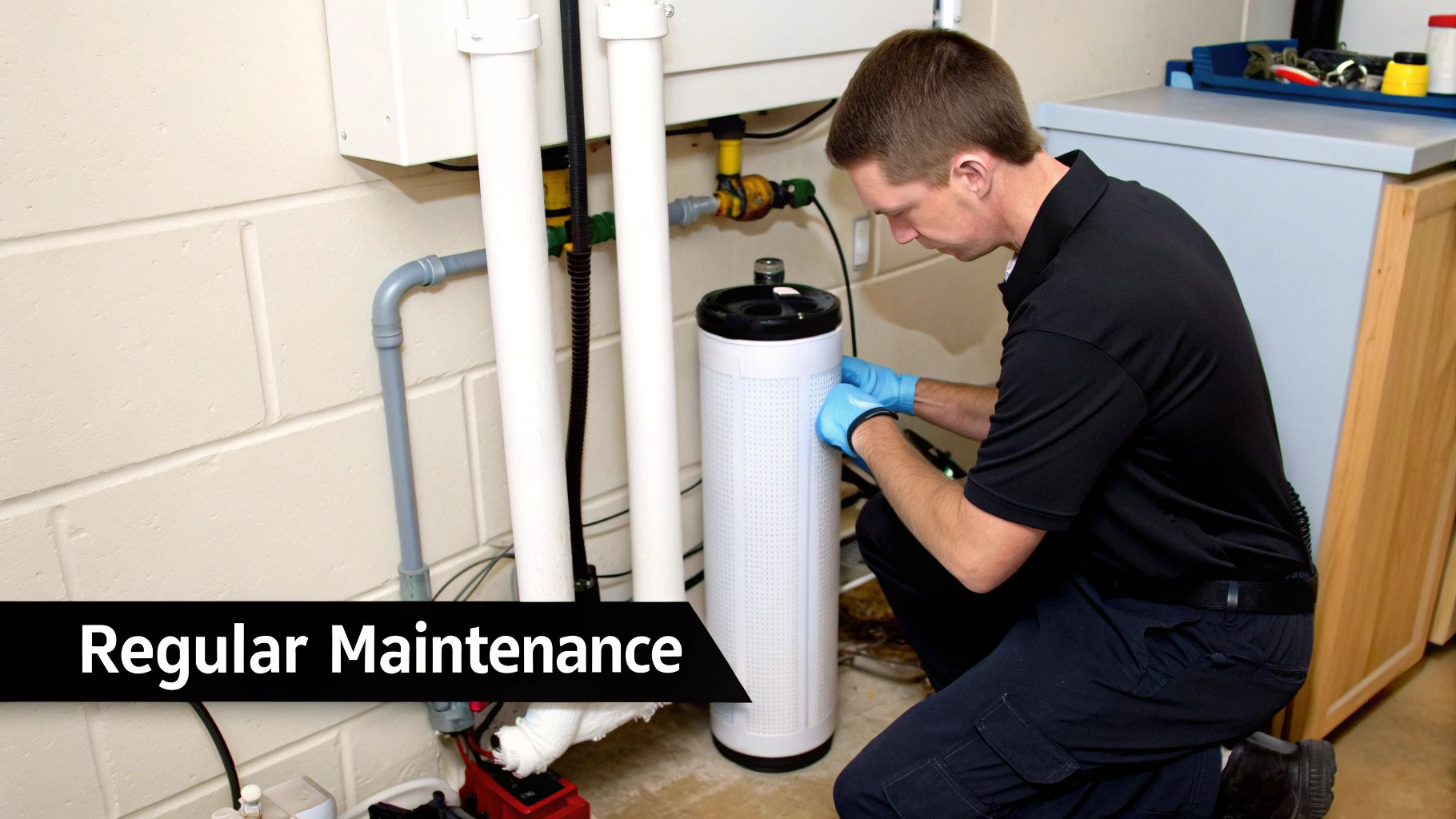
You've made a great investment in your family's health and your home's plumbing by installing a well water purification system. But just like your car, it needs a little regular attention to keep it running smoothly. Think of it less as a chore and more as the secret to ensuring the water from your taps stays pure and safe for years.
If you let things slide, you'll see a gradual drop in performance. Filters get clogged, the power of UV bulbs fades, and water softeners can stop doing their job. This not only reintroduces the very contaminants you wanted to get rid of but can also lead to some pretty expensive damage to the system itself.
Common Maintenance Tasks for Your System
While it's always smart to have a pro handle the bigger check-ups, knowing the basics of your system's upkeep puts you in the driver's seat. Each piece of equipment has its own needs, and staying on top of them is what guarantees reliability.
Here’s a quick rundown of what’s typically involved for the most common systems:
- Water Softeners: The main job here is keeping the brine tank filled with salt pellets. This salt is crucial for the ion exchange process that removes those pesky hardness minerals from your water.
- Sediment & Carbon Filters: These are your front-line soldiers, trapping grit, rust, and chemicals. They have a limited lifespan and usually need to be swapped out every 3 to 12 months, depending on how much sediment is in your water and how much you use.
- UV Purifiers: The ultraviolet bulb that zaps bacteria and viruses needs to be replaced once a year. It might still light up after 12 months, but its germ-killing intensity will have faded. For your family’s safety, this annual swap is non-negotiable.
The Risks of Deferred Maintenance
Putting off maintenance might feel like you're saving a few bucks now, but it almost always costs you more down the road. A neglected system has to work harder, which means it uses more energy or more salt to do the same job.
Think of it like skipping oil changes in your car. Sure, the engine will run for a while, but eventually, that neglect will lead to a major, costly breakdown. It's the exact same principle with your water system—a little consistent upkeep prevents catastrophic failures.
Eventually, putting it off for too long can lead to a complete system failure. That leaves you without treated water and facing a hefty repair bill.
Make Maintenance Effortless with Professional Service
We get it—life is busy. Remembering to change a filter or schedule a check-up can easily slip your mind. That’s why we offer professional maintenance and repair services to make protecting your investment totally hands-off.
With a scheduled service plan from Water Medic of Cape Coral, you get complete peace of mind. Our experienced technicians handle everything from filter changes to full system diagnostics, making sure your equipment is operating at peak performance. Let us worry about the details so you can just turn on the tap and enjoy clean, safe water every single day.
So, Why Water Medic?
Picking out a well water purification system for your home is a big decision, but it's really only the first step. The company you choose to install and maintain that system is just as crucial. That’s where real-world experience and local knowledge become game-changers, and it’s why so many homeowners here in Southwest Florida have put their trust in Water Medic of Cape Coral.
With over 25 years of boots-on-the-ground experience, we've dealt with just about every water problem you can imagine. We have a deep, practical understanding of the unique challenges our local wells present, from stubborn iron staining to the kind of hard water that clogs up everything. This means you’re not just getting a piece of equipment; you’re getting a solution designed specifically for your water.
We're More Than Just Installers—We're Your Water Experts
You can buy a water filter from a big-box store or some anonymous website, and they’ll happily ship you a box. We do things differently. We’re here to build a long-term relationship, one founded on trust and a genuine commitment to your family’s well-being.
Our partnership with you covers the entire journey to better water:
- An Honest Diagnosis: It all begins with our professional water testing services. We give you a straightforward, no-nonsense look at what’s really in your water.
- The Right Prescription: Using that data, we'll recommend a system that’s properly sized and equipped to handle your specific issues. No upselling, no one-size-fits-all gimmicks.
- A Flawless Installation: Our technicians are pros. They’ll make sure your system is installed correctly from the get-go, setting it up for a long, effective life.
- Support You Can Count On: We’re here for the long haul. Whether it's routine maintenance or an unexpected issue, you’ll know exactly who to call.
Your Neighbors in Southwest Florida
Your home’s water is far too important to trust to a generic solution or a company that doesn't understand our area. We’re not some faceless corporation; we’re your neighbors. We live here, we raise our families here, and we know the water here inside and out.
Choosing a water treatment partner is about more than just the hardware. It’s about the peace of mind that comes from knowing an expert is always in your corner, making sure your family has clean, safe water day after day.
When you call Water Medic, you’re not just a job number. You’re our neighbor, and we treat you like one. Ready to see what a difference that makes? Contact us today for a free consultation and let’s get you on the path to perfect water.
Your Well Water System Questions, Answered
When you're looking into well water purification systems for home, it’s natural to have a few questions pop up. After all, this is about the water your family uses every single day. We've heard just about every question in the book, so let's tackle some of the most common ones right here.
Getting good, clear answers is the first step toward making a decision you can feel great about.
How Often Should I Test My Well Water?
This is probably the most critical question any well owner can ask. Think of it like an annual check-up for your water. At the very least, you need to get your water professionally tested once per year for things like bacteria and nitrates. That’s your baseline for safety.
But you shouldn't stop there. It's also smart to test your water anytime you notice something's off—a weird taste, a strange smell, or a new color. Big events like a nearby flood or work on your septic system are also good triggers for a test. Staying on top of testing is how you catch problems before they become serious.
Can I Install a Water Purification System Myself?
It's tempting to go the DIY route, and for a small, single-faucet filter, that can work just fine. But a whole-house system is a completely different beast. These systems tie directly into your home's main water line, and getting it wrong can cause a world of headaches. We’re talking leaks, a serious drop in water pressure, or even damaging the new system you just bought (which often voids the warranty).
For a system designed to protect your entire home, professional installation isn't just a good idea—it's essential. A pro makes sure every fitting is perfect and that the system is calibrated to handle your home's specific water flow and pressure, ensuring it works safely and effectively for years.
How Long Do Well Water Systems Last?
A good system is a real investment, so you want it to last. The good news is that with regular, professional maintenance, they absolutely do. How long you can expect depends on the type of system you have.
- Water Softeners & Filters: A well-built model can easily last 10 to 15 years, and sometimes even longer.
- UV Purifiers: The main unit itself can last for decades. The key is the UV bulb inside, which needs to be replaced annually to keep it effective at neutralizing contaminants.
- Reverse Osmosis Systems: These are tough, robust systems that can often work for 15 to 20 years. You'll just need to replace the filters and membranes on a regular schedule.
Simply put, consistent upkeep is the secret to getting the most life out of your system. If you've got more questions, we've got more answers! Feel free to dig deeper in our comprehensive well water FAQs.
Ready to ensure every drop of water in your home is pure, safe, and clean? The experts at Water Medic of Cape Coral have the local knowledge and technical skill to design the perfect solution for your specific needs. Contact us today for a free, no-obligation consultation!