A Pro Guide to Pool Maintenance Cleaning in Southwest Florida
Owning a pool in Southwest Florida is the dream, isn't it? But keeping that dream from turning into a green, murky headache requires a smart, consistent maintenance plan. This isn't about guesswork; it's about having an actionable routine you can count on. A pristine, inviting pool doesn’t happen by accident—it’s the direct result of planned, diligent upkeep. At Water Medic, we believe that informed pool owners are happy pool owners, but we're always here to take the work off your hands.
Your Blueprint for a Flawless Florida Pool
Let's dive into the essentials. We'll start with the physical cleaning that keeps your water sparkling and free of all the leaves, bugs, and pollen that Florida throws at it. This means skimming the surface, brushing down the walls and steps, and vacuuming the floor. Think of these simple tasks as your first and best line of defense against cloudy water and stubborn stains.
The Foundation of a Healthy Pool
Beyond what you can see, the real secret lies in the water's chemistry. A consistent schedule is your best weapon against those frustrating problems that seem to pop up overnight, like an algae bloom after a heavy rain. Staying on top of your routine doesn't just keep the water looking good; it protects your investment in the pool's finish and equipment. More importantly, it keeps the water safe for your family and friends.
A truly well-maintained pool stands on a few key pillars:
- Consistent Circulation: You have to run that pump every single day. It's the only way to properly mix chemicals and ensure every drop of water gets filtered.
- Proper Filtration: A clean filter is your pool's workhorse. If it's clogged, it can't trap dirt and debris, and your water clarity will suffer.
- Balanced Chemistry: This is the big one. Keeping your chlorine, pH, and alkalinity in the right ranges is what stops bacteria in its tracks and protects your pool's surfaces from damage.
The real secret to a beautiful pool isn’t about complex chemistry or expensive gadgets—it's consistency. A simple, repeatable weekly routine will solve 90% of the problems a pool owner faces, but when it becomes a chore, professional service is the best solution.
Here's a quick-reference table that outlines the absolute must-do tasks every week. Sticking to this schedule will keep your pool healthy and clear, but remember, our technicians can handle all of this for you.
Essential Weekly Pool Maintenance Checklist
| Task | Frequency | Why It Matters for Your Pool |
|---|---|---|
| Test Water Chemistry | 1-2 times per week | Prevents algae, bacteria, and equipment corrosion. Ensures swimmer comfort. |
| Skim Surface | Every few days | Removes floating debris before it sinks and stains the pool floor. |
| Brush Walls & Steps | Weekly | Dislodges algae spores and dirt buildup that vacuuming can miss. |
| Empty Skimmer Baskets | 1-2 times per week | Maintains strong water flow to the pump, improving circulation and filtration. |
| Check Filter Pressure | Weekly | Indicates when your filter needs cleaning for optimal performance. |
Following these non-negotiable steps is the core of a successful DIY pool maintenance strategy in our unique Southwest Florida environment.
When to Seek Professional Support
Of course, there are times when you'd rather be swimming than working. For those moments, or when a problem seems too complex to handle on your own, calling in a professional is the smart move. Water Medic of Cape Coral is always here to help.
Understanding the basics helps you know when it's time to call for an expert touch. For those of us in this part of Florida, a solid pool care plan also means knowing the regional challenges, and you can find more on local pool care considerations in Bonita Springs for deeper insights.
Whether you need a one-time fix or are ready to hand over the work completely, our monthly pool maintenance plans are designed to keep your personal oasis perfect, so all you have to do is enjoy it.
Mastering Pool Chemistry for Clear and Safe Water
Diving into pool chemistry can feel like a flashback to high school science class, but our expert technicians make it seem easy. This isn't about memorizing the periodic table; it's about a simple balancing act that keeps your water sparkling, safe, and comfortable. Here in Southwest Florida, with our relentless sun and pop-up thunderstorms, getting that balance right is everything.
Think of your water as a tiny ecosystem. The whole point is to create an environment that’s hostile to nasty bacteria and algae but still gentle on your skin, eyes, and expensive pool equipment. To pull that off, you just need to keep an eye on a few key players.
The Core Four of Pool Chemistry
To get that pristine, inviting water, you really only need to monitor and adjust four main components. Nailing these is the secret to sidestepping most common pool headaches before they even get a chance to start.
- Chlorine: This is your sanitizer, the frontline defense against all the gunk you don't want in your pool. The ideal level for free chlorine is between 1.0 and 3.0 parts per million (ppm).
- pH: This is just a measure of how acidic or basic your water is. You're aiming for the sweet spot between 7.4 and 7.6. This not only keeps swimmers happy but also makes sure your chlorine can do its job effectively.
- Total Alkalinity (TA): Think of this as the anchor for your pH. It prevents the pH level from bouncing all over the place. Keep it in the 80 to 120 ppm range.
- Calcium Hardness (CH): This tells you how much dissolved calcium is in the water. Maintaining it between 200 and 400 ppm is crucial for protecting your pool's plaster, tile, and equipment from getting damaged.
Juggling these levels might seem like a lot at first, but it quickly becomes a simple routine. The tricky part? A classic Southwest Florida downpour can dilute everything in minutes, throwing your whole system out of whack and practically inviting an algae bloom. When that happens, you have to act fast.
If you feel like you’re constantly fighting a losing battle with your water chemistry, it might be time to call in a pro. Our expert chemical balancing service takes all the guesswork out of it, giving you perfectly balanced water every single time.
Testing and Dosing The Right Way
You can't fix what you can't measure. A good quality liquid test kit or reliable test strips are your best friends for this job. For the most accurate reading, always grab your water sample about elbow-deep and away from any return jets or the skimmer.
Once you have your numbers, the golden rule is to add chemicals one at a time. Never, ever mix them together before they go in the pool—that can create some seriously dangerous reactions. Always read the manufacturer’s directions and add chemicals while the pump is running to help them circulate properly.
A critical pro tip: Always adjust your Total Alkalinity first, then your pH, and finally your chlorine. Because alkalinity stabilizes pH, getting it right first makes balancing the other levels much easier and more effective.
Getting this wrong can get expensive quickly. The cost of pool chemicals is no joke, and proper management is a huge part of controlling your overall pool budget. In fact, annual pool maintenance in the U.S.—including chemicals, service, and energy—can run between USD 3,000 and USD 6,000. You can discover more about swimming pool industry insights to see how your own costs stack up.
When you first notice your water isn't looking its best, this decision tree is a great place to start.
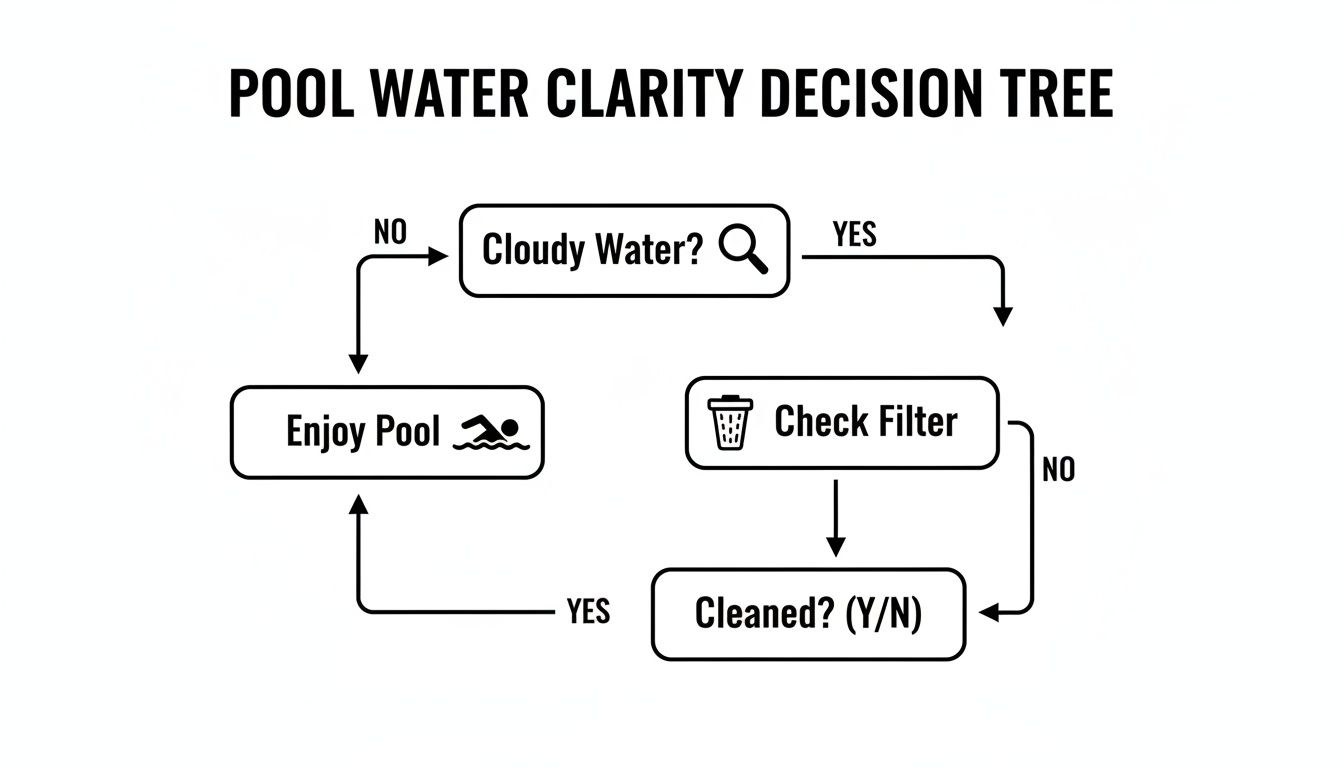
As the flowchart shows, before you start dumping in more chemicals, your first move should often be to check the filtration system. That’s often the real culprit behind cloudy water. Mastering your pool’s chemistry is a rhythm you get into—a constant cycle of testing, adjusting, and observing that protects your investment and ensures your pool is always ready when you are.
Caring for Your Pool's Hardest-Working Equipment
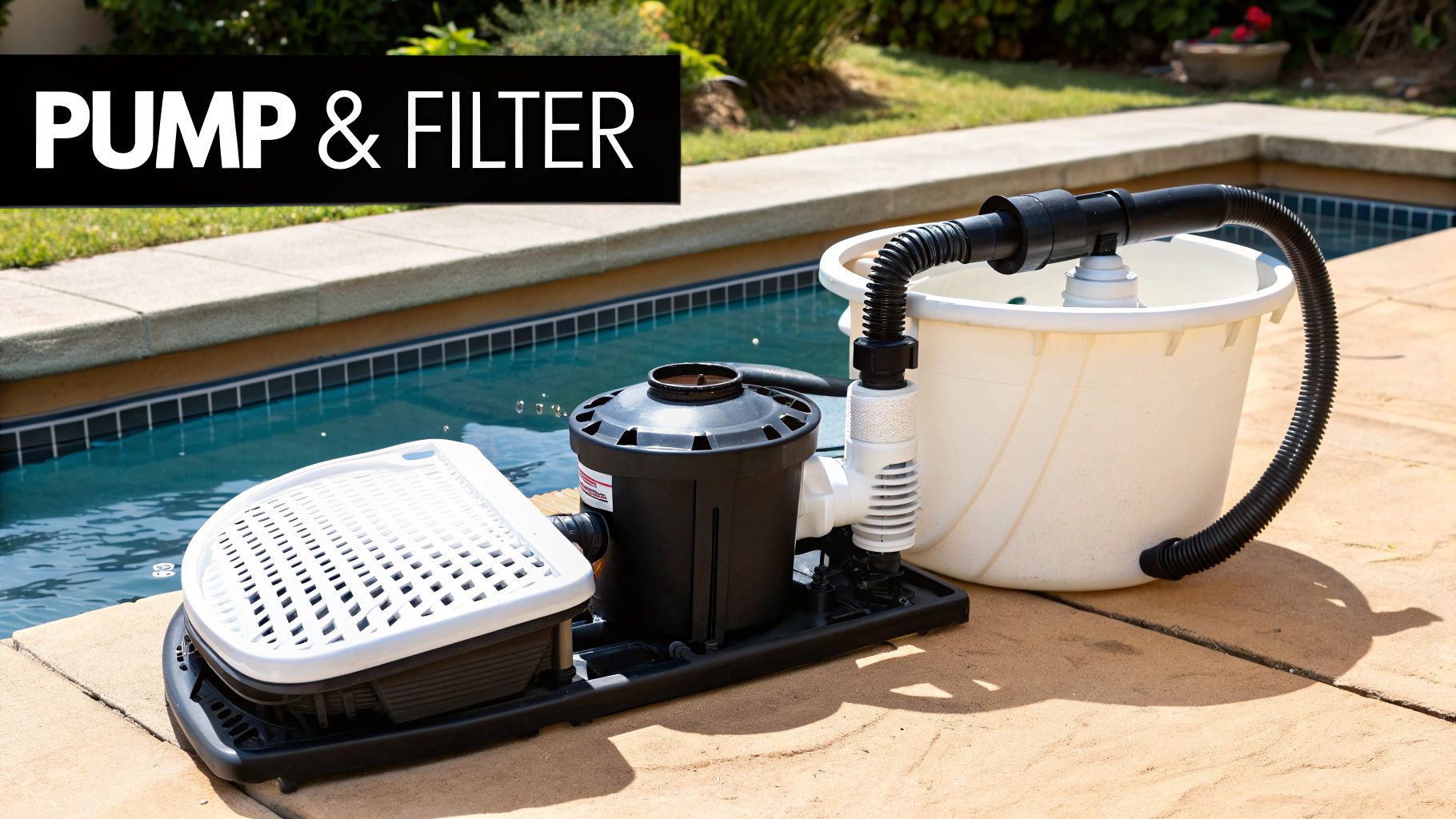
Think of your pool's pump and filter as its heart and lungs. They work tirelessly behind the scenes, circulating and clearing the water. Honestly, even perfectly balanced chemicals won't do much good if your water isn't moving properly. Taking care of this equipment isn't just a chore; it's the foundation of a healthy pool and your best defense against surprise repair bills.
This system might look complicated at first glance, but its daily needs are surprisingly simple. Once you understand what each part does, routine upkeep becomes second nature. A little attention here goes a very long way.
Keeping the Flow Strong: Skimmers and Pump Baskets
Your skimmers and the pump basket are your first line of defense. They catch the big stuff—leaves, twigs, palm fronds, and flower petals—before it can jam up your filter. When these baskets get full, water flow is choked off, forcing your pump to work way harder than it should. That strain doesn't just hurt performance; it can burn out your pump motor over time.
Get in the habit of checking these baskets often, especially after a windy day. Here in Southwest Florida, that can mean checking them every couple of days. Just turn off the pump, pop the lid, lift out the basket, and dump the gunk. A quick rinse with the hose before you put it back is all it takes to keep things flowing smoothly.
Understanding Your Pool Filter
The filter is where the real deep cleaning happens, grabbing all the tiny particles that make water look hazy. There are three main types, and each has its own cleaning routine. The most important tool for any filter is the pressure gauge.
Right after you clean your filter, take a look at the gauge and note the "clean" pressure reading (in PSI). When that gauge climbs 8-10 PSI above your starting point, it's telling you it's time for a cleaning.
- Sand Filters: These are the workhorses. You clean them by "backwashing," which just reverses the water flow to flush out all the trapped debris. It's a quick job, usually just a few minutes every few weeks.
- Cartridge Filters: With these, you pull out the big pleated cartridge element and just hose it down really well. Depending on how much use your pool gets, you’ll probably do this every few months.
- Diatomaceous Earth (D.E.) Filters: D.E. gives you the absolute clearest water, but it's also the most hands-on. You backwash it like a sand filter, but then you have to add new D.E. powder through the skimmer to recoat the internal grids.
Here's a pro tip: don't clean your filter too often. It sounds weird, but a filter that's just a little dirty actually traps finer particles better than one that's spotless. Always trust your pressure gauge, not a rigid calendar schedule.
A neglected filter is a recipe for cloudy water, algae, and can even permanently damage the equipment. One way to protect your system from getting clogged with grass clippings and other organic junk is installing fake turf around pools, which can make a huge difference in the debris load.
Spotting Trouble Before It Starts
Your equipment will usually give you a heads-up when something's wrong—you just have to listen. A loud humming, grinding, or a high-pitched whine from the pump motor is a clear cry for help. Another common one? Seeing a stream of air bubbles shooting from your return jets. That almost always means you've got an air leak, often from a bad o-ring on the pump lid.
Ignoring these warning signs can turn a simple fix into a full-blown replacement. If you hear weird noises, see leaks, or your pressure gauge isn't returning to normal after a cleaning, it's time to act. For a professional diagnosis and fix, our team can help you get to the bottom of it. You can learn more about our expert pool equipment services and book a check-up.
Modern Upgrades and Automation
Technology has made owning a pool so much easier. Swapping out an old single-speed pump for a modern variable-speed pump (VSP) is one of the smartest upgrades you can make. VSPs run at lower speeds for longer, which can slash your energy use by as much as 90%. The savings on your electric bill are real.
Automation is also a game-changer. The global pool cleaner market was valued at around USD 3.2 billion in 2023 and is expected to hit nearly USD 5.7 billion by 2032. That growth is all about robotic cleaners that scrub, vacuum, and filter on their own. This tech can cut your manual cleaning time by up to 40%, a huge win for any busy homeowner. Taking care of your equipment is the most direct way to ensure your pool remains a source of joy, not a constant chore.
Winning the War Against Algae and Common Pool Problems
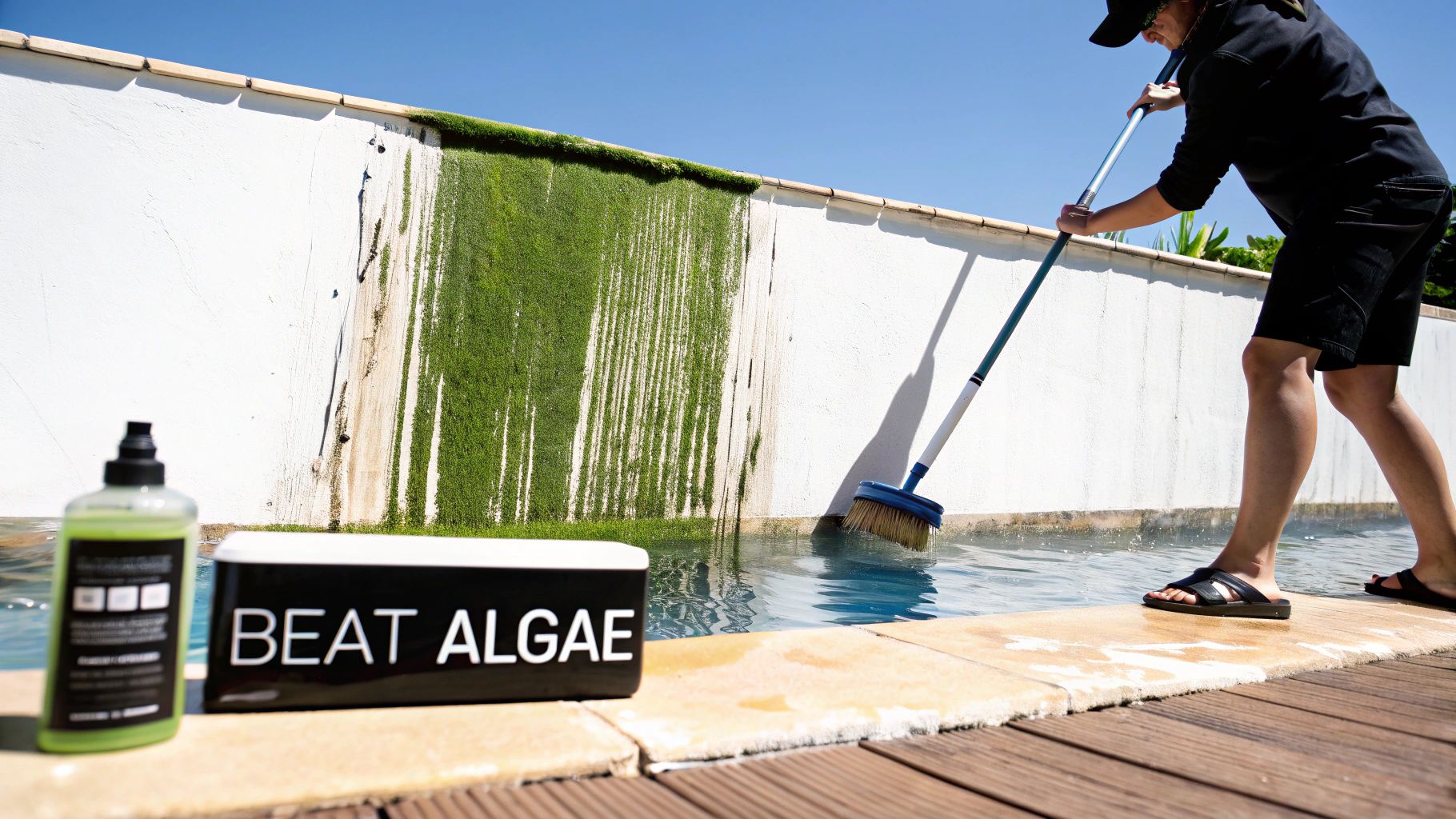
Here in Southwest Florida, algae can feel like a relentless enemy. One day your pool is sparkling, and the next, you spot that dreaded greenish tint. It’s the start of a frustrating battle no homeowner wants to fight. But with the right strategy, you can keep these unwanted guests from crashing your pool party.
Effective algae control is a non-negotiable part of any solid pool maintenance cleaning routine. Prevention is always your best defense—consistent chemical balance, proper filtration, and good circulation are your front line. But let's be realistic; sometimes, algae just happens. When it does, you need a battle plan.
Identifying and Treating Your Algae Problem
Not all algae are the same, and you can't treat them that way. Figuring out what you're up against is the first step to getting rid of it for good. Each type requires a slightly different approach.
Here are the three most common culprits you'll see:
- Green Algae: This is the one you’ll see most often. It usually pops up after a chemical imbalance or a filtration hiccup. It floats around, making the water cloudy, and loves to cling to the walls and floor.
- Mustard Algae: This tricky stuff looks like yellow-brown dust or pollen and tends to hide in shaded spots. It’s notoriously resistant to normal chlorine levels and brushes away easily, only to reappear a day later.
- Black Algae: The toughest of them all. Technically a bacteria, black algae forms a hard, protective shell. It shows up as small black spots and digs its roots deep into plaster, making it incredibly difficult to kill.
Before you even think about adding chemicals, your first and most critical move is to brush the pool walls vigorously. This is key. You're physically breaking down the algae's protective layer so the sanitizer can get in and do its job. For black algae, you absolutely need a stiff, stainless-steel brush to scrape the surface and crack its tough shell.
The Power of a Proper Pool Shock
After a good brushing, it's time to shock the pool. This means jacking up the chlorine level high enough to obliterate all the algae and anything else lurking in the water. For a typical green algae bloom, you’ll want to double or even triple the normal shock dose. For stubborn mustard or black algae, you may need to go even stronger.
Always, always shock your pool at dusk or night. The sun’s UV rays can burn off up to 90% of your free chlorine in just a couple of hours. Shocking after sunset gives your chemicals all night to work their magic. Be sure to let the pump run for at least 8-12 hours afterward to get that super-chlorinated water circulated everywhere.
The biggest mistake homeowners make is not using enough shock or skipping the brushing. A half-hearted treatment just makes the algae angry. Our professional services ensure the job is done right the first time, so it doesn't come back stronger.
After the shock, your pool will likely look cloudy and full of dead algae. Don't panic; this is normal. Just run your filter continuously and backwash or clean the cartridge as needed until the water clears. A clarifier or flocculant can also help clump those tiny dead particles together, making it easier for your filter to grab them.
Troubleshooting Other Common Headaches
Algae isn't the only thing that can ruin a perfect pool day. Other common problems can be just as frustrating if you don't know what's causing them.
- Cloudy Water: This is almost always a filtration or chemistry issue. First, check your filter pressure and give it a good cleaning if needed. Then, test your water—high pH or low chlorine are the usual suspects.
- Surface Stains: Stains can be organic (from leaves and berries) or metallic (from copper or iron). You have to know the source to use the right stain remover.
- Foam: Seeing foam on the surface? It's often caused by certain algaecides or a buildup of organic waste from lotions, oils, and soaps. A good shock treatment can usually break these contaminants down.
When you've tried everything and these problems just won't go away, it's a sign of a deeper issue. At that point, dumping in more chemicals is just throwing money down the drain. Our team specializes in diagnosing and solving these tough pool problems. Our advanced problem-solving services deliver a fast, effective fix to get your pool back to perfect.
Adapting Your Pool Care for the Florida Lifestyle
Living in Southwest Florida means your approach to pool maintenance and cleaning has to be as unpredictable as our weather. A set-it-and-forget-it routine that might work up north just won't fly here, especially with hurricane season on the horizon. Getting your pool ready for a major storm isn't just a suggestion; it's a non-negotiable part of protecting your home.
A little prep work ahead of time can be the difference between a quick cleanup and a complete, costly restoration. The idea is to protect your expensive equipment and keep your pool from turning into a swampy, debris-filled mess. It’s all about being proactive, not panicking when the forecast turns ugly.
Navigating Hurricane Season
When you hear a storm is heading our way, your first thought might be to drain the pool to keep it from overflowing. Fight that urge.
Do not drain your pool. This is the most critical piece of advice we can give. The weight of the water is the only thing keeping your pool shell anchored in the ground. Rising groundwater from a storm can literally float an empty pool right out of its foundation—a truly catastrophic failure.
Instead, here’s what you should actually do before the storm hits:
- Balance the Water: Shock your pool with a heavy dose of liquid chlorine. This gives it a fighting chance against all the contaminants and debris that are about to be dumped into it.
- Secure Loose Items: Take a walk around your pool deck and store everything—patio furniture, pool floats, skimmer poles, planters. If it isn't bolted down, it can become a dangerous projectile in high winds.
- Turn Off the Power: Go to your circuit breaker and kill the power to all of your pool equipment. This will protect your pump, heater, and lights from electrical surges. A common mistake is wrapping the equipment in plastic, but this just traps heat and moisture, which can cause even more damage.
After the storm passes, your pool might look like a disaster zone, but don't get discouraged. A step-by-step cleanup will get it back to beautiful. Just be patient and, above all, be safe. Never head outside to start cleaning until the storm has completely passed.
Your post-storm recovery will involve fishing out large debris with a leaf rake, cleaning out all the baskets, and then getting the power back on to start circulating the water. You’ll need to run your filter 24/7 for a while, brush and vacuum like crazy, and rebalance your water chemistry—which almost always means another strong shock treatment. It's a ton of work. For true peace of mind, our professional hurricane prep and recovery services are designed to handle every single step for you.
Other Florida-Specific Adjustments
Beyond hurricane season, life in Florida throws a few other curveballs at pool owners. The relentless sun causes a ton of water evaporation, which not only drives up your water bill but also concentrates the chemicals in your pool. A good solar cover is your best defense here; it can reduce evaporation by up to 95%.
Even our mild winters require a plan. You might not be swimming much, but you can't just ignore the pool. You can cut back on how long you run your pump, but you absolutely have to keep up with basic chemical balancing and cleaning. Neglect it, and a surprise warm spell will give you an instant algae bloom.
And then there's the spring pollen. That fine layer of yellow-green dust gets on everything, including the surface of your pool. When it’s falling, you’ll need to skim the water daily and run your filter more often just to keep the water clear and prevent your skimmer baskets from getting completely clogged. This kind of seasonal diligence is just part of the deal down here. It’s no surprise that the global pool maintenance service market is a massive industry, and in a pool-heavy area like ours, having an expert on call is crucial. You can read more about the pool service market growth to see just how much people rely on professional care.
Your Pool Maintenance Questions Answered
Even the most dedicated pool owner runs into questions. After all, keeping a pool sparkling in Southwest Florida isn't always straightforward. Our unique climate throws some curveballs, but knowing when to call for professional help can save you a ton of time, money, and headaches.
Think of this as your quick-reference guide for those moments when you're standing poolside, scratching your head. A little bit of know-how goes a long way in making sure your pool stays a backyard oasis, not a constant chore.
How Often Should I Really Test My Pool Water in Florida?
Here in the Sunshine State, with our intense heat and frequent downpours, water chemistry can change in the blink of an eye. You absolutely need to test your pool water for chlorine and pH 2-3 times per week, especially during the summer. This is non-negotiable if you want to stay ahead of problems.
Always, always test after a big rainstorm or a weekend pool party. Those events throw your water chemistry way out of whack. For things like total alkalinity and calcium hardness, a weekly check is usually fine. Staying on top of testing this frequently is your best defense against algae and cloudy water, but if it sounds like too much, our pool chemical service is the perfect solution.
Is a Robotic Pool Cleaner a Worthwhile Investment?
One hundred percent, yes. I get it—the upfront cost can make you pause. But a quality robotic pool cleaner is one of the smartest investments a Florida pool owner can make. These little workhorses run independently of your main filtration system, which means less strain on your pump and other expensive equipment.
They're just incredibly efficient. A good robot will scrub the walls and waterline and pick up fine silt and debris that your main system might miss. The result is a visibly cleaner pool and better circulation, all while you're doing something else. Over a few seasons, the time you save—not to mention the energy and chemical savings—makes it a no-brainer.
Investing in a robotic cleaner is like hiring a dedicated assistant for your pool. It works tirelessly in the background, handling the most tedious part of pool care, so you have more time to actually enjoy the water.
When Should I Call a Professional Instead of DIY?
Knowing your limits is key to protecting your investment. While you can handle the day-to-day stuff, there are clear signs it's time to call in a pro.
If you’re fighting a stubborn algae bloom that just won't clear up or can't get rid of cloudy water, it's time to make the call. Any strange noises from your equipment, like grinding or high-pitched whines, are red flags that need an expert diagnosis immediately. Our pool equipment repair team is ready to help.
Leave the big jobs—like acid washing, leak detection, or major equipment repairs—to certified technicians. Trying to tackle these yourself can easily turn a small problem into a very expensive disaster. A pro brings the right tools, the right experience, and the peace of mind that the job is done correctly the first time. For more answers, you can explore our extensive pool care frequently asked questions to build your knowledge even further.
When you need reliable, expert care for your pool, trust the team with over 25 years of experience in Southwest Florida. For everything from routine maintenance to complex repairs, Water Medic of Cape Coral is here to help. Visit us online to schedule your service today.