How to Purify Well Water: A Homeowner’s Practical Guide
Before you can even think about purifying your well water, you have to know exactly what you're up against. Trying to solve water problems based on a funny smell or a weird color is just a shot in the dark—it usually leads to the wrong solution and money down the drain. A proper, professional water test from Water Medic of Cape Coral is the only way to get a clear picture of what's coming out of your tap.
What's Really In Your Well Water?
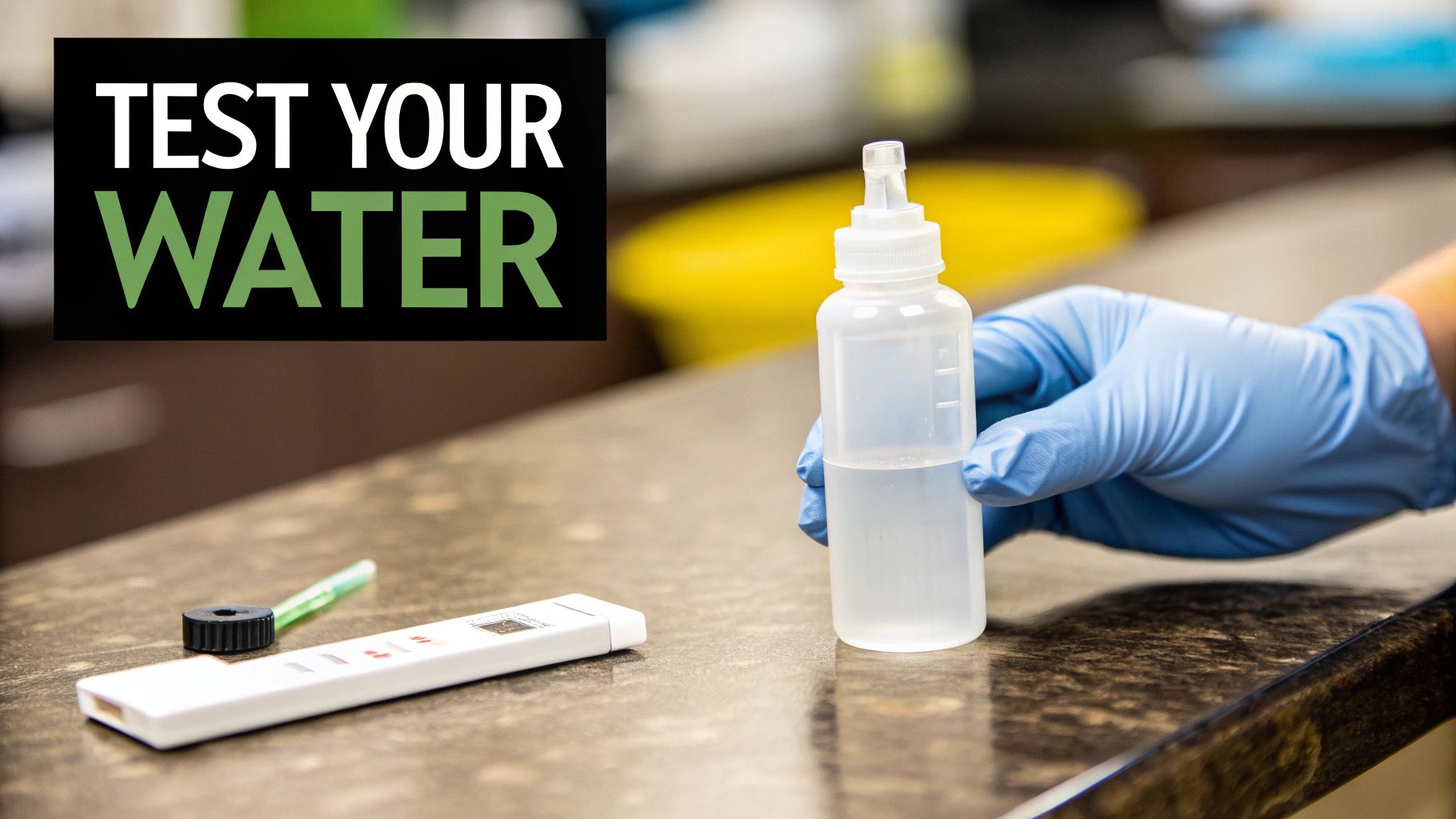
Unlike city water, which is treated and monitored by a utility, your private well is your responsibility. The quality of your water is a direct reflection of the local geology and everything happening in the environment around you, and it can absolutely change from one season to the next.
This direct pipeline from the ground means your well is vulnerable to all sorts of contaminants. And here's the kicker: many of the worst offenders can't be detected without specialized equipment.
The Dangers You Can't See
I can't stress this enough: some of the most serious threats in well water are completely invisible. You can't see them, smell them, or taste them, which makes relying on your senses alone a risky gamble for your family's health.
Here are a few of the invisible culprits we regularly find:
- Bacteria & Viruses: Nasty pathogens like E. coli can leach into the groundwater from failing septic systems or farm runoff, creating a serious health hazard. Our UV water treatment systems are the definitive solution for this threat.
- Nitrates: These are often tied to fertilizers and animal waste. High nitrate levels are especially dangerous for infants and expecting mothers.
- Arsenic: This is a naturally occurring—and highly toxic—element found in certain rock formations that can only be identified with a lab test.
- Hardness Minerals: While not typically harmful to your health, minerals like calcium and magnesium are brutal on your home. They create "hard water" that clogs pipes, ruins water heaters, and leaves crusty buildup on everything.
Think of it this way: a professional water test is the diagnosis before you get the prescription. Getting it right from the start saves you time, frustration, and gives you real peace of mind.
Sensory Clues You Shouldn't Ignore
While you can't see everything, some contaminants do leave clues. These are the telltale signs that your well is telling you it's time for a check-up. That "rotten egg" smell? It's a classic sign of hydrogen sulfide gas. Seeing ugly orange or brown stains in your sinks and toilets? That's almost always an iron problem.
This quick guide can help you connect the dots between what you're sensing and what might be in your water.
Common Well Water Contaminants and Their Telltale Signs
| Symptom | Potential Contaminant(s) | Recommended First Action |
|---|---|---|
| Rotten egg smell | Hydrogen Sulfide | Get a test to confirm levels and check for related bacteria. |
| Orange, brown, or red stains | Iron | Test for iron type (ferric vs. ferrous) and concentration. |
| Cloudy or murky water | Turbidity (sediment, silt, clay) | Identify the source of the sediment before choosing a filter. |
| Blue-green stains | Acidity (low pH) | Test pH levels to determine the level of corrosion. |
| Salty or brackish taste | Saltwater Intrusion, Chlorides | Test for total dissolved solids (TDS) and chlorides. |
These clues are a great starting point, but they never tell the whole story. You might have an iron problem causing stains, but is there also bacteria lurking in the water? The sulfur smell is annoying, but are your nitrate levels dangerously high? Only a comprehensive test gives you the full picture. For more on this, you might find some quick answers by reviewing our list of frequently asked questions about well water systems.
The Growing Need for Reliable Purification
Ensuring well water is safe isn't just a local concern here in Cape Coral—it's part of a much bigger trend. The global water purifier market, valued at around USD 59.8 billion, is expected to soar to USD 124.6 billion by 2033. That massive jump is happening because more and more people are aware of waterborne health risks. This data from the global water purifier market statistics confirms that families everywhere are making water safety a top priority.
So, the first real step in learning how to purify well water is to stop guessing and start testing. An expert analysis from a team like Water Medic of Cape Coral gives you the hard data you need to build a smart, effective, and lasting solution that’s right for your home.
Getting to Know Your Local Water Problems
Well water isn't a one-size-fits-all situation. The quality of the water coming out of your tap is a direct reflection of the ground it came from, and here in Southwest Florida, we have our own unique set of challenges. Cape Coral, with its intricate canal system and proximity to the coast, presents some very specific issues for well owners.
Figuring out what's really going on with your water is the first, most crucial step. If you just start guessing, you'll likely end up with a garage full of filters that don't work and a wallet that's a lot lighter. Let's talk about the real-world signs of common local contaminants so you can find a solution that actually lasts.
The Telltale Signs of Iron and Sulfur
Two of the most common complaints I hear from well owners are about those ugly rust-colored stains and a "rotten egg" smell that can clear a room. These aren't just minor annoyances. They're dead giveaways for specific contaminants that are doing a number on your plumbing, appliances, and even your morning coffee.
Ever lift the lid on your toilet tank and see a slimy, orange-brown gunk coating everything? That's a classic sign of iron bacteria. These little organisms thrive on the dissolved iron in your well, creating a nasty biofilm that clogs pipes, turns your white laundry a dingy yellow, and makes your water taste metallic. Just filtering the iron won't cut it; you have to deal with the bacteria, too.
The other big offender is hydrogen sulfide gas. It's the source of that unmistakable rotten egg odor, which usually hits you full-force when you turn on the hot water. Beyond the smell, high sulfur can tarnish your silverware and corrode your plumbing from the inside out. The good news is, our iron and sulfur removal systems eliminate these issues without needing a single chemical.
Spotting Saltwater Intrusion in Coastal Wells
Living in a beautiful place like Cape Coral comes with a water quality risk many people don't think about: saltwater intrusion. When too much freshwater is pumped out of our local aquifers, it can allow the denser seawater to creep in and contaminate the supply.
The signs are subtle at first. You probably won't taste it right away, but your home will notice.
Here’s what to watch for:
- Appliances Dying Young: Water heaters, dishwashers, and washing machines that give out years before they should are a huge red flag for corrosion.
- Pitting on Fixtures: Look for tiny pits or rust spots on your stainless steel sinks and faucets.
- A Slightly "Off" Taste: As the problem gets worse, you might start to notice a slightly brackish or salty taste in the water.
Saltwater intrusion is a serious issue in coastal communities. Ignoring it doesn't just mean you'll be replacing expensive appliances more often. It means your water has elevated levels of chlorides and total dissolved solids (TDS) that can only be removed with specialized treatment, like a reverse osmosis system.
Why This Isn't a DIY Fix
Every one of these local water problems—iron bacteria, high sulfur, and saltwater intrusion—needs a specific game plan. A simple carbon filter from a big-box store isn't going to do a thing for those orange stains or protect your pipes from corrosive salt.
This is where getting a professional diagnosis is non-negotiable. A real water analysis doesn't just tell you if you have these contaminants; it measures their exact levels. That data is everything when it comes to choosing and sizing the right equipment. The system needed for a little bit of iron is a world away from what’s required to handle a severe iron bacteria problem combined with high sulfur.
Trying to solve it yourself without that information is like throwing darts in the dark. You might get lucky, but you'll probably waste a lot of time, money, and sanity along the way. By recognizing these local symptoms and getting expert advice from the get-go, you can get a targeted, efficient solution that provides your family with clean, safe water for good.
Choosing the Right Purification System
Alright, you've got your water test results in hand. Think of that report as a roadmap—it tells you exactly what’s in your water. Now, it's time to pick the right system to get you to your destination: clean, safe water for your family. The world of water purification can seem complex, but it really just boils down to matching the right tool to the right problem.
Many people first reach for a simple pitcher or a faucet-mounted filter. They’re cheap and easy, but let's be honest, their capabilities are very limited. Sure, they might make your water taste a little better by reducing some chlorine, but they are completely outmatched by serious well water contaminants like bacteria, high iron, or saltwater intrusion.
To truly protect your family and your home's plumbing, a whole-house system is the only way to go. This isn't just a filter; it's a solution that treats water the moment it enters your home. That means every single tap—from the kitchen sink to the shower—delivers purified water. It's a real investment in your home's infrastructure and your family's health.
This quick visual guide can help you start connecting the dots between what you see, smell, or taste and what might be going on in your well.
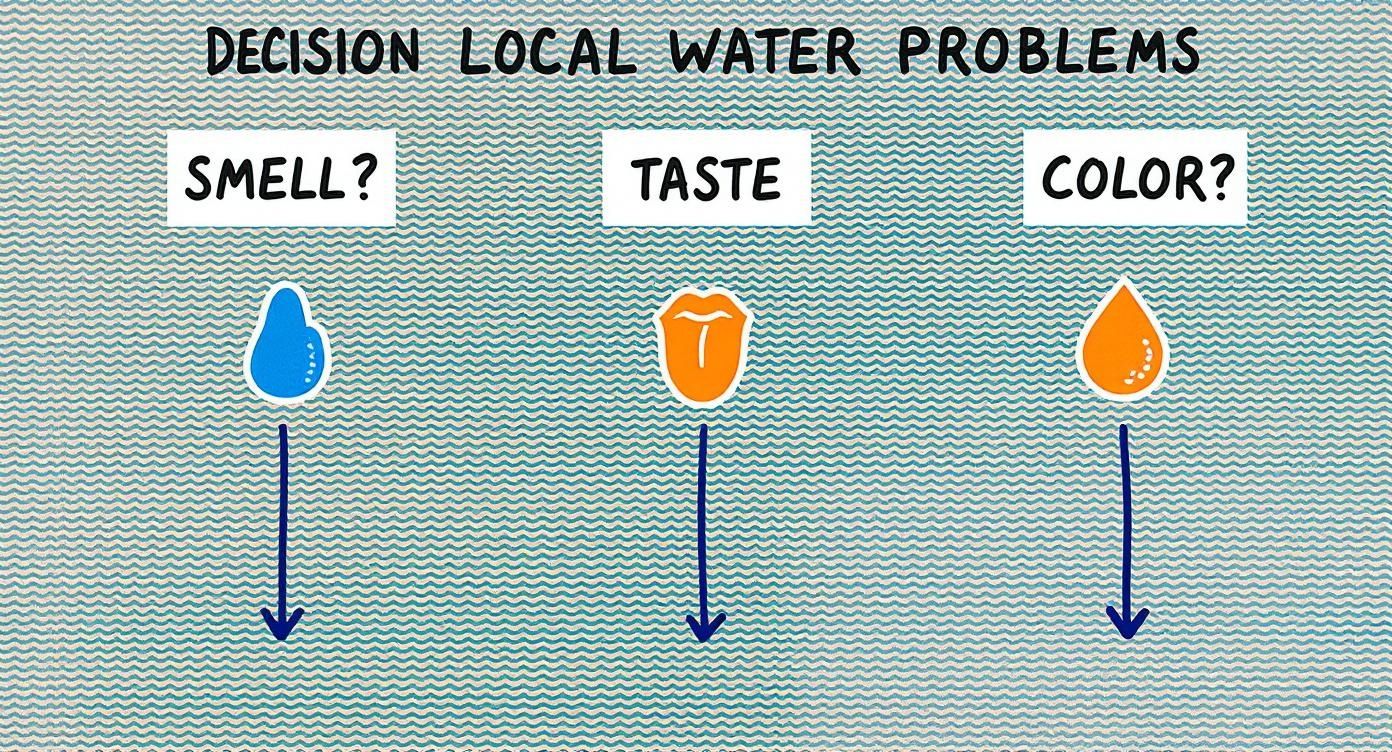
Think of it as a first-glance diagnostic tool. The clues your senses pick up can point you toward the underlying issue and the type of system you likely need.
Matching the System to the Contaminant
I can't stress this enough: there is no "one-size-fits-all" answer for well water. The best system for you is the one specifically designed to tackle what your water test found. Getting a custom solution from a professional like Water Medic of Cape Coral means you aren't overpaying for features you don't need or, even worse, installing a system that doesn't fix the actual problem.
Here’s a look at how specific systems solve the common issues we see all over Southwest Florida:
- Water Softeners for Hardness: If your report shows high levels of calcium and magnesium, a water softener is a must. It uses ion exchange to pull those minerals out, stopping the limescale that kills water heaters, clogs pipes, and leaves those chalky spots on your dishes.
- Iron & Sulfur Filters for Stains and Smells: Tired of those embarrassing orange rust stains and that "rotten egg" smell? You need a dedicated filter for that. Modern systems use air injection or specialized media to oxidize the iron and sulfur, effectively trapping them so you get crystal-clear, odor-free water.
- Activated Carbon Filters for Taste and Odor: These are the workhorses for improving the general taste and smell of water. They're fantastic at removing organic compounds. The market for activated carbon filters is projected to hit USD 2.6 billion by 2032, which really speaks to how effective and trusted this technology is.
Advanced Solutions for Purity and Safety
For some of the most serious well water contaminants, we need to bring in more advanced technology. These systems are designed to provide the highest level of protection against invisible threats that pose real health risks.
UV Sterilizers to Neutralize Bacteria
If your water test came back positive for bacteria like E. coli or coliform, a UV (ultraviolet) sterilizer is non-negotiable. It's a simple but brilliant technology. A powerful UV lamp zaps the water as it passes by, destroying the DNA of microorganisms and making them harmless. The best part? It does this without adding a single chemical to your water. A UV system is your final line of defense against waterborne illness.
Expert Tip: A common mistake I see is people assuming a standard filter removes bacteria. Most sediment filters do nothing to kill pathogens. Only a true disinfection system, like a UV sterilizer, can make your water biologically safe.
Reverse Osmosis for Ultimate Purity
When it comes to removing the absolute widest range of contaminants, nothing on the market beats reverse osmosis (RO). An RO system uses pressure to force water through a microscopic membrane. This membrane is so fine it can strip out dissolved salts, nitrates, arsenic, and countless other impurities that other systems simply can't touch. For those curious about the science, the technology shares principles with a lab water purifier for distilled water, which is designed for absolute purity.
Here in coastal areas like Cape Coral, where saltwater intrusion is a constant threat, RO is the gold standard. A https://watermedic.com/whole-home-reverse-osmosis/ is the definitive solution, giving you water that's better than bottled quality from every faucet. It’s the most complete way to achieve total peace of mind.
To help you see how these different systems stack up, here’s a quick comparison of the most common whole-house solutions we install for well water.
Well Water Purification System Comparison
| System Type | Best For Removing… | Average Cost | Maintenance Level | Best Fit |
|---|---|---|---|---|
| Water Softener | Hardness minerals (calcium, magnesium) | $1,500 – $3,500 | Low | Homes with limescale buildup, spotty dishes, and soap scum issues. |
| Iron & Sulfur Filter | Iron (rust stains), sulfur (rotten egg smell), manganese | $1,800 – $4,000 | Low | Wells with high iron/sulfur content causing aesthetic problems. |
| UV Sterilizer | Bacteria, viruses, protozoa, and other microorganisms | $800 – $2,000 | Low | Any well with a positive bacteria test; provides biological safety. |
| Reverse Osmosis (RO) | Dissolved solids, salt, nitrates, arsenic, lead, fluoride | $5,000 – $15,000+ | Medium | Homes with saltwater intrusion, high TDS, or for ultimate purity. |
Choosing the right system can feel like a big decision, but with your water test results and this guide, you’re well on your way. The key is to match the technology directly to your water’s unique chemistry for the best results.
Why Professional Installation Is Non-Negotiable
You’ve done your research, tested the water, and picked out a great purification system. It feels like the heavy lifting is done, but there's one last, critical step: the installation.
It’s tempting to see this as just another plumbing project—a weekend warrior task to save a few bucks. But let me tell you from experience, when it comes to something as vital as your family's water, this is the one place you absolutely don't want to cut corners. A DIY install can go wrong in ways you can't even imagine.
The Hidden Dangers of a DIY Installation
Trying to install a whole-house water system yourself is a bit like doing your own dental work. You might have some of the right tools, but a lack of specialized knowledge can create far bigger problems than the one you started with.
A seemingly small mistake during setup can cripple the entire system's effectiveness and even cause catastrophic damage to your home. These systems aren't just fancy filters; they are sophisticated pieces of equipment that have to be perfectly integrated into your home’s unique plumbing.
We see the same DIY pitfalls time and time again:
- Incorrect System Sizing: A pro calculates the right system size based on your home's flow rate (gallons per minute), peak water demand, and specific contaminant levels. An undersized system will kill your water pressure and fail to treat the water properly. An oversized one just wastes money and runs inefficiently.
- Tiny Leaks, Massive Damage: Even a minuscule, slow drip from a poorly sealed fitting can go unnoticed for weeks. Before you know it, that "minor" leak has caused thousands of dollars in water damage, invited mold into your walls, and started rotting out structural beams.
- Voided Warranties: That warranty on your expensive new system? It almost certainly requires professional installation. If something goes wrong with a unit you installed yourself, you're likely on the hook for the full cost of any repairs or a complete replacement.
Hiring a certified professional isn't just an expense; it's an investment in getting the job done right the first time. Think of it as the ultimate insurance policy for your equipment, your home, and your family's health.
The Difference Professional Expertise Makes
When you bring in a seasoned expert like Water Medic of Cape Coral, you’re getting more than just a plumber with a wrench. You're getting a water treatment specialist who lives and breathes the unique water challenges here in Southwest Florida. Our entire process is built to deliver a flawless installation and your complete peace of mind.
Just as professional installation is key for your well water system, understanding the broader benefits of hiring a professional waterproofing company underscores the value of expert service for any critical home system. The principle is identical: preventing water problems is always smarter and cheaper than cleaning up the mess later.
What Our Professional Service Guarantees
Bringing in our team is about making sure your investment works exactly as it should from day one. Our certified technicians have years of hands-on experience specifically with well water systems, which means we know how to spot and solve problems before they even start.
Here’s what you get when we handle the installation:
- Expert Assessment and Verification: We don’t just hook it up. We double-check your water test results against the equipment you've chosen to confirm it's the perfect match for your home's specific needs.
- Flawless and Compliant Installation: Our team ensures every connection is rock-solid, every component is calibrated correctly, and the entire setup meets all local plumbing codes. This isn't just about making it work; it's about making it safe.
- System Optimization: We don't just flip the switch and leave. We run a full set of diagnostics, test the water after treatment to prove it's pure, and then walk you through exactly how your new system works and what maintenance looks like.
- Ongoing Support and Accountability: Our relationship doesn't end when we drive away. You now have a dedicated partner for any future questions, maintenance reminders, or service calls.
Opting for a professional install is the final, most important step in purifying your well water. It’s what transforms a powerful piece of equipment into a reliable, integrated solution for clean, safe water throughout your home.
Keeping Your Water Pure for Years to Come
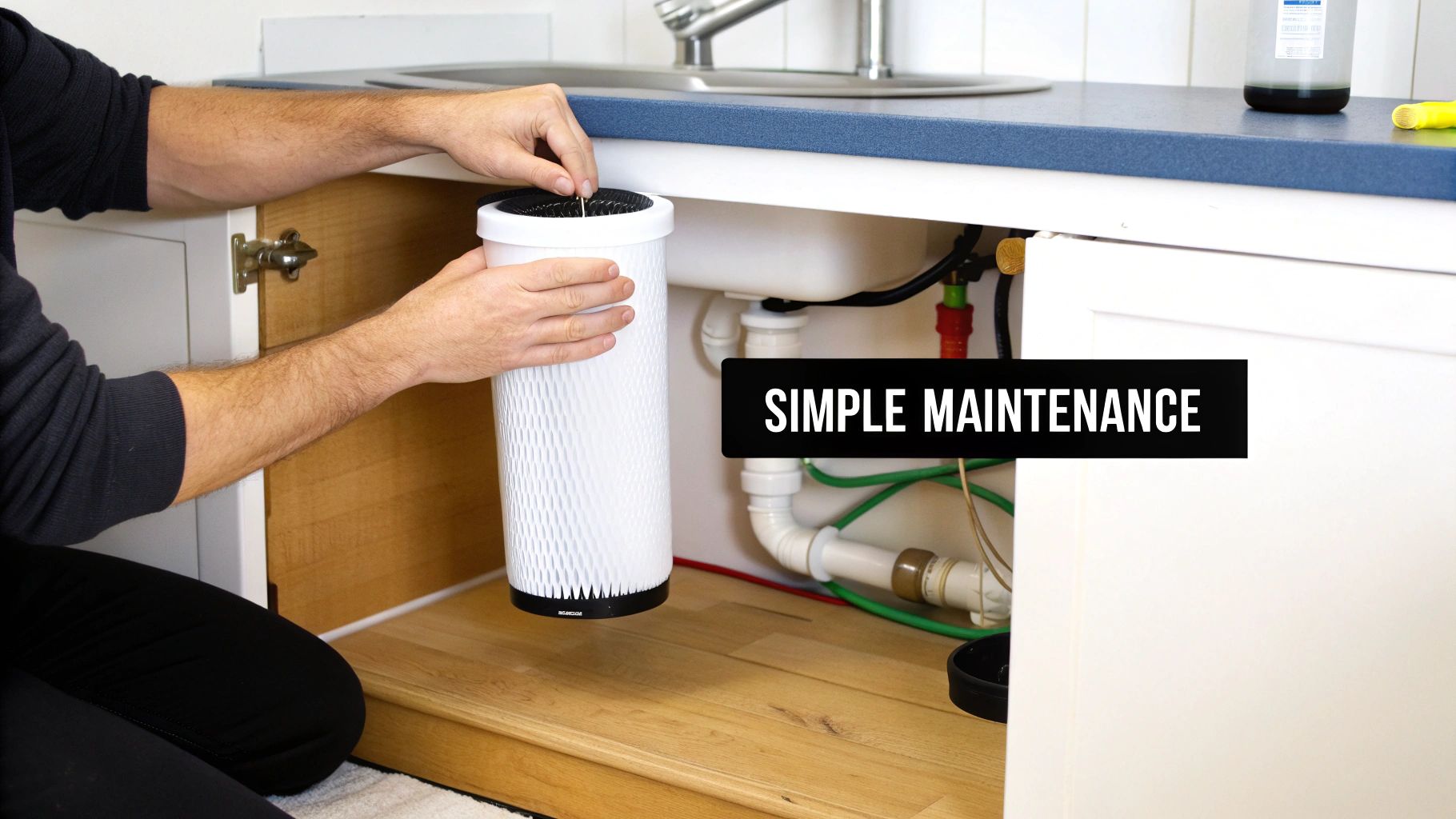
Think of your whole-house water purification system like a high-performance engine. You wouldn't expect it to run perfectly for years without an oil change or a tune-up. Your water system is the same—it needs consistent care to keep delivering the clean, safe water your family relies on.
Putting in a top-tier system is a fantastic first step, but the real key to lasting purity is what happens next. Neglecting routine care doesn't just reduce performance; it can lead to expensive damage and, worse, a false sense of security about what’s coming out of your tap.
Building a Simple Maintenance Schedule
Staying on top of your system’s needs doesn't have to be complicated. Each piece of equipment has its own simple checklist and timeline. Knowing these basics empowers you as a homeowner and ensures you get the maximum value and protection from your investment.
Here’s a practical guide to the most common maintenance tasks for well water systems:
- Reverse Osmosis (RO) Systems: These workhorses have multiple filters that need attention. The pre-filters, which catch sediment and chlorine before they reach the main membrane, should be swapped out every 6 to 12 months. The RO membrane itself, the heart of the system, typically lasts 2 to 5 years.
- Water Softeners: The main job here is simple: keep the brine tank filled with salt. I recommend checking the salt level monthly and topping it off as needed. This ensures the system can properly regenerate and keep removing those hard water minerals.
- UV Sterilizers: This is your frontline defense against bacteria and viruses, so you can't let it slide. The ultraviolet lamp has a finite lifespan and must be replaced annually. After a year, its intensity drops, and it can no longer guarantee it's zapping every microorganism.
Your water purification system is a working machine, not a static fixture. Routine upkeep is the only way to ensure it continues to do its job of protecting your family from the specific contaminants found in your well.
A Growing Global Focus on Water Safety
The need for well-maintained purification systems isn’t just a local issue in Cape Coral; it’s a global priority. With factors like urbanization and population growth impacting water quality worldwide, the demand for effective solutions is soaring.
The global market for these systems was recently valued at USD 56.38 billion and is projected to climb past USD 123.24 billion by 2037. Major investments, like China’s USD 14.2 billion commitment to rural water safety, show just how critical reliable purification is for public health. You can see more on these trends in this research on the water purification systems market.
This worldwide focus just underscores the importance of not only installing a system but also keeping it in peak condition.
The Hassle-Free Solution for Pure Water
Let’s be honest, life gets busy. Remembering when to change a filter or replace a UV lamp can easily fall to the bottom of the to-do list. That’s precisely why we created a simple, hands-off solution for homeowners who want guaranteed performance without the headache.
Our professional Maintenance and Service Plans take the guesswork and effort completely off your plate. We handle everything for you:
- We track the service schedule for every single component.
- We provide and install the correct, high-quality filters and parts.
- We perform system check-ups to make sure everything is running efficiently.
With our service plan, you never have to lift a finger. You just get to enjoy the peace of mind that comes from knowing your water is always pure, safe, and protected by experts. It's the easiest way to ensure your system works just as well five years from now as it did on day one.
Your Well Water Questions, Answered
When you're dealing with well water, it's natural to have a lot of questions. We get it. Moving from just guessing about your water quality to actually knowing what's in it is a big step. It all starts with a proper water test and ends with the right system for your home.
To help clear things up, here are answers to some of the most common questions we hear from homeowners in Southwest Florida.
How Often Should I Get My Well Water Tested?
This is probably the most important question, and the answer is straightforward: at least once a year. The Centers for Disease Control and Prevention (CDC) backs this up, recommending annual tests for bacteria, nitrates, and other usual suspects as a basic safety check.
That said, you should test more often if something changes. Notice a new taste, a weird smell, or a cloudy look? Time for a test. It's also wise to test after a big local event, like a flood or even heavy construction down the street, which can stir things up underground and introduce new problems.
Is a Basic Water Filter Pitcher Good Enough for Well Water?
A pitcher filter can make city water taste a bit better, but for well water, it's a hard no. It's simply not powerful enough for the job. Those simple carbon filters are designed to handle minor things, like the taste of chlorine from a municipal supply.
They are completely defenseless against the serious, invisible threats often lurking in well water, such as:
- Bacteria and viruses like E. coli
- Nitrates from local fertilizer runoff
- Dissolved minerals that make water hard
- Heavy metals like arsenic or lead
To tackle these, you absolutely need a dedicated, whole-house solution like a UV sterilizer or a reverse osmosis system. That's how you make sure your water is genuinely safe to drink.
The biggest mistake we see is people thinking "filtered" is the same as "purified." A pitcher filter can make unsafe water taste perfectly fine, which creates a dangerous false sense of security. Real purification neutralizes the biological and chemical threats you can't see, taste, or smell.
Is a Water Softener the Same Thing as a Water Purifier?
Nope, they're two different tools for two different jobs, though they often work together as a team. A water softener has one mission: remove the hardness minerals (calcium and magnesium) that cause that chalky scale buildup on everything. This saves your appliances and keeps your pipes clear.
A water purifier, on the other hand, is all about safety. It's built to remove health-concerning contaminants like bacteria, viruses, chemicals, and other dissolved solids. For many homes, the ideal setup is a water softener and a purification system working in tandem. You can see more details about how our different systems function on our well system FAQs page.
What's the Ballpark Cost for a Whole-House Well Water System?
The investment can vary quite a bit because there’s no one-size-fits-all solution. Your system has to be designed to fix your specific water issues.
For instance, a simple sediment filter might just be a few hundred dollars. But a more complex, multi-stage system built to handle a nasty combination of iron, sulfur bacteria, and saltwater intrusion could run several thousand.
Everything depends on what your professional water test reveals. This is why getting an on-site consultation is the only way to get a real quote. It ensures you’re paying for exactly what you need to fix your water—and nothing you don’t.
Ready to stop wondering and get real answers about your water? The team at Water Medic of Cape Coral has been solving Southwest Florida’s trickiest well water problems for over 25 years. Contact us today for a professional water analysis and a personalized quote.