what is tds in water: Understand levels and fixes
Ever stopped to think about what's actually in your glass of water besides, well, water? The answer lies in something called Total Dissolved Solids, or TDS. This is simply a measure of all the stuff—minerals, salts, metals, and even some organic matter—that has dissolved into your water on its journey to your home. Think of it as a key report card for your water's overall quality, and understanding it is the first step toward getting the pure, clean water your family deserves.
Decoding Total Dissolved Solids in Your Water
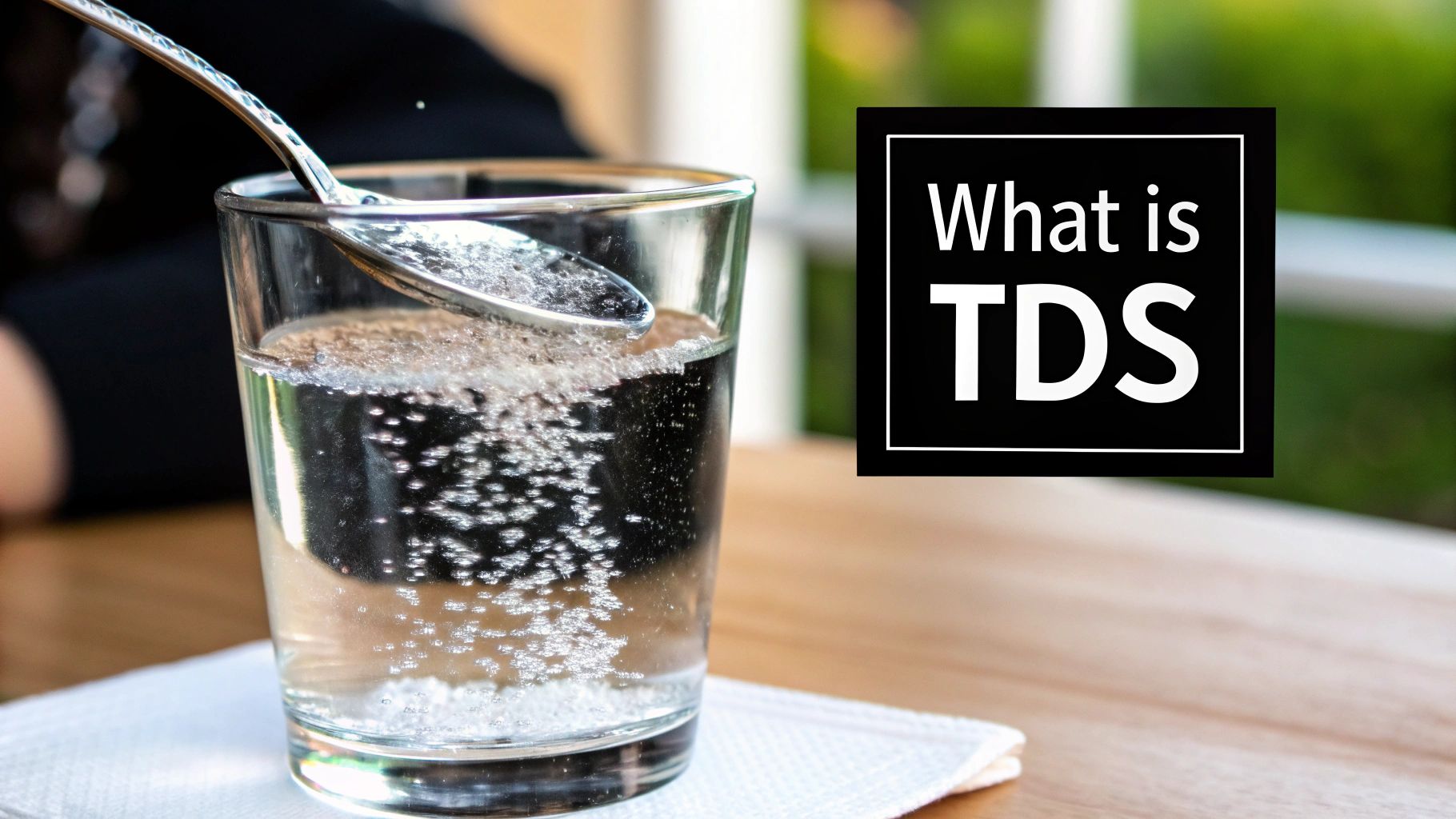
Imagine stirring a spoonful of sugar into a glass of water. It disappears, right? But you know it's still there because the water tastes sweet. TDS works on the same principle. It’s not a single substance, but rather a catch-all term for the countless invisible particles your water has picked up along the way.
These solids can come from anywhere. Some are completely natural, like minerals that water dissolves as it flows over rocks and through soil. Others are man-made, stemming from things like industrial discharge, road salts, or even the chemicals used in public water treatment. The final measurement, given in parts per million (PPM), gives you a snapshot of just how much "extra stuff" is in your tap water.
What Makes Up TDS
Not all dissolved solids are the same, and they don't all have the same effect. A high TDS reading could be a cocktail of different elements.
Here are some of the most common culprits:
- Inorganic Salts: These are usually the main contributors. We're talking about things like sodium, potassium, and chloride.
- Hardness Minerals: Calcium and magnesium are the big two here. They're the minerals responsible for creating hard water—a huge headache for many homeowners. If you’re battling chalky white spots on your dishes and faucets, you’ll want to check out our professional water softeners.
- Trace Metals: Elements like iron, copper, and manganese can also add to the TDS count, often leaving behind a distinct metallic taste.
It's crucial to understand that a TDS reading tells you the 'how much' but not the 'what.' It's a quantitative measurement, not a qualitative one. It reveals the total amount of dissolved substances but won't identify what they are, which is why a professional water analysis from Water Medic is so valuable.
So, how much is too much? The U.S. Environmental Protection Agency (EPA) recommends a maximum level of 500 PPM for drinking water. It’s important to note this is a secondary standard, meaning it's based on aesthetics—like taste, odor, and color—rather than being a hard-and-fast health rule.
Understanding TDS Levels at a Glance
To make it easier to see what those numbers mean, here's a quick reference table that breaks down TDS readings and what they typically indicate about your tap water.
| TDS Level (PPM) | Water Quality Classification | Common Characteristics |
|---|---|---|
| 0-50 | Ideal Drinking Water | Very pure, often found in distilled or reverse osmosis water. |
| 50-150 | Excellent Quality | Crisp and clean taste, typical of high-quality filtered water. |
| 150-300 | Good Quality | Generally acceptable, with a noticeable but slight mineral taste. |
| 300-500 | Fair Quality | Noticeable taste, cloudiness, or even a slight odor. |
| 500+ | Poor Quality | Often tastes salty or metallic; can stain fixtures and laundry. |
This table gives you a general idea, but every home's water is unique. Knowing your specific TDS level is the first step toward getting the clean, great-tasting water you deserve.
So, Why Should You Care About High TDS Levels?
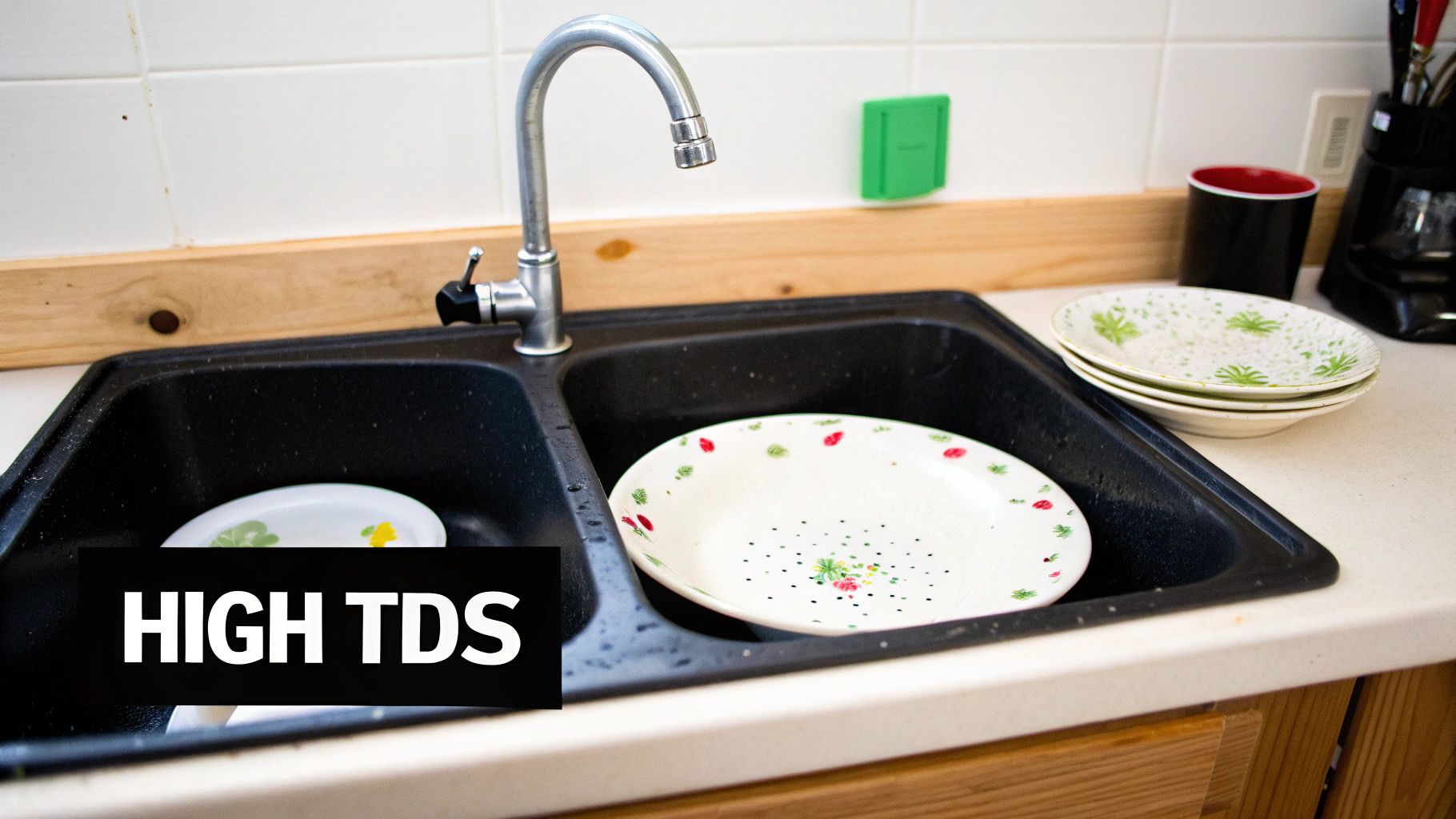
"Total Dissolved Solids" might sound like something you'd hear in a science class, but its impact is very real and probably already part of your daily life. The signs of high TDS often show up as common frustrations you might not have traced back to your water.
Ever pour a glass of water that just tastes… off? A bit salty, bitter, or even metallic? That's a classic sign. Those dissolved minerals and salts are directly affecting the taste, turning a simple glass of water into a letdown. It can even mess with the flavor of your morning coffee, tea, and everything you cook.
And what about those stubborn white spots on your clean dishes, shower doors, and faucets? That's limescale, the chalky mineral residue left behind when hard water evaporates. You can scrub all day, but if the problem is in your water, those spots will just keep coming back. Our water treatment solutions can put an end to this cycle for good.
The Hidden Damage It's Doing to Your Home
The headaches from high TDS go well beyond taste and annoying spots. The same minerals staining your glassware are quietly building up inside your home's plumbing and appliances, causing damage you can't see.
Think of this internal scale buildup like cholesterol in an artery—it slowly chokes off water flow and forces everything to work harder. Eventually, this leads to some serious problems:
- Skyrocketing Bills: When scale coats the heating element in your water heater, it has to burn more energy just to do its job. Your utility bills creep up without you even realizing why.
- Shorter Appliance Life: Your dishwasher, washing machine, and ice maker are all under constant strain from mineral buildup, leading to more breakdowns and a much shorter lifespan.
- Expensive Repairs: Clogged pipes and failing parts can lead to emergency plumbing calls and costly replacements that could have been completely avoided.
The only way to really protect your home is to know exactly what’s in your water. A high TDS reading is a red flag, but the real key is figuring out which specific minerals are causing the trouble.
This is why a basic DIY meter just doesn't cut it. To truly fix these issues, you need to understand the unique chemistry of your water. A comprehensive water analysis from our team at Water Medic gives you the full picture, allowing us to pinpoint the cause and recommend a solution that actually works for your Cape Coral home.
Measuring TDS and Making Sense of the Numbers
So, how do you get the TDS reading for your home's water? The quickest way is with one of those handheld digital TDS meters you see online. They work by measuring electrical conductivity—essentially, the more dissolved stuff in the water, the easier it is for electricity to pass through, which the meter translates into a TDS estimate.
It’s a neat trick, but it's not the whole story. The old-school way to measure TDS was to evaporate a water sample and physically weigh the residue left behind. While that method is slow, it's dead-on accurate. In contrast, those handy digital meters can be off by as much as 20%, since different minerals conduct electricity differently. You can dive deeper into the science behind TDS measurement accuracy in this technical guide if you're curious.
The real problem with a DIY test is that it raises more questions than it answers. It can tell you that you have a high number, but it can't tell you what is causing it.
Why the Number Itself Isn't Enough
Getting a TDS reading is a great first step, but it’s just one piece of a much larger puzzle. Is that high number coming from harmless minerals like calcium, or is it a red flag for something less desirable? A simple meter has no idea.
This is where a professional analysis makes all the difference. We see it all the time: homeowners come to us with a high TDS reading, worried about what it means for their family.
A DIY meter gives you a number. A professional water analysis from Water Medic tells you the full story behind that number, identifying the specific minerals and contaminants impacting your water.
Trying to solve a "high TDS" problem without knowing the cause is like taking medicine without a diagnosis. That’s why our comprehensive water analysis doesn't just give you a number; it gives you a detailed breakdown. We pinpoint exactly what’s in your water, allowing us to recommend a solution that actually fixes the problem instead of just taking a shot in the dark.
How High TDS Messes With Your Swimming Pool
For those of us in Cape Coral, a swimming pool isn't just a perk—it's a huge part of our lifestyle and a major investment in our homes. But what happens when that crystal-clear oasis starts fighting back? The same total dissolved solids that can be a problem in your drinking water can absolutely wreak havoc on your pool.
Think about everything that goes into your pool over a season: sunscreen, leaves, dirt, and all the chemicals you add to keep it clean. As water evaporates under the hot Florida sun, all that stuff gets left behind, becoming more and more concentrated. This is what drives your TDS level up.
Ideally, you want your pool's TDS to stay under 2,000 PPM. Once it starts creeping past that number, you’re heading for trouble.
The Unseen Damage High TDS Can Do
When TDS gets too high, the water essentially gets "heavy" and old. Your chlorine just can't do its job effectively anymore. It becomes sluggish, forcing you to dump in more and more chemicals just to keep the water from turning green. It's a frustrating—and expensive—cycle.
Here are the tell-tale signs that your TDS is out of control:
- Stubbornly Cloudy Water: The water just won't clear up, no matter how many times you shock it or run the filter.
- Irritated Skin and Eyes: Swimmers start complaining about itchy skin and red, stinging eyes after a dip.
- Corroding Equipment: That mineral-heavy water starts eating away at metal parts like ladders, light fixtures, and heater components, leading to costly repairs.
- Ugly Stains: Dissolved metals and minerals can leave nasty stains on your pool's plaster or liner that are tough to remove.
Simply put, high TDS turns your pool into a high-maintenance headache. It makes swimming uncomfortable and actively shortens the life of your expensive equipment.
Instead of just fighting the symptoms with more chemicals, the smart move is to tackle the root cause. Our team at Water Medic specializes in diagnosing and fixing high TDS problems, bringing your pool back into perfect balance.
To see how we can make your water pristine and safe again, check out our professional swimming pool services.
Effective Solutions for Lowering High TDS Water
Finding out you have high Total Dissolved Solids in your water is one thing, but figuring out how to fix it is the crucial next step. Thankfully, you don’t have to live with it. Powerful and reliable water treatment systems can purify your water, get rid of those unwanted solids, and protect your home’s plumbing and appliances from long-term damage.
When you need to get serious about reducing TDS, one method is the clear winner: Reverse Osmosis (RO). This isn't just a simple filter; it's an advanced purification process. An RO system uses a special semipermeable membrane that acts like a microscopic gatekeeper, forcing pure water molecules through while blocking almost everything else.
Just how effective is it? A good RO system can remove up to 99% of dissolved salts, minerals, and other contaminants. What you’re left with is incredibly pure, great-tasting water. For a complete solution that treats every faucet in your home, many Cape Coral residents turn to our Whole-House Reverse Osmosis systems to ensure top-quality water everywhere, from the kitchen sink to the shower.
Targeted Treatments for Specific Issues
While Reverse Osmosis is the top-tier solution for overall TDS reduction, sometimes the problem is more specific. If your high TDS is mainly due to calcium and magnesium—the two minerals that cause hard water—then a water softener is a fantastic and efficient solution.
Water softeners work through a process called ion exchange, specifically targeting and removing those hardness minerals. This not only brings down your TDS reading but also directly combats the limescale buildup that wreaks havoc on your appliances and leaves those annoying spots on your glassware. It’s like providing specialized protection for your home’s plumbing.
High TDS isn't just an issue inside the house; it can cause major headaches in your swimming pool, too.
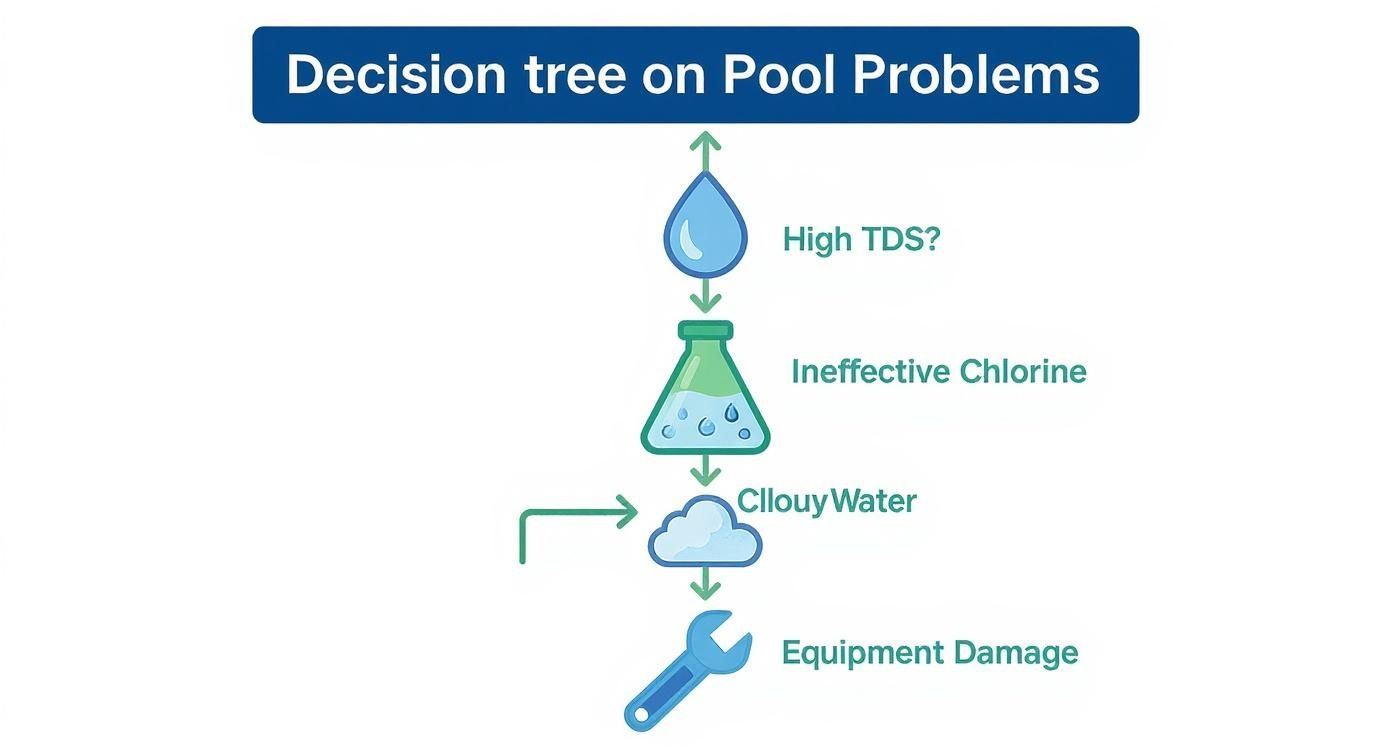
As you can see, a single problem—high TDS—can set off a chain reaction of frustrating and expensive pool issues. The same principle applies to your home's water. Getting to the root cause is the only way to find a lasting solution. At Water Medic, our experts start with a thorough water analysis to pinpoint exactly what’s going on. From there, we can recommend the right system or combination of treatments to solve your specific water challenges for good.
Your Top TDS Questions, Answered
We’ve covered a lot of ground, from what Total Dissolved Solids are to how they affect your home and pool. Let's wrap things up by tackling some of the most common questions we hear from homeowners here in Cape Coral.
Is a High TDS Level Always a Health Hazard?
Not necessarily. Many of the "solids" we're talking about are just minerals like calcium and magnesium, which aren't harmful. But a high TDS reading can be a red flag.
Think of it as a warning light. It might indicate the presence of less desirable things like nitrates or certain metals. The only way to know for sure what's in your water is to get it professionally tested. That's how you can be certain it's safe for your family.
What’s the Perfect TDS Level for Drinking Water?
The EPA recommends keeping TDS below 500 PPM (parts per million), but this is more about aesthetics—taste, smell, and clarity—than health. From our experience, the best-tasting water is usually in the 50-150 PPM range.
That’s the sweet spot our water treatment systems are designed to hit. The water that comes out of our reverse osmosis systems consistently falls into this ideal range, giving you that crisp, pure taste you want.
Will a Regular Water Filter Pitcher Lower My TDS?
Those popular carbon filter pitchers are great for making your water taste better by removing chlorine. However, they do not significantly reduce Total Dissolved Solids.
To really bring down a high TDS number, you need something more powerful. A whole-house reverse osmosis system is the go-to technology for truly purifying your water.
How Do I Get My Water Tested by a Pro?
It's actually really simple and the best first step you can take. Just give us a call to set up a free, no-pressure consultation.
Our experts will come out and run a detailed analysis of your home's water. We'll give you a straightforward report on your TDS levels and other important readings, then walk you through the best solutions for your specific situation.
Ready to see what’s really in your water? Contact Water Medic of Cape Coral today for a free water analysis and let's get you on the path to pure, clean water. Find out more at https://watermedic.com.