
Water Filtration System Comparison: Your Ultimate Guide
Picking the right water filtration system really boils down to one simple question: what are you trying to fix? Are you looking for a system that removes almost everything, like Reverse Osmosis, or are you more focused on improving the taste and smell with Activated Carbon? The best answer always depends on your home’s water quality, and our expert team at Water Medic can help you find the perfect solution.
How to Choose Your Ideal Home Water Filtration System
Trying to find the perfect water filtration system can feel overwhelming, but it doesn't need to be. The real goal is to match the right technology to your home’s specific water problems. That's how our clients get pure, safe, and great-tasting water from every faucet. This guide is designed to give you a straightforward water filtration system comparison to make that choice easier.
As local experts with over 25 years of experience here in Southwest Florida, we’ve helped countless homeowners cut through the confusion. We don’t just drop off a box; we provide a complete, professional solution. It starts with a free, professional water analysis and ends with a perfect installation and ongoing support, ensuring your system works flawlessly from day one.
Comparing Key Filtration Technologies
Getting a handle on the main differences between the most common systems is the first step. Each technology is a specialist, excelling at removing specific types of contaminants. Here’s a quick breakdown of what you need to know.
| Technology | Primary Function | Best For |
|---|---|---|
| Reverse Osmosis (RO) | Pushes water through a fine membrane to remove a massive range of contaminants, including salts, heavy metals, and Total Dissolved Solids (TDS). | Families who want the absolute highest level of purity for their drinking water or need to protect appliances from hard water minerals. |
| Activated Carbon | Acts like a sponge, adsorbing chemicals such as chlorine, pesticides, and VOCs that cause bad tastes and smells. | Homes on city water where the main goal is simply to get rid of that "chemical" taste and odor. |
| UV Purification | Uses ultraviolet light to scramble the DNA of microorganisms like bacteria and viruses, making them harmless. | Anyone using well water or concerned about biological contaminants making their way into their water supply. |
The best systems often don't rely on just one method. A top-tier Reverse Osmosis system, for example, will almost always include carbon pre-filters. This multi-stage approach protects the delicate RO membrane and creates a more robust defense against a wider array of impurities. We specialize in designing these comprehensive solutions.
Ultimately, this comparison is about giving you the clarity to make a great decision. If you're looking for the most complete solution on the market, learning more about a whole home reverse osmosis system is a fantastic next step. By the time you're done here, you'll have a much clearer picture of which technology fits your needs and how our expert team can bring it to life in your home.
Understanding the Contaminants in Your Water

Before you can even begin comparing water filtration systems, you need to know exactly what you’re up against. The reality is that no two water sources are identical. The contaminants found in city water are often wildly different from what you'd find in a private well. This is why a "one-size-fits-all" filter is rarely the right call—different impurities demand specific, expert-recommended solutions.
Getting a clear picture of your water's unique chemistry is the first, most critical step toward getting clean, safe water. If you skip this, you’re just guessing at which technology will actually protect your family.
Common Contaminants in Municipal and Well Water
Water can carry a whole host of substances. Some are harmless, but many others can ruin the taste, create unpleasant odors, or even pose long-term health risks. These impurities generally fall into a few main categories.
- Aesthetic Contaminants: These are the issues you can usually taste, see, or smell. Chlorine is a big one, used by municipalities for disinfection, but it leaves that distinct "swimming pool" odor. Sediment, like fine sand or rust from old pipes, is another common culprit that causes cloudy water.
- Hard Minerals: This is all about calcium and magnesium. While not dangerous to drink, these minerals are the reason you have "hard water." They’re responsible for the destructive scale buildup in your pipes and appliances, the stubborn soap scum on your shower doors, and that dry, itchy feeling on your skin. These minerals require a targeted approach, which you can learn more about in our guide to water softeners.
- Chemical Contaminants: This is the invisible stuff. We're talking about heavy metals like lead and arsenic, pesticides from agricultural runoff, and Volatile Organic Compounds (VOCs) that seep into both city water and private wells.
- Biological Contaminants: A major concern for anyone with a private well, this group includes bacteria (E. coli), viruses, and protozoa (Giardia). These microorganisms are invisible to the naked eye but can cause serious illness and require dedicated purification methods to be neutralized.
The best water treatment plan isn't about buying the most expensive or powerful system—it's about choosing the right one for the job. A system that excels at removing chlorine won’t touch bacteria, and a filter that catches sediment does nothing to address dissolved heavy metals.
The Only Way to Know for Sure
With such a wide range of potential issues, just grabbing a filter off the shelf at a big-box store is a gamble. You might fix one problem while leaving more serious, invisible threats completely untouched. A professional water analysis from Water Medic is the only way to get a clear, accurate picture of what’s really in your water.
This growing awareness is fueling a major trend. The global market for water filtration systems, valued at USD 14.23 billion in 2024, is expected to skyrocket to USD 35.59 billion by 2034. That surge shows just how much people want cleaner, safer water at home.
For those interested in the highest levels of water purity, it's worth looking into specialized systems. For example, understanding how facilities achieve ultra-pure water with equipment like lab water purifiers for distilled water highlights the technology available for specific, high-purity applications.
Our comprehensive water testing services give you the hard data you need to choose the most effective system for your home. It’s time to stop guessing about your water quality and start building a solution based on facts.
A Detailed Water Filtration System Comparison
Trying to choose a water filter can feel overwhelming. It's important to know that different systems are built to tackle different problems. A filter that’s great at getting rid of that chlorine smell from city water might be useless against invisible bacteria in a well.
This side-by-side comparison will break down the three big players—Reverse Osmosis, Activated Carbon, and UV Purification—so you can see exactly how they stack up. When we talk with homeowners, these are the exact criteria we use. It’s not about pushing one system over another; it's about finding what’s right for your water.
Reverse Osmosis (RO): The Purity Powerhouse
When it comes to pure water, Reverse Osmosis is the undisputed champ. It works by pushing water through an incredibly fine membrane, one with microscopic pores that literally strip out almost everything that isn't water.
This is by far the most thorough method, capable of removing up to 99% of all Total Dissolved Solids (TDS). That includes the really tough stuff like heavy metals (lead and arsenic), salts, fluoride, and nitrates. If you're looking for the absolute cleanest, purest water possible, an RO system from Water Medic is your answer.
Key Differentiator: While other systems are more specialized, Reverse Osmosis offers the most complete defense. Think of it less as a filter and more as a total purification system, perfect for anyone wanting to remove the widest possible array of contaminants from their drinking water.
Activated Carbon: The Taste and Odor Specialist
Activated Carbon filters are the go-to for making water taste, smell, and look great. The magic is in the carbon itself—its surface is incredibly porous and acts like a sponge, grabbing onto chemical contaminants through a process called adsorption.
It’s fantastic at removing chlorine, pesticides, herbicides, and those Volatile Organic Compounds (VOCs) that often give municipal water a "chemical" taste. It won't remove healthy minerals or microorganisms, but it excels at turning your tap water into something crisp, clean, and refreshing. For a closer look at how it works, feel free to check out our detailed guide on carbon filters.
UV Purification: The Guardian Against Germs
UV Purification is a totally different beast. Unlike RO and carbon, it doesn't physically remove anything. Instead, it’s a disinfection method. A powerful ultraviolet lamp zaps the water with UV-C light, which neutralizes nasty microorganisms like bacteria, viruses, and cysts (think Giardia and Cryptosporidium) in an instant.
This UV light scrambles their DNA, making it impossible for them to reproduce and cause illness. It’s a completely chemical-free and highly effective way to guarantee your water is biologically safe, which is why it’s a must-have for homes on well water.
Water Filtration Technology At-a-Glance Comparison
To help you see the differences more clearly, here's a quick table breaking down each technology based on what matters most to homeowners. This is the same framework our team uses to help you pinpoint the perfect system for your home and budget.
| Filtration Technology | Best For Removing | Typical Initial Cost | Annual Maintenance | Our Recommendation For |
|---|---|---|---|---|
| Reverse Osmosis (RO) | TDS, heavy metals, fluoride, salts, and virtually all other contaminants. | Moderate to High | Filter and membrane replacements every 1-3 years. | Families wanting the absolute purest drinking water, especially for cooking and consumption. |
| Activated Carbon | Chlorine, pesticides, VOCs, and other chemicals that cause bad tastes and odors. | Low to Moderate | Cartridge replacement every 6-12 months. | Homeowners on city water who primarily want to improve the taste and smell of their tap water. |
| UV Purification | Bacteria, viruses, cysts, and other living microorganisms. | Moderate | UV lamp replacement annually. | Anyone using a private well or concerned about microbiological safety in their water supply. |
This isn't just a niche industry; the global demand for clean water is booming. The water treatment market was valued at USD 41.75 billion in 2024 and is expected to hit USD 91.39 billion by 2034. It's telling that reverse osmosis systems command the largest slice of that pie at 29%, which really speaks to how effective people find them.
In the end, the best solution is often a hybrid one. A comprehensive setup might pair an RO system with UV purification to give you water that is not only incredibly pure but also biologically sterile. This is a common and highly effective strategy we see for homes on well water right here in Southwest Florida.
Matching a Filtration System to Your Lifestyle
Technical specs and data sheets are one thing, but the true test of a water filter is how it fits into your day-to-day life. The best water filtration system comparison isn’t just about the numbers; it’s about figuring out which system solves your specific problems. What works perfectly for your neighbor might be completely wrong for you.
The key is to first understand what you're trying to accomplish. Are you just fed up with the taste of city water? Worried about what might be lurking in your private well? Or are you aiming for the absolute purest water you can get? Each of these goals points to a very different solution.
For the City Homeowner Tired of Chlorine
If your water comes from a municipal supply, your biggest complaint is probably the taste and smell of chlorine. It’s great for disinfection at the plant, but it can ruin a good cup of coffee and make your morning shower smell like a swimming pool. You just want crisp, clean, refreshing water from the tap.
For this, a whole-home activated carbon filter is your best bet. Think of it as a massive sponge that soaks up chlorine and other chemical contaminants right as the water enters your house. The result is better-tasting water from every single faucet, not just the one at the kitchen sink.
- Primary Goal: Get rid of chemical tastes and odors.
- Best Solution: An activated carbon system is designed for exactly this.
- Why It Works: It uses adsorption to pull out chlorine and VOCs while leaving beneficial minerals behind.
- Our Recommendation: Take a look at our lineup of whole-home carbon filters and see how we can drastically improve your city water.
For the Well Water User Concerned About Safety
If you're on a private well, your concerns are completely different. Your water isn't treated with chlorine, so the primary risk is microbiological—bacteria, viruses, and other germs that can find their way into the groundwater. Since you can't see them, making sure your water is biologically safe is priority number one.
In this case, a UV Purification system is non-negotiable. It uses powerful ultraviolet light to zap 99.99% of harmful microorganisms, and it does it without adding any chemicals to your water. We often pair a UV system with a sediment pre-filter to get rid of any cloudiness, ensuring the light can penetrate the water and do its job effectively.
A common and highly effective strategy for well water is a multi-stage approach. By combining sediment filtration, a water softener for mineral removal, and a UV purifier for disinfection, you create a complete defense that addresses every aspect of well water quality.
For the Health-Conscious Family Seeking Ultimate Purity
For some folks, "good enough" isn't good enough. They want the purest water possible, free from everything from heavy metals and fluoride to the dissolved solids that other filters miss. This is especially true for families with young children or anyone managing specific health conditions.
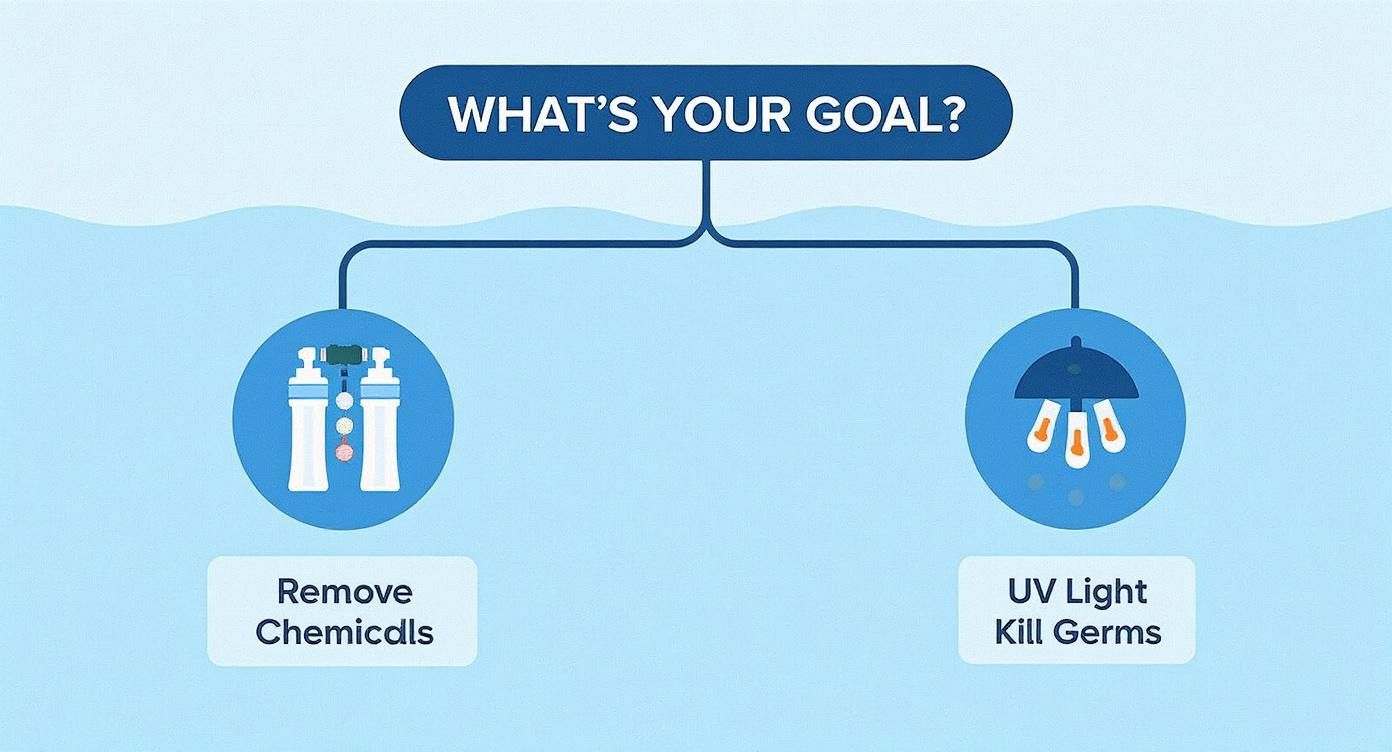
This decision tree shows how your main goal—removing chemicals or killing germs—points directly to the right technology, making a complex water filtration system comparison much simpler. The infographic visualizes that for the most complete removal of chemical contaminants, Reverse Osmosis is the top choice, while UV purification is the dedicated solution for microbiological safety.
The only way to achieve this level of purity is with a Reverse Osmosis (RO) system. It forces water through a hyper-fine membrane that strips out up to 99% of all contaminants, producing water that is incredibly clean. It’s the same technology used for most bottled water, but available right at your sink.
An under-sink RO system is perfect for getting pristine drinking and cooking water, while a whole-home system delivers that purity to every tap. To see this technology in action, learn more about our advanced reverse osmosis systems. This is how we turn technical data into a personalized solution for your family's exact needs.
Making Your Final Decision with Confidence
https://www.youtube.com/embed/5jfeETVqL78
Making sense of all the different water filtration systems can feel like a lot, but by now, you have a solid game plan. The key is to match the technology to what you want to achieve with your water. Are you trying to get rid of that chlorine smell, kill bacteria, or get the purest drinking water possible? Knowing your goal is half the battle.
Think of this decision as an investment. It's not just about buying a piece of equipment; it's about protecting your family's health and even extending the life of your pipes and appliances. We don’t just sell systems—we partner with you to make sure you have clean, safe, and great-tasting water for the long haul.
Turning Knowledge into Action
Let's quickly boil it down to what each system does best. Remember, these are specialized tools, and sometimes the smartest solution is to combine them.
- Reverse Osmosis (RO): When you want the highest level of purity, this is your answer. RO is the only technology that tackles the widest range of contaminants, pulling out things like heavy metals, salts, and fluoride.
- Activated Carbon: This is all about improving the taste and smell of your water. If your main complaint is the chemical odor from city treatment, a whole-home carbon filter is a fantastic and cost-effective fix.
- UV Purification: For anyone on well water, this is non-negotiable. It's your chemical-free defense against invisible threats like bacteria and viruses, making sure your water is truly safe to drink.
Here's the most important thing to remember: The "best" system is simply the one that solves your specific water problems. Without a professional water test, you're just guessing. Our analysis takes the guesswork out of the equation.
Why Professional Guidance Is the Final Step
Doing your homework online is a great start, but it can’t tell you everything. A professional on-site evaluation accounts for the little things a guide can't, like your home's unique plumbing, water pressure, and flow rate. Our experts make sure the system you choose will work perfectly in your home without causing any new headaches.
This need for effective filtration is a growing trend. The global water filter market was valued at USD 15.88 billion in 2024 and is expected to hit USD 26.42 billion by 2032. This isn't just a local concern; it’s a worldwide movement driven by people wanting safer water and better technology.
And once your water is purified, what's next? If you plan on storing it, you'll want to look into the right kind of potable water storage tanks to maintain its quality.
The final piece of the puzzle is a recommendation built just for you, based on your water test and how you live. Let our experts help you put it all together, so you can feel confident in your choice.
Ready for perfect water? Contact us today to schedule your free, no-obligation water assessment.
Got Questions? We've Got Answers
Making the right choice for your home's water can feel overwhelming. To clear things up, here are answers to the questions we hear most often from homeowners just like you.
How Often Should I Be Changing My Water Filters?
This is probably the single most important maintenance task, and the answer really depends on your system and how much water your family uses. There’s no one-size-fits-all schedule.
As a general guideline, you can expect:
- Activated Carbon Filters: Every 6 to 12 months is a safe bet.
- Reverse Osmosis Pre-filters: These also typically last 6 to 12 months.
- RO Membranes: The heart of the system can last 2 to 3 years, but only if the pre-filters are doing their job.
- UV Lamps: You'll need a new one every year to ensure it’s still effective at neutralizing microorganisms.
Forget about marking your calendar. We offer simple maintenance plans where our team tracks everything and handles the filter changes for you. This way, your system is always running at its best, and you don't have to give it a second thought.
Is a Filtration System Going to Ruin My Water Pressure?
That's a valid concern. Nobody wants a weak shower. The good news is that a properly sized and professionally installed system will have a negligible effect on your water pressure—so small you won't even notice it.
Pressure problems pop up when a system is too small for the home or when the installation is botched. We head this off from the start by conducting a thorough assessment of your plumbing, flow rate, and existing pressure. Our technicians only use high-flow components and design the installation to ensure you maintain that strong, steady pressure you're used to.
Can I Just Install a System Myself?
You can certainly handle smaller, point-of-use units like a faucet filter. But a whole-home system? That's a different league entirely. These systems are complex and need to be tied directly into your main water line by a professional.
A DIY installation on a whole-home system is a recipe for trouble. You risk leaks, serious water damage, and you could even void the system's warranty. Think of professional installation as an insurance policy that guarantees your system works perfectly from the get-go.
Our certified technicians make sure every seal is tight and every setting is calibrated for Southwest Florida's unique water challenges. It’s the only way to be certain you're getting the full value and protection from your investment.
Does Filtering Water Get Rid of the Good Minerals?
That all comes down to the technology. When you look at a water filtration system comparison, you'll see different methods have different results. Systems using activated carbon or UV light don't remove minerals, so healthy ones like calcium and magnesium stay put.
Reverse osmosis is another story. It's designed to be extremely thorough, and its membrane removes nearly everything—unwanted contaminants, yes, but also those beneficial minerals. For anyone who wants the purest water possible but still prefers the taste of mineral water, we have a simple solution: a remineralization filter. This add-on puts a healthy balance of minerals back into the water right before it comes out of your tap.
It’s truly the best of both worlds: pristine, safe water that also tastes fantastic. If you’re ready to explore a system that can deliver both, take a look at our whole home filtration solutions. Our team can put together the perfect setup for your home.
Ready to enjoy pure, safe, and delicious water from every tap? The experts at Water Medic of Cape Coral are here to help. We have over 25 years of experience providing top-tier water solutions in Southwest Florida. Contact us today for a free water assessment and personalized recommendation.