Water Descaler vs Water Softener Which Is Right for Your Home?
When you're trying to choose between a water descaler and a water softener, it really boils down to one simple question: do you want to remove the hard minerals or just condition them? A water softener actually takes minerals like calcium and magnesium out of your water, giving you truly soft water. A descaler, on the other hand, changes the structure of those minerals so they can't form scale, but it leaves them in the water.
Your perfect solution depends on what you're trying to fix. Are you tired of hard water problems and want to eliminate them completely, or is your main goal just to protect your plumbing? At Water Medic, our expert team can help you find the perfect solution tailored to your home's needs.
Descaler vs Softener: The Definitive Answer for Hard Water
Hard water is a relentless headache for homeowners. It leaves behind that chalky white residue on faucets and shower doors, makes your appliances work harder, and can eventually lead to serious plumbing issues. Picking the right system to fight back can seem daunting, but it gets much clearer once you understand what each technology is designed to do.
Here at Water Medic, we walk Southwest Florida residents through this decision every single day. The best system for your home is always going to depend on your specific water chemistry and what you're hoping to accomplish. Our professional installation and service ensure you get the right solution, installed correctly.
How They Work: Ion Exchange vs. Crystallization
A water softener works through a process called ion exchange. It uses a resin bed to grab onto the "hard" minerals (calcium and magnesium) and swaps them out for "soft" sodium ions. This is why you need to add salt to a traditional softener. The result is water that feels silky smooth and gives you all the classic benefits—brighter laundry, softer skin, and spotless dishes.
A water descaler, also called a conditioner, uses a completely different, salt-free method often called Template Assisted Crystallization (TAC). Instead of removing the minerals, it uses a special media to convert them into tiny, stable crystals that won't stick to surfaces. The minerals are still there, but they flow right through your plumbing without causing scale buildup.
Core Differences at a Glance
For a straightforward comparison, this table breaks down the main distinctions between the two systems.
Water Descaler vs Water Softener At-a-Glance
| Feature | Water Softener | Water Descaler |
|---|---|---|
| Primary Function | Removes hardness minerals | Conditions minerals to prevent scale |
| Effect on Water | Creates truly "soft" water | Minerals remain; water is not softened |
| Technology Used | Ion exchange (uses salt) | Template Assisted Crystallization (TAC) |
| Ideal Use Case | Complete hard water elimination | Scale prevention with zero maintenance |
| Feel of Water | Silky, sometimes "slimy" | Unchanged |
| Maintenance | Requires salt refills | Virtually maintenance-free |
As you can see, the choice between a water descaler and a water softener is a choice between comprehensive treatment and targeted protection. As we dive deeper, you’ll get the clarity you need to make the right investment for your home.
Demand for softeners continues to grow because people want to protect their investments. A quality system can extend a water heater's life by up to 30% and reduce its energy costs by preventing that insulating layer of scale from forming. You can find more about these trends in recent water softener market analysis.
Ultimately, deciding which system is right for you means weighing these differences against your household needs. To see how we can help, feel free to explore our primary services page to learn more about our professional solutions.
How Each System Actually Deals With Hard Water
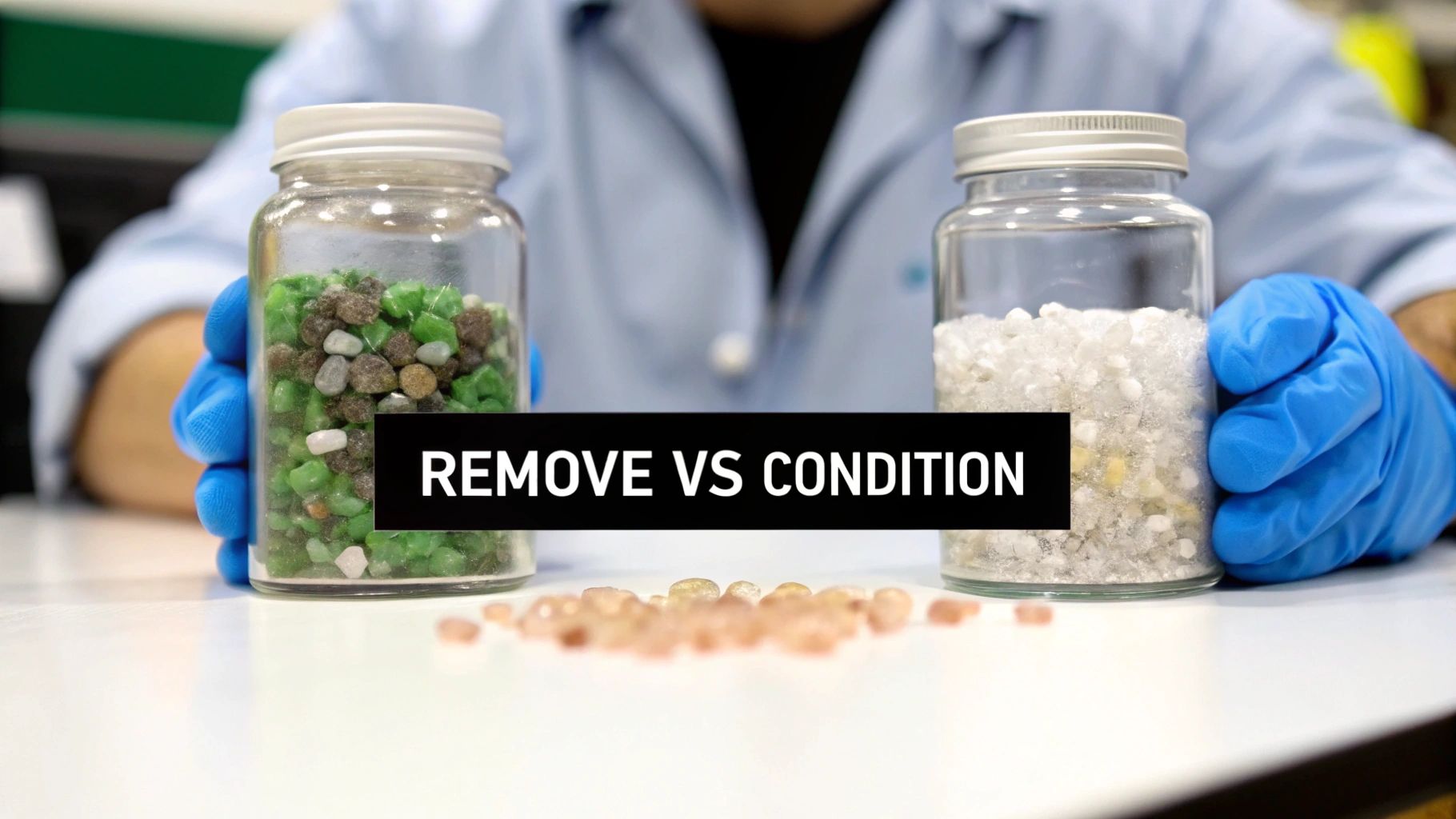
To pick the right system, you first have to get your head around one core idea: one of these systems removes the problem, while the other just changes how the problem behaves. It's a fundamental difference that affects everything from the feel of your water to the health of your pipes.
This distinction between removing vs. conditioning is genuinely the most important piece of the puzzle. It’s the key to understanding why you get such different results from each one. Let's break down how each approach works in the real world.
Water Softeners: The Ion Exchange Method
A traditional water softener uses a tried-and-true scientific process called ion exchange. Think of it as a bouncer at a club, swapping an undesirable guest for a welcome one. Inside the softener's tank, there's a bed of resin beads that are covered in sodium ions.
As your hard water flows through, the calcium and magnesium—the minerals that create all that nasty scale—are drawn to these beads. The resin grabs onto the hardness minerals and, in return, releases a sodium ion into the water. It’s a direct swap.
This trade effectively removes the hardness minerals entirely, sending genuinely soft water through your home. This is exactly why you get that noticeably slick, silky feeling in the shower and why soap lathers up so easily. The minerals that cause the problems are literally gone. If you want to dive deeper into how this could change your home, check out our professional water softener solutions.
At Water Medic, our technicians see the results firsthand. A properly installed ion exchange system doesn't just stop new scale from forming; it can slowly dissolve and flush away years of existing buildup in your pipes, which helps restore water flow and appliance efficiency.
Eventually, those resin beads fill up with hardness minerals and can't hold any more. That’s when the system runs a "regeneration" cycle. It uses a saltwater brine to wash all the captured calcium and magnesium off the beads and down the drain, reloading them with fresh sodium so they’re ready to get back to work.
Water Descalers: The Conditioning Approach
Water descalers, which you'll also hear called water conditioners, work in a completely different way. They don't take anything out of the water. Instead, their whole job is to change the physical structure of the minerals so they can't stick to anything. The most common technology for this is Template Assisted Crystallization (TAC).
With TAC technology, hard water flows over a special media that acts as a catalyst. This media encourages the calcium and magnesium ions to clump together and form tiny, stable micro-crystals. These little crystals are completely harmless and can't latch onto your pipes, faucets, or the heating element in your water heater.
Here’s what that means for you:
- Minerals Stay In: The calcium and magnesium are still in the water, just in a new, crystalline form that can’t cause scale.
- Scale is Prevented: Since the crystals can't stick, they just pass right through your plumbing and go down the drain.
- No Salt, No Waste: This process is completely salt-free and doesn't require a regeneration cycle, making it a very low-maintenance option.
The key thing to remember is that a descaler conditions the water but doesn't actually "soften" it. The water chemistry is basically the same, so you won't get that silky feeling or see soap lather up like you would with a softener. Its sole purpose is to protect your plumbing and appliances from scale. This is precisely why having a Water Medic expert perform an on-site water analysis is so critical; we can figure out if your main goal is simply scale prevention or if you need total hardness removal, and then point you to the right technology for the job.
What to Expect Day-to-Day: A Practical Comparison
Let’s get down to what really matters: how will one of these systems actually change your daily life? The technical jargon is one thing, but the tangible results you see and feel in your home are what count. Your choice directly impacts everything from your morning shower to the lifespan of your expensive appliances.
The most obvious differences pop up in tasks that involve soap and water. A water softener physically removes the minerals that kill soap lather, which means you'll notice a huge change. A descaler, on the other hand, is designed to prevent scale but leaves those minerals in the water, so the day-to-day feel of your water and how it behaves with soap will be pretty much the same as it is now.
The Shower and Skin Feel Experience
One of the first places you'll feel a difference is in the shower. Water softeners create a distinctly different sensation on your skin by taking out the calcium and magnesium.
- With a Water Softener: The water feels slick, almost silky. This is because there are no hard minerals left to react with soap, so it rinses away completely. Many people call this a "slippery" feeling, which is the classic sign of truly soft water.
- With a Water Descaler: Your shower experience won't change. Because the minerals are still floating around—just in a crystallized form—the water's texture and the way it interacts with your skin will feel identical to what you're used to.
A water softener delivers that classic 'slippery' shower feel because the hardness minerals are gone. Descaler-treated water feels exactly the same as untreated hard water. This single difference in comfort is often the tipping point for homeowners who want more than just scale prevention.
While treating hard water is the main goal, you can also improve your setup by upgrading fixtures. For example, it's worth understanding a pressure compensating showerhead or aerator to get the most out of your water flow and efficiency.
Laundry, Dishes, and Soap Efficiency
The impact of removing hard minerals touches every cleaning chore in your house. Everyone in Southwest Florida knows how hard water leaves clothes feeling stiff and puts a cloudy film on dishes.
A water softener is a direct fix for these problems. You’ll immediately notice you need way less detergent to get your laundry clean, and your clothes will come out of the wash feeling softer and looking brighter. Glassware from the dishwasher? It'll be sparkling and free of those frustrating hard water spots.
A descaler, however, won't help you here. Since it doesn't actually remove the minerals, you won't see any improvement in soap lather or a reduction in soap scum. Its job is to protect the guts of your washing machine and dishwasher from scale, not to change how well they wash.
To make this crystal clear, here’s a look at the real-world outcomes you can expect.
Practical Outcome Comparison Descaler vs Softener
| Household Task/Effect | Result with a Water Softener | Result with a Water Descaler |
|---|---|---|
| Showering/Bathing | "Slippery" or silky skin feel; easy rinsing | No change in water feel; same as untreated hard water |
| Soap & Shampoo Lather | Rich, abundant lather with less product used | No improvement in lathering |
| Laundry (Clothes) | Softer, brighter clothes; less detergent needed | No change in fabric feel or detergent use |
| Dishes & Glassware | Spot-free and sparkling results | No reduction in hard water spots on dishes |
| Sinks & Faucets | Significantly less soap scum buildup | No reduction in soap scum buildup |
| Scale Prevention | Complete prevention of new scale; can slowly dissolve old scale | Prevents new scale from forming on surfaces |
As you can see, a softener changes the chemical behavior of your water, while a descaler focuses solely on preventing scale buildup inside your plumbing system.
Protecting Your Pipes and Appliances
This is where the race gets a lot closer. Both systems are designed to stop damaging scale buildup, but they go about it in different ways with varying results.
A water softener offers total protection. By eliminating scale-forming minerals at the source, it guarantees your pipes, water heater, coffee maker, and other appliances are safe from limescale's insulating and efficiency-killing effects. In fact, soft water can even slowly dissolve and clear away some existing scale over time.
A water descaler also prevents new scale from forming by crystallizing the minerals so they can't stick to surfaces. This is a solid strategy for protecting your plumbing and appliances from future damage. It’s generally not as effective, though, at removing scale that's already caked on. Systems like our ScaleNet Salt-Free Conditioner are a fantastic, maintenance-free option for homeowners whose primary goal is protecting their home's infrastructure. You can learn more about how our salt-free water conditioners offer powerful scale prevention.
While softeners have been the standard for decades, electronic water descalers are gaining serious ground. Projections show the global market for these systems hitting $1.32 billion by 2033, with a 10.4% annual growth rate. North America is leading the charge, largely due to a growing awareness of water quality issues. This surge in popularity makes it clear that more and more people are looking for effective, low-maintenance ways to fight scale.
How Do You Choose the Right System for Florida Pools and Plumbing?
Living in Southwest Florida, we all know the deal with our water. It's packed with minerals that create a constant battle against scale buildup on our pool tiles, corrosion in our equipment, and clogs in our pipes. When you're weighing a water descaler against a water softener, our local water chemistry is the single most important factor.
The right choice goes beyond just protecting your plumbing; it's about making your life easier. This is especially true if you own a pool, where picking the wrong system can cause a world of headaches you didn't sign up for. Let’s break down how each of these systems really performs right here in our backyards.
Protecting Your Pool Investment
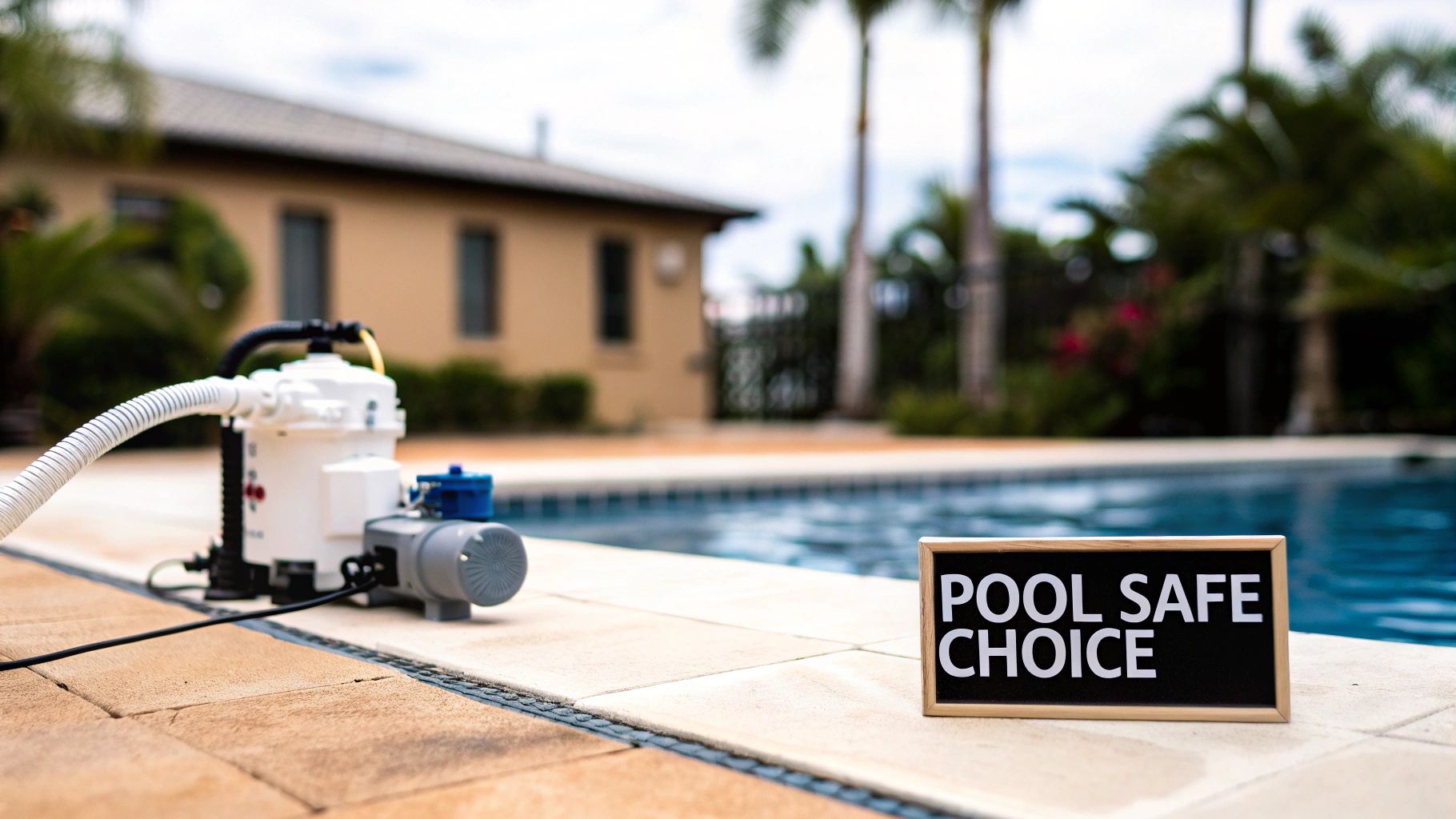
If you have a swimming pool in Cape Coral or anywhere nearby, a water descaler is almost always the way to go. It's really that simple, and the reason is salt. Water softeners work by swapping out hardness minerals for sodium, and dumping all that extra sodium into your pool is asking for trouble.
Adding salt throws your pool's chemistry out of whack. It can mess with your chlorine's effectiveness and, more importantly, it corrodes everything made of metal—ladders, light fixtures, and especially your expensive heater. It can also damage salt chlorine generators, which are calibrated for very specific salinity levels.
A water descaler, on the other hand, is a pool owner’s best friend.
- No more scale buildup: It changes the structure of calcium and magnesium, so that ugly white line of scale never gets a chance to form on your tiles or inside your pump and filter.
- Keeps water chemistry stable: A descaler adds absolutely nothing to the water. Your pool's delicate chemical balance stays exactly where you want it.
- Protects your equipment: By stopping mineral buildup before it starts, a descaler helps all your pool equipment run more efficiently and last longer—without introducing corrosive salt.
For pool owners, the decision is a no-brainer. A descaler protects your investment from scale damage without the corrosive side effects of added sodium. It’s the key to maintaining a pristine pool you can actually enjoy.
By taking mineral buildup out of the equation, a descaler means you’ll spend less time and money on frustrating repairs and more time relaxing in the water. For more tips on keeping your pool in top shape, check out our guide to frequently asked pool questions.
What About Your Home's Plumbing System?
Now, when we shift the conversation to your home’s plumbing, the debate gets a little more interesting. Both systems do a great job of preventing future scale buildup, which is the main goal. But they handle the scale that’s already there in completely different ways.
A water softener has a real edge if you're in an older home with years of existing limescale. The softened water is "hungry" for minerals, so it will gradually dissolve and wash away the scale that's already caked inside your pipes. Over time, this can actually restore lost water pressure and make your water heater run better.
A water descaler is all about prevention. It’s brilliant at stopping new scale from forming by making minerals unable to stick to surfaces. It won’t, however, do much about the buildup that's already there. This makes it a perfect fit for new construction or homes with plumbing in good condition.
Here's a quick look at how they stack up for your pipes:
| Plumbing Concern | Water Softener | Water Descaler |
|---|---|---|
| New Scale Prevention | Excellent, completely stops new scale. | Excellent, prevents new scale from adhering. |
| Existing Scale Removal | Effective, gradually dissolves old buildup. | Ineffective, does not remove existing scale. |
| Appliance Protection | Protects from scale and soap scum. | Protects from scale only. |
Ultimately, the best choice for your plumbing depends on its current condition. The easiest way to know for sure is to have an expert take a look. Here at Water Medic, our technicians can assess your home's unique situation and give you a straight-up recommendation.
Health Considerations and Sodium Intake
Another huge consideration for many of us here in Florida is the extra sodium that comes with a traditional water softener. That ion exchange process adds a small, but real, amount of sodium to the water you drink and cook with. For most people, it's not a big deal.
But if you or someone in your family is on a low-sodium diet for health reasons, like managing high blood pressure, it’s definitely something to think about. The harder your water is to begin with, the more sodium is needed to soften it, which can add up.
This is where water descalers have a clear advantage: they are 100% salt-free. They condition your water without adding a single thing to it, leaving the mineral composition completely unchanged. This makes them the obvious choice for anyone who needs to watch their sodium intake, ensuring your water treatment doesn't interfere with your health.
Breaking Down the True Cost: Initial Price vs. Long-Term Value
When you're comparing a water descaler to a water softener, the sticker price is just the beginning of the story. To really understand the investment, you have to look at the total cost of ownership—what you’ll actually spend over the life of the system. This means factoring in everything from installation to the day-to-day costs of keeping it running.
Choosing the right system isn't just about fixing your scale problem today; it's about picking a solution that makes financial sense for your home or property years down the road. Let’s get into the real numbers.
Upfront Installation Costs
At first glance, the initial investment for both systems looks pretty similar. Whether you choose a quality water softener or a high-performance descaler, the cost for the unit and professional installation often falls into a comparable range.
Several things can move that price tag up or down:
- System Size: A bigger house with more bathrooms and higher water demand needs a more powerful system, which costs more.
- Plumbing Work: If your main water line is tucked away in a tight crawlspace, installation will take more labor than if it's easily accessible in a garage.
- Model & Features: Just like with cars, premium models with advanced features will have a higher upfront cost in either category.
Here at Water Medic, we believe in straightforward pricing. Our technicians handle the installation from start to finish, making sure your system is set up for peak performance from day one, so you get the most out of your investment.
The Long-Term Operational Expenses
This is where the two systems really start to part ways financially. A water softener comes with ongoing costs that will hit your wallet every single month. A descaler, on the other hand, is what we in the industry call a "set it and forget it" solution—once it's in, you're done spending.
After 10 years, it's not uncommon for the recurring costs of a water softener to add up to more than what you paid for the system in the first place. A descaler has virtually no running costs, which makes its long-term value crystal clear.
Grasping this fundamental difference is the key to calculating the true cost of ownership and making a smart financial choice for your property.
Calculating the True Cost of Water Softeners
With a traditional water softener, the biggest and most consistent expense is salt. The system can't do its job without it, using bags of salt to create a brine that flushes away the hard minerals it has trapped.
- The Salt Bill: Depending on how hard your water is and how much you use, a typical family can easily go through a 40-pound bag of salt every month or two. That's a permanent line item on your shopping list.
- Water and Power: The regeneration cycle also dumps a lot of water down the drain—anywhere from 25 to 65 gallons per cycle. That extra water use shows up on your utility bill. Plus, the system's electronic valve needs electricity 24/7.
These costs aren't a one-time thing; they are a permanent part of owning a water softener. It’s an effective system, but it demands a continuous financial commitment for its entire lifespan.
The Financial Advantage of a Water Descaler
A water descaler’s biggest selling point, financially speaking, is its near-zero operational cost. It works by changing the structure of minerals so they can't form scale, which means it doesn't need salt, doesn't need to backwash, and has no regeneration cycles.
Once a professional installs it, the descaler just works. You'll never have to haul heavy bags of salt from the store again. There's no wastewater, and there are no monthly supplies to budget for. This makes it a fantastic choice for anyone who values a low-maintenance, predictable solution.
When you look at the financials over five or ten years, the comparison becomes simple. A softener gives you truly soft water but at the price of constant upkeep. A descaler gives you targeted scale prevention with a much, much lower total cost of ownership.
Ready to figure out which system makes the most sense for your home and budget? We can help you find the perfect fit. Request a personalized quote today, and our experts will give you a clear, no-obligation breakdown.
Making Your Final Decision: A Recommendation Guide
When you get down to it, choosing between a water descaler and a water softener really boils down to one question: What are you trying to achieve? Are you looking for a complete change in how your water feels and behaves, or is your main goal simply to protect your home’s pipes and appliances with the least amount of fuss?
Each system takes a fundamentally different approach to solving hard water problems. Think of this as a straightforward guide to help you match the right technology to what you actually need, especially here in Southwest Florida. We see these scenarios every day, and a well-informed decision now will pay dividends for years to come.
Best for Families Seeking Softer Skin and Brighter Laundry
For families fed up with the daily irritations of hard water, a water softener is the only way to go. If you want that noticeably softer skin after a shower, laundry that feels less like cardboard, and dishes that come out of the dishwasher sparkling clean, a softener is the clear winner.
A softener gets these results by physically removing the hard minerals—calcium and magnesium—from your water. This is a game-changer. You’ll find yourself using far less soap, shampoo, and detergent. The soap scum that builds up on shower doors and sinks will dramatically decrease. That classic “slippery” feel of soft water is the undeniable proof that the hardness minerals are gone.
Best for Meticulous Pool Owners
If you're a pool owner in Florida, a water descaler is almost always the smarter choice. The reason is simple: salt. A traditional softener adds sodium to your water, and that’s the last thing you want in your pool system. Salt can corrode expensive heaters, ladders, and other equipment, not to mention it can completely throw off your carefully balanced pool chemistry.
A descaler, on the other hand, is entirely salt-free. It stops that ugly white scale line from forming on your tiles and protects your pump and filter from internal mineral buildup without introducing anything corrosive into the water. It’s the perfect, non-invasive way to safeguard your pool investment and make maintenance easier.
This flowchart breaks down the financial side of the decision, highlighting how a softener’s recurring salt costs compare to a descaler's one-time investment.
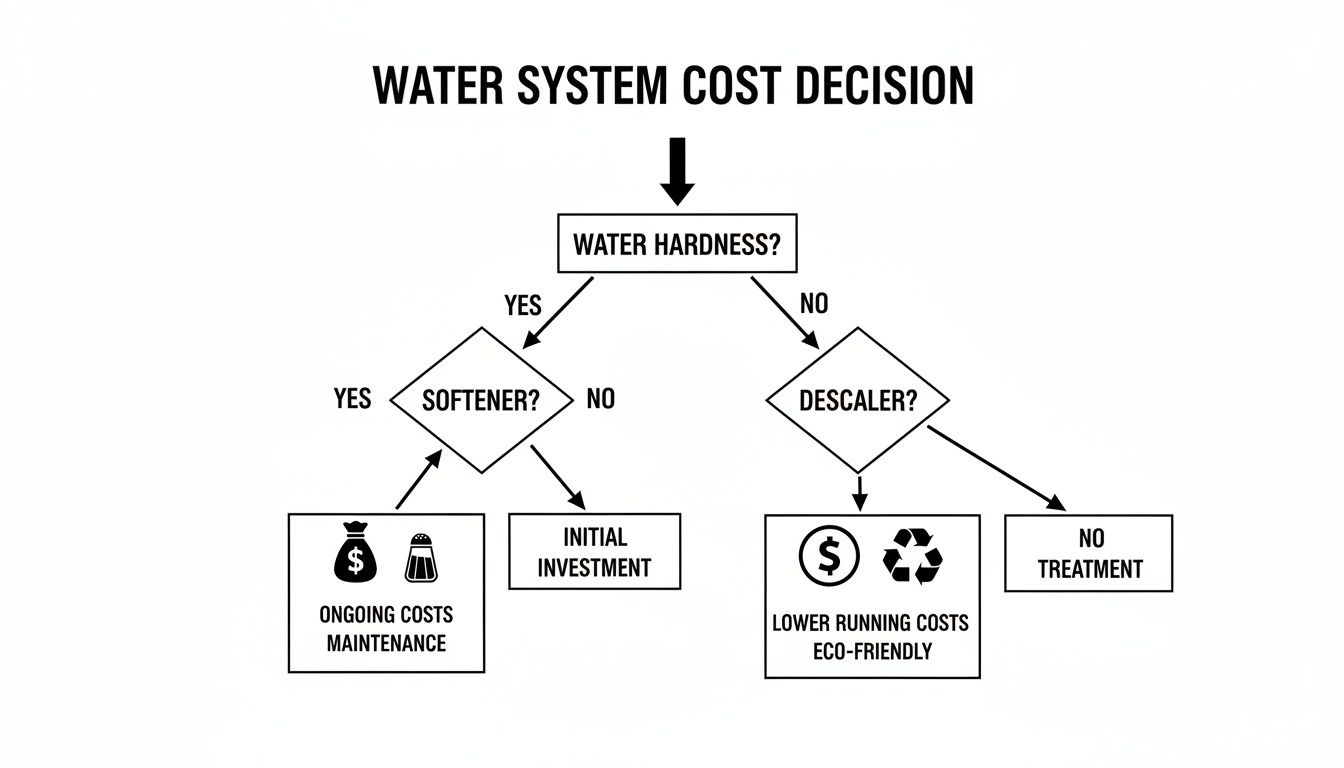
As you can see, while both systems have an upfront cost, only the softener comes with the ongoing expense of buying salt bags. This makes the descaler a more predictable and often more economical choice over the long haul.
Best for Low-Maintenance Lifestyles
For anyone who values a "set it and forget it" approach, a water descaler is the perfect fit. Once it’s installed, it does its job without any intervention from you. There are no heavy salt bags to buy and haul, no electricity needed, and no regeneration cycles that waste water.
This makes it an ideal solution for busy families, seasonal residents with vacation properties, or simply anyone who doesn't want another household chore on their to-do list. You get the peace of mind knowing your pipes and appliances are protected from future scale damage, all with zero upkeep.
The best solution is always the one that fits your home and lifestyle perfectly. While these recommendations cover the most common needs, every home's water is unique.
The only way to be certain which system is right for you is to know exactly what’s in your water. At Water Medic, we believe in solving problems based on facts, not guesswork. That's why we encourage you to schedule a free water analysis with one of our experts. We'll give you a clear, personalized recommendation you can trust.
Got Questions? We've Got Answers
When you're digging into water treatment, a few key questions always come up. It's smart to think about the long-term details before you decide between a descaler and a softener. Let's tackle the most common ones we hear from homeowners.
Will a Water Softener Actually Clean Out the Scale Already in My Pipes?
Absolutely. This is one of the biggest, and often overlooked, benefits of a traditional water softener. The softened water is mineral-hungry, so as it flows through your pipes, it gradually breaks down and dissolves the existing limescale that’s been building up for years.
You'll see the results over time—better water pressure, more efficient appliances, and a plumbing system that can finally breathe again.
Is the Water Safe to Drink from These Systems?
Yes, water from both descalers and softeners is safe to drink. The key difference is sodium. Descalers don't add anything to your water, so the taste and composition stay the same.
Water softeners, on the other hand, add a very small amount of sodium during the ion exchange process. While it's usually not enough for most people to notice, it’s something to consider if you're on a strictly low-sodium diet for health reasons.
How Long Will My New System Last?
You're making a real investment, so lifespan matters. A quality water softener, when it's properly installed and maintained, should give you 10-15 years of reliable service, sometimes even longer.
Water descalers have a bit of an edge here. Since they have no moving parts and don't use salt, there's less wear and tear. It’s not uncommon for them to last well over 15 years.
A quick note on installation: We can't stress this enough—get it done by a pro. A proper setup not only protects your warranty but also guarantees the system works correctly from the start. A shoddy DIY job can cause headaches you don't need.
Do I Really Need to Hire a Professional for Installation?
Look, we know some homeowners are very handy. But for a water treatment system, we always recommend calling in a professional. A certified plumber or water treatment specialist knows the local codes and the little details that make a huge difference in performance.
Plus, most manufacturer warranties require professional installation to be valid. Our team at Water Medic has installed countless systems, and we make sure it's done right the first time, every time.
At Water Medic, we believe in finding the right fix for your water, not just selling a one-size-fits-all box. If you're ready to figure out what your home truly needs, give us a call for a free water analysis.