
Your Guide to the Reverse Osmosis Filter replacement Schedule
Knowing when to change the filters in your reverse osmosis system is the single most important part of keeping it running well and your water tasting great. While the standard advice is to replace pre-filters every 6-12 months and the RO membrane every 2-5 years, think of these as starting points, not hard-and-fast rules. Entrusting your system to a professional service ensures these critical tasks are handled correctly, protecting your investment and guaranteeing pure water.
The Essential RO Filter Replacement Schedule
The best way to think about your RO system is like an assembly line. Each filter has a specific job to do before passing the water to the next stage. If one station gets clogged or stops working, the whole line slows down and quality suffers. Sticking to a professional reverse osmosis filter replacement schedule prevents this breakdown and ensures you get the most out of your system.
It's about more than just water quality, too—it’s about protecting your investment. When those initial pre-filters get clogged with sediment and chlorine, they put a massive strain on the RO membrane. That membrane is the most sensitive and expensive part of the system, and forcing it to do the pre-filters' job will wear it out in a fraction of its normal lifespan. A professional maintenance plan is the smartest way to avoid costly premature replacements.
Your Quick-Reference Timeline
To make things easier, here's a simple, at-a-glance guide for the core components in most residential RO systems. This schedule is a solid baseline that will keep each part of the filtration process humming along.
For those of us in Southwest Florida, our notoriously hard water and higher sediment levels can clog these components faster than average. If you're not sure where your system stands, our team at Water Medic can help with our expert whole house reverse osmosis services and get you on a schedule that makes sense for our local water.
Following a consistent replacement schedule is the single most important maintenance task for any RO system owner. It directly impacts water safety, system longevity, and long-term costs.
To help you keep track, here is a breakdown of what each filter does and how often you should plan on replacing it.
Standard RO Component Replacement Timeline
This table is a handy cheat sheet for the typical replacement frequency of each major part in your reverse osmosis system.
| RO Component | Primary Function | Typical Replacement Schedule |
|---|---|---|
| Sediment Pre-Filter | The first line of defense, catching large particles like rust, sand, and dirt. | 6-12 Months |
| Carbon Pre-Filter | Absorbs chlorine, chemicals, and other contaminants that cause bad tastes and can ruin the membrane. | 6-12 Months |
| RO Membrane | The heart of the system, removing up to 99% of dissolved solids (TDS) on a microscopic level. | 2-5 Years |
| Polishing Post-Filter | The final carbon filter that gives the water a last "polish" for a clean, crisp taste before it hits your glass. | 12 Months |
Remember, this timeline is a general guide. The two biggest factors that will change your personal schedule are how much water your family uses and the quality of your water source, whether it's from a city supply or a private well. Next, we'll get into how our experts can fine-tune this schedule for your specific home.
Why Pre-Filters Are Your System’s First Line Of Defense
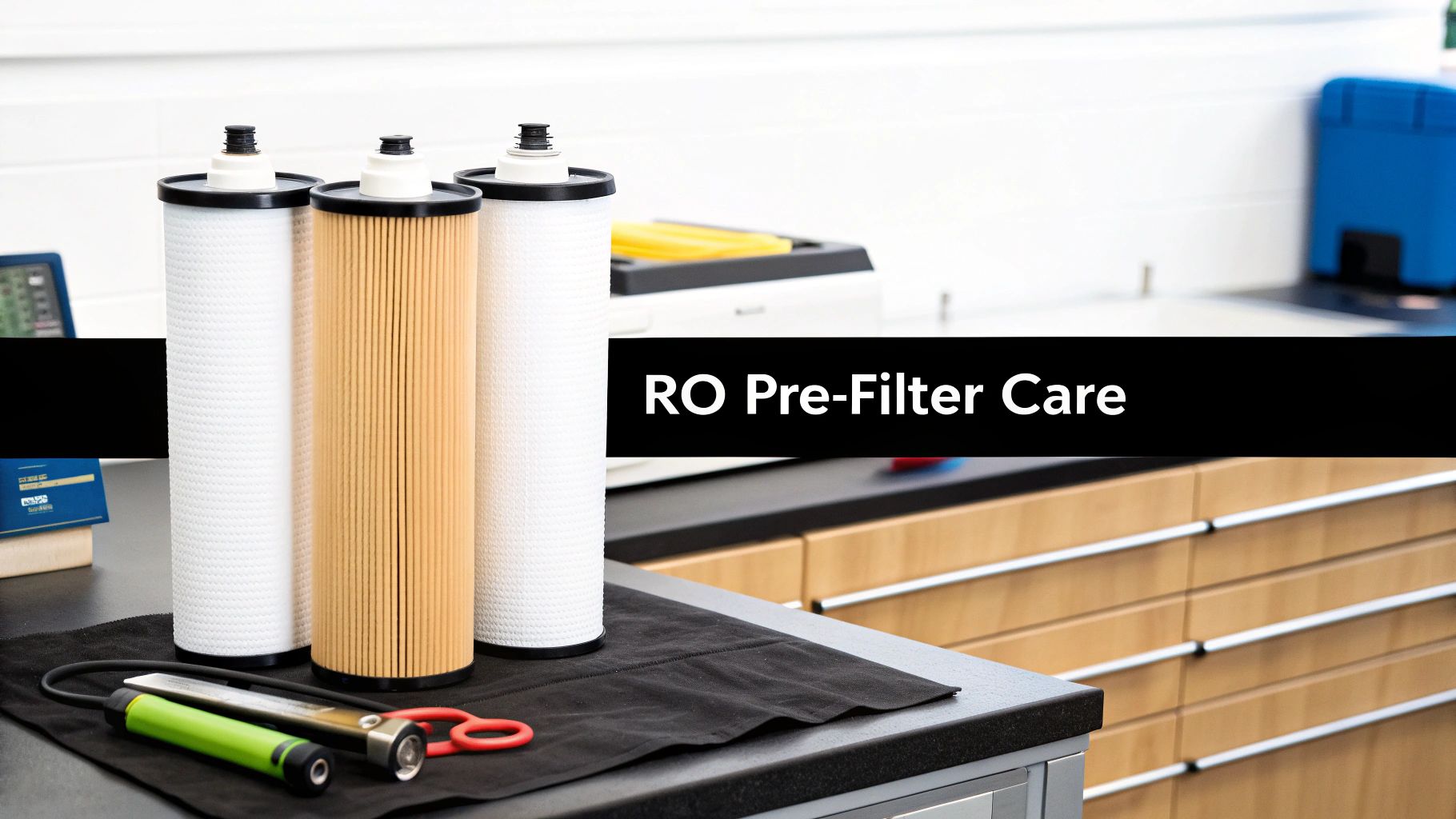
Before water ever reaches the heart of your reverse osmosis system—the membrane—it has to get past the pre-filters. Think of them as the unsung heroes, the diligent gatekeepers whose entire job is to block the big, bulky troublemakers before they can cause any real damage. Without them, your system’s performance would nosedive.
This frontline defense is a tag-team effort. First up is the sediment filter, which acts like a micro-sieve, catching all the visible grit like dirt, sand, and rust flakes. Right behind it is the carbon filter. Its job is more about absorption; it soaks up chemicals like chlorine, which is notorious for causing bad tastes and odors.
This one-two punch is absolutely crucial for protecting the delicate RO membrane. Chlorine, in particular, is a membrane's worst enemy. It can literally eat away at the membrane material, creating holes and rendering it useless. The pre-filters are designed to take that hit, sacrificing themselves so the more expensive and critical membrane can continue to do its job.
The Impact Of Southwest Florida Water
Here in Southwest Florida, our water puts pre-filters through the wringer. They don't just work hard; they're on the clock 24/7, battling local water conditions that put an immense strain on any filtration system. This is precisely why a generic reverse osmosis filter replacement schedule you might find online simply won't cut it for homes in Cape Coral.
Whether you're on city water or a private well, your filters are fighting a very specific local battle every single day.
- Well Water Issues: Many private wells in our area are notorious for high levels of sediment, sand, and even iron. This gunk can clog a sediment filter in a surprisingly short amount of time, strangling your water pressure and flow.
- Municipal Water Treatment: The city treats our water with chlorine to keep it safe, which is a good thing. However, that same chlorine will destroy an RO membrane if it gets through. Your carbon pre-filter is the only thing standing in the way.
In Southwest Florida, staying on top of pre-filter changes isn't just a suggestion—it's a financial necessity. Spending a little on these filters now directly prevents the premature, and much more expensive, failure of your RO membrane down the line.
Protecting Your Investment With A Timely Schedule
Because these pre-filters are working so incredibly hard, sticking to a strict 6 to 12-month replacement schedule is non-negotiable. If you try to push them past their limits, you're just kicking off a domino effect of problems. A clogged sediment filter makes the carbon filter work harder, and once the carbon filter is exhausted, chlorine gets a straight shot at your membrane.
Ignoring this schedule can lead to clogs that slash your water flow by up to 50%. Sticking to a 6-to-12-month interval is the industry standard for protecting your system and ensuring it performs as it should.
We get it—remembering to change filters is just another chore. This is where professional service really shines. At Water Medic, our team knows Southwest Florida water inside and out. We provide timely, reliable filter changes to ensure your system's first line of defense never falters. You can learn more about the specific job of a carbon filter and see why it's so vital. Let us handle the maintenance schedule, so you can simply enjoy pure, fantastic-tasting water without a second thought.
Understanding the RO Membrane Replacement Cycle
If the pre-filters are the gatekeepers, the reverse osmosis membrane is the very heart of your entire system. This is where the real purification magic happens. Imagine an incredibly fine, semi-permeable screen with pores so tiny that only pure water molecules can squeeze through, leaving virtually all dissolved solids and contaminants behind.
This component is the most advanced and, not surprisingly, the most expensive part of your setup. Its health is directly tied to how well the pre-filters are doing their job. Every grain of sediment or bit of chlorine that gets past a worn-out pre-filter ends up hitting the membrane, causing gradual but irreversible damage.
Protecting this core component is the main reason we have a reverse osmosis filter replacement schedule in the first place. Trying to save a few dollars by stretching out the life of your pre-filters is a classic false economy—it will almost certainly lead to the early failure of a part that costs hundreds to replace.
The Membrane’s Lifespan and Local Challenges
An RO membrane is a tough piece of equipment, built to last anywhere from 2 to 5 years under perfect conditions. The catch? "Perfect conditions" are hard to come by, especially here in Southwest Florida. Our unique water challenges mean you should probably expect a lifespan closer to the lower end of that range.
In our area, a membrane often lasts about 2-3 years, and that's with diligent pre-filter maintenance. If upkeep is spotty, you could easily cut that lifespan in half as contaminants foul the delicate surface. This fouling can cause the membrane's efficiency to plummet from a solid 95% rejection rate down to as low as 70%. You can dig deeper into how maintenance impacts longevity with insights from industry experts at Ongaro and Sons.
The single biggest factor determining your RO membrane's lifespan is the consistency of your pre-filter replacement schedule. A healthy membrane is a direct result of well-maintained sediment and carbon filters.
This is where professional experience really pays off. At Water Medic, we don't just swap out parts; we understand the unique water chemistry in Cape Coral. We can accurately gauge the stress on your system and give you a realistic replacement timeline that protects your investment. Our services for under-sink reverse osmosis systems are designed to get the most out of every single component.
What Is TDS Rejection Rate?
So, how can you tell if your membrane is on its way out? You can't just look at it. The ultimate report card for your membrane is its Total Dissolved Solids (TDS) rejection rate. This simple percentage tells you exactly how well it's stripping impurities from your water.
Figuring it out is pretty straightforward:
- Measure Incoming Water: Grab a TDS meter and test your regular tap water before it goes into the RO system.
- Measure Purified Water: Now, test the water coming directly from your RO faucet.
- Calculate the Percentage: The difference between the two numbers, shown as a percentage, is your rejection rate.
For instance, if your tap water reads 300 ppm and your RO water is 15 ppm, your system has a rejection rate of 95%. That's fantastic. But if that rate ever drops below 90%, it’s a clear signal that the membrane is wearing out and needs to be replaced soon.
Our technicians run this test during every service visit, giving you a clear, data-driven picture of your system’s health. It takes all the guesswork out of the equation and ensures you’re always drinking the purest water possible.
How Water Quality And Usage Impact Your Schedule
Those standard timelines you see for filter replacement? Think of them as a baseline, a good starting point—but rarely a perfect fit for the real world. To create a truly effective reverse osmosis filter replacement schedule, we have to get personal. It all comes down to the two biggest variables that affect your system’s lifespan: your water source and how much water your family uses every day.
A one-size-fits-all approach just doesn't cut it. The stress on an RO system can be wildly different from one home to the next, even if you're neighbors. This is why our professional team moves past guesswork to build a maintenance plan based on your specific situation.
Instead of just changing filters when the calendar tells you to, you can rely on our expertise. We understand these factors and build a custom schedule that swaps out filters only when they’re truly spent, which saves you money and guarantees you’re always getting the purest water.
Municipal Water vs. Well Water Demands
Your water source is, without a doubt, the single biggest factor determining how hard your pre-filters have to work. Here in Southwest Florida, the difference between city water and a private well is night and day, and your replacement schedule absolutely has to account for that.
- Municipal Water: City water is treated before it ever reaches your home, usually with chlorine to kill bacteria. While that makes it safe, chlorine is the natural enemy of an RO membrane. Your carbon pre-filter takes the hit, absorbing all that chlorine, and its lifespan is tied directly to how much of the chemical is in your local water supply.
- Private Well Water: Well water is a whole different ballgame. It often comes loaded with higher levels of sediment, sand, iron, and hardness minerals like calcium and magnesium. This stuff forces the sediment pre-filter to work overtime and can lead to clogs much faster if you aren't keeping a close eye on it.
This is where our professional water analysis really makes a difference. We can test your water to identify the exact contaminants you're dealing with. From there, we can build a customized replacement schedule that’s both effective and budget-friendly. For a closer look, you can explore our specialized well water treatment solutions.
Household Consumption: The Deciding Factor
Beyond the source, the sheer volume of water your family uses plays a huge role. It’s simple math: a big family will use up filters much faster than a single person or a couple. Every gallon you run through the system leaves behind a tiny bit of sediment or gets another dose of chlorine absorbed, pushing those filters closer to their limit.
The lifespan of your RO filters isn't measured in months—it's measured in gallons. A calendar is just an estimate; your household's actual water consumption is the true measure of a filter's remaining life.
Our own data from years in the field shows that high-consumption homes in Southwest Florida often need filter changes up to twice as frequently as low-use ones. A single person might get 12 months out of their pre-filters, while a family of four using 300-400 gallons a day might need a change every 6 months as the filters get saturated with our region’s hard water minerals. Trident Plumbing's blog offers more great insights on this topic.
The table below gives you a clearer picture of how water sources here in Southwest Florida can change the game for your maintenance schedule.
Customizing Your Schedule Based On Water Source
| Water Source | Common Contaminants | Recommended Pre-Filter Change Frequency | Recommended Membrane Check Frequency |
|---|---|---|---|
| Cape Coral Municipal Water | Chlorine, Disinfection Byproducts, Hardness | 6-9 Months | Every 12 Months |
| Fort Myers Municipal Water | Chlorine, Higher Hardness Levels, Sediment | 6 Months | Every 12 Months |
| Private Well (Rural Lee County) | Iron, Hydrogen Sulfide, High TDS, Sediment | 3-6 Months | Every 6-12 Months |
| Brackish Well (Coastal Areas) | High TDS, Salt, Hardness, Iron | 3-6 Months | Every 6 Months |
As you can see, there’s no single right answer. A custom plan based on your unique water profile is the only way to ensure your system runs efficiently and effectively for years to come.
This decision tree shows just how critical diligent pre-filter maintenance is for protecting your RO membrane's lifespan.
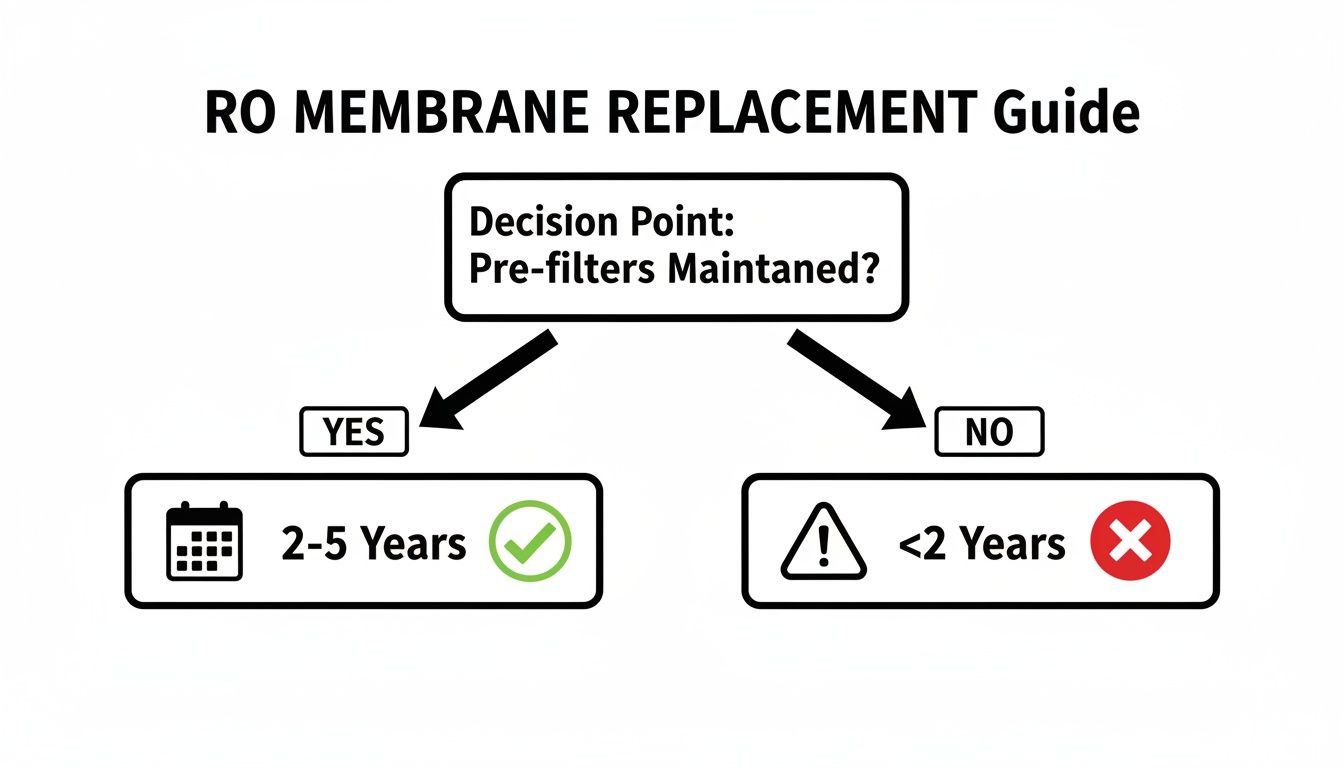
The visual makes it crystal clear: slacking on your pre-filter changes is the fastest way to ruin the most expensive and important part of your entire RO system.
Telltale Signs You Need A Filter Change
While your calendar is a great guide, your reverse osmosis system has its own ways of telling you it needs attention. Think of it as your system communicating directly with you. Sticking to a reverse osmosis filter replacement schedule is a must, but learning to spot these physical clues lets you stay one step ahead.
Ignoring these warnings is a bit like driving with the "check engine" light on. You might get away with it for a little while, but eventually, a small, easily fixable issue can spiral into a much bigger and more expensive problem. By simply paying attention to your water's flow, taste, and smell, you can catch problems early.
Changes In Water Pressure And Flow
One of the first things you'll probably notice is a drop in water pressure from the RO faucet. Has your once-strong stream slowed to a disappointing trickle? This is the classic sign of a clogged filter.
This happens when the sediment and carbon pre-filters get loaded up with all the gunk they’ve been pulling from your water. They essentially become a bottleneck, choking the flow of water before it can even reach the RO membrane. It’s a clear signal that your system is working way too hard.
The Return Of Unpleasant Tastes And Odors
Remember that pure, clean taste your water had when the system was new? If you start tasting that old, familiar chlorine flavor or notice a musty smell creeping back in, your filters are waving a white flag. This is a dead giveaway that the carbon filters are spent.
Carbon filters act like sponges for the chemicals that cause bad tastes and odors. Once they’re full, they simply can't absorb any more, and all those unwanted elements slip right through into your glass.
A change in your water's taste or smell is never something to ignore. It's a direct indication that your filtration barrier has been compromised and contaminants are getting through.
Slower Tank Refill Times
Here’s a more subtle clue: listen to your system after you fill up a large pitcher of water. You can usually hear it kick on to refill the storage tank. If that refilling process seems to be taking a lot longer than it used to, clogged filters are almost certainly the culprit.
This goes hand-in-hand with the drop in water pressure. Because the clogged pre-filters are slowing everything down, it naturally takes much more time for the system to produce and store purified water.
The Definitive Proof: A TDS Meter
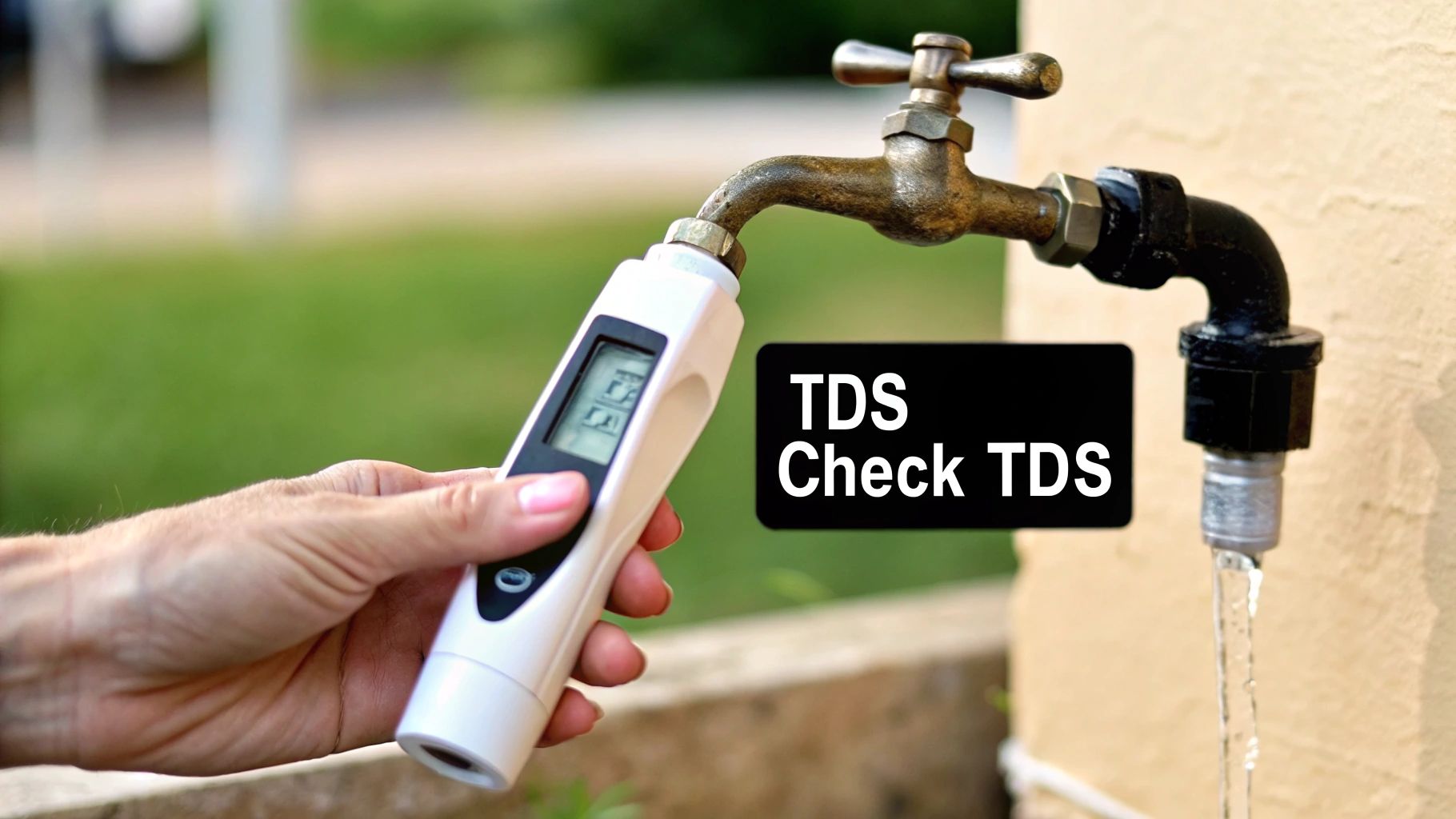
Your senses are great for spotting trouble, but for hard evidence, you need data. A Total Dissolved Solids (TDS) meter is a small, inexpensive gadget that gives you the undeniable truth about your water quality and, most importantly, your RO membrane’s health.
It couldn't be simpler to use:
- First, test your regular tap water to get a baseline reading.
- Next, test the water coming directly from your RO faucet.
- A healthy, functioning membrane should be removing 90% or more of the total dissolved solids.
If you see that "rejection rate" start to drop, you have irrefutable proof that your RO membrane is wearing out and it's time for a replacement.
If you've noticed any of these signs, don't wait for things to get worse. At Water Medic, we can professionally diagnose the issue and pinpoint the exact cause. Our experts will perform a comprehensive system check-up, including TDS testing, to restore your system to peak performance and ensure your family’s water is always as pure and safe as it should be.
Let Water Medic Handle Your RO Maintenance for You
You have enough to worry about without adding your water treatment system to the list. As we've covered, keeping a consistent, personalized reverse osmosis filter replacement schedule is absolutely critical for your family's health, the taste of your water, and the lifespan of your equipment. When you partner with Water Medic of Cape Coral, that burden is ours, not yours.
With over 25 years of experience focused squarely on Southwest Florida's unique water challenges—from whole-house RO systems to complex well water setups—we’re the local experts you can depend on. Our deep-rooted understanding of Cape Coral's specific water chemistry means we build maintenance plans that are designed to work right here, right now.
Your Local Water Treatment Experts
We do a lot more than just swap out old filters. Think of our service as a long-term commitment to ensuring your system delivers pure, safe water day in and day out. We've designed a full suite of services to keep your RO system running at its absolute best.
Our services include:
- Routine Filter Changes: We manage the schedule so you don't have to, making sure every component is replaced exactly when it should be.
- Comprehensive System Check-Ups: Our technicians inspect everything—we look for leaks, test pressure levels, and verify that every part is functioning perfectly.
- Professional TDS Testing: You get a precise, data-backed report on your membrane's performance and the true quality of your water.
- Emergency Repairs: If an issue pops up, our skilled technicians are on call to deliver fast, effective solutions.
To keep everything running smoothly and on time, professional teams like Water Medic often use tools like Field Service Management software solutions to manage schedules and dispatch technicians efficiently.
Partnering with a professional service takes the guesswork and hassle out of RO maintenance. It’s an investment in consistent water quality and the long-term health of your equipment.
Let us build a truly worry-free maintenance plan for your home. You can see our proactive approach firsthand by looking into our monthly maintenance service options.
Ready to experience the difference local expertise makes? Contact Water Medic today to schedule your service.
Got Questions About RO Maintenance? We’ve Got Answers.
When it comes to keeping your reverse osmosis system running perfectly, a few questions always pop up. It's only natural to wonder about the hands-on details, from cost to whether you can tackle the job yourself. Let's clear up some of the most common questions we hear from homeowners.
Can I Replace My Own RO Filters?
You absolutely can, especially if you're comfortable with basic plumbing tasks and have the right tools. However, it's one of those jobs where a small mistake can lead to a big headache.
A professional service call from Water Medic isn't just about swapping out a cartridge. We make sure the exact right filters are used for your model, everything is sealed tight to prevent leaks (which can cause a world of water damage), and we fully sanitize the system housing. That last step is a big one—it prevents bacteria from setting up shop inside your clean water system, something that’s easy to miss when you're doing it yourself.
How Much Does Professional Filter Replacement Cost?
The price tag really depends on your specific RO system and how many stages of filtration it has. Here at Water Medic, we believe in being completely upfront—no surprises, no hidden fees.
We’ll always give you a clear, detailed quote before we touch a thing. The best way to know for sure is to get in touch for a free estimate. That way, you get a precise number based on your actual equipment.
A professional service call is more than just a filter change. It's a check-up for your whole system. We can spot small issues before they turn into costly repairs, adding a ton of value beyond just the new filters.
Does a Water Softener Change My RO Filter Schedule?
Yes, and for the better! Having a water softener is like giving your RO system a superhero sidekick, particularly with the notoriously hard water we get here in Southwest Florida. The softener tackles the heavy lifting by removing hard minerals like calcium and magnesium before they ever reach the RO unit.
Think of it as a bodyguard for the most critical and expensive component: the RO membrane. By stopping mineral scale from building up and clogging the membrane's tiny pores, a softener can significantly extend its life. Your system runs more efficiently and you save a lot of money on membrane replacements down the road.
Ready to take the guesswork out of your RO maintenance? Let the local experts at Water Medic of Cape Coral create a worry-free plan that guarantees pure, safe, and great-tasting water for your family.