How to Raise pH in Pool Water A Practical Homeowner Guide
When your pool's pH dips too low, the quickest fix is usually soda ash, also known as sodium carbonate. This readily available chemical is incredibly effective at nudging the pH back into that sweet spot: the ideal range of 7.4 to 7.6. Getting this balance right isn't just a chemistry chore; it's the foundation of a safe, comfortable, and healthy pool.
Why Balancing Your Pool pH Matters
Knowing how to raise the pH in your pool is about so much more than hitting a target on a test strip. It’s one of the most important things you can do to protect both your swimmers and your pool's expensive equipment. Once the pH drops below 7.2, the water turns acidic, and that’s when a whole mess of frustrating and costly problems can begin.
The first thing you’ll probably notice is swimmer discomfort. That stinging, burning sensation in your eyes? That's low pH. Itchy skin after a swim? That's low pH, too. It can even fade and damage swimsuits over time. Worse yet, acidic water absolutely demolishes chlorine's effectiveness, forcing it to work much harder and get used up faster. This leaves the door wide open for algae and bacteria to take hold, all while you're spending more money just to keep sanitizer levels up.
The Impact of Low pH on Pool Equipment
Beyond making your swim unpleasant, acidic water is actively eating away at the vital components of your pool. The damage might not be obvious at first, but it can lead to some major repair bills down the road.
- Heater Cores: The copper heat exchanger in your pool heater is a prime target. Acidic water will corrode it, leading to leaks and a very expensive replacement.
- Pump Seals and Impellers: All the delicate seals and moving parts inside your pump are vulnerable. Corrosion causes leaks and can ultimately lead to complete pump failure.
- Pool Liners and Surfaces: In a vinyl liner pool, low pH can cause the liner to wrinkle and become brittle. For gunite pools, it can etch plaster or pebble surfaces, making them rough and uncomfortable.
Low pH isn't just an inconvenience; it's a direct threat to the longevity of your pool equipment. Consistently maintaining the correct pH is one of the most effective ways to prevent premature equipment failure and protect your investment.
Here’s a quick-reference table to help you visualize the process.
At a Glance Pool pH Correction Plan
| Step | Tool/Chemical | Target Range | Key Action |
|---|---|---|---|
| Test Water | Quality Test Kit | 7.4 – 7.6 | Get an accurate pH and alkalinity reading first. |
| Calculate Dose | Soda Ash (Sodium Carbonate) | N/A | Use package directions based on your pool volume. |
| Pre-dissolve | Clean Bucket | N/A | Mix soda ash with pool water to prevent clouding. |
| Add to Pool | Pool with Pump Running | N/A | Pour solution around the edges of the pool. |
| Re-Test | Quality Test Kit | 7.4 – 7.6 | Wait 4-6 hours then test again to confirm. |
Following these steps will put you on the right path to a balanced pool.
While you can certainly make these adjustments yourself, achieving a stable chemical balance requires a bit of precision. To keep your pool in top shape, it's helpful to understand all the essential steps of comprehensive pool water treatment. For those who'd rather skip the guesswork and get guaranteed results, our professional monthly maintenance plans ensure your pool chemistry is dialed in perfectly, week after week.
What's Making My Pool pH Keep Dropping?
If it feels like you're in a constant fight to keep your pool's pH up, you're not going crazy. Several factors, especially here in Southwest Florida, are always working to push your water chemistry toward the acidic side. Figuring out why is the single most important step. It's the difference between being a "pool chemist" and just a "pool janitor" who only treats symptoms.
Dumping in chemicals without knowing what’s causing the drop is like bailing out a boat without plugging the leak. You'll find yourself stuck in a frustrating loop of testing and dosing, burning through money on chemicals that only offer a temporary band-aid. A pH that just won't stay put is a loud-and-clear signal that something is continuously adding acid to your pool.
The Usual Suspects Behind Low Pool pH
More often than not, it's a combination of environmental and chemical factors that send your pH levels diving. Let's look at the most common culprits so you can start to identify what might be happening with your pool.
-
Heavy Rainfall: We get a lot of rain in Southwest Florida, and it's not our friend when it comes to pool chemistry. Rainwater is naturally acidic, usually with a pH between 5.0 and 5.5. A good downpour can drop hundreds of gallons of this acidic water into your pool, which will hammer both your pH and your total alkalinity.
-
Organic Debris: All those leaves, grass clippings, and pollen that blow into the pool don't just look messy. As this organic stuff breaks down, it releases acids directly into the water, causing a slow but relentless drop in pH.
-
Your Chlorine Type: This is a big one that a lot of pool owners miss. Those common, convenient chlorine tablets (Trichlor) are incredibly acidic, with a pH of around 2.8 to 3.0. They do a great job sanitizing, but using them consistently is one of the leading causes of chronically low pH. You're essentially adding a little bit of acid every single day.
A Pro Tip: Think of Total Alkalinity as a bodyguard for your pH. When rain and debris overwhelm your alkalinity, your pH is left defenseless and crashes. A professional analysis from our team can tell you if your alkalinity levels are strong enough to withstand these daily attacks.
Nailing down the exact cause can be a real head-scratcher since it’s often a mix of these issues. This is where a little expert diagnosis goes a long way. Our technicians don’t just glance at the pH reading; we look at the whole picture—your landscaping, your equipment, your chemical routine—to find the real source of the imbalance.
The Vicious Cycle of Acidic Water
When your pool's pH dips below the ideal 7.2 level, the problem is much bigger than a number on a test strip. Acidic water kicks off a chain reaction that's not only uncomfortable for swimmers but also actively destroys your expensive pool equipment. This isn’t just a chemistry issue; it’s a direct threat to your investment.
The first thing you’ll probably notice is how the water feels. That stinging sensation in your eyes or that dry, itchy skin after a swim? That's the acid. But the damage you can't see is usually much worse.
Acidic water is corrosive. It's literally eating away at your pool's most vulnerable parts:
- Pool Heaters: The copper heat exchanger inside your heater is a prime target for corrosion, which can spring leaks and lead to a very expensive replacement.
- Pump and Filter Parts: The seals, O-rings, and impellers in your pump and filter system will wear out much faster, setting you up for unexpected equipment failures.
- Pool Surfaces: Acid can etch and roughen plaster, pebble, and tile grout, making the surface feel like sandpaper. If you have a vinyl liner, it can become brittle and start to wrinkle.
Constantly battling low pH is more than an annoyance; it’s a sign your pool is in a state of distress. Instead of guessing at the problem, let our experts give you a clear diagnosis. Our weekly maintenance service is designed to get to the root of these issues, keeping your pH locked in and protecting your pool for the long haul.
The Pro’s Method for Raising Pool pH with Soda Ash
When your pool's pH just won't budge from the low end, it's time to stop guessing and start using the same reliable tool the pros trust: soda ash. You might know it as sodium carbonate, but in the pool world, it’s the go-to for raising pH effectively. This isn't some secret, complicated chemical—it's a straightforward base that gets the job done right when you use it with a little know-how.
Knowing how to raise ph in pool water is about more than just chucking a scoop of powder into the deep end. It’s a measured process. The goal is to hit your target pH without overshooting it and creating a whole new set of problems, like cloudy water. A professional approach is all about making controlled, predictable adjustments.
Start with an Accurate Water Test
Before you even think about opening a bag of chemicals, you need a clear picture of what’s happening in your water. This is non-negotiable. And you need to test for more than just pH; you absolutely have to get a read on your Total Alkalinity (TA). These two are intrinsically linked, and trying to adjust one without knowing the other is a surefire way to get frustrated.
Think of Total Alkalinity as the buffer, or the anchor, for your pH. If your TA is too low, your pH will swing wildly at the slightest provocation. Too high, and it will stubbornly resist any change you try to make. You want to see that Total Alkalinity sitting comfortably in the 80-120 ppm range before you start tweaking the pH.
Any seasoned pool tech will tell you they never treat pH in a vacuum. We always look at Total Alkalinity first. Get that stable, and you’ve built the foundation you need for a stable pH. Skip this, and you're just chasing your tail.
Once you’ve confirmed your alkalinity is in a good place, then you can zero in on the exact amount of soda ash needed to get your pH into that sweet spot of 7.4 to 7.6.
Calculating the Right Dose of Soda Ash
This is where a lot of pool owners go wrong. Adding too little soda ash won’t solve your acidic water problem, but dumping in too much can send your pH soaring. That can lead to cloudy water and nasty scale buildup. Precision is everything, and it all starts with your pool’s volume.
The key to learning how to raise pool pH quickly and correctly is using a clear dosing formula. As a general rule of thumb, about one ounce of soda ash per 1,000 gallons of water will typically raise your pH by about 0.1.
Let's say you have a common 20,000-gallon pool here in Southwest Florida, and your test shows a pH of 7.1. To get to a target of 7.4 (a 0.3 increase), you'd need a carefully measured dose. A pro will always test pH and alkalinity after an addition, waiting at least 4 to 6 hours for the water to circulate fully before retesting. This prevents overshooting the mark and causing that dreaded cloudiness from calcium precipitation. You can dive deeper into the relationship between pool pH and alkalinity problems on intheswim.com.
The Safe and Proper Way to Add It
Once you’ve got your dose calculated, the next step is adding it to the pool correctly. You never want to just broadcast the dry powder across the surface. It can settle on your pool’s finish, take forever to dissolve, and create cloudy spots or even stains.
Here’s how we do it in the field:
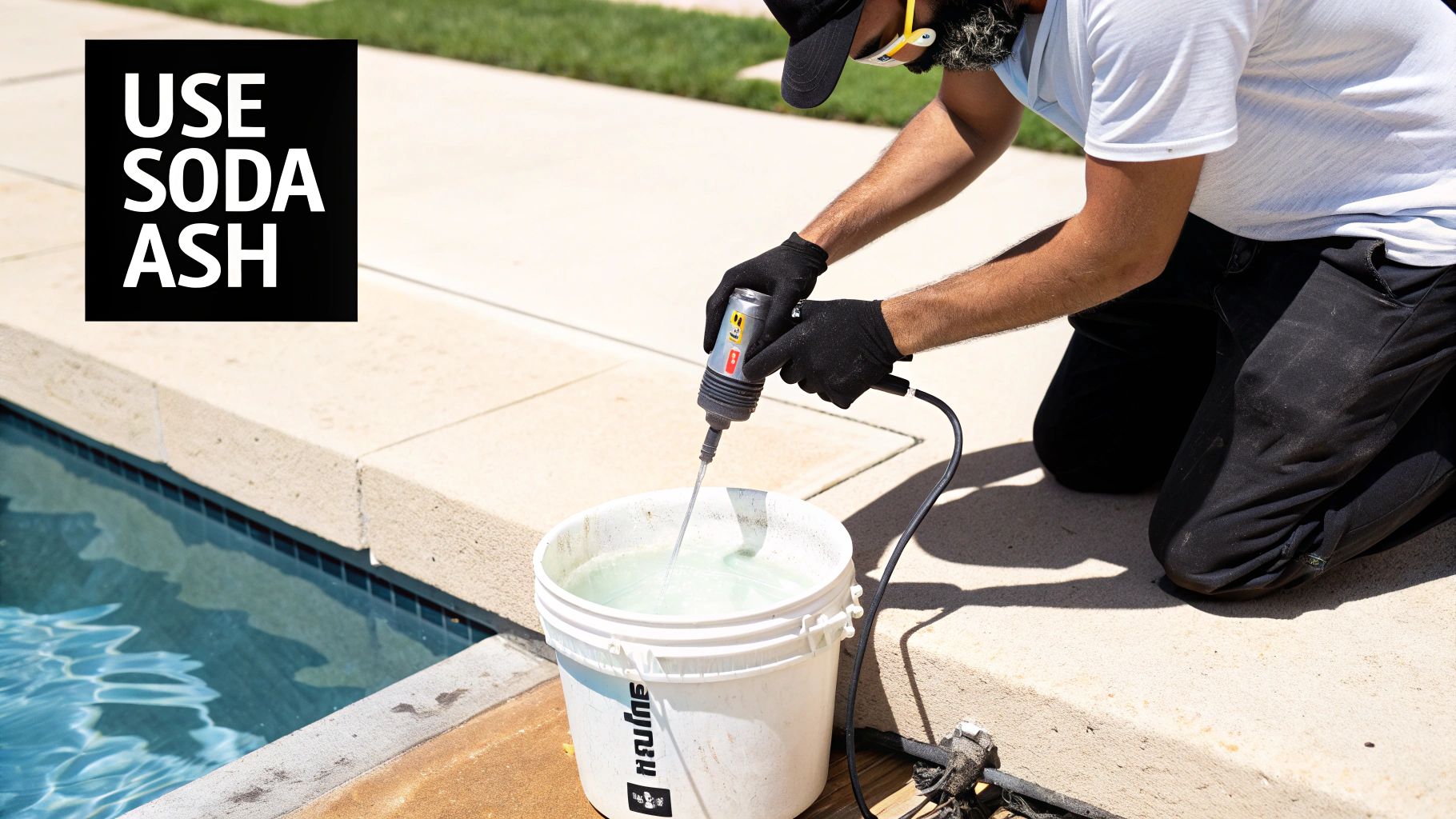
- Gear Up for Safety: Always put on protective gloves and safety glasses. Soda ash is an irritant, and you don’t want it on your skin or in your eyes.
- Pre-dissolve the Chemical: Grab a clean, five-gallon bucket and fill it about three-quarters of the way with pool water. Slowly add your measured soda ash to the water, not the other way around. Stir it gently with a stick until it’s completely dissolved.
- Get the Water Moving: Make sure your pool pump is running. This is critical for distributing the solution evenly.
- Pour and Walk: With the pump on, slowly pour the dissolved solution around the perimeter of the pool. Make sure to pour it into the water away from the skimmer or any other fittings.
This technique ensures the soda ash gets to work right away, dispersing quickly and efficiently without creating any concentrated hotspots.
Patience: The Final Ingredient
After you've added the solution, the most important thing to do is… nothing. Just wait. The chemical needs time to mix throughout the entire volume of water. It’s tempting to retest after an hour, but this will only give you a false reading and might trick you into adding more chemicals—a classic rookie mistake.
Let the pump run for at least 4 to 6 hours to ensure the water has fully turned over. After that waiting period, go ahead and retest both your pH and Total Alkalinity. If they’re still a little off, you can repeat the process with a smaller, calculated dose.
This methodical approach might seem a bit slow, but it delivers accurate, stable results you can count on. It’s the difference between constantly battling your pool chemistry and actually managing it. Of course, if this sounds like a hassle, our weekly maintenance service can handle it all for you, keeping your pool perfectly balanced so you don't have to lift a finger.
Troubleshooting Common pH Adjustment Issues
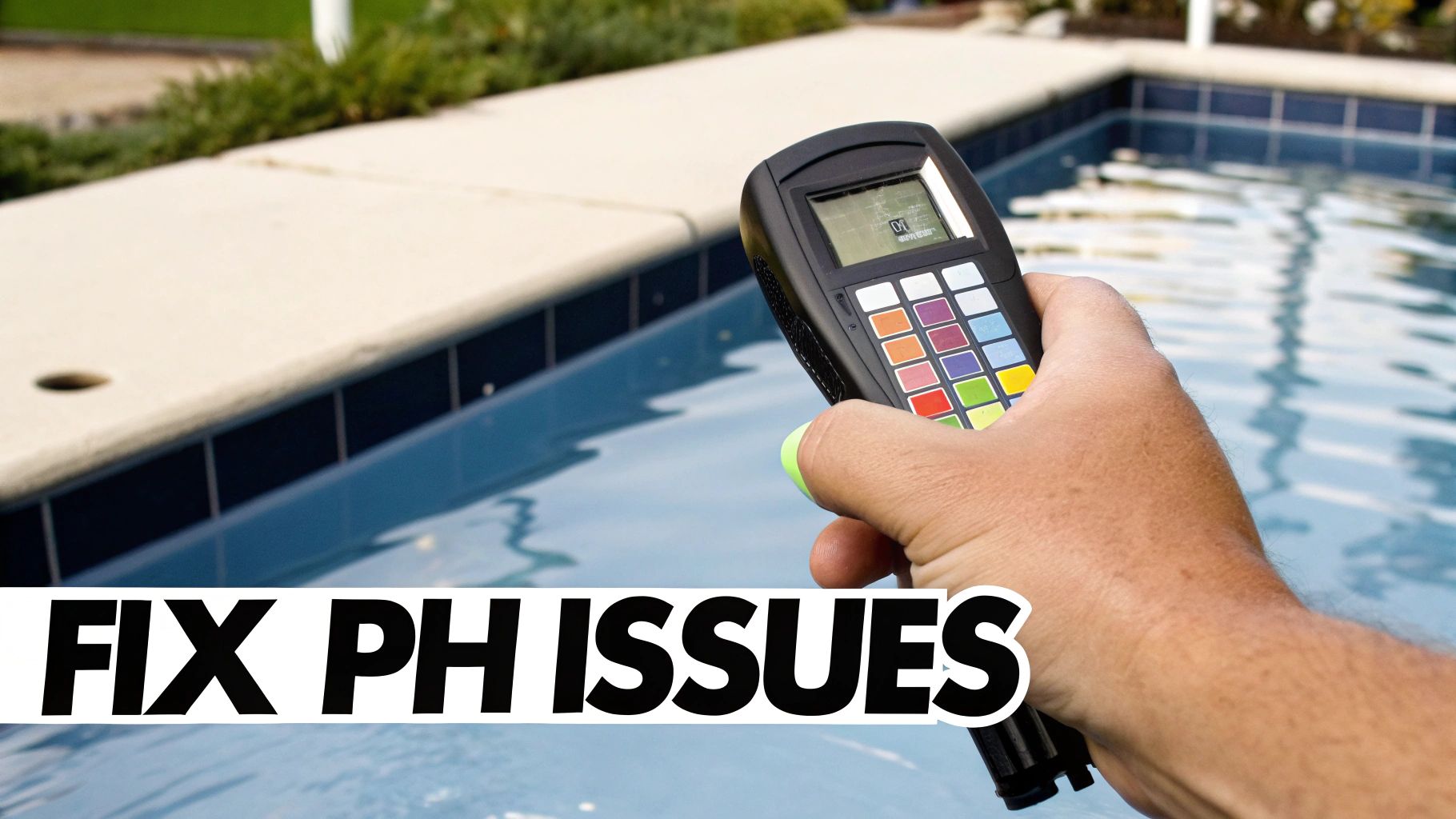
Even when you do everything by the book, pool chemistry can have a mind of its own. You’ve measured carefully, added the soda ash, and given it time to work, but your pH reading hasn't budged. Or worse, a new problem has popped up. Don't sweat it—this happens to a lot of pool owners figuring out how to raise ph in pool water on their own.
These annoying setbacks are usually just symptoms of a bigger imbalance. Once you learn to read the signs, you can finally get off the chemical rollercoaster and enjoy consistently clear water.
Why Didn't My pH Change After Adding Soda Ash?
This one is, by far, the most common frustration I hear about. You add what should have been more than enough soda ash, but your test strip is still screaming "low pH." Nine times out of ten, the real problem is your Total Alkalinity (TA).
Think of Total Alkalinity as a buffer, or a bodyguard, for your pH. It's what gives the water the ability to resist big swings in pH. When your TA is too low (anything below 80 ppm), it can't keep the pH locked in. So, when you add soda ash, the effect is temporary or just doesn't happen at all. Your pH has no foundation to stand on.
The fix is to tackle the alkalinity first. Use an alkalinity increaser (sodium bicarbonate) to get your TA into that sweet spot of 80-120 ppm. Once your alkalinity is solid, you'll see that your pH becomes much easier to manage.
Help, My Pool Is Cloudy After Adding Chemicals!
So, you got the pH up, but now your beautiful, clear pool looks like a cloudy mess. This is usually a tell-tale sign that too much chemical went in too fast. Dumping a large amount of soda ash in one spot can cause a reaction where the calcium in your water "precipitates," essentially falling out of the solution and making the water look milky.
This is a frequent issue here in Southwest Florida, where our water is notoriously hard. High calcium hardness plus a sudden pH spike is the perfect recipe for cloudy water.
The pro-level trick to prevent this is to always pre-dissolve the soda ash in a bucket of pool water. Then, with the pump running, walk around the edge of the pool and pour the mixture in slowly. This lets it mix in gently instead of shocking the system.
If the damage is done, don't panic. Run your filter continuously for 24-48 hours. Most of the time, this is all it takes to clear things up. If it's still cloudy after two days, you might need a pro to take a look.
Breaking Free From the pH Rollercoaster
Feel like you're in a constant battle, with your pH bouncing from one extreme to the other? This wild ride is another classic symptom of an alkalinity issue. With unstable TA, your pH becomes hyper-sensitive to everything—a rainstorm, leaves, even just people swimming—and swings all over the place.
Getting your Total Alkalinity balanced is the only way to stop the cycle. A stable TA provides the buffering it needs to keep your pH right in that ideal 7.4-7.6 range. Imbalanced water can also lead to other problems, like mineral buildup. If you're seeing chalky residue on your tile, you might want to look into professional techniques for removing hard water stains and mineral deposits.
Tired of playing chemist? Let us handle the balancing act with our professional maintenance. Our experienced techs are experts at spotting and fixing these problems before they start, so your pool is always perfect and ready to enjoy. We take all the guesswork out of it for you.
Looking Beyond Chemicals: Natural Ways to Manage Pool pH
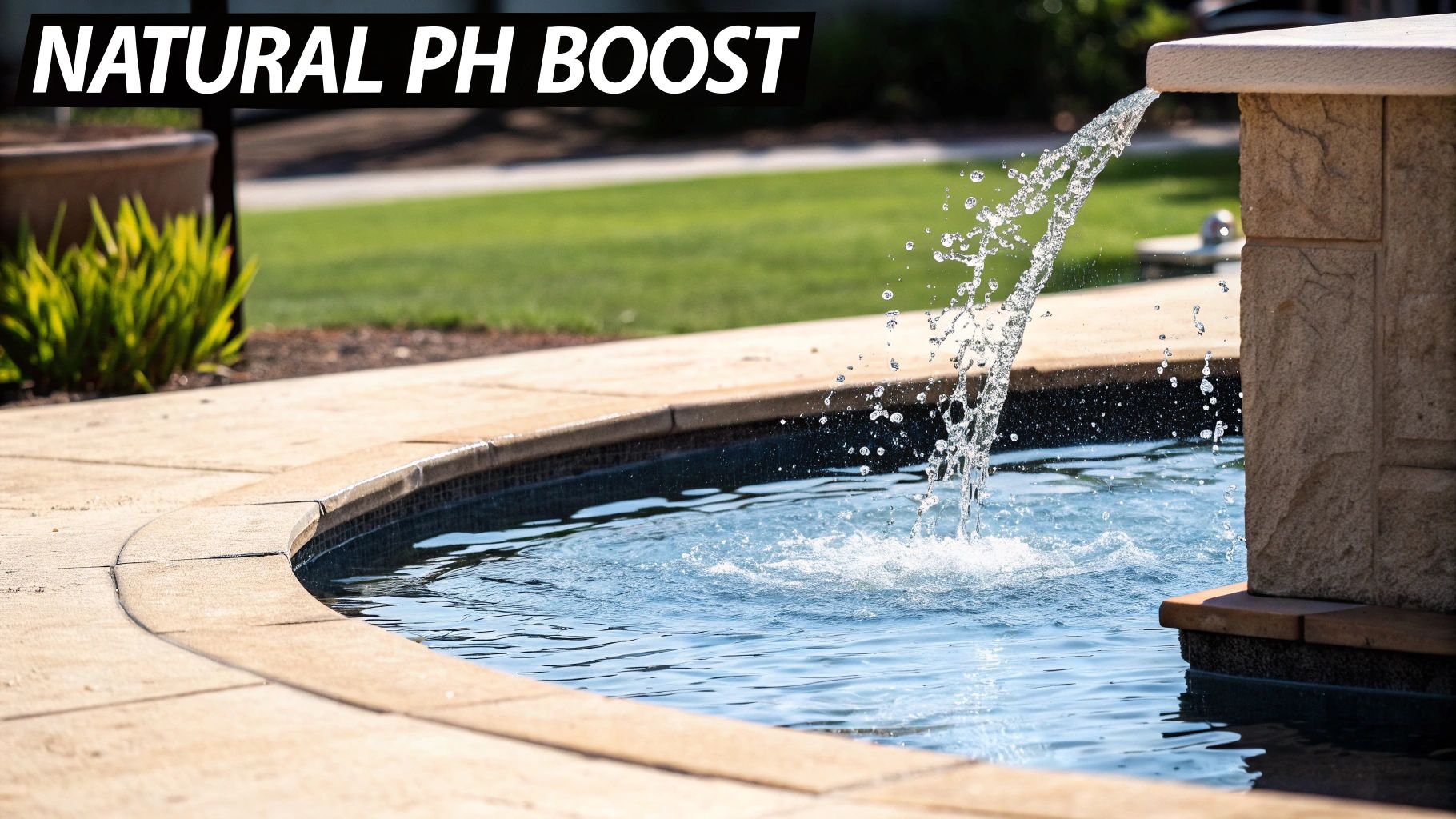
Sure, soda ash is the go-to chemical for a quick pH fix, but if you're serious about how to raise pH in pool water and keep it stable, you have to look beyond what's in the bag. A swimming pool is a living, breathing system, and sometimes the best tools are the ones already built into it. The most powerful non-chemical method for raising pH is something you might be doing without even realizing it: aeration.
Simply put, aeration is just mixing air with your pool water. If you have features that churn, splash, or spray—like waterfalls, fountains, spa spillovers, or even just return jets pointed up at the surface—you're already aerating. Understanding this process can be a game-changer, especially if you feel like you're constantly fighting to keep your pH from dropping.
Why Water Features Drive Your pH Up
The secret behind aeration's power is its effect on carbon dioxide (CO2). When CO2 dissolves in pool water, it creates carbonic acid, which, as the name implies, drives your pH down.
Aeration reverses that. By agitating the surface, it literally forces the dissolved CO2 out of the water and back into the atmosphere. As that CO2 escapes, the carbonic acid levels drop, and your pH naturally begins to climb. It’s a beautifully simple process, but it has a massive impact on your pool's chemistry.
A Pro's Perspective: For pools with big water features, aeration is a constant upward nudge on the pH. This is exactly why a cookie-cutter approach to pool chemistry never works. A seasoned tech will always factor in the pool's unique design before ever adding a chemical.
Here in Southwest Florida, with so many pools featuring waterfalls and spa spillovers, this is something we see every day. The constant aeration can push pH up by 0.2 to 0.6 units over a few days or weeks. It’s why we often need to check the water chemistry more frequently on these pools. You can read more about the science of maintaining optimal pool pH levels on sensorex.com.
How to Adjust Your Game Plan for an Aerated Pool
If your pool has features that create a lot of splash, your maintenance strategy has to adapt. A classic sign is a pH that’s always trying to climb while your alkalinity seems to drift down. The trick isn't to fight the pH directly but to manage the Total Alkalinity, letting the aeration do the heavy lifting for the pH.
- Go easy on the soda ash. You'll likely need far less pH increaser than a pool owner without these features.
- You might need more acid. It sounds counterintuitive, but you may find yourself adding muriatic acid more often to keep that natural pH rise in check.
- Focus on alkalinity. Keeping your Total Alkalinity in the ideal range is your top priority. It acts as a buffer, preventing the pH from spiking too high.
Working with your pool's natural tendencies—not against them—is the mark of smart pool care. It’s about understanding the whole system, not just reacting to a test strip. If you're ready to stop guessing and get your water chemistry dialed in, our team at Water Medic can build a customized maintenance plan that accounts for your pool’s unique personality.
When to Stop Guessing and Call the Professionals
Knowing how to raise ph in pool water is an essential skill for any pool owner. But let's be honest, there are times when you feel like you're in a never-ending fight with your water chemistry. If you're constantly adding chemicals and just not getting results, it’s probably a sign of a bigger issue that a bag of soda ash can't fix.
Knowing when to put down the test strips and call in an expert isn't throwing in the towel. It’s the smartest move you can make to protect your pool. Sometimes, the real problem is hiding in your equipment or a more complex chemical imbalance that needs a trained eye. Tossing in more and more chemicals without knowing the root cause is like throwing money into cloudy water—it won't fix anything and might even make things worse.
Clear Signs It's Time to Call Water Medic
A one-off low pH reading is usually no big deal. But when it becomes a recurring nightmare, that’s a major red flag. If any of these scenarios sound painfully familiar, it’s time to stop guessing and have our team take a look.
- The pH Rollercoaster: You add the right amount of soda ash, the pH level looks great, and then two days later, it’s plummeted again. This constant up-and-down is a classic sign that another factor, like your total alkalinity, is completely out of whack.
- Stubbornly Cloudy Water: Your water has a milky, hazy look that just won't clear up, no matter how long you run the filter or how many times you shock it. This often points to problems like high calcium hardness, a failing filter, or an imbalance that's crippling your sanitizer's effectiveness.
- Visible Damage: Are you seeing pitting on your metal ladders? Discoloration on the pool lights? Maybe a rough, chalky film building up on your waterline tiles? That’s physical proof that corrosive water is actively eating away at your pool's surfaces and expensive equipment.
Investing in professional service isn't just another bill—it's preventative maintenance. A subtle problem with your pump or filter can cause a massive chain reaction in your water chemistry. Catching it early can save you thousands down the road by avoiding a complete equipment meltdown.
The Professional Advantage
When you bring in our team, you're getting far more than just a guy who dumps chemicals into the water. We use advanced diagnostic tools, from high-precision digital water analyzers to equipment pressure tests, to find the exact source of the problem. We live and breathe Southwest Florida pool care, so we know the unique challenges our environment throws at your water.
Often, a persistent pH issue isn't even a water chemistry problem at its core—it's a symptom of a failing pump seal or a sand filter that’s long overdue for a change. Our expertise in pool equipment repair means we can spot and fix the mechanical issues that are causing the chemical chaos in the first place. Our weekly maintenance plans offer total peace of mind, knowing your pool is in the hands of experts who see the whole picture, keeping your water perfect week after week.
Still Have Questions About Raising Your Pool’s pH?
Even with a step-by-step guide, you're bound to run into some specific head-scratchers when you’re staring at a test strip. It’s completely normal. Getting those questions answered is how you go from just following directions to truly understanding your pool's chemistry.
Here are a few of the most common questions we get from pool owners right here in Southwest Florida.
Can I Just Use Baking Soda Instead of Soda Ash?
This is easily one of the most frequent questions we hear, and it's a great one. While they sound alike, baking soda (sodium bicarbonate) and soda ash (sodium carbonate) have very different jobs in your pool.
Think of it this way: baking soda is your go-to for raising Total Alkalinity. It will nudge the pH up a little, but its main impact is on alkalinity. Soda ash, on the other hand, is designed to raise the pH level directly and significantly.
If your pH is low but your alkalinity is already sitting pretty in that 80-120 ppm sweet spot, soda ash is what you need. Grabbing the baking soda in this situation is a classic mistake that will send your alkalinity through the roof, often leading to cloudy water and scale buildup.
How Long Should I Wait to Test After a Big Florida Rainstorm?
Patience is key here. Our afternoon downpours are naturally acidic and can send your pH plummeting. After the rain stops, you need to let your system mix everything together before you test.
The best practice is to run your pool pump for at least one full turnover. For most pools, that’s about 4 to 8 hours. If you test too soon, you might just be sampling a pocket of rainwater near the surface, giving you a wildly inaccurate reading and causing you to add way more chemicals than you actually need.
Here’s a pro tip we share with our clients: check your water before a predicted storm. If you know your alkalinity is on the higher end of the ideal range, it acts as a buffer, helping your pool better absorb that acidic rainwater without going into a chemical tailspin.
My pH Is Low, but My Chlorine Is High. What Gives?
Yes, this happens all the time, and it's a frustrating cycle for many pool owners. A low pH makes chlorine very aggressive and hyperactive, but it also burns off incredibly fast.
You might add a fresh dose of chlorine and get a high reading, only to find it has vanished just a few hours later, leaving your pool vulnerable. This is not only ineffective but also expensive, as you're constantly fighting a losing battle.
Bringing your pH back into the ideal 7.4-7.6 range is the only way to break the cycle. Stable pH makes your chlorine more efficient and longer-lasting, which ultimately saves you money and keeps your water consistently sanitized.
For more answers to common questions, check out our extensive pool care FAQs to become a more informed pool owner.
Tired of the constant testing and chemical guesswork? The team at Water Medic of Cape Coral offers expert weekly maintenance to keep your pool perfectly balanced and sparkling clear, so you can just relax and enjoy it. Visit us at https://watermedic.com to get your free estimate today.