
Your Guide to Whole House Reverse osmosis Systems
Imagine this: you turn on any faucet in your house—the kitchen sink, the shower, the laundry room—and out comes pristine, purified water. Every single time. That’s the reality a whole house reverse osmosis system delivers. It’s not just about filtering the water at one sink; it's a complete solution that treats every drop of water entering your home.
What Are Whole House Reverse Osmosis Systems?
Think of a whole house reverse osmosis (RO) system as a central purification hub for your entire home. We install it right where the main water line enters your house, so it treats everything from the get-go. This is a big step up from the small, under-the-sink filters that only handle one faucet. For homeowners who are serious about getting rid of hard water, eliminating weird tastes and smells, and having total confidence in their water, this is the ultimate answer.
It basically acts as a high-tech gatekeeper for your home's water. The core of the system is a multi-stage filtration process built around a sophisticated semipermeable membrane. This membrane is the real workhorse, with pores so incredibly fine that they only let pure water molecules squeeze through, effectively blocking up to 99% of contaminants from ever reaching your taps.
The Ultimate Barrier Against Impurities
There's a reason this technology is the gold standard in water treatment. In fact, reverse osmosis technology holds the largest slice of the global water treatment market pie, accounting for about 29% of a $45.15 billion industry. Its popularity comes down to one thing: it’s exceptionally good at removing an incredibly wide range of impurities. You can dig into more data on the global water treatment market to see just how dominant it is.
So, what exactly does a whole house RO system filter out? The list is pretty comprehensive:
- Dissolved Solids: These are the minerals like calcium and magnesium that cause hard water, leave crusty scale buildup on your fixtures, and create stubborn soap scum.
- Heavy Metals: We’re talking about harmful contaminants like lead, mercury, and arsenic that you definitely don’t want in your water.
- Chemicals: It removes chlorine, fluoride, and pesticides that can give your water an unpleasant taste and pose health risks.
- Microscopic Threats: This includes bacteria and viruses, but also emerging concerns that are getting more attention lately, like microplastics and trace pharmaceutical residues.
By installing a whole house system, you're not just getting better drinking water. You're upgrading the quality of water you use to cook, bathe, and wash your clothes in, protecting both your family's health and your home's plumbing and appliances.
For a quick overview, here's a look at the key advantages a whole house RO brings to your home.
At-a-Glance Benefits of Whole House RO
| Feature | Benefit to Your Home and Family |
|---|---|
| Comprehensive Filtration | Every tap, from the shower to the kitchen sink, delivers purified water. |
| Appliance & Plumbing Protection | Prevents scale buildup, extending the life of your water heater, dishwasher, and pipes. |
| Healthier Skin & Hair | Bathing in soft, chemical-free water can reduce dryness and irritation. |
| Superior Taste & Odor | Eliminates chlorine and other contaminants, resulting in clean, great-tasting water. |
| Peace of Mind | Removes a wide spectrum of pollutants, including heavy metals, bacteria, and chemicals. |
This complete purification is a game-changer, especially here in Southwest Florida where both city water and well water can have their own set of problems. If you've noticed any issues with your water, the best first step is to find out exactly what you're dealing with. A free water test from our experts can pinpoint the specific contaminants in your water and help us figure out the perfect solution for your home.
How Reverse Osmosis Transforms Your Water
Think of a whole-house reverse osmosis system like a highly secure purification plant for your home, with the RO membrane acting as its most exclusive gatekeeper. This isn't just a simple strainer; it's a sophisticated barrier with pores so tiny that only pure water molecules get the green light, leaving nearly everything else behind. But this transformation doesn't happen all at once. It's a multi-stage journey that systematically strips away impurities to deliver exceptionally pure water to every tap in your house.
This whole process is a team effort, and each stage has a crucial job to do. Before your water ever meets the advanced RO membrane, it has to pass through a series of protective pre-filters. These initial steps are absolutely essential for keeping the entire system running effectively for years to come.
The Multi-Stage Purification Journey
The journey kicks off with a sediment pre-filter. Its role is straightforward: catch the big stuff. We're talking about the larger, more obvious particles you might find in your water, such as:
- Rust flakes from aging pipes
- Sand and silt (especially common with well water)
- Any other gunk that can make water look cloudy
By grabbing these larger particles right away, the sediment filter acts as a bodyguard, preventing the more delicate and expensive components down the line from getting clogged. It clears the path for the real deep cleaning to begin.
Next up, the water flows through one or more carbon block pre-filters. These filters are the chemical specialists, using a process called adsorption to grab onto contaminants. They're fantastic at removing chlorine—the disinfectant municipalities use that can unfortunately wreak havoc on a delicate RO membrane. Carbon filters also do wonders for your water's taste and smell by removing other volatile organic compounds (VOCs).
The illustration below gives you a great visual of how this works, showing untreated water entering the system and emerging as pristine, purified water for your entire home.
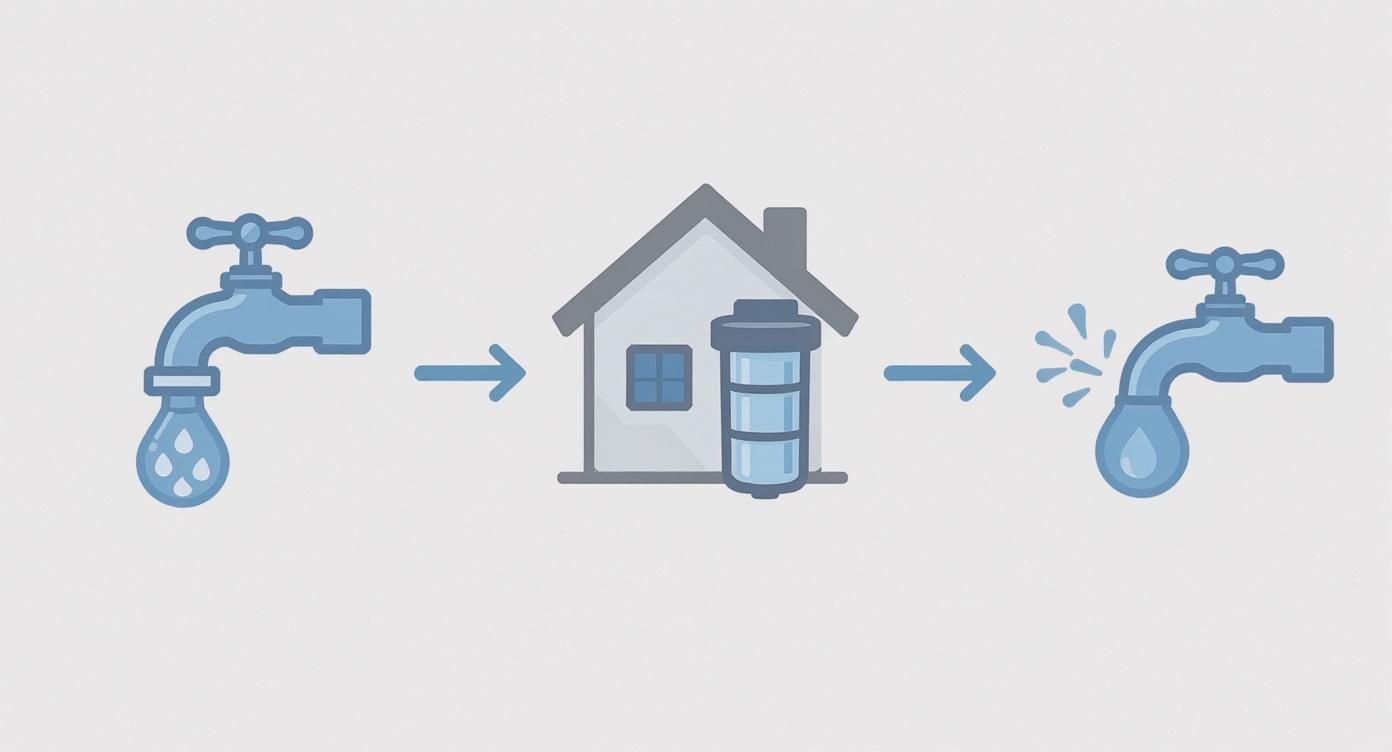
This really drives home how a whole-home system becomes the central hub for guaranteeing every drop of water from every faucet is clean and safe.
The Heart of the System: The RO Membrane
Now that the larger debris and harsh chemicals are gone, the water is ready for the main event—the reverse osmosis membrane. This is where the magic really happens. High pressure forces the water against this special semipermeable membrane, which rejects up to 99% of all total dissolved solids (TDS). It blocks a huge range of microscopic contaminants that the earlier filters simply can't catch, like lead, arsenic, fluoride, salts, and even bacteria.
The reverse osmosis membrane is the true workhorse, responsible for producing water of exceptional purity. This is why properly maintaining the pre-filters is so crucial—it protects this vital and powerful component.
The incredible efficiency of this membrane is why RO technology has taken off globally. Today's best systems use thin-film composite membranes, which dominate about 78.3% of the material market share because they're just that good at filtering and built to last. When combined with a spiral-wound filter module design, you get a powerful system that’s surprisingly compact and energy-efficient. For those who want to dive deeper into the tech, you can explore the RO membrane market report.
Final Touches and Consistent Pressure
After its journey through the membrane, the purified water moves into a dedicated storage tank. Because the RO process is so fine and deliberate, it takes time. The storage tank ensures you have a plentiful supply of pure water ready and waiting whenever you need it.
From the tank, the water often gets one last "polish" from a post-filter (usually another carbon filter). This final touch removes any lingering tastes or odors that might have been picked up in the tank, making sure the water is perfect right before it travels to your faucets.
Finally, to make sure you never have to trade purity for power, a repressurization pump gives the water a boost. We professionally size and install this pump to deliver strong, consistent flow to every showerhead, faucet, and appliance. It’s the final step that guarantees your experience with purified water is seamless—combining the ultimate purity with the powerful performance you expect. When you're ready to see what this process can do for your home's water, the first step is a complimentary water analysis from our experts.
Comparing Home Water Treatment Systems
Walking into the world of water treatment can feel a little overwhelming. You've got all sorts of different technologies, and every single one claims to be the best. To cut through the noise, it helps to put the most common options side-by-side. Once you understand what each system is actually designed to do, it becomes crystal clear why a whole house reverse osmosis system is the most complete solution for total water purity.
A lot of homeowners start out with smaller, more localized filters. These are a good first step, but they definitely have their limits. A point-of-use system, for instance, is just what it sounds like—it's installed at a single point, usually your kitchen sink.
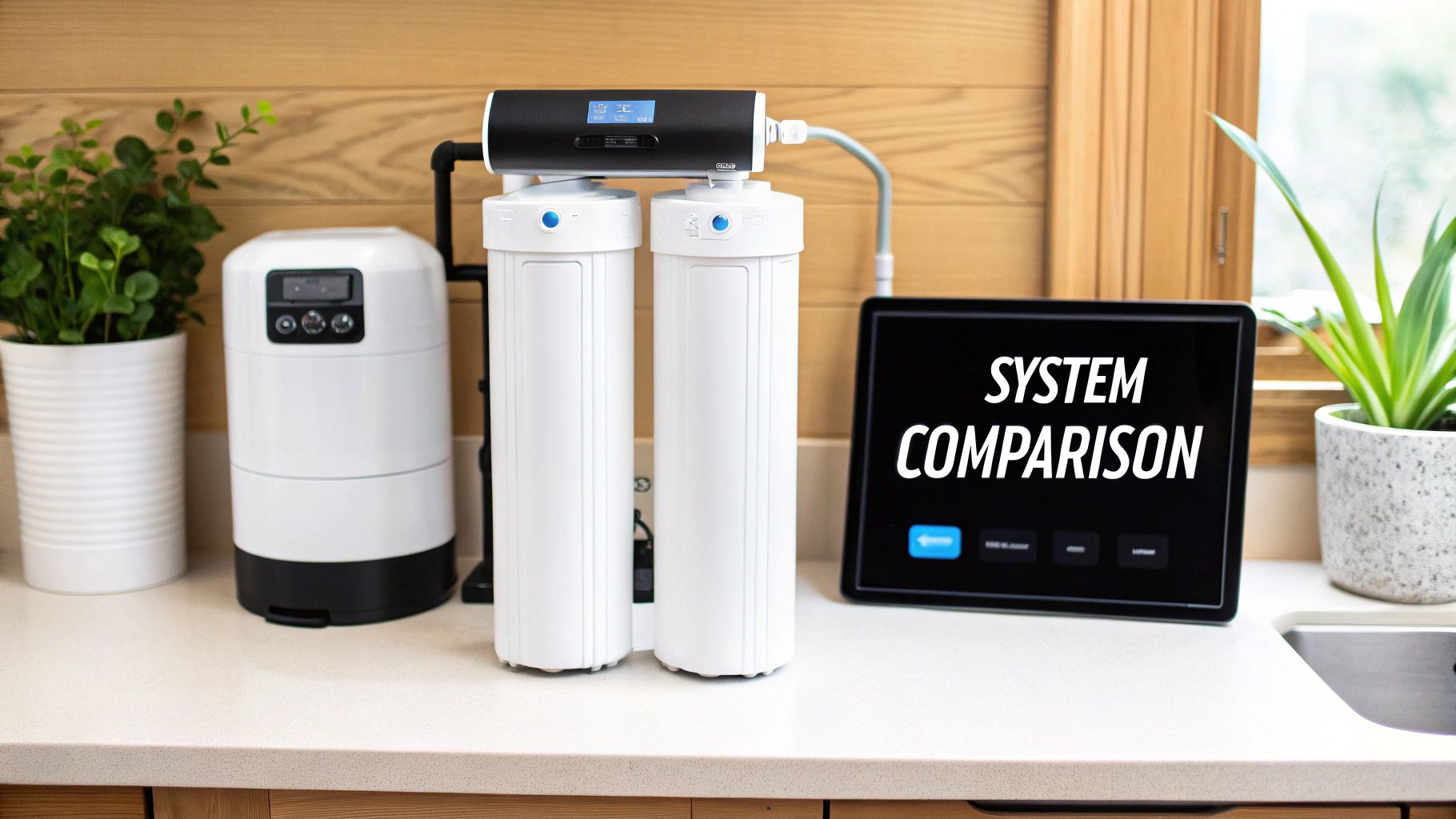
Point-of-Use vs. Whole House Systems
A point-of-use (POU) reverse osmosis filter is fantastic for getting purified drinking and cooking water right from one tap. It uses the exact same powerful RO technology, just on a much smaller scale. While it's great for that one spot, it leaves every other faucet, shower, and appliance in your home completely unprotected from whatever is in your water supply.
That means you’re still bathing in chlorinated water, your dishwasher is fighting a losing battle against hard water scale, and your washing machine is using water that can make your clothes feel scratchy and fade over time. If you're only focused on drinking water, you can learn more about how an under-sink reverse osmosis system works to see if it's enough for you. But for true, comprehensive protection, you have to think bigger.
A whole house RO system treats every drop of water the moment it enters your home. It’s the difference between patching a small leak and fixing the problem at the source.
Water Softeners Don't Purify
Water softeners are incredibly common, and they do one specific job exceptionally well: they remove "hardness" minerals like calcium and magnesium. They use a process called ion exchange to swap out these minerals, which stops that chalky scale buildup, protects your appliances, and helps soap lather up beautifully.
But here’s the crucial part: a water softener is not a water filter. It won’t touch chlorine, lead, pesticides, bacteria, or the huge list of other dissolved solids. It brilliantly solves the problem of hardness but leaves hundreds of other potential contaminants flowing through your pipes. That's a critical distinction for families concerned about the overall health and quality of their water.
Carbon Filters Improve Taste but Miss A Lot
Whole house carbon filters are all about improving the taste and smell of your water. They're fantastic at grabbing onto chlorine and other chemicals that give municipal water that unpleasant "pool" taste. This alone makes your water much more enjoyable to drink and use.
The catch? Carbon filters don't remove dissolved solids. Things like heavy metals, salts, nitrates, fluoride, and arsenic will sail right through. While they're a major upgrade from untreated city water, they just don't provide true purification.
When you lay it all out, a clear picture starts to form. Water softeners take care of hardness. Carbon filters make your water taste better. Only a whole house reverse osmosis system tackles hardness, taste, and the complete removal of dissolved contaminants for total purity.
It's also worth noting that when you're looking at different options, a comprehensive system can be one of the best home improvements for resale, adding real, tangible value to your property.
To make this even easier, let’s look at a direct comparison.
Whole House Water Treatment Systems Compared
This table breaks down the most common whole-home water treatment technologies to help you see exactly where each one shines.
| System Type | Primary Function | What It Removes | Best For |
|---|---|---|---|
| Whole House Reverse Osmosis | Total Purification | Dissolved solids, heavy metals, chemicals, bacteria, hardness minerals, and more. | Homeowners seeking the highest level of purity at every tap for health and home protection. |
| Water Softener | Hardness Removal | Calcium and magnesium (the minerals that cause scale). | Homes with significant hard water issues where the main goal is protecting plumbing and appliances. |
| Whole House Carbon Filter | Taste & Odor Improvement | Chlorine, chloramines, pesticides, and other chemicals. | Improving the aesthetic qualities of municipally treated water without removing minerals. |
| Point-of-Use RO Filter | Single-Tap Purification | The same contaminants as whole house RO, but only at one specific faucet. | Renters or homeowners wanting purified drinking water without a whole-home investment. |
Ultimately, picking the right system really comes down to what you want to achieve. If you're looking for an all-in-one solution that delivers pure, soft, and fantastic-tasting water from every single faucet in your home, a whole house reverse osmosis system is the definitive choice.
Solving Florida's Unique Water Challenges
Living in Southwest Florida comes with its perks, but the water quality isn't always one of them. Whether you're in a Cape Coral canal home or a Fort Myers neighborhood, you’re dealing with water issues that folks in other parts of the country just don't see. The problems coming from our city taps and private wells affect everything from the taste of our drinking water to how long our appliances last. This is exactly why a whole house reverse osmosis system is less of a luxury and more of a necessity around here.
If you're on a municipal supply, you're likely familiar with the "pool" smell and taste of chlorine used for disinfection. It’s not exactly refreshing. Beyond that, Florida water is famously hard, meaning it’s packed with minerals like calcium and magnesium. This is what causes that stubborn, chalky scale buildup on your faucets, showerheads, and inside your pipes.
That mineral gunk isn't just ugly. It's actively damaging your home's most expensive appliances. It forces your water heater, dishwasher, and washing machine to struggle, leading to early breakdowns. It’s also the culprit behind dry, itchy skin and brittle hair after a shower—you’re essentially bathing in liquid rock.
The Headaches of Private Wells
For homeowners relying on private wells, the water challenges can be even more complex. The groundwater here in Southwest Florida is often high in Total Dissolved Solids (TDS), which is just a technical way of saying it's full of salts, minerals, and other dissolved stuff. High TDS ruins the taste and can be a red flag for other unwanted contaminants.
On top of that, well owners frequently battle a list of specific troublemakers:
- Sulfur: The source of that unmistakable "rotten egg" smell that makes turning on the tap a truly unpleasant experience.
- Iron: This is what causes those ugly orange and brown stains in your sinks, toilets, and even on your laundry, while also giving your water a metallic tang.
- Bacteria and Tannins: These organic contaminants can be a health risk and often cause discolored, murky water that requires a serious purification strategy.
These issues are why a simple pitcher filter or a basic softener just won't cut it. When your well water is giving you problems, it’s time to take it seriously. Our team has seen it all, and you can learn more about our approach to expert well water repair and treatment.
The All-in-One Solution for Florida Water
This is where a whole house reverse osmosis system truly shines. It isn’t just a filter that targets one or two problems; it’s a complete solution that acts as a fortress against the entire spectrum of our local water woes. It methodically strips out the chlorine from city water, the dissolved minerals causing hardness, and the iron, sulfur, and bacteria that plague so many wells.
By installing a whole house RO system, you are making a smart, long-term investment in your home and family. It’s the single most effective way to protect your plumbing from scale, safeguard your health from unseen contaminants, and dramatically improve the feel of your water.
Think about what that really means for your day-to-day life. Your appliances will run more efficiently and could last for years longer without being constantly attacked by hard water. Your skin and hair will feel softer and healthier, free from the harsh effects of chlorine and minerals. Above all, you get the peace of mind that comes from knowing every single drop of water in your home—from the kitchen sink to the shower—is pure, safe, and tastes great. For anyone living in Southwest Florida, it's the definitive answer to our unique water challenges.
Our Expert Installation and Maintenance Process
Putting a whole house reverse osmosis system in your home is a big decision, but it's one that pays off every time you turn on a faucet. Our job is to make that entire process, from the first conversation to years of reliable service, feel straightforward and stress-free. We sweat the details so you can just relax and enjoy the incredible difference pure water makes.
It all starts with getting to know your home and your water. We’re not fans of cookie-cutter solutions because every well and every home is different. Our technicians begin by performing a comprehensive water analysis to see exactly what’s in your water, which lets us design a system that’s perfectly matched to your needs.
The Water Medic Installation Experience
A top-tier system is only as good as its installation. Our seasoned pros follow a careful, methodical process to make sure your whole house reverse osmosis system is integrated perfectly with your home's plumbing.
- Initial Site Assessment: We’ll walk the property with you, find the best spot for the main RO unit, storage tank, and repressurization pump, and make sure everything is placed for easy access down the road.
- Precise System Sizing: We'll look at your family's size and daily water habits to calculate the right system capacity. This step is crucial for avoiding any future issues with water pressure and ensuring you never run out of purified water.
- Seamless Integration: Our technicians will then expertly tie the system into your main water line. Every component, from the pre-filters to the RO membrane, is installed to meet the highest industry standards for a clean, professional setup.
- Final System Testing: Before we pack up, we put the entire system through its paces. We double-check every connection for leaks, test the water pressure, and confirm the water quality is exactly where it should be—pristine.
A professional installation isn't just about getting the system up and running. It’s about guaranteeing efficiency, long life, and total peace of mind. Our team makes sure every part works in perfect harmony from the moment we flip the switch.
Hassle-Free Maintenance for Peak Performance
Just like a car, your RO system needs a little regular attention to keep it performing at its best. The filters and membrane are the workhorses of the system, and they need to be replaced on a schedule to ensure your water stays pure and the system runs efficiently.
This technology is becoming more and more common in homes. The global market for reverse osmosis systems was valued at $7.15 billion in 2021 and is expected to hit $8.8 billion by 2025. It's clear that homeowners everywhere are prioritizing healthier water. You can learn more about the RO system market trends to see just how popular these systems have become.
Here’s what a typical maintenance schedule looks like:
- Sediment and Carbon Pre-Filters: These are your system's first line of defense. They typically need to be swapped out every 12 to 18 months, though it can vary based on your water's starting quality.
- RO Membrane: This is the heart of the system. It’s remarkably durable, but we recommend replacing it every 2 to 4 years to ensure it keeps capturing those microscopic contaminants.
- Post-Filter: This final "polishing" filter should be changed out once a year to keep your water tasting exceptionally fresh and clean.
We know you have better things to do than track filter replacement dates. That’s why we offer service plans that take all the guesswork out of maintenance. With our proactive support, you'll never have to think about it again. Check out our monthly maintenance plans and let us handle everything for you.
Ready for a Free Water Consultation?
You've learned what a whole-house reverse osmosis system can do. Now, the next step toward getting truly pure water flowing from every tap is simple and completely obligation-free. Taking charge of your home's water quality is one of the best investments you can make for your family's health and your home itself.
Think about it—a home where every drop of water is crisp, clean, and delicious. Coffee tastes richer, your skin and hair feel softer without the harshness of chlorine and hard minerals, and you get total peace of mind knowing your family is safe from hidden contaminants. You’d also be protecting your expensive appliances and plumbing from the damaging scale buildup common across Southwest Florida.
Your Path to Pure Water
The journey to perfect water starts with knowing exactly what’s in it now. To design the right system, we need a complete picture of your water's unique challenges. While we always conduct our own analysis, some homeowners also choose independent specialized water testing services for an even more detailed report.
The best way to begin is by scheduling a complimentary consultation with one of our Water Medic experts. This isn't a sales pitch; it's a genuine problem-solving session focused on your home and your needs.
Our goal is to give you clear, honest information without any pressure. We want to educate you so you can feel confident making the right choice for your family.
Here’s what you can expect when we visit:
- Detailed On-Site Water Analysis: We'll test your water right there on the spot to identify levels of hardness, chlorine, TDS (Total Dissolved Solids), iron, and sulfur.
- Thorough Home Evaluation: We'll take a look at your plumbing, discuss your family's water usage, and find the best spot for the equipment to determine the perfect system size and setup.
- Custom, No-Surprises Quote: You’ll get a clear, itemized proposal with no hidden fees, outlining exactly what it will take to meet your water quality goals.
Let us make this process easy. Contact Water Medic of Cape Coral today to book your free consultation and take the first step toward perfect water throughout your home.
Common Questions About Whole House RO
It's completely normal to have a few more questions running through your mind, even after getting a good grasp on how a whole house reverse osmosis system works. Making this kind of investment in your home is a big decision, and you should feel confident about it.
We've pulled together the most common questions we hear from homeowners right here in Southwest Florida to give you the clear, straightforward answers you're looking for.
What's the Typical Cost for a Whole House RO System?
The investment for a whole-house reverse osmosis system can start at a few thousand dollars and go up to $10,000 or more. That's a wide range, and for good reason—the final cost really comes down to your specific situation.
We look at the size of your home, how much water your family uses daily, and most importantly, what's actually in your water. For example, a home on well water with high levels of iron and that "rotten egg" sulfur smell will need more pre-treatment than a home on city water, which affects the price.
After we conduct a free water consultation, we'll give you a detailed and transparent quote. You'll know exactly what you're paying for. Plus, here at Water Medic, we offer flexible financing options to help make this upgrade fit more comfortably within your budget.
Will This Thing Kill My Water Pressure?
This is probably the number one concern we hear, and it's a valid one. The reverse osmosis membrane is incredibly fine, and pushing water through it does slow things down. But here’s the good news: a professionally designed system will not leave you with weak, trickling showers.
We engineer our systems to overcome this challenge with two key components:
- A large storage tank: Think of it as a reservoir of purified water, always full and ready to go the instant you turn on a faucet.
- A repressurization pump: As water leaves the tank, this pump gives it a powerful boost, ensuring you get strong, consistent pressure at every tap, shower, and appliance in your house.
Our technicians size these components specifically for your home's plumbing and your family's needs. You'll never have to compromise.
With a professional setup from Water Medic, you get the best of both worlds: ultra-pure water from every faucet with the strong, reliable pressure you expect.
How Much Water Does a Whole House RO System Waste?
Reverse osmosis cleans your water by pushing the good stuff through a membrane and flushing the bad stuff—the contaminants—down the drain. That flushing process does create wastewater.
While it's true that older systems could be pretty wasteful, modern whole house reverse osmosis systems have come a long way. The amount of wastewater varies, but the high-efficiency systems we install are engineered to minimize waste while delivering the purest water possible. We can walk you through the exact efficiency ratings of different models during your consultation.
Ready to get answers specific to your home and your water? The expert team at Water Medic of Cape Coral is here to help you navigate every step, from a free water analysis to a flawless professional installation.