
What is hard water? Signs, Causes, and Easy Protection Tips
Ever wonder why your soap just won't lather up properly, or why your brand-new glassware comes out of the dishwasher looking cloudy? You're likely dealing with hard water.
At its core, hard water is simply water that has a high concentration of dissolved minerals, mostly calcium and magnesium. Think about where our water comes from. Before it ever reaches your faucet, it travels through the ground, often pushing through layers of limestone and other rock formations. This is especially true here in Southwest Florida.
As water makes this underground journey, it picks up tiny mineral particles along the way. By the time it flows into your home, it’s carrying a heavy load of these invisible minerals.
Your Quick Guide To Understanding Hard Water
It’s a surprisingly common issue. In fact, an estimated 85% of American homes are plagued by hard water. While the minerals themselves aren't harmful to your health, they are the culprits behind a long list of frustrating—and often expensive—household problems.
When you try to wash your hands or do laundry, the calcium and magnesium in hard water react with soap to create a sticky, gunky residue known as soap scum. This film doesn't just rinse away. It clings to your skin, making it feel dry and itchy, leaves your hair looking dull, and builds up on your shower doors and tiles.
The Real Cost Of Mineral Buildup
That chalky white crust you see on your faucets and showerheads? That’s limescale, and it’s the calling card of hard water. Unfortunately, the buildup you can see is often just the tip of the iceberg.
Limescale quietly accumulates inside your plumbing and all your water-using appliances—from the coffee maker to your expensive water heater and dishwasher. Over time, this buildup chokes off water flow, slashes efficiency, and puts a huge strain on your appliances, often leading to breakdowns years ahead of schedule.
Hard water doesn't just make cleaning a chore; it actively works against your home's plumbing and appliances, shortening their lifespan and driving up your energy bills. Getting to the root of the problem is the only way to truly fix it.
Understanding the signs of hard water is the first step toward protecting your home and your wallet. Once you know what you're up against, you can find a real solution—like a whole-house reverse osmosis system—to stop the damage before it starts.
Hard Water At A Glance
To put it all together, here’s a quick summary of what defines hard water and why it's such a headache for homeowners.
| Characteristic | Description |
|---|---|
| High Mineral Content | Contains a heavy load of dissolved calcium and magnesium. |
| Causes Soap Scum | Minerals react with soap to form a sticky, insoluble film on skin and surfaces. |
| Forms Limescale | Leaves behind chalky white deposits on faucets, showerheads, and inside pipes. |
| Reduces Efficiency | Scale buildup forces appliances to use more energy, raising utility bills. |
| Damages Appliances | Can lead to the early failure of water heaters, dishwashers, and washing machines. |
Ultimately, these characteristics all add up to more work, more money spent on repairs, and more daily frustration for you and your family.
The Science Behind Your Hard Water Problem
To get to the bottom of hard water, we have to follow its journey from the sky right into your home. It all starts as naturally soft rainwater. But as that water seeps into the ground, it begins a long, slow trip through layers of earth and rock.
Here in Southwest Florida, that journey is a direct path through immense, porous deposits of limestone, chalk, and gypsum. These rock formations are loaded with mineral salts—primarily calcium carbonate and magnesium sulfate.
Think of the ground beneath us as a giant, natural mineral dispenser. As pure, soft water filters down, it acts like a solvent, dissolving these minerals and carrying them along for the ride. With every foot it travels, it gets a little bit harder. By the time it’s pumped from an aquifer or a private well, it’s no longer simple H₂O; it’s a mineral-heavy solution.
Decoding Hard Water Measurements
When you hear people talk about water hardness, you'll probably hear terms like "grains per gallon" or "parts per million." They might sound a bit technical, but they're just two different ways of measuring the same thing: the concentration of dissolved minerals.
Let’s quickly clear them up:
- Parts Per Million (PPM): This is a simple weight-to-weight comparison. One PPM just means there's one milligram of mineral content for every liter of water. Imagine one single red jellybean mixed into a container of one million white ones—that’s one PPM.
- Grains Per Gallon (GPG): This is the more traditional unit you’ll see in the water treatment industry. One grain is equal to about 17.1 PPM. It’s like measuring distance in feet versus meters; they both get the job done, just on a different scale.
Getting a handle on these numbers is what helps you understand if you have a minor nuisance or a major problem on your hands. A higher number in either PPM or GPG means more minerals, and that translates directly to more potential for costly damage.
The science is clear: the geology of Southwest Florida directly contributes to some of the hardest water in the nation. This isn't just a minor inconvenience; it's a predictable chemical process that requires a dedicated solution to manage.
This isn't a small, localized issue, either. Hard water is essentially water with a high mineral load, and according to the U.S. Geological Survey (USGS), it’s a massive problem affecting more than 85% of American homes. The classifications are pretty standard: anything over 180 ppm (or 10.5 GPG) is considered very hard.
Unfortunately for us, most areas in Florida show up bright red on national water hardness maps, landing squarely in that "very hard" category. You can learn more about water hardness classifications from this detailed overview.
This scientific reality explains why so many of us see that frustrating scale buildup on fixtures and why our appliances seem to fail prematurely. The mineral content is just too high to ignore. That’s why a professional water analysis is the essential first step—it tells us exactly what we're dealing with so we can find the right solution, like a high-efficiency Water Medic water softener.
Spotting The Tell-Tale Signs Of Hard Water
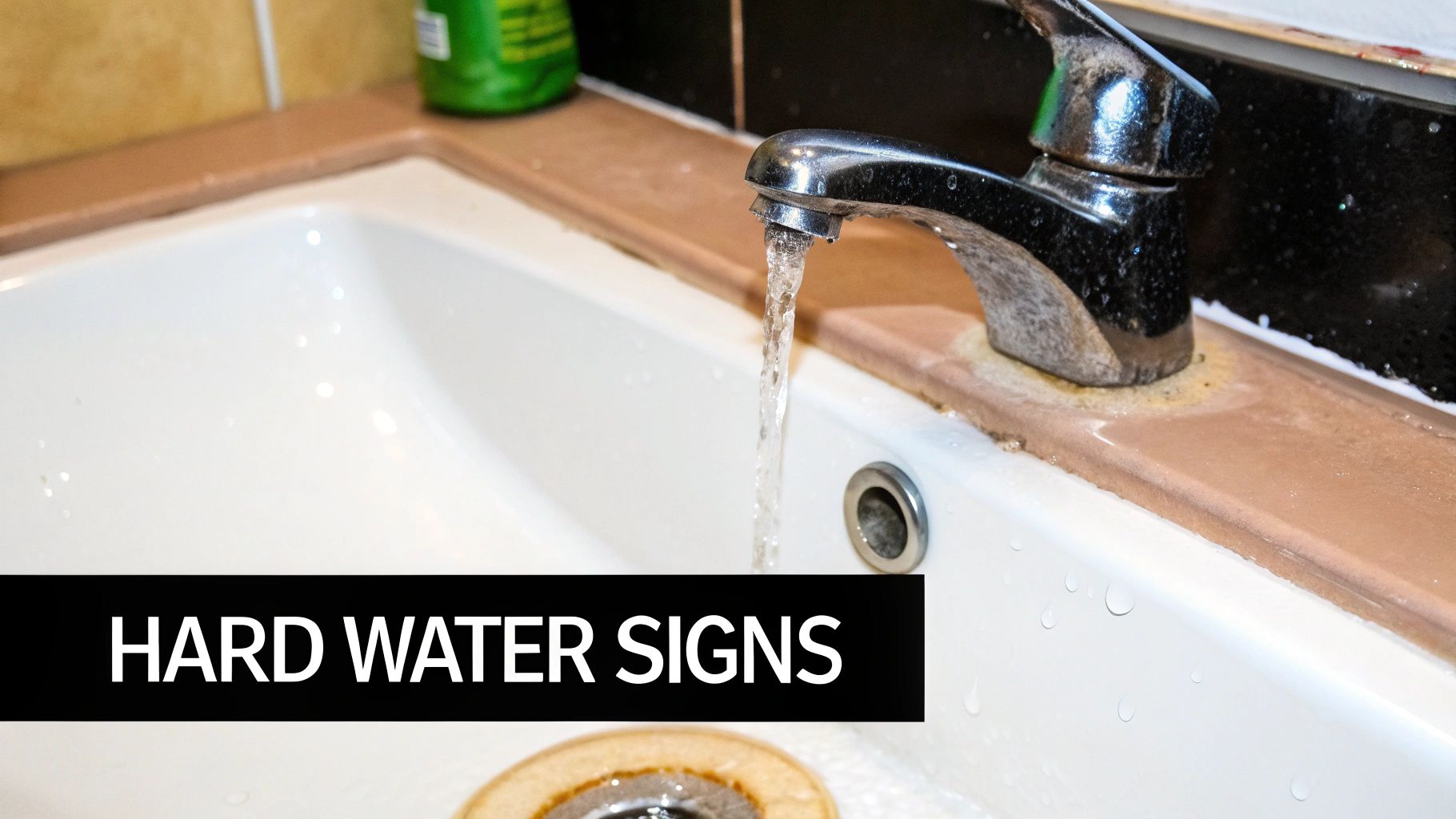
You don't need a PhD in chemistry to figure out if you have a hard water problem—the evidence is probably all around your home right now. These issues often seem small and unrelated at first, just daily frustrations you learn to live with. But once you know what to look for, you'll start to see they all point back to the same culprit: mineral-heavy water.
Those dissolved minerals, mostly calcium and magnesium, are invisible when they flow from your tap. The moment they interact with heat or soap, however, they leave a destructive trail. Recognizing these signs is the first step toward protecting your home, your appliances, and even your family’s comfort with our professional water treatment services.
Annoying Signs In Your Bathroom And Kitchen
Your bathroom is ground zero for hard water problems. Ever wonder what that stubborn, filmy layer is on your shower doors and tiles? That’s soap scum, and it happens when soap molecules bind with calcium and magnesium instead of rinsing cleanly down the drain.
You’ll probably notice a few other tell-tale signs, too:
- Chalky White Scale: Take a close look at your faucets and showerheads. That crusty, white buildup is limescale, the most obvious fingerprint of hard water.
- Constant Spotting: If your glasses, dishes, and silverware emerge from the dishwasher looking cloudy, that's mineral residue. No amount of pre-rinsing or high-end detergent seems to make them sparkle.
- Dull and Lifeless Hair: Hard water minerals coat every strand of your hair, making it nearly impossible for shampoos to lather properly. This leaves behind a residue that can make your hair feel dry, brittle, and unmanageable.
- Dry, Irritated Skin: Just like with your hair, that sticky soap scum clings to your skin. It can clog pores, cause dryness, and aggravate sensitive skin conditions.
Living with hard water isn't just a minor annoyance; it's a reality for a huge portion of the country, especially here in Southwest Florida. In fact, over 85% of U.S. households deal with it. This leads to stiff, scratchy laundry, mineral rings in toilets, and using way more soap and detergent just to get things clean. Meanwhile, scale deposits can cause reduced water pressure, spike your water heater's energy use by 20-48%, and drastically shorten the life of your appliances.
Damage To Your Appliances And Plumbing
The problems you can see are frustrating, but it’s the damage you can't see that often hits your wallet the hardest. Limescale silently builds up inside your pipes and water-using appliances, slowly choking their efficiency and setting them up for a much earlier-than-expected breakdown.
Your water heater is particularly at risk. As mineral deposits cake onto the heating element, it has to work significantly harder—and use more energy—just to heat the water. That means higher utility bills and a system under constant strain. This internal damage is happening in your dishwasher, washing machine, and coffee maker, too.
The constant battle against soap scum, stiff laundry, and appliance breakdowns is exhausting. These aren't separate problems but symptoms of a single issue—and solving it at the source with a proper water treatment system is the only way to win.
Problems For Pool Owners In Southwest Florida
For those of us in the region, the fight against hard water often extends right into the backyard. High levels of calcium and magnesium in the local water supply can turn a beautiful swimming pool into a constant maintenance headache.
Here are the most common signs a pool is struggling with hard water:
- Cloudy or Murky Water: High calcium hardness makes it incredibly difficult to keep your pool water crystal clear, no matter how carefully you balance your chemicals.
- Scale on Pool Surfaces: You'll start to see a rough, white line of scale forming at the waterline on your tiles. It’s ugly, feels like sandpaper, and is a nightmare to scrub off.
- Clogged Filters and Equipment: Limescale can build up inside your pool pump, filter, and heater, restricting flow, reducing their efficiency, and leading to expensive repairs.
These issues don't just hurt your pool's appearance; they force you to use more chemicals and spend more time and money on upkeep. A pristine pool starts with the quality of the water you fill it with.
How To Test Your Home's Water Hardness
If you're seeing the tell-tale signs of dingy laundry and chalky faucets, it's time to confirm what you probably already suspect. Finding out your home’s exact water hardness level is the crucial first step toward finding the right solution. The good news is, you don't need a full-blown science lab to figure it out.
You can actually get a rough idea right now with a simple soap test. Grab a clean, clear bottle with a lid, fill it about a third of the way with tap water, and add 10-15 drops of pure liquid soap—something basic like castile soap works best, not a modern detergent. Now, shake it like you mean it for about 30 seconds.
Got a bottle full of fluffy, long-lasting suds sitting on top of clear water? You likely have soft water. If you’re looking at a sad, scummy layer of bubbles and the water underneath is cloudy or milky, that's a classic sign of hard water. That cloudiness is the soap reacting with the calcium and magnesium, creating soap scum right in the bottle.
Getting More Precise Results
The soap test is a great party trick, but it won't tell you how hard your water is. For that, you need a number. At-home test strips, which you can find at any big-box home improvement store, will give you a much clearer picture. They provide a specific measurement, usually in Grains Per Gallon (GPG) or Parts Per Million (PPM), so you know the scale of the problem you're dealing with.
But for us here in Southwest Florida, especially if you're on a private well, hardness is often just one character in a larger story. Our local water is notorious for containing other things like iron, sulfur, or tannins, none of which will show up on a basic hardness test. Getting a handle on your well water often starts with a few key questions, and you can find many of those answers in our guide to well water FAQs.
The most reliable way to understand your home’s unique water profile is through a professional water analysis. A simple test strip can confirm hardness, but a comprehensive test reveals the full story of what’s in your water.
A professional test from Water Medic goes way beyond a simple GPG number. Our experts conduct a thorough analysis on-site, identifying not just the exact hardness level but also detecting those other common contaminants specific to our region. This complete picture is what allows us to recommend a system that solves all your water quality issues, not just the ones you can see.
Ready to get a definitive answer? We offer a free, no-obligation water analysis right in your home. It’s the smartest and most reliable first step toward protecting your appliances, improving your family’s comfort, and getting the clean, pure water you deserve.
Choosing The Right Hard Water Treatment System
So, you’ve noticed the tell-tale signs of hard water and the test results confirmed it. What’s next? Finding a real, long-term solution. Diving into the world of water treatment can feel a little overwhelming, but it really comes down to three main types of systems, each tackling the problem in a unique way.
Getting a handle on how these technologies work is the key to picking the right one to protect your home, your appliances, and your family.
Traditional Water Softeners: The Industry Standard
The most common and time-tested solution is a traditional salt-based water softener. Think of these as the workhorses of the water treatment world. They run on a straightforward principle called ion exchange.
Inside the system is a tank filled with tiny resin beads that are coated with sodium ions. When hard water flows over them, the calcium and magnesium minerals—the culprits behind all that scale—are drawn to the beads like magnets. They trade places, releasing the sodium into the water. The result? Genuinely soft water flows to your taps, while the hard minerals get trapped and are later flushed out during a "regeneration" cycle.
This approach is incredibly effective at getting rid of limescale and soap scum, which is why it's such a popular choice. It’s worth noting that the process does add a small amount of sodium to your water, but for most people, this isn't a health concern. You can learn more about how they work in our detailed guide to high-efficiency water softeners.
Salt-Free Conditioners: A Different Approach
For those looking for an alternative to salt, salt-free water conditioners offer a completely different strategy. It’s important to understand that these systems don't actually remove the hard minerals.
Instead, they use a process that changes the physical shape of the calcium and magnesium crystals. This clever trick stops the minerals from being able to stick to your pipes and fixtures, so they can no longer form that destructive scale. The minerals are still in your water, but they simply flow right through your plumbing without causing any harm. This makes conditioners a fantastic low-maintenance option for anyone focused purely on scale prevention.
Whole-House Reverse Osmosis: The Ultimate Solution
While softeners and conditioners focus specifically on hardness minerals, a whole-house reverse osmosis (RO) system is in a league of its own. This is a complete water purification powerhouse, tackling not just hardness but a whole spectrum of other contaminants. It’s truly the gold standard for water quality.
A whole-house RO system pushes water through a special semipermeable membrane that has microscopic pores. This membrane acts like a super-fine gatekeeper, blocking calcium and magnesium along with a long list of other unwanted guests.
- Purity: It can remove up to 99% of all dissolved solids, including things like fluoride, lead, arsenic, and nitrates.
- Effectiveness: It also filters out pesticides, herbicides, and other chemicals that are often a concern, especially in well water.
- Complete Protection: You get water that is not just perfectly soft but exceptionally pure from every single faucet in your home.
This flowchart walks you through the process, from a simple at-home check to a professional analysis that points toward the best solution for your specific water.
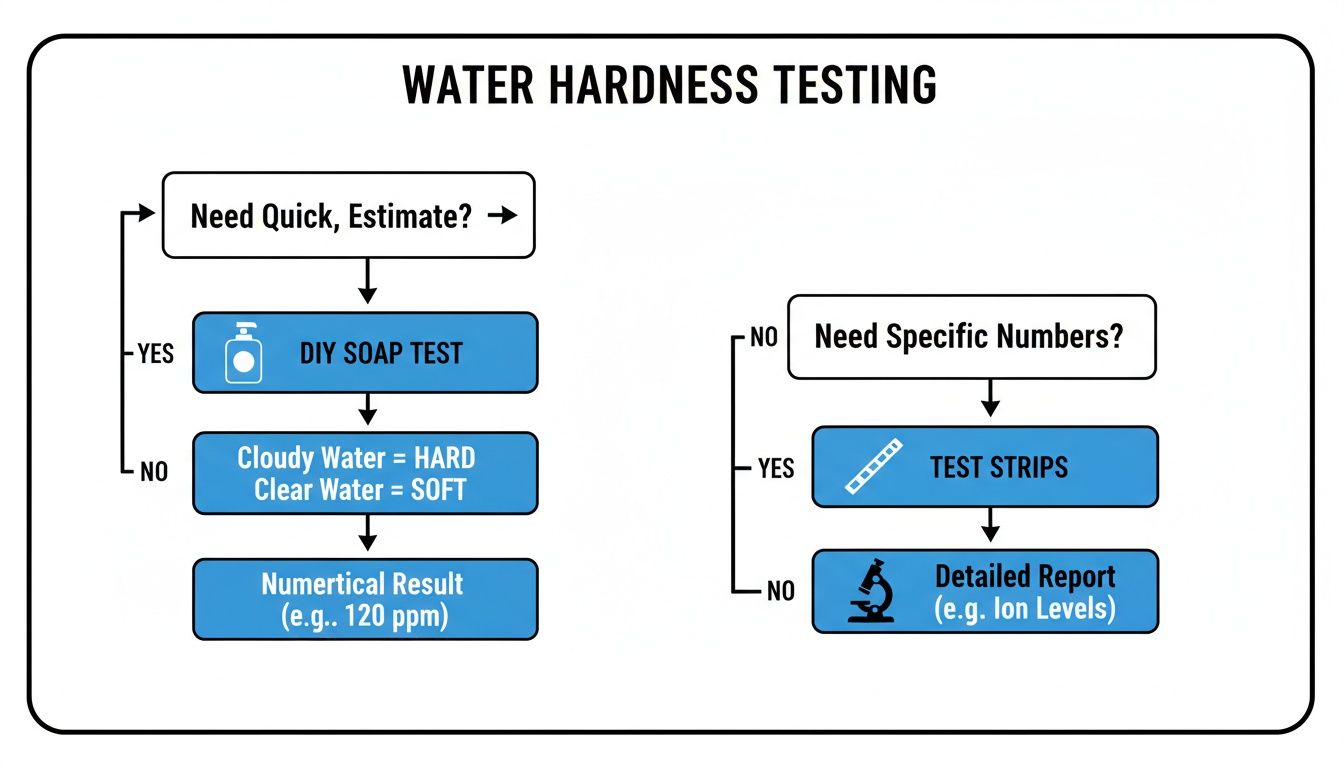
The journey from a basic soap test to a comprehensive professional analysis really highlights an important point: while you can easily spot the problem, an expert evaluation is what leads to the perfect, long-term solution.
Hard water isn't just a minor annoyance; it’s a nationwide issue, with more than 85% of U.S. water supplies qualifying as hard. Here in Sunbelt states like Florida, we often deal with very hard water—levels surging past 180 ppm—which means a daily struggle for homeowners. That scale buildup isn't just ugly; it insulates the heating elements in your water heater, slashing its efficiency by up to 30%.
For our neighbors in Cape Coral, Water Medic's 25+ years of local expertise means we know exactly what it takes to win that battle. Our whole-house reverse osmosis systems deliver 99.9% pure water, removing over 95% of minerals and helping homeowners avoid $500-$1,000 in annual appliance repair costs. You can discover more insights about national water hardness from the USGS.
For Southwest Florida homeowners, particularly those on well water, a whole-house RO system is more than just a softener—it's a complete purification solution that provides peace of mind with every drop.
Choosing the right system really depends on your specific water quality and what you want to achieve. A side-by-side comparison can make the decision much clearer.
Comparing Hard Water Treatment Systems
Here’s a breakdown of the most popular water treatment options to help you choose the best fit for your home.
| Treatment Method | How It Works | Best For | Considerations |
|---|---|---|---|
| Water Softener | Exchanges calcium/magnesium for sodium ions. | Homes with high hardness wanting to eliminate scale and soap scum. | Adds a small amount of sodium to water; requires salt refills. |
| Water Conditioner | Alters mineral crystals to prevent them from sticking. | Preventing limescale buildup without using salt or chemicals. | Does not remove minerals, so water is not technically "soft." |
| Whole-House RO | Forces water through a fine membrane to filter contaminants. | Achieving the highest level of purity by removing minerals and contaminants. | More significant initial investment; provides unparalleled water quality. |
Ultimately, for anyone who wants the purest, safest, and softest water possible, a whole-house reverse osmosis system is the definitive answer. It solves the root problems of hard water while also delivering pristine, great-tasting water throughout your entire home.
Protect Your Home With Water Medic Of Cape Coral
Are you tired of dealing with the fallout from hard water? It often feels like a constant, uphill battle. Your towels come out of the laundry feeling stiff and scratchy, your shower doors are permanently coated in a film of soap scum, and you’re always wondering when your next appliance is going to give out. It's a frustrating cycle of extra cleaning, buying more soap that barely lathers, and facing the unexpected cost of a new water heater.
But you don't have to live with it. A real, lasting solution is closer than you think.
For over 25 years, our team at Water Medic of Cape Coral has been solving the exact water problems homeowners across Southwest Florida face every day. We don't just have a general understanding of hard water; we know your water. We've seen it all, from the unique mineral profiles in local well water to the havoc it can wreak on a swimming pool.
Your Local Partner In Pure Water
Being deeply rooted in this community means we're more than just a company—we're your neighbors. We’ve earned our reputation by being honest, showing up with real expertise, and making sure our customers are genuinely happy. We know that a solution that works for one house might not be right for the one next door. That's why we skip the cookie-cutter approach and start with a personal consultation to figure out exactly what's going on with your water.
Stop letting hard water dictate your daily routine and damage your home. Take the first step toward a permanent solution and reclaim your peace of mind with the help of a trusted local expert.
We truly believe every family in Southwest Florida deserves to have clean, soft, and safe water flowing through their home. Whether you need an efficient water softener to tackle mineral buildup or want the unparalleled purity of a whole-house reverse osmosis system, our team has the hands-on experience to install the right system for your home and budget. Our aim isn't just to treat the symptoms—it's to deliver pristine water to every single tap in your house.
It's time to end the fight against mineral-heavy water. Let our team put our expertise to work for you. Take a look at the full range of our professional water treatment services to see how we can protect your plumbing, appliances, and your family's comfort.
Ready to see the difference? Contact Water Medic of Cape Coral today to set up your free water analysis and discover what truly pure water can do for your home.
Frequently Asked Questions About Hard Water
It's one thing to read about the signs and solutions for hard water, but it's another to have those lingering questions answered. And that's perfectly normal. When you start digging into your home's water quality, it’s natural to wonder about health, safety, and what equipment really solves the problem.
We get these questions all the time from homeowners just like you. Here are some clear, straightforward answers to help you feel confident about the next steps you take for your home and family.
Is Hard Water Safe To Drink?
Yes, from a health perspective, hard water is generally considered safe to drink. The main culprits—calcium and magnesium—are actually essential minerals our bodies use. The U.S. Environmental Protection Agency (EPA) doesn't even regulate water hardness because it's seen as an aesthetic or nuisance issue, not a direct health threat.
But while the minerals won't hurt you to drink, the real trouble with what is hard water is the havoc it wreaks everywhere else. The problem isn't what it does to your body, but what it does to your plumbing, appliances, skin, and hair.
How Is Hard Water Different From Contaminated Water?
This is a critical question, and the answer is key, especially if you're on a private well. Hard water simply means there's a high concentration of dissolved minerals. Contaminated water, on the other hand, contains harmful substances that can make you sick.
Harmful contaminants could include:
- Bacteria and Viruses: Microscopic organisms that cause a range of illnesses.
- Chemicals: Things like pesticides, herbicides, or industrial runoff.
- Heavy Metals: Dangerous elements like lead, arsenic, and mercury.
A standard water softener is only built to tackle the hardness minerals. It won't touch dangerous contaminants. That’s why a comprehensive solution like a whole-house reverse osmosis system is often the smartest investment for total water purity.
Think of it this way: Hard water is a costly nuisance that damages your home. Contaminated water is a direct health risk that demands immediate action. Knowing the difference helps you choose the right fix.
Why Is Hard Water A Bigger Problem For Well Water?
If you have a private well here in Southwest Florida, you're on the front lines of the hard water battle. City water goes through a municipal treatment process, but well water is pulled directly from underground aquifers. These aquifers are surrounded by limestone and other rock formations that are packed with minerals.
As a result, well water is almost always significantly harder than city water. It's also more likely to have other frustrating issues like high iron that leaves rusty orange stains or sulfur that gives off that distinct "rotten egg" smell—problems that a basic softener can't handle alone.
Do Water Softeners Add A Lot Of Sodium?
This is a common concern. A salt-based water softener uses a process called ion exchange, where it trades the hard mineral ions (calcium and magnesium) for sodium ions. So yes, it does add a bit of sodium to your water, but it's probably less than you think.
The exact amount depends entirely on how hard your water is to begin with. For the vast majority of households, the added sodium is minimal and isn't a dietary issue. However, if you're on a strictly monitored, low-sodium diet, it's a completely valid consideration. It's also another reason why many people prefer a whole-house RO system, which purifies water by physically filtering out minerals rather than swapping them.
Ready to stop guessing and finally get a real solution for your water problems? For over 25 years, Water Medic of Cape Coral has been the go-to expert for homeowners across Southwest Florida. We provide professional analysis and systems designed for our local water.
Contact us today to schedule your free water test and see what a difference pure, soft water can make in your home.