
Your Guide to Well Water Filtration Systems for Sulfur
That rotten egg smell from your faucet is a dead giveaway—you've got a sulfur problem in your well water. The culprit is hydrogen sulfide gas (H₂S), and getting rid of it for good requires a specialized well water filtration system for sulfur. With the right setup, you can finally get back to enjoying clean, fresh-tasting water and protect your home's plumbing from the damage this gas can cause.
Finally Eliminate That Rotten Egg Smell From Your Well Water
If you're a homeowner with a private well, that potent rotten egg odor can make using your water a miserable experience. It's caused by hydrogen sulfide, a gas that's either naturally present in the groundwater or produced by certain bacteria living in your well system. Trust us, you're not alone in this—it's one of the most common complaints we hear from well owners in Southwest Florida.
The good news is that this is a completely fixable problem. Modern filtration technology is incredibly effective at removing sulfur and transforming your water from unpleasant to pristine. But getting rid of the smell is just one part of the equation; you're also protecting your home's infrastructure from long-term damage.
More Than Just a Bad Smell
Hydrogen sulfide gas isn't just a nuisance; it’s corrosive. Left untreated, it will eat away at metal pipes, fixtures, and appliances like your dishwasher and water heater. If you’ve ever noticed ugly black or yellow stains on silverware, laundry, or bathroom sinks, you're seeing the classic signs of sulfur's corrosive power at work.
The first and most critical step toward solving your sulfur problem is a professional water analysis. Guessing at the source or concentration of sulfur almost always leads to the wrong solution and wasted money.
A proper test from Water Medic will tell us the exact concentration of hydrogen sulfide in your water. Just as importantly, it will flag other common troublemakers like iron and manganese, which often go hand-in-hand with sulfur and can interfere with certain types of filters. Without that data, picking the right system is just a shot in the dark.
Finding the Right Solution for Your Home
Once we have a clear picture of your water's chemistry, we can zero in on an effective filtration system. And there are great options out there. This is a widespread issue—over 13 million U.S. households rely on private wells, and some surveys show up to 20% of them report sulfur problems. Fortunately, today's systems can reduce hydrogen sulfide levels by over 99% in a single pass. You can discover more insights about the sulfur adsorbent market and see just how common this technology has become.
Solutions can be as simple as aeration, which uses oxygen to help the gas escape, or as robust as advanced oxidation and filtration systems. One of the most effective approaches involves well water aerators, which are specifically designed to inject air into the water supply and strip out unwanted gases. We can walk you through all the options and find the perfect fit for your home, ensuring you get clean, great-tasting water from every single tap.
Finding the Real Source of That Rotten Egg Smell
Before you can even think about a filtration system, you have to play detective. Pinpointing exactly where that awful rotten egg smell is coming from is the absolute first step. Jumping straight to a solution without a proper diagnosis is like trying to fix a car without popping the hood—you’ll just end up wasting time and money on a fix that doesn't actually solve the problem.
The sulfur smell in well water almost always boils down to one of two things: hydrogen sulfide gas or sulfur-reducing bacteria (SRB). Figuring out which one you're dealing with is the key to getting rid of the smell for good.
Is it a Gas or a Bug?
Hydrogen sulfide is a naturally occurring gas. As groundwater trickles through layers of shale, sandstone, or near underground oil or coal deposits, this gas can dissolve into it. Think of it like the fizz in a can of soda—the gas is trapped in the water while it's under pressure deep in the ground. The moment you turn on your faucet, you release that pressure, and the gas escapes into the air, creating the smell.
Sulfur-reducing bacteria, on the other hand, are tiny living organisms. They love dark, oxygen-poor environments, which makes places like your well casing, plumbing pipes, and especially your water heater prime real estate. These little critters don't make the smell directly. Instead, they "breathe in" naturally occurring sulfates in the water and "exhale" hydrogen sulfide gas as waste.
A Quick Diagnostic Test You Can Do Right Now
You can get a huge clue about the source of your sulfur problem with a simple test. This quick check helps narrow things down and gives our technicians a head start when they come out to your home.
- Check the Cold Water: Find a faucet you rarely use (like in a guest bathroom). Run only the cold water for a couple of minutes. Fill a glass, walk away from the sink, and give it a sniff.
- Check the Hot Water: Now, go back to that same faucet and run only the hot water. Fill a second glass, take it to another room, and smell it.
By comparing the two, you can get a pretty good idea of what's going on. If the smell is only in the hot water (or is much, much worse), the problem is almost certainly inside your water heater. If both the hot and cold water smell equally bad, the issue is coming from your well itself.
This little experiment is a crucial, money-saving step. Dealing with a contaminated water heater is a completely different—and often much simpler—process than installing a whole-house system to treat all the water coming from your well. For a closer look at common water issues, you can explore our comprehensive water treatment solutions.
Why a Professional Water Test is a Must
While the hot-and-cold water test is a great starting point, it doesn’t tell the whole story. To choose the right well water filtration system for sulfur, a professional water analysis is absolutely essential. This isn't just about confirming you have a sulfur problem; it's about getting the exact details needed for a permanent solution.
A proper lab test from Water Medic will tell us the precise concentration of hydrogen sulfide, measured in parts per million (PPM). More importantly, it will also screen for other troublemakers common in Southwest Florida wells, like iron, manganese, and tannins. These contaminants often tag along with sulfur and can completely foul up certain types of filtration equipment, so we have to know they’re there to design a system that will work flawlessly for years to come.
Comparing the Top Sulfur Filtration Technologies
Once you’ve confirmed that rotten egg smell is coming from your well, the next step is choosing the right tool for the job. Diving into the world of well water filtration systems for sulfur can feel a bit overwhelming, but it really just boils down to matching the right technology to your specific water chemistry. There’s no single "best" system—only the one that’s perfectly suited for your home.
Think of it like being a doctor for your water. You wouldn’t prescribe the same medicine for every illness, and we don't recommend the same filter for every well. A professional water test gives us the diagnosis, which then points us toward the most effective treatment methods.
This simple decision tree can help you visualize that initial diagnostic process—figuring out if the problem is your water heater or the well itself.
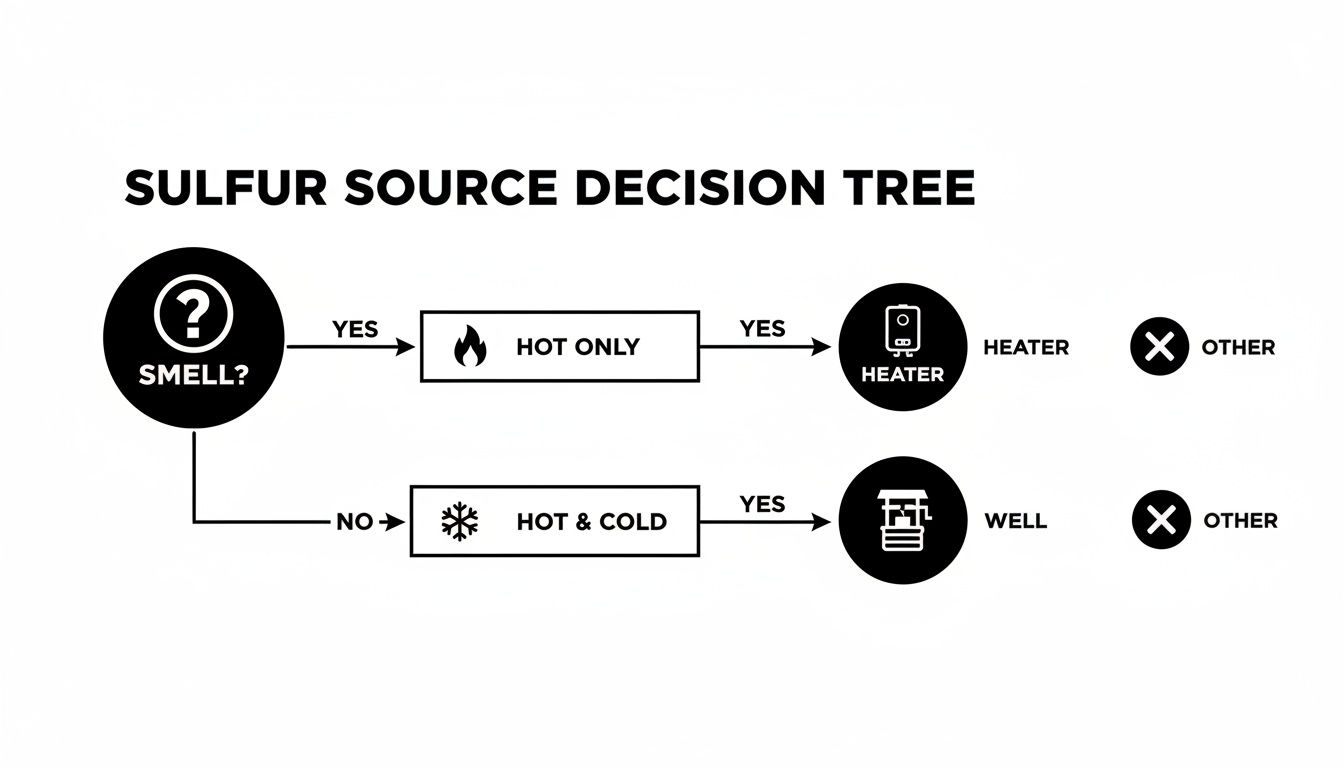
This flowchart shows the first critical question you need to answer. It guides you to the most likely source based on a simple hot-versus-cold water smell test.
H3: Air Injection Systems
Aeration is one of the most natural and chemical-free ways to get rid of hydrogen sulfide. The principle is simple: expose the smelly gas to oxygen. When sulfur-rich water mixes with air, the hydrogen sulfide gas oxidizes, turning into tiny, solid sulfur particles that can be easily filtered out.
Imagine opening a can of soda. That fizz is dissolved gas escaping. Aeration does something similar for your water, "venting" the trapped hydrogen sulfide out before it ever reaches your faucet. Modern air injection systems do this all inside a single tank, making them a compact and highly efficient solution.
- Best For: Low to moderate levels of hydrogen sulfide, typically under 10 ppm.
- Pros: It’s completely chemical-free, has low ongoing costs, and also does a great job removing iron and manganese.
- Cons: It might not be powerful enough for very high sulfur concentrations or when sulfur-reducing bacteria are the root cause.
H3: Oxidation-Filtration Systems
For more stubborn sulfur problems, you need a little more muscle. That's where an oxidation-filtration system comes in. These systems use a special filter media, like manganese greensand or other catalytic materials, that rapidly oxidizes hydrogen sulfide on contact.
As water flows through the media, sulfur is instantly converted into solid particles and trapped. The system then periodically backwashes itself, flushing those trapped particles down the drain and cleaning the media for the next round. This method is a real workhorse, reliably handling moderate to high sulfur levels.
H3: Catalytic Carbon Filters
You’ve probably heard of carbon filters for improving taste, but standard carbon doesn't do much for sulfur. Catalytic carbon, on the other hand, is a different beast. This enhanced media is specifically designed to accelerate the chemical reaction that turns hydrogen sulfide gas into harmless solid sulfur.
These filters are an excellent choice for homes with lower sulfur concentrations. They're simple, don't require chemicals, and are fantastic at polishing the water for a clean, crisp taste. The only catch is that with higher sulfur levels, the carbon can get used up quickly, meaning you’ll be replacing it more often.
Choosing the right filtration technology is a science. Factors like water pH, flow rate, and the presence of other contaminants like iron are just as important as the sulfur level itself. This is where professional guidance prevents costly mistakes.
H3: Chemical Injection Systems
When you're facing very high levels of hydrogen sulfide or dealing with a nasty sulfur-reducing bacteria problem, a chemical injection system is often the most dependable solution. These systems use a small pump to inject a precise amount of an oxidizer, usually chlorine or hydrogen peroxide, into your water.
This chemical instantly neutralizes the sulfur and, more importantly, kills any bacteria in the water. After injection, a holding tank gives the chemical time to work its magic before the water flows through a carbon filter to remove any leftover chemical taste or smell. While you do have to refill the chemical solution tank, this method is second to none for solving severe contamination.
- Chlorination: Extremely effective against both sulfur and bacteria, and it’s relatively inexpensive.
- Hydrogen Peroxide: A powerful oxidizer that breaks down into just oxygen and water, making it a popular chlorine-free alternative.
H3: Ozone Generators
At the very top of the performance ladder, you'll find ozone systems. Ozone (O₃) is an incredibly powerful oxidizing agent—far stronger than chlorine—that annihilates hydrogen sulfide and bacteria on contact. An ozone generator creates this gas from the oxygen in the air and injects it into your water supply.
The ozone works almost instantly and then simply reverts back to regular oxygen, leaving zero chemical residue behind. This makes it an exceptionally effective and clean method for tackling the most severe sulfur, iron, and bacteria issues all at once.
To help you see how these options stack up, here’s a quick comparison.
At-a-Glance Comparison of Sulfur Filtration Methods
| Filtration Method | Best For (Sulfur Level) | Pros | Cons | Maintenance Level |
|---|---|---|---|---|
| Air Injection | Low to Moderate (<10 ppm) | Chemical-free, low operating cost, also removes iron/manganese. | Not effective for very high levels or bacteria issues. | Low |
| Oxidation-Filtration | Moderate to High | Very reliable, handles higher sulfur levels effectively. | Media may need eventual replacement, requires backwashing. | Low to Medium |
| Catalytic Carbon | Low (<2-3 ppm) | Simple, improves taste, no chemicals. | Media exhausts quickly with higher sulfur, requires frequent replacement. | Medium |
| Chemical Injection | High to Very High (>10 ppm) | Kills bacteria, handles extreme sulfur, highly effective. | Requires refilling chemical tank, more complex setup. | Medium to High |
| Ozone Generator | Very High / Severe | Most powerful oxidizer, no chemical residue, kills bacteria. | Higher initial investment, more complex technology. | Low |
This table gives you a starting point, but the nuances of your water chemistry will ultimately determine the best fit.
While our focus here is on whole-house well systems, understanding the broader world of water treatment, including the different types of water filtration systems used in other applications, highlights how specialized these technologies are.
Ultimately, the best well water filtration system for sulfur is the one engineered to solve your exact problem. By starting with a professional water test, our experts at Water Medic can analyze your results and design a system that will deliver clean, odor-free water for years to come.
Choosing the Right System for Your Southwest Florida Home
Picking a well water filtration system here in Southwest Florida isn't like buying a new appliance at the store. Our local groundwater is a unique cocktail of issues that can completely overwhelm a generic, off-the-shelf filter. The geology under our feet means our water is often loaded with dissolved minerals—what we call "hard water"—but the trouble rarely stops there.
Many homeowners in Cape Coral, Fort Myers, and our neighboring communities are fighting a battle with high levels of iron, tannins, and, of course, that rotten egg sulfur smell. These contaminants are pulled directly from the limestone and organic deposits of the Floridan aquifer system. This specific blend is exactly why choosing the right well water filtration systems for sulfur is so much trickier here than in other parts of the country.
Honestly, a one-size-fits-all filter from a big-box store is almost guaranteed to fail. It might mask the smell for a little while, but it's not built to handle the iron that will inevitably clog it or the hardness that will kill its efficiency. This is why having local expertise isn't just a nice-to-have; it's a must.
Matching Flow Rate to Your Household's Needs
One of the first things we have to get right is the flow rate, measured in gallons per minute (GPM). This number tells us how much treated water a system can deliver at any given moment. If a system is too small for your home, you'll feel it immediately—water pressure will tank the second someone flushes a toilet while the shower is running.
To nail this down, a pro from Water Medic looks at your family's real-world water usage:
- Number of Bathrooms: More bathrooms create a higher potential for simultaneous demand.
- Family Size: How many people live in the house directly impacts peak water needs.
- Water-Using Appliances: Think about your high-efficiency washing machine, dishwasher, and any fancy multi-head showers. They all add up.
By carefully calculating your home’s peak demand, we can make sure the system we design provides all the clean, odor-free water you need without ever sacrificing pressure. It's a technical detail, but it makes a huge difference in your day-to-day life.
Understanding the True Cost of Ownership
The price tag on the system itself is just the beginning. To make a smart decision, you have to look at the long-term costs of maintenance and upkeep. A cheaper system might look good upfront, but if it needs pricey media replacements every six months, it's a terrible bargain.
A tailored solution designed by a local professional accounts for your specific water chemistry, ensuring the system operates efficiently and maintenance costs are predictable. This approach prevents the costly cycle of trial-and-error that comes with generic solutions.
We believe in being upfront about this. When our team recommends a system, we’ll walk you through the entire cost of ownership. We'll cover scheduled maintenance, the expected lifespan of the filter media, and any chemicals needed for systems like chlorinators. Our goal is a solution that’s not just effective today but is also affordable to run for years to come. You can see how we support our customers with our professional monthly maintenance plans.
The Absolute Necessity of Professional Installation
Finally, even the best, most expensive equipment on the market will fail if it isn't installed correctly. Proper installation is a science. It’s way more than just connecting a few pipes—it demands a deep understanding of plumbing dynamics, precise system calibration based on your water test, and making sure every component works seamlessly with your existing well.
A professional installation by a Water Medic technician guarantees your system is set up for peak performance from day one. We take care of everything, from ensuring the backwash cycle has proper drainage to perfectly calibrating injection pumps for chemical feeders. This level of detail doesn't just give you the clean water you're paying for; it protects your investment and keeps your manufacturer's warranty valid. Don't leave something as important as your water quality to chance—let our experts build you a solution that lasts.
Professional Installation and Long-Term System Care
Choosing the right well water filtration system for sulfur is the first big step toward getting clean, odor-free water. But there are two final, crucial pieces to the puzzle: a flawless installation and consistent, long-term care. You can have the best equipment in the world, but if it isn't set up and maintained correctly, it simply won't perform as it should.
Tackling the installation yourself is a major gamble. These aren't simple "plug-and-play" appliances; they're complex systems that have to integrate perfectly with your home's unique plumbing. An amateur setup often leads to leaks, incorrect system calibration that doesn't actually remove the sulfur, or even permanent equipment damage—which almost always voids the manufacturer's warranty.
The Value of Expert Installation
Professional installation is so much more than just connecting a few pipes. When our technicians at Water Medic install a system, we're making sure every single component is calibrated to the specific results of your water analysis. This precision ensures your system operates at peak efficiency from day one.
We take care of all the technical details that make the difference, including:
- Correct Sizing and Flow Rate: We make sure the system can handle your household's peak water demand without causing a frustrating drop in pressure.
- Proper Media Loading: We use the exact amount and type of filtration media needed to tackle your specific sulfur levels.
- Backwash Cycle Programming: We set up the self-cleaning cycles to run at the right time and for the right duration, keeping the system effective and the media clean.
A professional installation is your guarantee that the system will perform as promised. It takes the guesswork out of the equation and protects you from the costly headaches of a setup gone wrong, giving you total peace of mind.
This professional touch is absolutely vital for long-term reliability. Recent EPA data from 2023 shows that 18% of U.S. wells have sulfur odors strong enough to be a nuisance, contributing to an estimated $2 billion in annual economic loss from appliance damage. A properly installed and maintained system prevents you from becoming part of that statistic.
Long-Term Care and Proactive Maintenance
Once your system is up and running, routine maintenance is what keeps it that way. Think of it like your car—it needs regular oil changes to run smoothly. Your water filter is no different; it needs periodic service to keep delivering fresh, clean water for years to come.
What that maintenance looks like depends entirely on your system. An air injection system might need its injector cleaned every so often. A chemical feed system will need its solution tank refilled. Filters that use special media, like manganese greensand or catalytic carbon, will eventually need that media topped off or replaced to keep up their sulfur-removing power.
To make this completely hands-off for you, we offer comprehensive service plans. Our technicians handle all the scheduled upkeep, from replacing media to servicing pumps. Opting for one of our professional monthly maintenance plans is the smartest way to ensure your system performs flawlessly for its entire lifespan, protecting your home and family with consistently great water.
Still Have Questions About Sulfur Water Filters?
Even after digging into the technology, you probably still have a few questions. That's completely normal. Most homeowners run into the same concerns when they're finally ready to tackle that rotten egg smell. Let's clear up some of the most common questions we get.
Will a Sulfur Filter Get Rid of the Iron, Too?
This is a big one, especially here in Southwest Florida where sulfur and iron often show up together. The short answer is: it really depends on the type of system you choose.
Thankfully, some of the best well water filtration systems for sulfur are designed to knock out both problems at the same time.
- Air Injection/Oxidation Systems: These are fantastic dual-purpose filters. The same process that turns the smelly hydrogen sulfide gas into a solid particle also works on dissolved iron, converting it into tiny rust particles that get trapped in the filter.
- Chemical Injection Systems: If you're using a system that injects chlorine or hydrogen peroxide, it will oxidize both sulfur and iron. This makes it a powerful option for wells with high levels of both contaminants.
- Ozone Generators: Ozone is the strongest oxidizer of the bunch. It's incredibly good at handling high concentrations of sulfur, iron, and even manganese all at once.
On the other hand, a simple catalytic carbon filter, which works great for low levels of sulfur, won't make a dent in your iron problem. The only way to know for sure what you're up against is to get a professional water test.
What's the Real Cost of a Whole House Sulfur Filtration System?
The price for a whole-house system can swing pretty wildly, and it all comes down to what's actually in your water. It's impossible to give a flat price without a water test, but I can walk you through the factors that determine the final cost.
Here’s what moves the price tag:
- How Bad is the Smell?: The more hydrogen sulfide in your water, the more powerful (and more expensive) the system needs to be. A simple air injection filter for a minor odor will cost less than a heavy-duty ozone generator needed for a serious problem.
- What Else is in the Water?: If you're also dealing with high iron, manganese, or bacteria, you'll need a more comprehensive, multi-stage system, which naturally affects the total investment.
- How Big is Your Home?: A larger house with more bathrooms needs a system that can keep up with the demand (a higher Gallons Per Minute, or GPM). Bigger equipment is needed to maintain good water pressure, and that generally costs more.
Investing in a system that's properly sized and professionally installed for your specific water is always the most cost-effective route in the long run. It saves you from the headache and wasted money of an undersized, off-the-shelf filter that just can't keep up.
Can't I Just Use a Regular Carbon Filter for the Sulfur Smell?
This is a common thought, but it almost always leads to frustration. While a standard activated carbon filter—like the one in your fridge or a pitcher filter—is great for removing chlorine and making city water taste better, it's practically useless against hydrogen sulfide gas.
A basic carbon filter might knock back a very faint odor for a day or two, but it will get overwhelmed and stop working almost immediately. To actually solve a sulfur problem, you need a system that physically changes the gas into a solid particle through oxidation. That's why technologies like aeration, manganese greensand, or catalytic carbon (which is very different from standard carbon) are required.
Trying to use a basic filter for a real sulfur problem is like trying to put out a bonfire with a squirt gun—it's just not the right tool for the job.
For more perspectives on different water quality issues, you can find some helpful general water filtration advice. Getting a solid understanding helps you make a confident choice.
Ready to finally get rid of that rotten egg smell for good? The expert team at Water Medic of Cape Coral will perform a professional water analysis and design a custom well water filtration system that delivers clean, great-tasting water to every faucet in your home. https://watermedic.com