
Ultimate Guide to swimming pool cleaning and maintenance for a pristine pool
A beautiful, sparkling pool is the centerpiece of any Florida backyard, but it doesn't stay that way on its own. Keeping it clean and safe takes a consistent, hands-on approach that goes far beyond just scooping out a few leaves. Real swimming pool cleaning and maintenance is a predictable routine of skimming, brushing, vacuuming, and managing the water's delicate chemical balance.
This guide is your roadmap. It's designed to help you sidestep the common frustrations that trip up new pool owners and protect the major investment sitting in your backyard.
The Foundation of a Sparkling Pool
A crystal-clear pool is the product of a well-executed plan. We always tell our clients to think of it as a partnership: physical cleaning on one side, chemical balancing on the other. You simply can't have one without the other.
Skimming debris and brushing down the walls is a wasted effort if your sanitizer levels are zero. Likewise, perfectly balanced water won't stay clear for long if the pool is full of dirt and algae spores. It's a constant balancing act that our professional technicians have perfected.
This isn't just about looks, either. Proper, proactive upkeep is your first line of defense in protecting your pool's plaster or vinyl from ugly staining. More importantly, it keeps your expensive equipment—your pump and filter—from getting overworked and failing years before it should. By tackling small, regular tasks, you stop minor headaches from turning into massive, budget-busting repairs.
Why Consistency is Key
The secret to successful swimming pool cleaning and maintenance is just showing up. Routine is everything. When you let things slide, you open the door to frustrating problems that always demand more time, more money, and a whole lot more chemicals to fix.
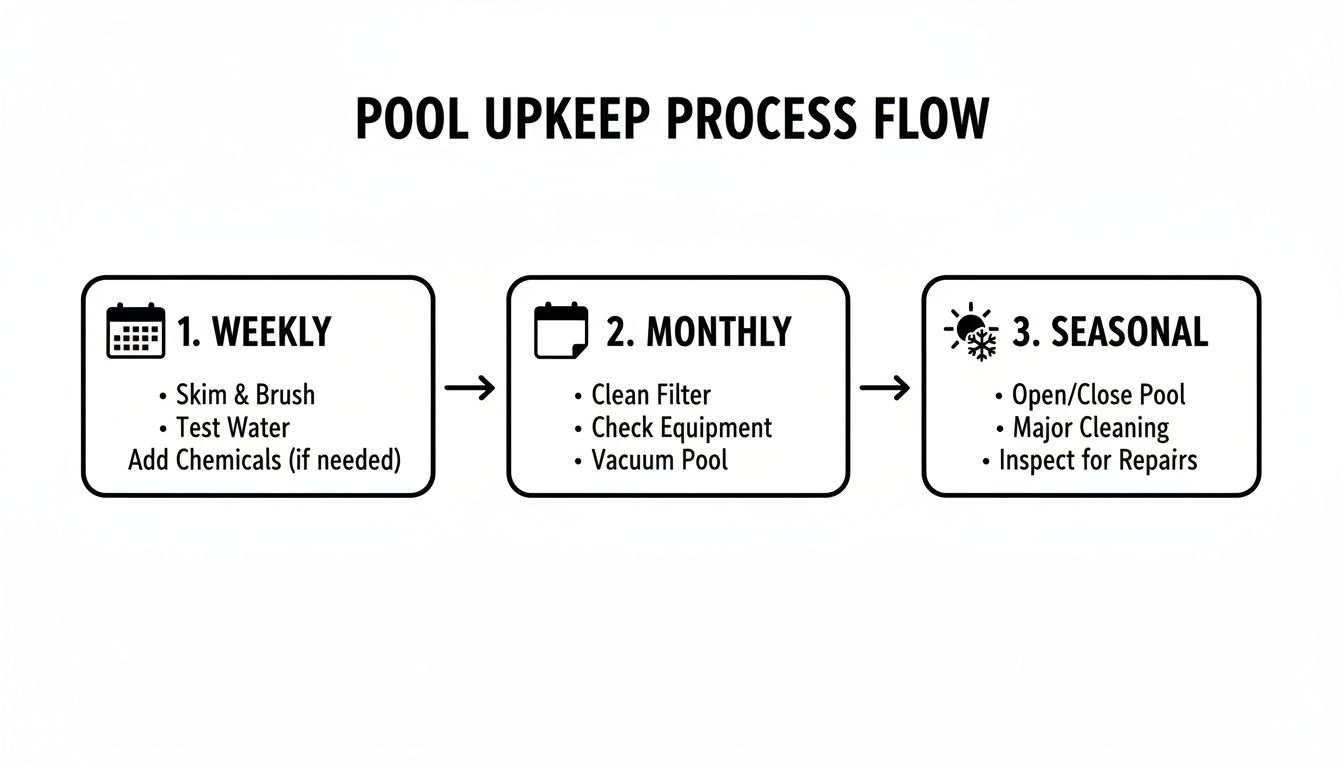
Getting into a simple rhythm for your weekly, monthly, and seasonal chores is what makes owning a pool a joy instead of a burden.
This guide will walk you through the non-negotiables every pool owner should master. We'll cover:
- Core Routines: The "what" and "why" behind your weekly, monthly, and seasonal duties.
- Problem Prevention: How a few simple actions can stop algae blooms and cloudy water dead in their tracks.
- Safety and Longevity: How to ensure the water is always safe for a swim while making your pool equipment last as long as possible.
A well-maintained pool isn't just a luxury; it's a protected asset. Consistent care prevents the gradual decay that can devalue your property and lead to expensive, avoidable repairs down the line.
Of course, life in Southwest Florida gets busy. Finding the time to do all of this yourself isn't always in the cards. For those weeks when your schedule is packed, or you’re facing a problem that feels overwhelming, calling in a professional is the best way to get some peace of mind. When you need a hand, services like our expert pool care can provide the reliable support to make sure your pool is always ready when you are.
Your Weekly Pool Care Routine
If you want that inviting blue sparkle every weekend, carving out a little time each week makes all the difference. A handful of minutes skim-and-brush sessions prevents bigger headaches later on. Plus, your pool stays safe, clear, and swim-ready whenever the urge strikes.
Think of this routine as an insurance policy. Dirt, leaves, sunscreen residue and pollen drift in daily, offering a feast for algae and bacteria. Staying on top of these unwelcome guests gives your sanitizer a fighting chance instead of letting it work overtime against cloudiness and discoloration.
Skimming The Surface For A Healthier Pool
The quickest way to brighten up your water is by skimming off the top. Armed with a long-handled net, circle the pool and scoop out leaves, grass clippings and stray bugs before they sink.
• Push debris toward a single collection point to save effort
• Aim for a daily ritual or, at minimum, every other day
• You’ll notice up to 30% less strain on your filter when you stay consistent
A real-world trick: tackle this first thing in the morning when wind and swimmers haven’t stirred things up. You’ll spend less time hunting wayward leaves later in the day.
The Importance Of Brushing Walls And Floors
Hidden algae spores cling to walls and steps, especially in corners and behind fixtures where circulation lags. A week’s worth of buildup can form a slippery micro-layer that breeds bacteria. Brushing every surface sends those spores into suspension, where your filter and sanitizer can take them out.
Use a sturdy pool brush and focus on:
- Railings, ladders and steps
- Pool corners and light niches
- Areas just beneath the waterline
After brushing, run your filter long enough to clear the cloud. You’ll be amazed how much cleaner a quick scrub can make tiles and plaster look.
Cleaning Your Skimmer And Pump Baskets
Your skimmer and pump baskets do the heavy lifting of catching larger debris. When they clog, water flow slows, equipment strains and energy costs climb. Left unchecked, you risk pump failure—a pricey headache.
Empty these baskets at least once or twice a week. If they’re overflowing each time you check, it’s a sign to tighten up your routine.
A clean skimmer basket is non-negotiable for pump health. Reduced water flow from a clogged basket is one of the leading causes of premature pump failure, a repair that can cost hundreds of dollars.
These weekly chores lay the groundwork for deeper monthly and seasonal care. For many homeowners, letting professionals handle both the consistency and the finer points is a game-changer. Discover our full comprehensive monthly maintenance plan to see how we build on these fundamentals, so you never have to worry about a muddy dip again.
Decoding Pool Chemistry and Water Balance
Let's be honest, getting your pool chemistry right can feel like a high school science class you never signed up for. But this is, without a doubt, the most critical part of swimming pool cleaning and maintenance. It’s what turns cloudy, algae-prone water into a sparkling, inviting oasis.
You can skim and vacuum all day, but if the water chemistry is off, you’re fighting a losing battle. Think of it this way: physical cleaning removes the visible gunk, while balanced chemistry handles the microscopic threats. One simply can't work without the other.
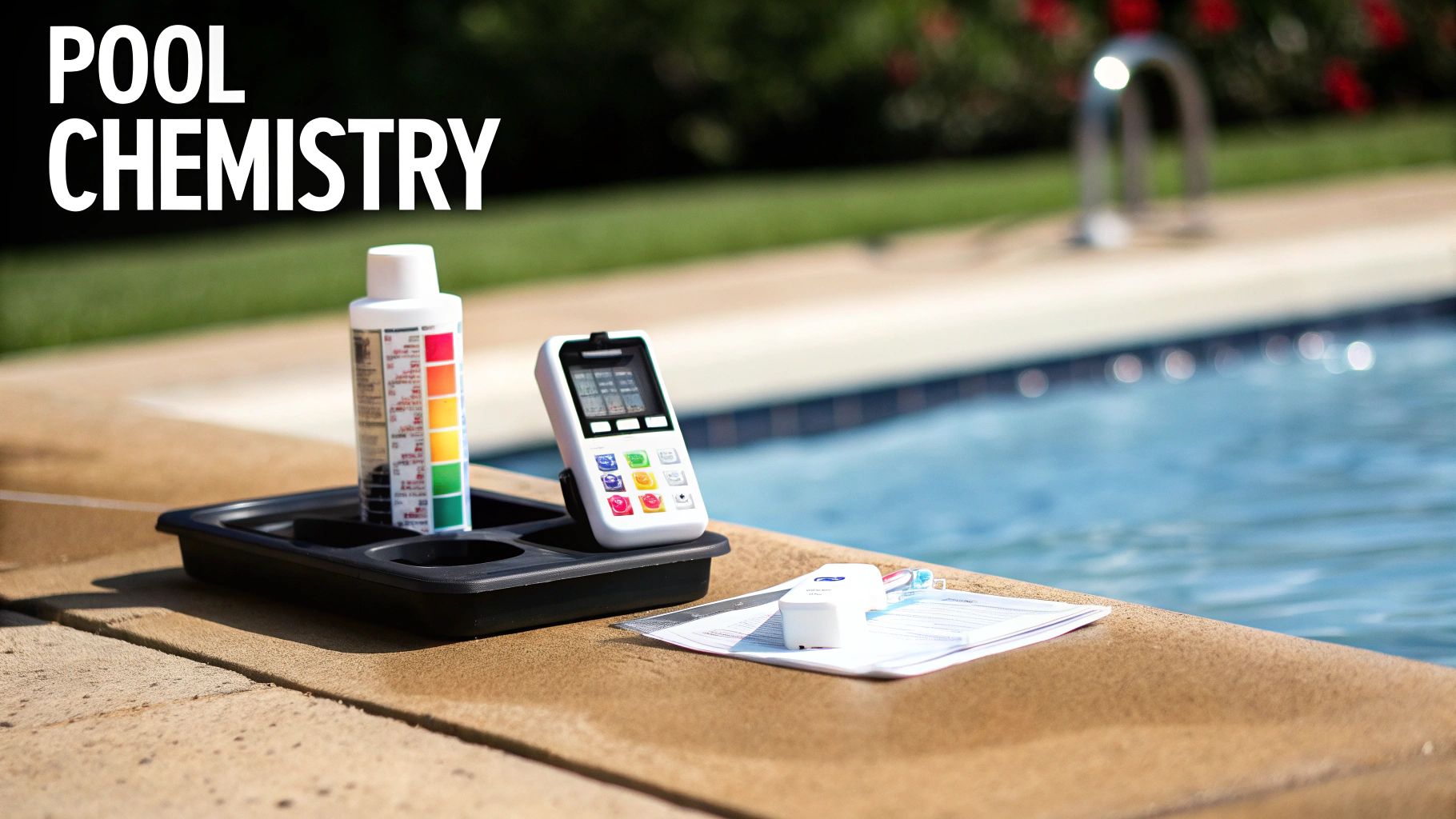
The “Core Four” Chemical Levels to Master
Don't get overwhelmed by all the different chemicals on the shelf. If you can get a handle on these four pillars of water balance, you'll solve 90% of common pool problems before they even start.
- Chlorine: This is your sanitizer, the workhorse that kills bacteria, algae, and other nasty stuff. You're aiming for a free chlorine level between 1-3 parts per million (ppm).
- pH: This simply measures how acidic or basic your water is. Keeping it in the sweet spot of 7.4 to 7.6 is crucial, as it directly impacts how well your chlorine can do its job.
- Total Alkalinity (TA): Think of this as the pH's bodyguard. It acts as a buffer, preventing wild pH swings every time it rains or you have a pool party. Keep it between 80 and 120 ppm.
- Calcium Hardness (CH): This is the measure of dissolved calcium. The ideal range of 200 to 400 ppm protects your pool's plaster, tile, and equipment from getting etched or caked with scale deposits.
These levels all work together. For instance, if your pH creeps up above 7.8, your chlorine becomes lazy and almost useless, even if your test kit says the ppm is fine. This is a classic trap—pool owners keep dumping in more chlorine, wondering why the water is still green. The real problem was the pH.
How to Test and Adjust Your Water
You can't manage what you don't measure. Get in the habit of testing your water at least twice a week during the swim season, especially for chlorine and pH. Test for alkalinity and calcium hardness about once a week. You can use quality test strips or a liquid reagent kit—both work well if you use them consistently.
When it's time to add chemicals, always read the directions on the package. A great pro-tip is to pre-dissolve granular chemicals in a bucket of pool water first. Then, carefully broadcast the mixture across the pool's surface. This simple step prevents undissolved granules from sinking and bleaching your pool liner or damaging the plaster.
Proper chemical management isn't just about clear water; it's about swimmer comfort and safety. Imbalanced water is the leading cause of skin irritation and red eyes after a swim.
Juggling all these chemicals and tests can feel like a part-time job. Many Southwest Florida homeowners find that between the cost of chemicals (easily $300 to $800 a year) and the value of their own time, hiring a pro just makes sense. Professional service often provides incredible value, taking the constant guesswork off your plate.
If you're tired of handling chlorine, a salt system is a fantastic alternative. These systems use dissolved salt to generate their own chlorine, resulting in softer-feeling water and a more stable, hands-off sanitizing experience. You can learn more about how our expert salt system services can simplify your routine.
Ultimately, mastering your pool's chemistry is the key to enjoying it. It ensures every swim is in water that's not just beautiful, but perfectly safe and comfortable. When you're ready to hand that job over to the experts, Water Medic is here to keep your water perfectly balanced, so all you have to do is jump in.
Keeping Your Pool Equipment in Prime Condition
If water chemistry is the science of a crystal-clear pool, then your pump and filter are its heart and lungs. This system is the lifeblood of your pool, and honestly, consistent care is the single best thing you can do to sidestep those sudden, eye-watering repair bills. Ignoring it is like never changing the oil in your car—sooner or later, you're going to end up stranded.
A little proactive attention does more than just extend the life of your machinery; it also keeps your energy bills from creeping up. A pump that's struggling or a filter that's clogged has to work overtime just to move water, and you'll see that extra effort reflected on your FPL statement.
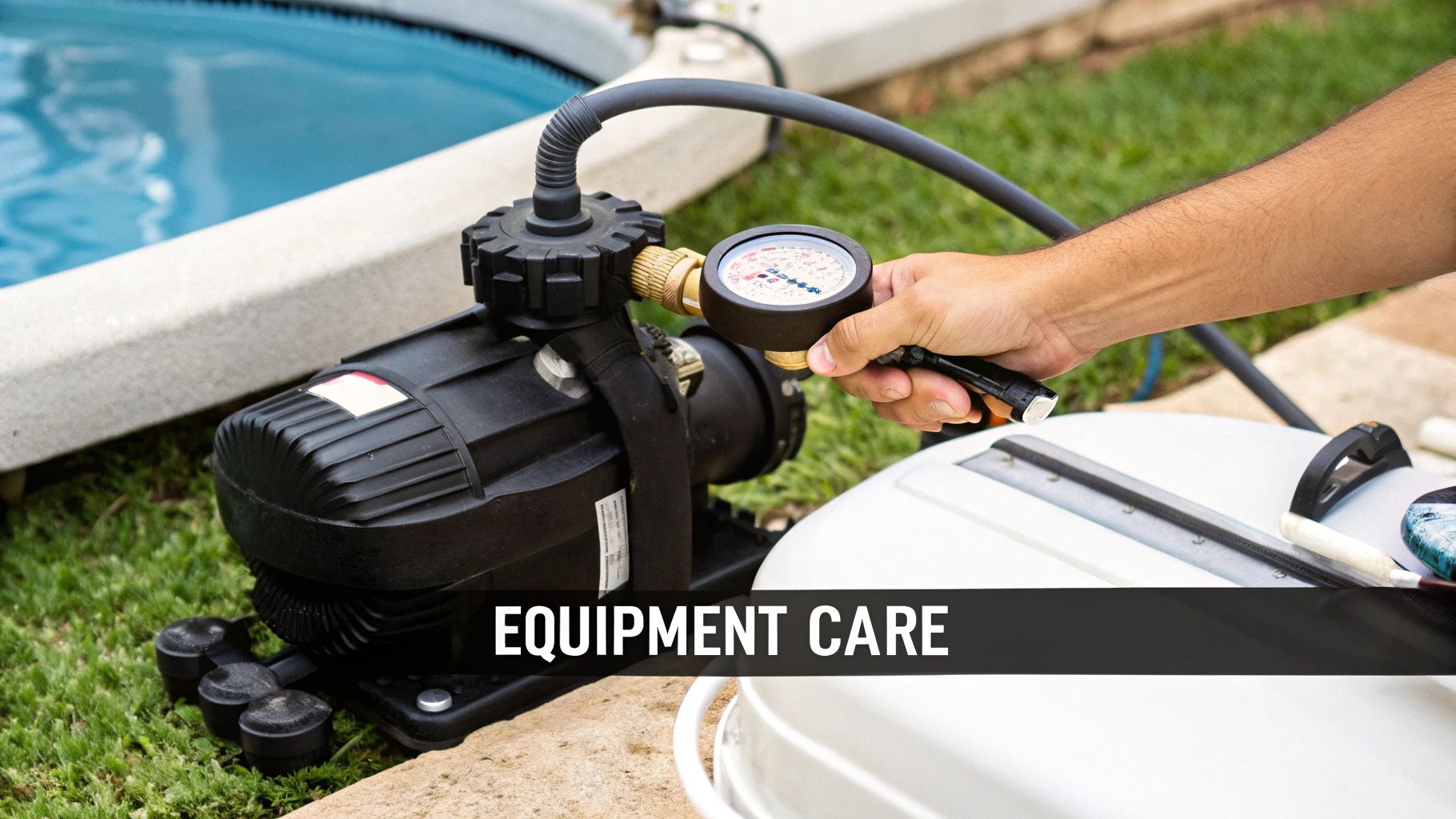
Your Monthly Equipment Health Check
Once a month, just take a few minutes to walk out to your equipment pad and give everything a good once-over. This isn't complicated stuff. It's really just about listening and looking for anything that seems off. You’d be surprised what you can catch before it turns into a major headache.
- Listen to Your Pump: Get close and listen. Is the motor humming along smoothly, or are you hearing a high-pitched squeal? How about a low, grinding rumble? Those unusual noises are often the first sign of failing bearings, a problem that’s much, much cheaper to fix before the entire motor seizes up.
- Check for Leaks: Look around the pump, filter, and all the plumbing connections. See any drips? Any puddles forming? Even a tiny leak can waste hundreds of gallons of perfectly balanced water over a month. Worse, it can suck air into the system, putting a massive strain on your pump.
- Inspect the Pressure Gauge: This little dial on your filter is your best friend. After you clean your filter, take a mental note (or a picture) of the pressure reading. That’s your clean baseline. When the pressure climbs 8-10 PSI above that number, the filter is screaming for a cleaning. It’s full of gunk and restricting the flow.
A Quick Guide to Filter Cleaning
How you clean your filter really depends on which type you have. The goal is always the same, though: get the trapped debris out so water can flow freely again.
- Sand Filters: These are the old workhorses. Cleaning is as simple as "backwashing," which just means reversing the water flow to flush all the trapped dirt out through a waste line. Do this whenever that pressure gauge tells you to.
- Cartridge Filters: Inside this type of filter is a pleated fabric cartridge. You'll need to turn off the system, open the housing, and pull the cartridge out. Give it a really thorough cleaning with a garden hose, making sure you spray down between every single pleat. Every few months, a soak in a filter cleaning solution will break down oils and lotions to help it last longer.
- Diatomaceous Earth (D.E.) Filters: These guys give you the absolute finest filtration, but they do ask for a bit more attention. You backwash them like a sand filter to flush out the old, dirty D.E. powder. Afterward, you have to add a fresh scoop of D.E. through the skimmer to recoat the internal grids.
Proactive equipment care isn't just about dodging a breakdown; it's about efficiency. A clean filter and a healthy pump can cut your pool's energy use by as much as 50%. That's real money back in your pocket over a long, hot Florida swimming season.
While these checks are pretty straightforward, it's just as important to know when a problem is out of your league. A leak you just can't pinpoint, a motor that hums but won't start, or a cracked filter tank are all signs to put down the tools and pick up the phone.
Trying to tackle complex electrical or plumbing work without the right training can easily turn a small problem into a catastrophe, or worse, create a serious safety hazard. If you suspect a major issue, the smartest and safest move is to get help from a certified technician who handles professional pool equipment repair day in and day out. They’ll get the job done right the first time.
Seasonal Pool Care and Storm Preparedness
Routine weekly cleaning keeps a pool inviting, but seasonal maintenance is what defends your investment against Florida’s wild weather swings. As temperatures shift and storm systems approach, it pays to look beyond the basics.
In Southwest Florida, preparing for hurricane season isn’t optional—it’s essential. A few well-timed tasks can mean the difference between a quick cleanup and weeks of frustration (not to mention major repair bills).
Hurricane And Storm Prep Checklist
Before dark clouds roll in, walk through this checklist to lock down your pool area:
-
Do Not Drain Your Pool
A full pool exerts thousands of pounds of hydrostatic pressure on its structure, preventing it from “floating” out of the ground when the soil gets saturated. -
Turn Off All Power
Head to the breaker box and switch off electricity for the pump, motor, lights, and any automatic systems. This simple move guards against power surges and flood damage. -
Store Loose Items
Patio furniture, pool toys and cleaning tools can become dangerous projectiles in high winds. Stash them in a garage or shed—far from windows and screens. -
Add Extra Chlorine
Stormwater dilutes your sanitizer and brings in debris. A heavy “shock” dose of liquid or granular chlorine before the worst weather hits gives you a head start against bacteria and algae bloom.
As part of seasonal care, understanding tips for storm preparedness is vital to protect your pool and surrounding areas from severe weather. Once the skies clear, start by clearing debris, rebalancing chemicals, and inspecting equipment before flipping the power back on.
Advanced Seasonal Maintenance Tasks
Beyond storms, certain elements quietly build up and wreak havoc over months. Tackling these deeper issues keeps water clear and systems running smoothly.
One critical metric to watch is Total Dissolved Solids (TDS). As water evaporates, salts, minerals, and chemical byproducts concentrate. Left unchecked, levels above 2,000 ppm can render sanitizers ineffective and invite cloudy water or persistent algae.
When TDS climbs too high, it’s not a chemical tweak that fixes it. You need a partial drain and fresh fill to reset the balance.
That refill process is best handled during cooler months when demand on your pool is lower.
Stubborn stains also demand seasonal attention. Leaf stains and algae are usually treated with powerful shocks, while metal discoloration—from copper pipes or well water—requires specialized stain removers and precise dosing to avoid making things worse.
These advanced tasks—and post-storm recovery—can be time-intensive and complex. For many homeowners, the confidence of professional support is priceless. Our expert seasonal maintenance services cover everything from hurricane prep to deep cleans and stain removal, so your pool stays in top shape all year long.
Knowing When to Call in the Pool Service Pros
Taking care of your own pool can be incredibly rewarding. There's a real satisfaction in seeing that crystal-clear water and knowing you made it happen. But let's be honest, sometimes the DIY route hits a dead end.
You might encounter stubborn problems that just don't respond to the usual bag of tricks. Or maybe you're just tired of spending your precious weekend hours wrestling with chemicals instead of relaxing in the water. That's when calling a professional isn't giving up—it's just being smart.
Recognizing when you're in over your head is key. It can save you from a world of frustration and, frankly, some pretty expensive mistakes. If you feel like you're stuck in a loop, treating the same problem over and over, that's your cue to bring in an expert.
Red Flags That It's Time for a Pro
Some pool issues are just plain tough to beat without the right experience and commercial-grade equipment. Pouring more and more money into store-bought chemicals often just masks the real problem or even makes it worse.
Keep an eye out for these classic trouble signs:
- Stubborn Algae Blooms: You've shocked the pool, brushed it relentlessly, but that green or black algae just keeps creeping back. A pro can diagnose the root cause, which might be anything from hidden phosphates to a filtration issue you can't see.
- Persistently Cloudy Water: If your water stays hazy no matter what you do, you're fighting an uphill battle. It could be an inefficient filter, high TDS (Total Dissolved Solids), or a chemical imbalance that standard test strips just won't catch.
- Equipment Malfunctions: This is a big one. Grinding noises from the pump, mysterious leaks, or any kind of electrical issue are not the time for a YouTube tutorial. Messing with pool equipment without proper training is a serious safety hazard.
Think of hiring a professional as an investment—in your property, your safety, and your free time. An expert can solve in an hour what might take you an entire weekend, all while preventing small issues from turning into major, costly repairs.
There's a reason the pool service industry is so massive. Projections show the U.S. pool cleaning and services market hitting around $7.2 billion by 2025. That number tells a story: millions of homeowners understand the value of professional expertise. You can read more about the growing swimming pool market to see just how common it is to rely on the pros.
At the end of the day, you bought a pool to enjoy it. When the maintenance starts feeling more like a chore than a choice, letting an expert take the reins is the best move you can make. Our professional pool services are designed to give you that perfect, swim-ready pool every single day, so all you have to do is grab a towel and jump in.
Your Pool Maintenance Questions, Answered
If you're like most pool owners in Southwest Florida, you've probably had a few head-scratching moments. That's completely normal. Let's tackle some of the most common questions we hear, giving you clear answers to help you maintain a perfect pool.
How Often Should I Really Be Testing My Water?
During the heavy-use summer months, you absolutely need to be testing your pool water 2-3 times per week. No shortcuts here.
Your main focus should be on chlorine and pH, as these are the most volatile and critical for swimmer safety. Then, on a weekly basis, get a reading on your total alkalinity and calcium hardness. Staying on top of this routine is your best bet for preventing problems before they start.
What’s Making My Water Cloudy and How Do I Fix It?
Cloudy water is the most frequent complaint we get, and it almost always comes down to one of three things: imbalanced chemicals, a dirty filter, or not enough chlorine.
Start by testing your water—that's always step one. If your pH or alkalinity is way off, that's likely your culprit. Adjust it, let the system run, and see what happens. If the water is balanced but still cloudy, your filter is the next suspect. Give it a good, thorough cleaning.
If you've balanced the chemicals and cleaned the filter and you're still looking at a milky pool, you might be dealing with something more complex, like high Total Dissolved Solids (TDS) or even a failing filter system. At that point, getting a professional diagnosis from our troubleshooting team can save you a lot of time and frustration.
Is It Cheaper to Maintain My Own Pool or Hire a Pro?
This is the classic debate, and the honest answer is: it depends.
Going the DIY route can definitely save you money on labor costs, but don't forget to factor in your own time, plus the upfront and ongoing cost of chemicals, test kits, and equipment. For many, a professional service is an investment in peace of mind. You get an expert who knows exactly what to look for, uses high-quality chemicals, and can often spot a small issue before it becomes an expensive repair.
Ultimately, it comes down to your lifestyle. If you enjoy the process and have the time, DIY can be rewarding. But if you'd rather spend your free time actually swimming, hiring a pro is a fantastic choice.
Ready to take the guesswork out of pool care? Let the experts at Water Medic of Cape Coral give you the reliable, professional swimming pool cleaning and maintenance you deserve. Visit us online to get your free estimate! https://watermedic.com