How to Fix Pool Water Turning Green Quickly & Effectively
It’s a moment every pool owner dreads: pulling back the cover to find a murky, green swamp where your crystal-clear oasis used to be. The culprit is almost always the same: algae. This microscopic plant life can explode seemingly overnight, sometimes turning clear water green in as little as 24 hours.
This happens when your pool's primary line of defense—chlorine—gets overwhelmed, giving algae the opening it needs to take over.
The Three Main Reasons Your Pool Turned Green
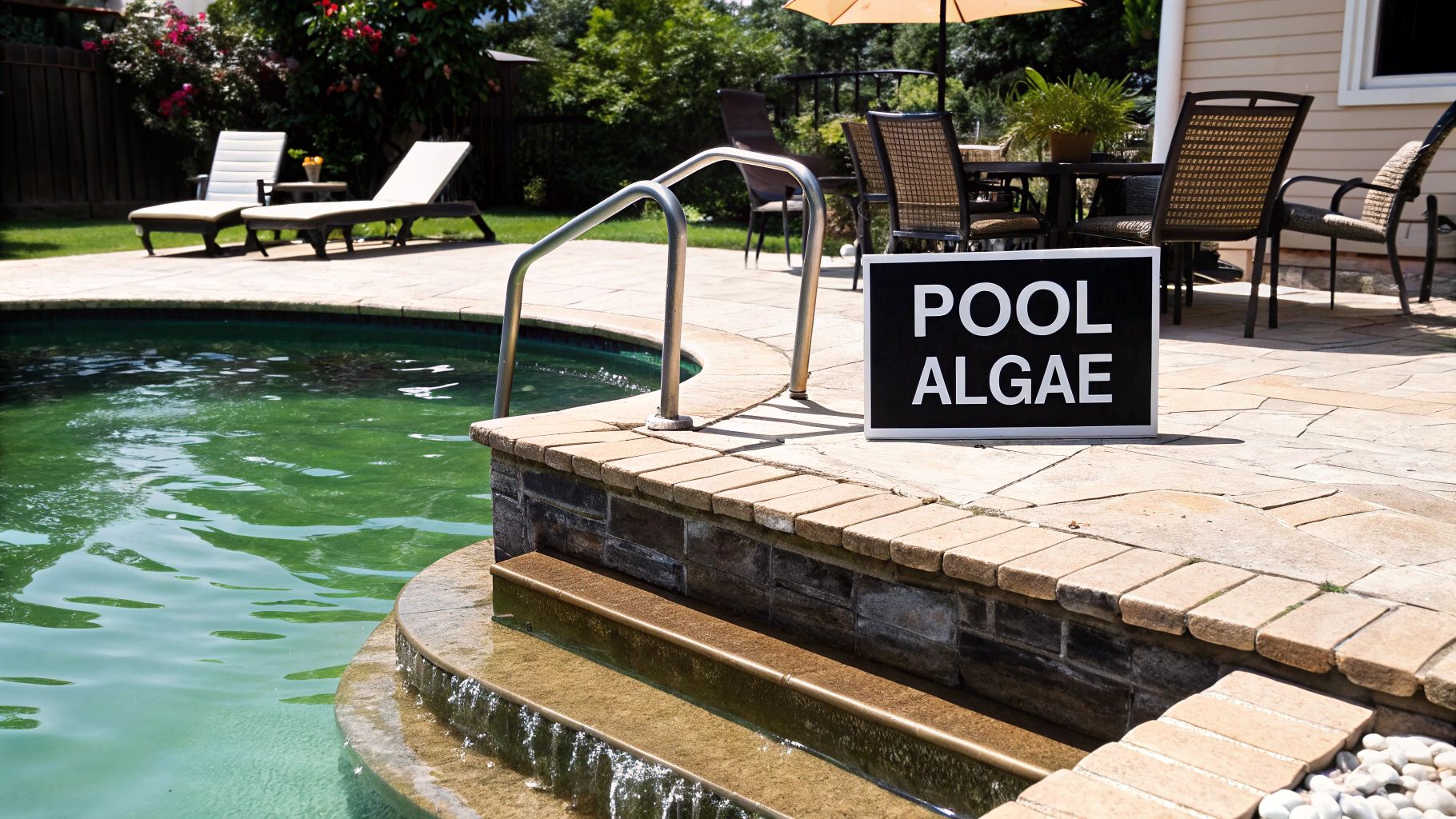
That sinking feeling you get when you see green water is something most of us have experienced. But don't worry, understanding the root cause is the first step toward getting your pool back and keeping it that way.
The green you're seeing is from a full-blown algae bloom. Under the right conditions, an algae population can double every 24 to 48 hours. This kind of rapid growth is almost always triggered by a failure in one of three critical areas of pool maintenance. For those interested in the latest science, you can find more details about algae innovations from industry experts.
What’s Really Causing the Bloom?
Let's get right to it. The battle against a green pool is fought on three fronts: chemical balance, water circulation, and filtration. When one of these systems breaks down, algae seize the opportunity.
This quick table sums up what you're likely seeing and why.
Green Pool Algae At-A-Glance
| Symptom | Primary Cause | Quick Fix Hint |
|---|---|---|
| Water has a light green haze | Low Chlorine | Your sanitizer has dipped below effective levels. |
| Patches of green on walls/floor | Poor Circulation | Water isn't moving, creating "dead spots." |
| Cloudy, murky green water | Filtration Issues | The filter isn't removing algae and debris. |
Think of these three elements as the legs of a stool. If one is weak, the whole system collapses.
A Closer Look at the Causes
-
Low Chlorine Levels: Chlorine is your pool’s workhorse, sanitizing the water and killing off algae spores. Once the level drops below the ideal range of 1-3 parts per million (ppm), algae can multiply without resistance. Things like heavy rain, a big pool party, or even intense sunlight can burn through chlorine faster than you’d expect.
-
Poor Water Circulation: Algae love stagnant water. If your pump isn't running long enough—a solid 8-12 hours a day is the standard—or if your return jets aren't angled properly, you'll get "dead spots." These are calm pockets of water where algae can settle and start a bloom undisturbed.
-
Filtration Problems: Your filter is what physically removes algae (both living and dead) from the water. A dirty or clogged filter simply can't keep up. The debris and organic matter left behind become food for new algae, creating a vicious cycle.
A green pool often points to a deeper issue that just dumping in more chemicals won't fix. It could be an underlying equipment failure or a stubborn chemical imbalance that needs an experienced eye to sort out.
If you’ve tried the usual shock treatment and are still fighting the green, getting a professional diagnosis can save you a ton of time and frustration. The seasoned technicians at Water Medic provide thorough pool services in Cape Coral to pinpoint the exact cause and implement a fix that lasts, so you can get back to enjoying your pool.
Figure Out What's Really Going On in Your Water
Before you start pouring chemicals into that green water, you need a clear battle plan. The single biggest—and most expensive—mistake I see pool owners make is treating the symptom (green water) without diagnosing the cause. Getting an accurate read on your water chemistry is the only way to avoid wasting time and money on solutions that won't work.
It's easy to fall into the guessing game trap. You see green, you think chlorine. But it's often more complicated than that. For instance, if your pool's pH is too high (say, above 7.8), any chlorine you dump in becomes practically useless. The algae will keep right on growing, even after you've shocked it. This is a classic example of how one imbalance can create the perfect environment for an algae bloom.
What to Test Before You Treat
To get to the root of the problem, you'll need to check a few key chemical levels. Think of these as your pool's vital signs—they'll tell you exactly what you need to do next.
- Free Chlorine (FC): This is the "active" chlorine that's actually available to kill algae and bacteria. You're shooting for 1-3 parts per million (ppm).
- pH Level: This measures how acidic or alkaline your water is. You need to keep it in a tight range of 7.2 to 7.6 for your sanitizer to work effectively.
- Total Alkalinity (TA): This is the buffer that helps keep your pH from swinging wildly. The sweet spot is between 80-120 ppm.
- Cyanuric Acid (CYA): Also known as "stabilizer," CYA protects your chlorine from being burned off by the sun. The ideal level is 30-50 ppm. If it gets too high, it can actually "lock up" your chlorine, rendering it useless.
This visual gives you a quick look at the most critical tests and the target ranges you're aiming for.
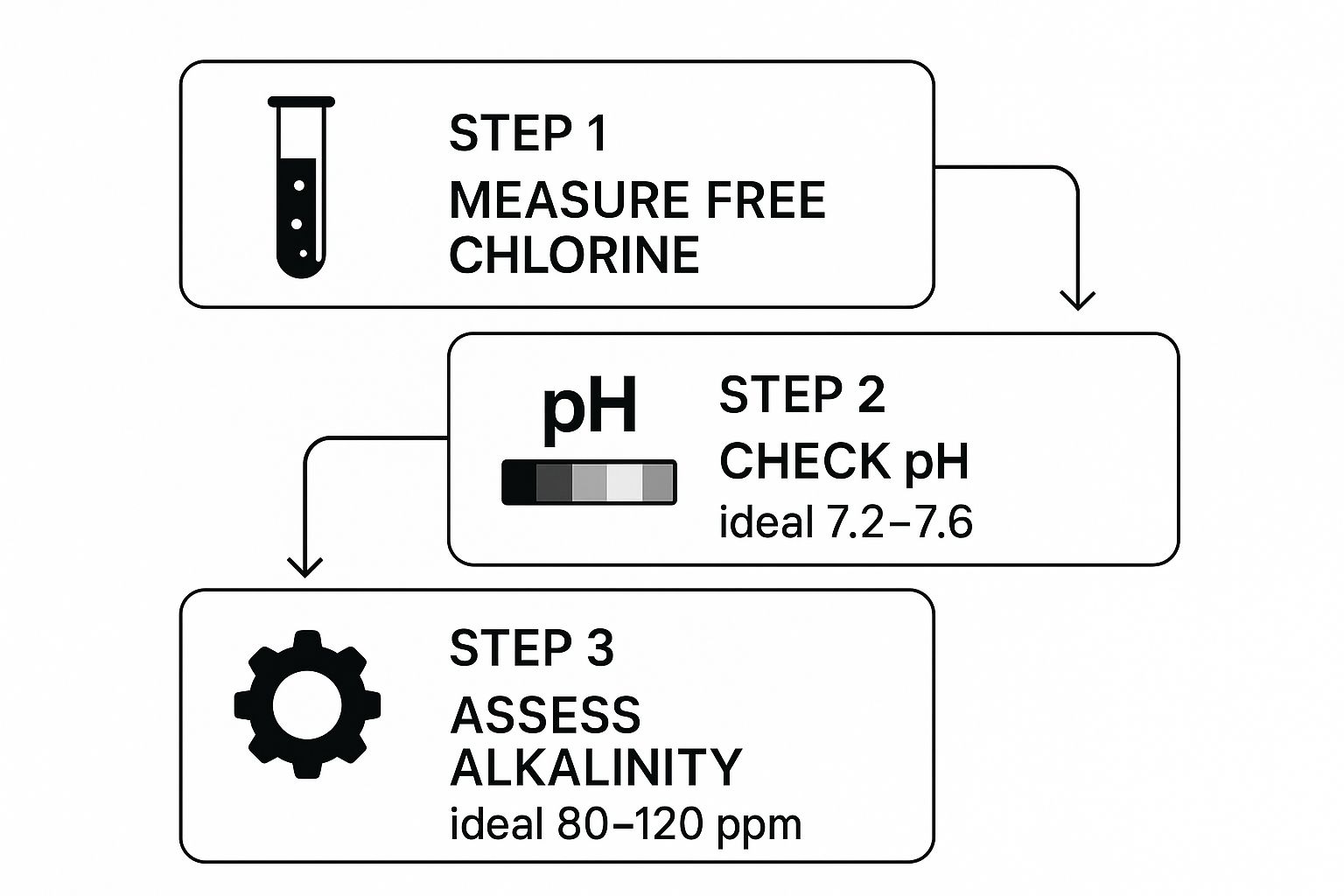
As you can see, all these levels are connected. That's why getting a complete picture is so important before you start adding anything to the water.
Your Testing Options: Home Kits vs. Professional Analysis
If you're testing at home, you've got two main choices: test strips or liquid test kits. Test strips are fast and simple, but they often give you a ballpark reading at best. Liquid kits that use reagents are generally more accurate, provided you follow the directions to the letter.
The real frustration comes from a misdiagnosis. Adding the wrong chemical doesn't just fail to clear up the green; it can throw other levels out of whack, creating an even bigger mess to clean up. This is where getting a professional opinion can save you a world of headache.
Don't let a simple water test turn into a complex chemistry experiment. An inaccurate reading can send you down a rabbit hole of adding the wrong chemicals, wasting both your time and money while the algae continues to multiply.
To get foolproof results and a clear path forward, nothing beats a professional analysis. Our Professional Water Testing Service uses sophisticated digital equipment that gives a precise snapshot of your water's health. We'll tell you exactly what's needed to kill the algae and bring your pool back into balance, taking all the guesswork out of the equation. Let our team get you back to enjoying clear, beautiful water fast.
Your Chemical Plan to Kill Algae
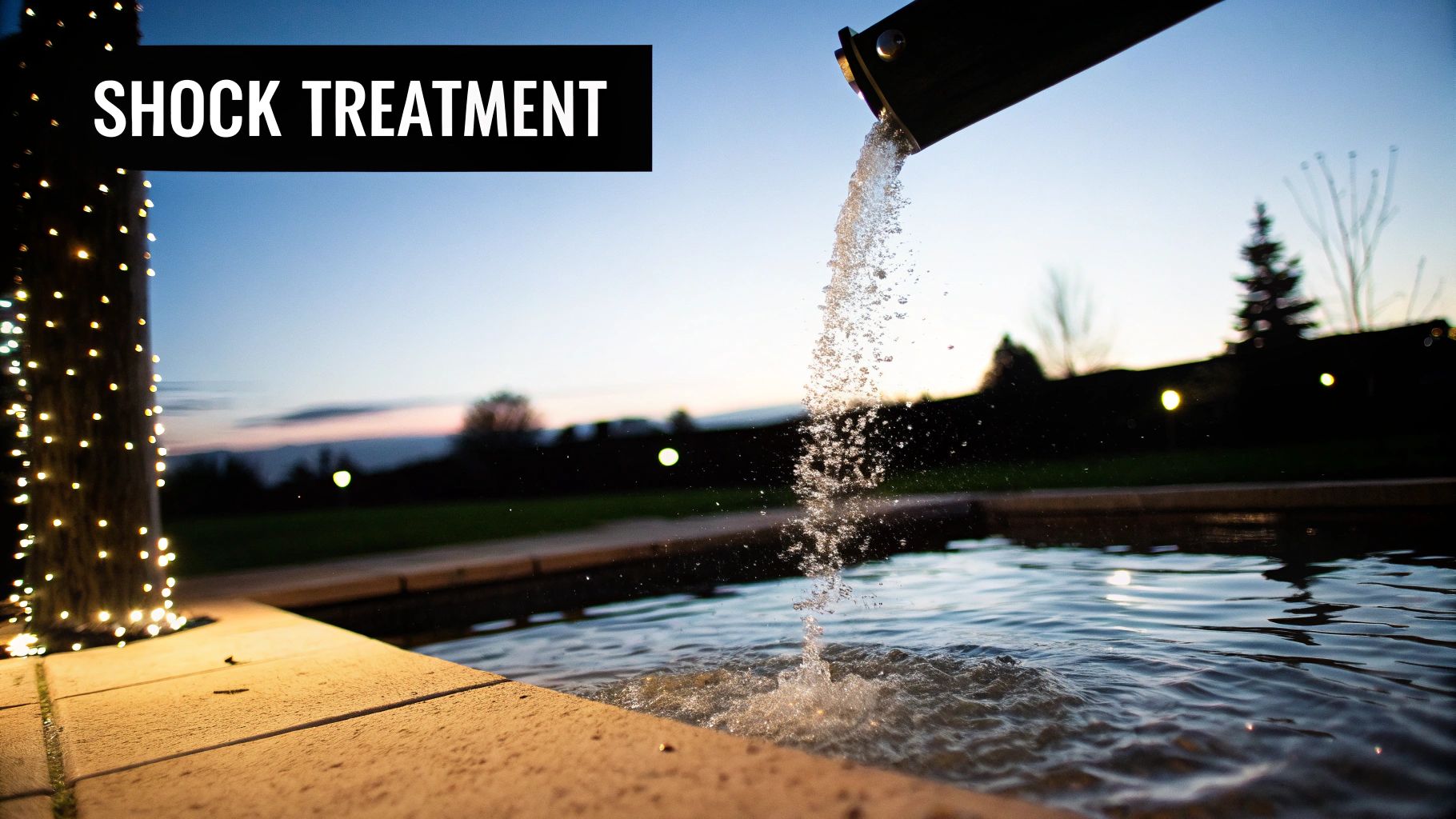
Alright, you've got your water test results. Now it's time to go on the offensive. The goal here isn't just about dumping chlorine in the water and hoping for the best; it's about methodically creating an environment where algae simply can't survive. The order you do things in is absolutely crucial.
One of the most common—and costly—mistakes I see homeowners make is shocking the pool right away. If your pH and alkalinity are out of whack, a huge chunk of that expensive shock is going to be completely useless. You're just throwing money away. Always, always get your basic water chemistry in line first.
Balance Before You Battle
The very first move is to get your pH and alkalinity dialed in. Think of it like preparing the battlefield for the main assault. If your pH is too high (anything above 7.6), chlorine's power to kill algae is severely weakened. You need to get that pH down into the sweet spot of 7.2 to 7.6 before you even think about adding shock.
Next up is total alkalinity, which should be between 80 and 120 ppm. Alkalinity is what keeps your pH from bouncing all over the place during the aggressive treatment to come. Once these two levels are stable, your sanitizer can finally do its job at full strength.
The Pool Shocking Process: Hitting the Algae Hard
"Shocking the pool" is just a pool-pro term for superchlorination. We're essentially raising the free chlorine level so high that it obliterates all the algae, bacteria, and other nasty stuff in the water. This is the knockout punch in your fight against a green pool.
The amount of shock you'll need depends entirely on how green your water is. A light green, hazy pool requires a much different dose than one that looks like a dark, murky swamp. The trick is adding enough shock to not only kill the algae but also leave behind a strong chlorine residual to keep it from coming back.
Pro Tip: Timing is everything when you shock your pool. The sun’s UV rays can burn off up to 90% of unstabilized chlorine in just a couple of hours. To get the most bang for your buck, always shock your pool at dusk or overnight. This gives the chemicals a long, uninterrupted window to work their magic.
If you're feeling overwhelmed by handling all these chemicals or just want the problem solved fast, our Pool Shock Services can take the guesswork out of it. Our pros use professional-grade products to safely wipe out the algae and get your water crystal clear again.
How Much Shock Is Enough?
Guessing how much shock to use is a recipe for frustration. Too little, and the algae will laugh it off and keep growing. Too much is just a waste of money and can be harsh on your pool's surfaces. The color of your water is actually a pretty reliable guide.
To get you started, here’s a quick reference for a typical 10,000-gallon pool. But remember, always double-check the instructions on the product you're using, as concentrations can vary.
Shock Treatment Dosage Guide
This table provides a great starting point for how much shock to use based on the color of your pool water.
| Pool Water Color | Severity | Recommended Shock Dosage (per 10,000 gallons) |
|---|---|---|
| Light Green / Teal | Mild Algae Bloom | 2 lbs (or 2 gallons) of shock |
| Medium Green | Moderate Algae Bloom | 3 lbs (or 3 gallons) of shock |
| Dark Green / Black | Severe Algae Bloom | 4 lbs (or 4 gallons) of shock |
When dealing with a really severe algae problem, you’re basically performing what we call a "slam" treatment. This means you have to maintain an extremely high chlorine level for an extended period until the water is completely clear. It's an intense process that requires careful handling of powerful chemicals.
To truly get a handle on preventing green water, a solid grasp of the essential steps of pool water treatment is non-negotiable. Now that you've shocked the pool, the next step is to put your filter system into overdrive to clean up the mess.
Letting Your Filter Do the Heavy Lifting
https://www.youtube.com/embed/xQE4CPkBJPo
Once you've shocked the pool, don't be alarmed if the water turns a cloudy, milky-white or even a grayish-green. This is actually what you want to see—it’s a clear sign the shock has worked and the algae are dead.
Now, the real cleanup begins. The chemistry has done its part, and it's time for your pool's mechanical workhorse, the filter, to take over and clear out all that dead debris.
To make that happen, you'll need to run your pump and filter continuously. I’m talking 24 hours a day, without stopping, until that water is crystal clear again. This isn't the time to be frugal with your electricity; cutting the run time short gives any lingering algae a foothold to come roaring back, and you'll be right back where you started.
Think of it this way: your filter is now straining out millions of tiny, dead algae particles. It’s a huge job, and it’s going to get clogged much, much faster than it normally would. That means you need to stay on top of cleaning it.
Keeping Your Filter at Peak Performance
A clean filter is your best friend during this process. As it pulls all that gunk from the water, the internal pressure will climb, and its ability to trap more debris will plummet. A clogged filter just circulates cloudy water, dragging out the cleanup for days.
How you handle this depends entirely on what kind of filter you have:
- Sand Filters: Keep a close eye on your pressure gauge. You’ll need to backwash the filter anytime the pressure reads 8-10 PSI higher than its normal "clean" pressure. When you're dealing with a major algae bloom, you might find yourself doing this once or even twice a day.
- Cartridge Filters: This is a more hands-on job. You'll have to pull the cartridges out and give them a really thorough spray-down with a garden hose. Plan on doing this daily until the pool clears up.
- Diatomaceous Earth (D.E.) Filters: These work a bit like sand filters. You’ll backwash when the pressure climbs, but then you have the crucial extra step of adding a fresh scoop of D.E. powder through the skimmer to recharge the filter grids.
I've seen it countless times: a homeowner does everything right with the chemicals but the pool stays cloudy. The most common culprit is an undersized, old, or poorly maintained filter. If you've been running that pump for days and cleaning the filter constantly with little to show for it, your equipment is likely the real problem.
Old filter sand that's turned to concrete, a worn-out cartridge, or a pump that's just not moving enough water can make it nearly impossible to clear up an algae mess. No amount of chemicals can fix a mechanical failure. This is where getting a professional eye on the situation can save you a world of frustration. Our technicians are experts at spotting these hidden equipment issues.
If you feel like you're just spinning your wheels, our expert pool equipment inspection and repair services can diagnose the root cause and get you back to a clear pool much faster.
Keeping Your Pool Crystal Clear All Season
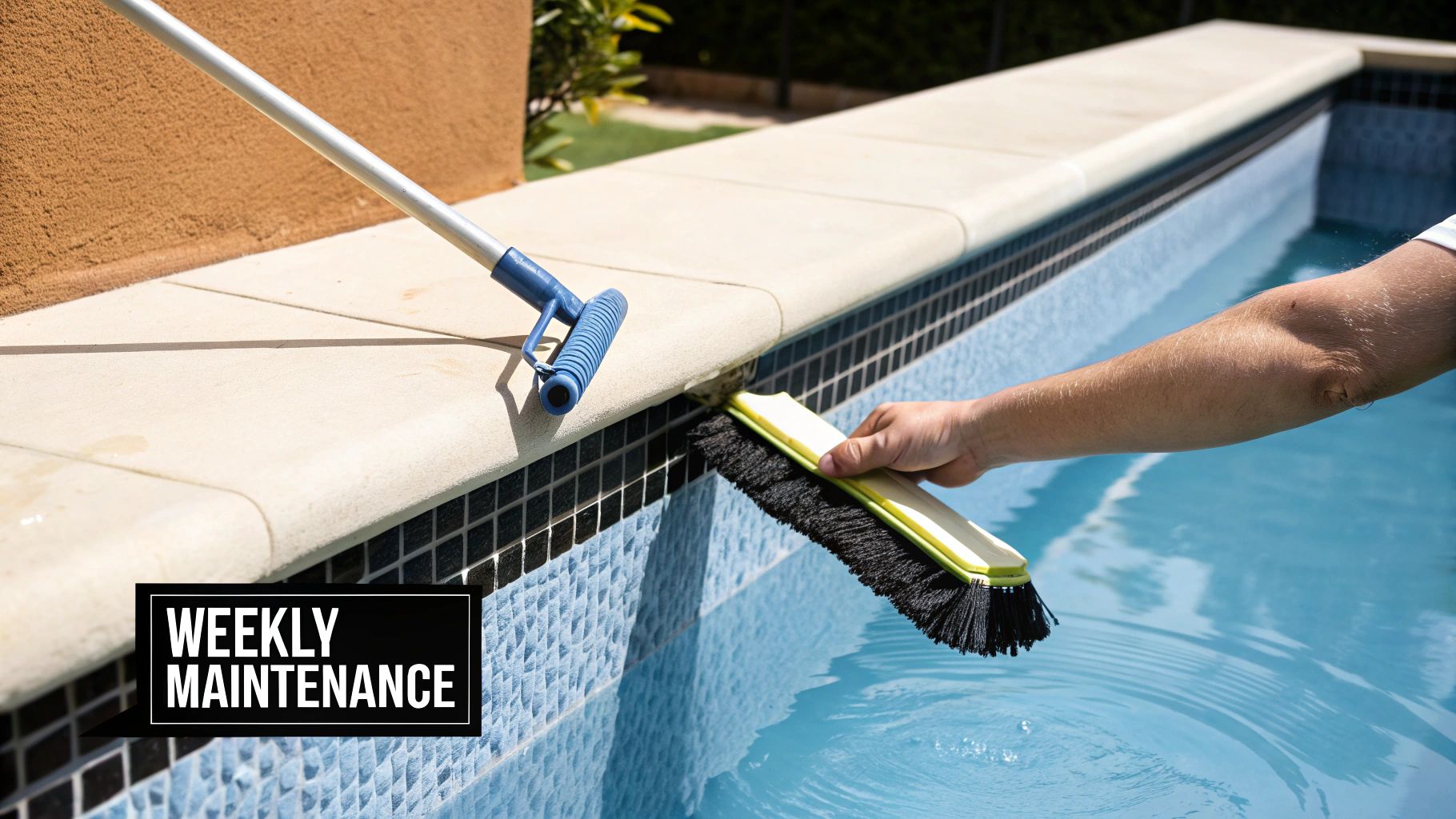
So you’ve won the battle and cleared up that green water. Great work! Now the real mission begins: keeping it that way.
Trust me when I say that preventing a green pool is a hundred times easier—and cheaper—than fixing one. The secret isn't some magic formula; it's just about being consistent. A little bit of weekly upkeep is all it takes to keep your pool a sparkling oasis, ready for you to jump in whenever the mood strikes.
Your Weekly Prevention Checklist
Think of this as your simple, non-negotiable insurance policy against green water. A consistent routine is your absolute best defense.
- Test and Balance: Once a week, minimum, test your free chlorine and pH. You’re aiming to keep that free chlorine between 1-3 ppm and the pH in that sweet spot of 7.2 to 7.6. Make small tweaks as needed to stay in range.
- Brush the Walls and Steps: Algae spores are sneaky. They need to grab onto a surface to start a colony. A quick brushing once a week knocks them loose and sends them right into the chlorinated water, where they can be zapped.
- Empty Baskets: Check your skimmer and pump baskets. When they get clogged with leaves and debris, they choke your water flow, leading to dead spots where algae just loves to grow.
This simple routine is the bedrock of a healthy, clear pool. Stick with it, and you'll stop algae before it even has a chance to start.
Battling Mother Nature
Even with a perfect schedule, the outside world is always trying to mess with your pool chemistry. Weather and your yard can throw a wrench in your plans.
A heavy rainstorm, for instance, doesn't just add water; it dilutes your chemicals and washes in all sorts of organic junk. Things like leaves, pollen, and grass clippings are basically algae superfoods. After a big storm or a day of lawn mowing, it's a smart move to test your water and maybe add a small dose of shock to give your chlorine a boost.
Another great way to keep debris out while also managing water temperature is by using a good cover. Learning about the best solar pool covers can be a game-changer for reducing your maintenance workload.
The easiest way to guarantee a swim-ready pool all season is to hand the work over to a professional. A dedicated service plan removes the burden of weekly chores and provides peace of mind that your pool is always perfectly balanced and safe.
For homeowners who’d rather spend their time swimming than testing and scrubbing, our maintenance plans are the perfect answer. We handle the hassle so you can enjoy a worry-free summer. Check out our popular monthly pool maintenance options and let us keep your pool perfect. Reach out for a free quote today
Answering Your Green Pool Questions
Even with the best plan, you're bound to have questions. It’s completely normal. Here are the most common things our technicians hear from homeowners who are fed up with seeing green, along with some real-world answers to help you out.
How Long Does It Take to Clear a Green Pool?
Honestly, it all comes down to just how green we're talking. A light green, slightly cloudy pool? You can probably turn that around in 2-3 days with the right chemicals and non-stop filtration. But if you're looking at a dark green swamp, be prepared for it to take a week, maybe even longer.
The speed of recovery really hinges on a few things: how warm the water is, how well your filter is working, and whether you nail the chemical dosage from the start.
If you don't see a major change within 48 hours after shocking, that’s a red flag. It almost always points to a bigger chemical issue or a problem with your equipment. At that point, it’s smart to get a professional opinion before you pour more money down the drain.
Is It Safe to Swim in a Green Pool?
That's an easy one: absolutely not. Green water is the most obvious sign that your sanitizer has been wiped out, leaving nothing to kill off nasty contaminants. Your pool becomes the perfect home for harmful bacteria like E. coli.
Besides the bacteria, the algae itself is a risk. Certain types, especially blue-green algae, can release toxins. The occurrence of these harmful algal blooms has actually been on the rise, and they can cause everything from skin irritation to serious illness if swallowed.
But the most immediate danger is the murky water. It's a huge drowning risk because you can't see the bottom or anyone who might be in trouble.
Key Takeaway: Never let anyone swim until the water is crystal clear and your test kit gives you the all-clear on chemical balance. Safety always comes first.
Why Did My Pool Turn Green Seemingly Overnight?
It can feel like it happens in the blink of an eye, and you're not wrong. Algae spores multiply at an incredible speed once they have the right environment. A sudden bloom is almost always caused by a perfect storm of events.
Think of a heavy rainstorm that dilutes your chlorine, followed by a hot, sunny day. Or a big pool party that uses up all the sanitizer. That's all it takes. This is exactly why staying on top of your weekly maintenance is the best defense.
Our team has answered tons of questions just like these over the years. For more tips from the pros, check out our complete list of pool care frequently asked questions.
Don't let a green pool throw a wrench in your summer plans. The experts at Water Medic of Cape Coral have been turning green pools back into sparkling backyard retreats for over 25 years. When you need fast, reliable help, contact us today.