
A Modern Pool Service Agreement Template For Florida Companies
A solid pool service agreement template isn't just paperwork—it's the backbone of your business. It's the tool that sets crystal-clear expectations, stops arguments before they start, and makes sure you get paid on time for your hard work. Think of it as a clear roadmap for every client, spelling out everything from weekly chemical checks to how you'll handle emergency repairs.
Starting every new job with a signed contract instantly positions you as a serious, trustworthy professional, turning potential headaches into smooth, predictable business.
Your Contract Is Your Most Valuable Business Tool

Let’s be real for a minute. In the pool business, verbal agreements are a recipe for disaster. Relying on a handshake and a good memory is how you end up in frustrating, money-losing arguments.
You've probably been there. A client questions the bill for extra algaecide after a bloom, or they don’t understand why a massive post-hurricane cleanup isn't part of their regular monthly fee. These situations create tension, eat away at trust, and can easily lead to late payments—or no payment at all.
A well-written pool service agreement gets rid of all that gray area from day one. It shifts the dynamic from a casual gig to a professional partnership built on mutual respect and clarity. This isn't just about covering your bases legally; it's about building a business that can grow and thrive.
Building A Foundation Of Trust
A comprehensive contract is your first chance to show a new client you mean business. It proves you're organized, detail-oriented, and committed to doing high-quality work. After more than 25 years of experience in the tough Southwest Florida market, we can tell you that a clear agreement is the single best way to start a client relationship off on the right foot.
When every service, cost, and "what-if" scenario is spelled out, it eliminates scope creep and guarantees you're paid for every bit of your labor and materials. A proper agreement must define:
- The exact services included in the recurring fee.
- The costs for anything extra, like filter cleanings, salt cell maintenance, or specialty chemicals.
- Your policies on things like scheduling, bad weather, and making sure you can access the property.
- Clear payment terms, including due dates and what happens if a payment is late.
A great service agreement does more than just list tasks. It communicates the value and professionalism of your company before you even skim the first leaf. It's the bedrock of a healthy, long-term client relationship.
If you need a solid starting point for creating formal documents, exploring various agreement templates can give you a major head start.
Key Components Of A Professional Pool Service Agreement
Your pool service agreement is the blueprint for every client relationship. To make it effective, you need to include a few non-negotiable sections. The table below breaks down the absolute must-haves that protect your company, secure your income, and set the stage for a great partnership.
| Component | Why It's Crucial | Example Clause Snippet |
|---|---|---|
| Scope of Services | Clearly defines what is and is not included in the standard service to prevent scope creep. | "Weekly service includes skimming, brushing, vacuuming, and balancing of standard chemicals (chlorine, pH)." |
| Payment Terms | Ensures timely payment and outlines procedures for late fees or additional work. | "Monthly service fee is due on the 1st of each month. A late fee of $25 will be applied after 10 days." |
| Liability & Insurance | Protects your business from claims related to pre-existing conditions or unforeseen events. | "Company is not liable for damage to pool surfaces or equipment due to age or improper prior maintenance." |
| Termination Clause | Provides a clear and professional process for ending the service agreement for either party. | "Either party may terminate this agreement with 30 days' written notice." |
Each of these pieces plays a vital role in managing expectations and keeping your business profitable. We'll dive deeper into how to write and customize each one throughout this guide.
Defining Your Scope Of Services To Prevent Scope Creep

The "Scope of Services" section is where the rubber meets the road in your pool service agreement. This is where you draw clear, unmistakable lines in the sand, defining precisely what your monthly fee covers—and just as importantly, what it doesn't. From our experience, misunderstandings here are the number one cause of client disputes and unpaid invoices.
Think of it less as a simple checklist and more as a detailed game plan for every service visit. Using vague terms like "pool care" is just asking for scope creep, where clients start expecting you to handle extra work for free. Your goal is to frame your services as a complete, professional care package while making sure you get paid fairly for every single task you perform.
Detailing Standard Weekly Maintenance
First things first, your agreement needs a clear breakdown of the recurring tasks you'll handle on each visit. This sets a solid baseline for what the client can expect and justifies your monthly rate. Never assume they know what "balancing the water" actually entails; you have to spell it out.
A solid "Weekly Services" clause should include specific actions like these:
- Water Chemistry Testing and Balancing: Specify which chemicals are included in the base price (think chlorine, pH balancers, and alkalinity adjusters). This one detail can prevent a ton of headaches over specialty chemical costs down the line.
- Surface Skimming: State clearly that you'll remove leaves and other floating debris from the pool's surface.
- Wall Brushing: Mention that you'll be brushing the pool walls, steps, and benches to keep algae from getting a foothold.
- Pool Floor Cleaning: Get specific. Will you be vacuuming? If so, is it "as needed" or a full vacuum every single week? The difference matters.
- Equipment Inspection: Include a visual check of the pump, filter, and other accessible equipment to spot any obvious issues before they become big problems.
This level of detail transforms your agreement from a loose promise into a concrete commitment. It shows off your thoroughness and professionalism from day one.
Defining Services That Cost Extra
This part is all about protecting your bottom line. After you’ve detailed what’s included, you need an equally clear list of services that come with an additional charge. This is your defense against those classic "while you're here, can you just…" requests that absolutely kill your schedule and profitability.
A real-world scenario we see all the time in Cape Coral is a client asking for a full filter cleaning after they hosted a big party over the weekend. If your agreement doesn't list filter cleaning as a separate, billable service, you're stuck doing an hour of extra work for free.
Your agreement should act as your silent salesperson, clearly outlining value-added services. By listing these tasks as separate line items, you're not just preventing scope creep; you're actively creating upsell opportunities.
Here are a few common services that should always be listed as "Additional Cost Items":
- Filter Cartridge Cleaning or Backwashing: Specify the frequency and cost for this essential but time-consuming task.
- Salt Cell Inspection and Cleaning: A must-have service for saltwater pools that requires specific know-how.
- Algae Treatments: If a pool turns green due to weather or neglect, the extra chemicals and labor needed to fix it should absolutely be billable.
- Calcium Scaling Removal: This is a tough, labor-intensive job that is definitely not part of standard weekly maintenance.
- Storm or Debris Cleanup: After a classic Florida storm, a pool cleanup can take hours. This needs to be defined as an hourly or flat-rate emergency service.
The global pool cleaning market is expected to hit an incredible USD 45.49 billion by 2032. This growth shows just how much homeowners, especially here in Southwest Florida, value professional care. When you clearly define every service, you position your business at that professional standard and make sure clients understand the full value you bring to the table. You can dive deeper into these market trends shaping the pool service industry on Businesswire.com.
Creating Tiered Service Packages For Upsells
One of the smartest ways to structure your scope of services is by offering tiered packages right in the agreement. This is a powerful sales strategy that lets clients pick their own level of care while giving you an immediate chance to increase the contract's value. Instead of just one list of services, you're presenting options.
This simple change turns the contract signing process from a formality into a productive sales conversation.
Example Tiered Packages
| Package Tier | Included Services | Ideal Client |
|---|---|---|
| Basic Care | Chemical balancing, basket emptying, and equipment check. | The hands-on homeowner who handles their own skimming and vacuuming. |
| Premium Care | All Basic services plus weekly skimming, brushing, and vacuuming. | The busy professional who wants a consistently clean pool without the work. |
| All-Inclusive | All Premium services plus scheduled filter cleanings and salt cell maintenance. | The property manager or vacation rental owner who needs total peace of mind. |
Presenting choices like this empowers the client to select the service that truly fits their needs and budget. It also subtly educates them on everything involved in comprehensive pool care, which naturally justifies the higher price points for the more inclusive packages. For clients looking for these kinds of structured options, checking out a professional monthly pool maintenance plan can be the perfect next step. This strategy has worked wonders for us, often leading clients who called about basic service to upgrade to a premium package once they see all the value laid out so clearly.
Structuring Payments And Pricing For Healthy Cash Flow
The moment a client questions an invoice, you’ll wish you had spent more time on the payment section of your contract. A handshake agreement just won't cut it when your cash flow is on the line. This part of your service agreement is all about making sure you get paid on time, every time, for the hard work you do.
Let's put it in perspective. The swimming pool cleaning industry in the U.S. is a massive $8.8 billion market. For homeowners, annual pool care can easily run between $3,000 and $6,000. Your service agreement is the single best tool you have to frame this as a predictable, manageable investment rather than a surprise expense. It prevents sticker shock and sets a professional tone from day one.
A solid payment clause eliminates any grey areas, keeping your business financially healthy and your client relationships positive.
Choosing The Right Pricing Model For Florida Pools
The pricing model you land on will directly shape your profitability and how clients see the value in your service. Here in the unique Southwest Florida market, a few different approaches are common, each with its own set of pros and cons. Whatever you choose, your agreement needs to spell it out clearly.
Here’s a breakdown of the pricing structures you see most often:
-
Flat Monthly Fee: This is hands-down the simplest model and the easiest sell for most clients. They pay one fixed price each month, which typically covers your labor and all the standard balancing chemicals. For you, it means predictable revenue; for them, it's a simple line item in their budget.
-
Service Plus Chemicals: In this setup, you charge a base rate for your weekly visit and then add a separate line item for the exact amount and cost of chemicals used. This can be more profitable, especially during a rainy summer when a pool needs extra attention to stay balanced.
-
Chemical-Only Service: Some companies offer a lower-cost plan that only includes water testing and chemical balancing, leaving the netting, brushing, and vacuuming to the homeowner. It can be a decent entry-level service, but you give up a lot of control over the pool's overall condition.
Before we dive into the nitty-gritty of which one to pick, let's compare them side-by-side.
Comparing Pool Service Pricing Models
This table breaks down the most common pricing structures to help you figure out the best fit for your business and your clients.
| Pricing Model | Best For | Pros | Cons |
|---|---|---|---|
| Flat Monthly Fee | Businesses prioritizing predictable revenue and simple client billing. | Consistent cash flow, easy for clients to budget, fewer invoicing questions. | Profit margins can shrink if chemical costs spike unexpectedly. |
| Service Plus Chemicals | Companies wanting to maximize profit per job and ensure costs are always covered. | Higher potential profit, especially on pools that require more chemicals. | Can lead to fluctuating invoices and more questions from clients. |
| Chemical-Only Service | New businesses or those looking to add a low-cost, entry-level service tier. | Low barrier to entry for new clients, less time-intensive per stop. | Lower revenue per client, no control over physical cleaning. |
So, which one is the winner?
Our Take: For most pool service pros in our area, the flat monthly fee is the way to go. It simplifies your entire billing process and gives you the most consistent cash flow. You can—and should—list specialty treatments like phosphate removers, algaecides, or filter cleanings as separate, billable extras in your agreement.
Essential Clauses For Financial Protection
Beyond the pricing model, your agreement needs a few more clauses to protect your revenue and manage the financial side of the business. Think of these as your safety net.
One of the most valuable clauses you can include is an Authorization for Additional Repairs. This gives you pre-approved permission from the client to handle small, necessary repairs up to a set dollar amount—say, $75 or $100—without having to stop and get a new work order.
This is a huge win-win. You can replace a cracked skimmer basket or a bad pump lid o-ring on the spot, preventing a bigger problem down the road and adding a bit of profitable work to your visit. The client gets their issue fixed immediately without the hassle of scheduling another call.
Your agreement should also clearly define:
- Accepted Payment Methods: List exactly how you take payment (credit card, ACH transfer, check).
- Due Dates and Late Fees: Be specific. State that payment is due on the 1st of the month and spell out the exact late fee that will be applied after a short grace period.
- Price Adjustment Clause: Give yourself the flexibility to adjust your pricing annually to keep up with rising chemical and fuel costs. Just be sure to state that you’ll provide 30 days' written notice.
To really nail down consistent income, look into tools that provide automated payment reminders to improve cash flow. These systems can send a friendly nudge when an invoice is due, saving you from the awkward task of chasing down money.
And for those bigger repair jobs that pop up, making them more manageable for your clients can be a game-changer. Offering payment plans or financing can make your services much more accessible. You can learn more about how to set this up by checking out our guide on financing options for pool repairs.
By building these financial safeguards directly into your pool service agreement, you’re not just writing a contract—you’re building a more resilient and profitable business.
Florida-Specific Clauses: Your Defense Against Hurricanes and Headaches
Running a pool business in Florida is a different beast entirely. We’re not just cleaning pools; we’re fighting against brutal sun that cooks equipment, pop-up thunderstorms that wreck water chemistry overnight, and, of course, hurricane season. Your pool service agreement has to be built for these unique Sunshine State realities.
This is about more than just legal boilerplate. It’s about creating clauses that anticipate real-world Florida problems. Get this wrong, and you could find yourself blamed for a five-year-old pump dying during a July heatwave or a lanai screen that gets shredded during a tropical storm—things that are completely out of your hands.
Nailing Down Your Limitation of Liability
One of the most important parts of your Florida contract is the Limitation of Liability clause. This is where you draw a clear line in the sand, defining what you are and are not responsible for. Think of it as your first line of defense against a client trying to pin a pre-existing problem on you.
Here’s a classic scenario: you sign on a new client with a 15-year-old pump and filter system. A few months later, the pump motor gives out. Without a rock-solid liability clause, that client might point the finger at you, claiming your service somehow caused the failure.
Your agreement needs to spell out that your company is not liable for:
- Failure of old or pre-existing equipment: This covers pumps, filters, heaters, and automation systems that are already past their prime.
- Damage from severe weather: Think hurricanes, tropical storms, and intense lightning.
- Normal wear and tear on pool surfaces: Plaster, pebble, and vinyl finishes naturally degrade over time from sun and chemicals. You need to make it clear you're not responsible for this aging process.
Your contract sets the ground rules. It protects your business by establishing that you're there for maintenance, not to act as an insurance policy for aging equipment or Mother Nature's mood swings.
A great tip? Include your license and insurance details right in the contract. It’s a simple, upfront move that builds instant trust and shows you’re a serious, professional outfit.
The Hurricane Clause You Can't Skip (Force Majeure)
In a state where an "Act of God" often has a name and a projected storm track, a Force Majeure clause isn't optional—it's essential. This is the legal provision that saves you when unforeseen events make it impossible to stick to your service schedule.
Picture this: a major hurricane is barreling toward the coast. Your week is pure chaos. You're busy helping clients drop in pumps, strap down furniture, and "shock and flock" their pools. Performing your regular weekly cleaning for every single customer is simply not going to happen.
The Force Majeure clause is what keeps you from being in breach of contract. Make sure it specifically lists events that matter here in Florida:
- Hurricanes
- Tropical storms
- Flooding
- Named storms and government-issued warnings
This clause gives you the breathing room to focus on safety and storm prep without worrying about legal blowback from clients whose regular service was, for very good reason, put on hold.
Outlining a Clear and Fair Termination Clause
Every good business relationship needs a clear off-ramp. Your Termination Clause defines how you or the client can end the service agreement professionally. It prevents you from getting a text on Monday morning saying, "Don't come this week, we're done," leaving you with a sudden hole in your route.
A 30-day written notice is the industry standard and for good reason. It’s fair to everyone. This gives you enough runway to fill that spot in your schedule, and it gives the client time to find a new company without their pool turning green.
This section should also clarify how the final payment is handled, making sure any outstanding balances are settled when service ends. Defining the exit strategy from the beginning keeps things professional from the first visit to the last. If clients want to learn more about our commitment to these standards, our main pool services page offers a great overview.
Bringing New Clients On Board with Your Agreement
A rock-solid pool service agreement is a powerful tool, but only if you know how to use it. Don't let it be a document that just gets signed and tossed in a file. Instead, make it the cornerstone of your client onboarding—a process that should build trust and crystal-clear expectations right from day one.
The way you present this agreement can make or break a new client relationship. Forget just emailing a PDF and hoping for a signature. Use it as a prop during your first visit to the property. This simple shift turns a dry legal formality into a collaborative walkthrough, proving you're thorough, transparent, and genuinely invested in taking care of their pool.
The First On-Site Walkthrough
That initial visit to a potential client's backyard is your golden opportunity to shine. This isn't just about selling a service; it's about demonstrating your expertise. With your agreement in hand, you can conduct a detailed inspection, pointing out potential issues that need to be noted before you ever dip a net in the water.
During this walkthrough, we always make a point to:
- Check all the equipment: We're talking about the pump, filter, heater, salt cell, and any automation. We're looking for age, signs of wear, and obvious operational problems.
- Inspect the pool's surface: Are there stains, cracks, or any signs of plaster delamination? These are things you need to know about upfront.
- Look at the big picture: Take note of the deck's condition, the screen enclosure, and any landscaping (like those pesky oak trees) that could affect the pool.
This isn't just about finding things to fix. It’s about heading off future problems and managing liability from the get-go. And that brings us to our most important tip.
Documenting the "Before" Picture
Here's a piece of advice that has saved us more headaches than we can count: take timestamped photos and videos of everything during that initial inspection. The pool, the equipment pad, the skimmer lids—get it all. This creates an undeniable visual record of how things looked before your service began.
We then attach these photos as an addendum to the service agreement. It’s a simple step, but it establishes a baseline condition. It protects you from getting blamed for a hairline crack in the filter that was already there or for plaster that was faded long before you showed up. When the client signs the agreement with that addendum, they are formally acknowledging the pool's starting point.
Your best defense against a future dispute over property damage or equipment failure is a visual record. It shifts the responsibility for pre-existing conditions exactly where it belongs.
This whole process—inspection, documentation, and agreement—is designed to manage critical issues like liability, unexpected weather events, and even contract termination from the very start.
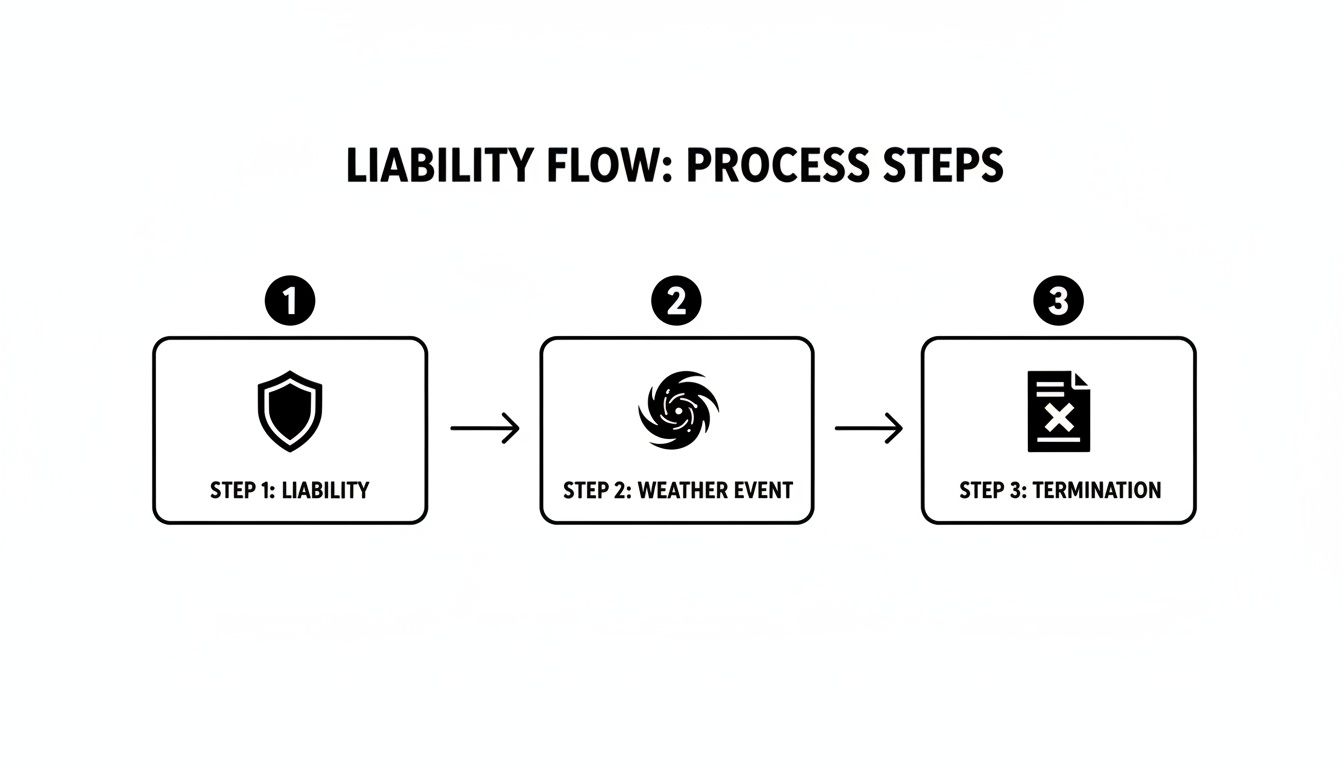
As you can see, tackling liability first makes you better prepared for anything that comes next, whether it’s a hurricane or a simple need to part ways.
Talking Through the Fine Print
Once your inspection is done, take a few minutes to sit down with the client and go over the key parts of the agreement. Please, don't just hand them a clipboard and a pen. Guide them through it. You want to make sure they actually understand what they're signing.
We always make sure to clarify these specific areas:
- Scope of Service: We point to the exact list of what’s included in their monthly rate and then clearly mention services that cost extra, like a filter cleaning or a post-hurricane cleanup. No surprises.
- Payment Terms: "Your payment is due on the 1st of each month. If we find a repair is needed, we'll send a separate quote for your approval before doing any work." Keep it simple and direct.
- Access and Communication: Confirm their service day and explain how you'll communicate, whether it's through a door hanger or a detailed email report after each visit.
By making the contract an integral part of a smooth, professional onboarding, you immediately set yourself apart from the competition. It tells the client you're a serious business owner who values clear communication and top-notch service. To get a feel for how these professional standards play out in the field, check out our range of expert pool services and see the difference it makes.
A Few Common Questions About Pool Service Agreements
Even with the best template in hand, you're bound to have questions. Over the years, we've heard just about everything from both new pool pros and homeowners here in Southwest Florida. Let's tackle some of the most common ones.
Is a Handshake Deal Good Enough? Do I Really Need a Written Contract?
Let me be blunt: absolutely, you need a written agreement. A verbal "handshake deal" is probably the single biggest risk you can take in this business. It's just asking for misunderstandings about what's included, arguments over payment, and massive headaches if something goes wrong.
A solid pool service agreement is your best friend. It protects you, and it protects the homeowner by putting everything in black and white. It clearly spells out services, costs, and what each party is responsible for, leaving no room for confusion. Honestly, it's a sign of a true professional. It shows you run a serious business, not just a side hustle.
How Often Should I Tweak My Pool Service Agreement?
Your business changes, and your contract needs to keep up. We make it a point to review our agreement at least once a year. Think of it as an annual check-up for the health of your business operations.
This yearly review is the perfect time to:
- Adjust for Rising Costs: The price of chlorine, fuel, and even insurance is always on the move. Your pricing has to reflect that reality to keep your business profitable.
- Add New Offerings: Maybe you started offering pressure washing or advanced tile cleaning this year. Get those added to your agreement as optional, billable services.
- Keep It Legal: Florida laws and local regulations can shift. An annual update ensures your contract is still compliant and enforceable.
Making this a yearly habit means your agreement always reflects how you actually do business.
What’s the Number One Argument This Agreement Prevents?
Easy. It's the surprise bill. Homeowners get frustrated by unexpected charges for work they thought was included in the monthly fee. This is usually for things like a special floc treatment after a huge storm, an extra filter cleaning during pollen season, or the cost of a new pump basket.
Your best defense here is a crystal-clear 'Scope of Services' section combined with an 'Authorization for Additional Work' clause. Together, they eliminate sticker shock. The scope defines exactly what the monthly fee covers, and the authorization clause creates a simple process for getting approval before you do any extra-cost work.
This turns a potential fight into a straightforward, pre-approved transaction. Clients really appreciate that transparency, and it goes a long way in building trust. For a look at other common topics, check out our guide answering frequently asked pool care questions.
Can I Just Grab a Generic Template Online for My Florida Business?
We’d be careful with that. A generic, one-size-fits-all template from a random website might seem like a quick fix, but it's a huge gamble. These documents almost always miss the specific details needed for Florida's unique legal and environmental challenges.
For example, a generic contract probably won't mention:
- Your specific policies for hurricane preparation and post-storm cleanup.
- Liability clauses related to equipment damage from our intense sun.
- Protocols for dealing with the massive summer downpours that can throw pool chemistry completely out of whack.
You absolutely have to tailor any template to your business and the realities of servicing pools in Florida. While our template is a great starting point, we always suggest having a local lawyer give your final draft a quick look-over. It’s a small investment for some serious peace of mind.
Ready to elevate your business with professional, reliable service that your clients can count on? Water Medic of Cape Coral has over 25 years of experience keeping Southwest Florida pools pristine. Let us handle the hard work so you can enjoy peace of mind. Visit us at https://watermedic.com to learn more about our expert pool maintenance and water treatment solutions.