
Pool Pump Not Working A Guide For Florida Homeowners
When your pool pump is not working, it’s usually due to a simple power issue or a blockage you can fix in just a few minutes. The most common culprits? A tripped circuit breaker, a wonky timer, or a skimmer basket crammed with debris. You’ll want to act fast, though—a stagnant pool in the Florida heat can start turning green with algae in less than 24 hours.
Your First Response Guide To A Dead Pool Pump
That sudden, unnerving silence from your pool equipment is a sound every Southwest Florida homeowner knows and dreads. But here's the good news: a quiet pump doesn't automatically mean a huge repair bill is on the horizon. More often than not, a few basic checks will get your system humming again.
Before you start worrying, let's walk through the essential first steps. This is your initial diagnostic checklist—a way to rule out the simple stuff before you even think about complex mechanical or electrical failures.
Start With The Obvious: Power And Timers
Your first stop should always be the power source. It sounds almost too simple, but you'd be surprised how often the fix is just a flipped switch.
Make your way to your home's main electrical panel and find the circuit breaker for your pool equipment. Breakers are safety devices; they trip to protect your pump motor from power surges, a common occurrence after a classic Florida thunderstorm.
If the breaker is in the "off" position or stuck in the middle, reset it. Push it firmly to the "off" position first, then flip it back to "on." While you're at it, take a look at the pump's timer. Is it getting power? Are the "on" and "off" trippers set correctly for the current time?
This flowchart breaks down these initial steps, guiding you from the breaker box to the baskets. It's a great visual for quickly figuring out if you have an electrical issue or a physical one.

Following this logical path can save you a ton of time and help you pinpoint the problem without any guesswork.
Before you call a professional, running through these quick checks can often solve the problem in minutes. This table summarizes the most common issues you can identify yourself.
Quick Pool Pump Diagnostic Checklist
| Symptom | Potential Cause | Your Next Step |
|---|---|---|
| Complete Silence | No power to the pump. | Check the circuit breaker and timer settings. |
| Pump Hums, Won't Start | Jammed impeller or bad capacitor. | Turn off power. Check for debris in the pump basket. If clear, you may need a pro. |
| Pump Runs, No Water Flow | Clogged baskets or air leak. | Clean skimmer and pump baskets. Check for visible cracks in the plumbing. |
| Pump Turns On/Off Quickly | Overheating or electrical issue. | Ensure the pump vents are clear. If it persists, call a technician. |
This checklist is your go-to reference. If the simple steps don't resolve the issue, you’ll have a much better idea of what to tell your pool technician.
Inspect For Clogs And Blockages
If the power is on but nothing's happening, it's time to hunt for clogs. A pump that can't pull in water—a condition called "losing prime"—can't do its job and will often shut down to prevent itself from burning out.
Here's where to look:
- Skimmer Baskets: Pop the lids on your pool's skimmers. If they're stuffed with leaves, palm fronds, or kids' toys, the pump is being starved of water.
- Pump Basket: First, kill the power at the breaker. Then, open the pump lid and check its internal strainer basket. This is the last line of defense before debris can reach the delicate impeller.
A pump basket packed solid with debris is one of the top reasons a pool pump stops working. Making this a weekly check is the single best thing you can do to prevent headaches and service calls.
Clearing out these baskets often brings the pump right back to life. Keeping them clean is a fundamental part of any solid pool care routine. Of course, if you'd rather not deal with it, you can learn more about our hands-off professional monthly maintenance plans that take care of everything for you.
If you've checked the power and cleared the baskets and the pump still isn't working, it's time to consider that something more serious might be going on.
Solving Common Electrical and Power Problems
When your pool pump suddenly goes silent, it's natural to think the worst—a total pump failure. But hold off on panicking. More often than not, the culprit is something simple and electrical, not a catastrophic mechanical breakdown. Here in Southwest Florida, a pop-up thunderstorm is all it takes to trip a breaker, so that’s always the first place our technicians look if a customer’s pool pump is not working.
Head over to your main electrical panel and find the breaker labeled for your pool equipment. Is it in the middle position? That means it's tripped. To reset it, you have to push it firmly all the way to the "off" position first, then flip it back to "on." Also, take a look for a GFCI outlet near your pump—the kind with the "test" and "reset" buttons. Just pressing that "reset" button can sometimes bring everything back to life.
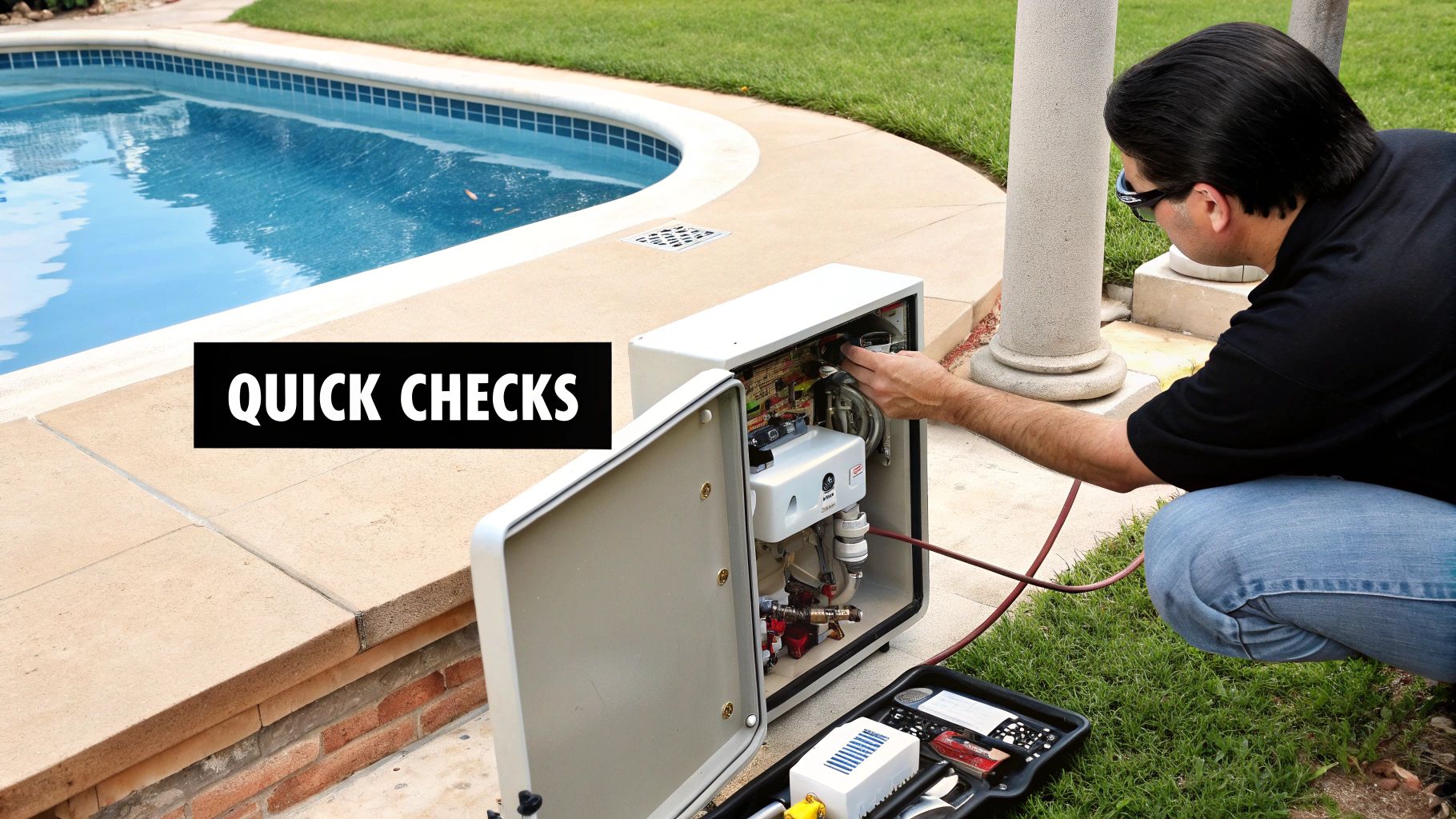
While a one-off tripped breaker is usually no big deal, if it starts happening repeatedly, that’s a red flag. It could point to a bigger problem with the circuit itself. If you're curious about what to look for, you can learn more about how to tell if a circuit breaker is bad, as a faulty one needs to be replaced by a pro.
When the Motor Hums But Won't Start
Hearing a distinct humming or buzzing sound from the motor, but the shaft isn't spinning? This is a classic symptom, and it almost always points to one thing: a bad capacitor. Think of the capacitor as a small battery that provides the initial kick of energy to get the motor turning.
These components wear out over time, and the intense Florida heat definitely speeds up their demise. A capacitor is a pretty cheap part, but it holds a serious electrical charge, even when the power to the pump is completely off.
Safety First: Don't even think about touching or trying to replace a capacitor yourself. They can deliver a nasty, dangerous electrical shock. This is a job strictly for a trained professional.
If you hear that tell-tale hum, the smartest and safest thing you can do is kill the power at the breaker and call for an expert.
Faulty Timers and Hidden Wiring Issues
Sometimes the power problem is sneakier than a tripped breaker or a humming motor. We've seen plenty of old-school mechanical timers fail where the internal gears just give out, preventing the switch from ever making contact. The timer clock might still be ticking away, but it's not actually sending any juice to the pump.
Beyond timers, other hidden gremlins can pop up, such as:
- Loose Connections: Constant vibration from the motor can slowly work wires loose inside the timer box or at the pump's connection terminals.
- Corroded Wires: Our humid, salty air is brutal on electrical components, causing corrosion that blocks the flow of electricity.
- Pest Damage: It happens. Little critters can get into the housing and chew through wiring, creating a short.
This is where DIY troubleshooting hits a hard stop. Diagnosing and fixing wiring requires specialized tools and a solid understanding of electrical codes. If you suspect faulty wiring, a bad capacitor, or have breakers that won't stop tripping, don't take a chance. Call the licensed pros at Water Medic to handle it safely and correctly, so you can get back to enjoying your pool.
Spotting an Overheating Pool Pump Motor
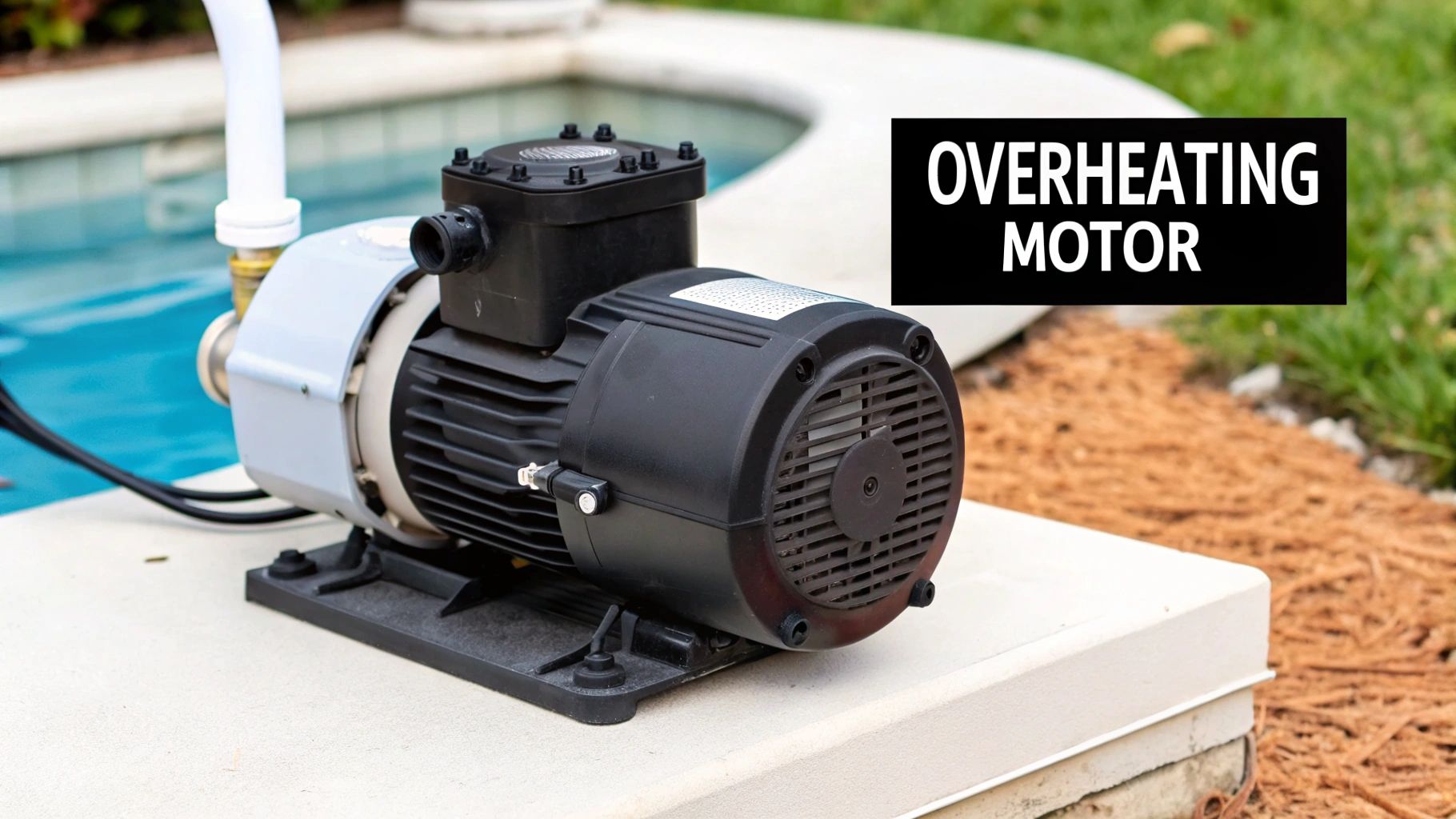
Here in the relentless Southwest Florida heat, an overheating motor is more than just a minor hiccup; it’s one of the top reasons your pool pump is not working. If you've ever seen your pump run for a bit, shut off out of the blue, and then kick back on later, you've witnessed a classic symptom. That's the internal thermal overload switch doing its job, protecting the motor from burning itself out.
This frustrating on-and-off cycle is your pump's way of telling you something is wrong. The constant high temperatures we get in places like Cape Coral put a massive strain on these motors. When a pump starts overheating, it's usually fighting against a problem you can often spot and fix yourself.
Why Pool Pump Motors Overheat
A motor that's running too hot is rarely a fluke. It's almost always a symptom of another problem, usually tied to poor airflow or excessive internal friction. Just think of it like any other engine—it has to be able to cool itself down.
From what we see out in the field every day, these are the usual suspects:
- Clogged Vents: The motor casing has air vents for a reason—to pull in cool air. But over time, they get packed with leaves, mulch, dirt, and even spider webs. This effectively suffocates the motor, causing it to overheat.
- Constant Sun Exposure: Is your pump sitting in the direct, blazing Florida sun all day? If it doesn't have a cover or some shade, it's fighting a losing battle. The dark housing just soaks up the heat, sending its operating temperature through the roof.
- Bad Bearings: When the motor bearings start to wear out, they create more friction. All that extra friction generates an incredible amount of heat and is a dead giveaway that the motor is on its last legs.
An overheating motor is one of the most common and serious issues causing pool pump failures, a problem that disproportionately affects homeowners during peak summer months. You can explore more data on seasonal pool equipment challenges on marketdataforecast.com.
Getting ahead of these issues can be the difference between a simple fix and having to replace the entire motor.
The Telltale Signs of a Struggling Motor
Besides the pump shutting itself off, there are a couple of other dead giveaways. Go ahead and carefully touch the motor housing. Is it too hot to comfortably keep your hand on it for more than a few seconds? Are you hearing a high-pitched whine or a grinding noise? Both are clear signs that the internal parts are under serious stress.
We see this a lot with older, single-speed pumps. They are especially prone to overheating because they run at max power all the time, which means maximum heat and friction. This is one of the strongest arguments for upgrading to a newer, more efficient model. You can see how the technology has improved by checking out the variable-speed pool pumps on the market today; they run much cooler and can slash your energy bills.
Because our pools run year-round here, the equipment takes a beating. A quick preventative check is your best bet. Our technicians are trained to find the root cause of overheating fast, whether it's just clearing out a blocked vent or spotting worn-out bearings before they seize up completely. Catching these things early will save you from the headache of a dead pump and a green pool.
Diagnosing Water Flow Issues And Mechanical Failures
So, you've checked the power, and the motor isn't scorching hot, but your pool water is as still as a pond. What's next? It's time to roll up your sleeves and play detective, because when a pool pump is not working even with power, the culprit is almost always something mechanical or an issue with the water flow itself.
This means we need to look at the guts of the system—the plumbing, the impeller, and all the seals—to figure out what’s putting a stop to the circulation. Your investigation starts with two of the most common and frustrating problems: blockages and air leaks. These sneaky issues can easily make you think the entire pump is toast when, in reality, it's just being starved of water or is sucking in air.
Hunting Down Suction Side Air Leaks
An air leak on the suction side—that’s all the plumbing pulling water into your pump—is a notorious headache for pool owners. A leak here prevents the pump from priming, which is just the fancy term for creating the vacuum it needs to pull water from the pool. Instead of water, it just gulps down air, causing it to run dry and eventually overheat.
The signs of an air leak can be subtle, but once you know what to look for, they’re pretty clear:
- Bubbles From Return Jets: This is the tell-tale sign. See a constant stream of tiny bubbles shooting out of the return jets? Air is getting into the lines somewhere.
- A Low Water Level in the Pump Basket: Pop the lid. If the pump basket isn't completely full of water while the pump is running, air is displacing it.
- The Pump Struggles to Prime: Does your pump whine and struggle for more than a minute or two before it finally starts moving water? An air leak is the likely suspect.
The most common spot for an air leak is a bad o-ring on the pump lid. If it's old, cracked, or not lubricated, it won't create a proper seal. This simple part causes a surprising number of service calls.
Give the pump lid a good once-over for any cracks and inspect the o-ring for signs of wear and tear. While you’re there, check every pipe fitting on the suction side of the pump. A loose or cracked fitting is another prime entry point for air.
Checking for a Clogged Impeller
What if the motor is humming away happily but not a drop of water is moving? The problem could be a clog lodged deep inside the pump. The impeller is the part that does the real work—it's a spinning disc that flings water out and gets the circulation going. But it doesn't take much to stop it. A single acorn, a clump of leaves, or even a small pebble can get wedged in there and bring the whole operation to a halt.
First things first: kill the power at the circuit breaker. Safety is non-negotiable here. Once the power is off, you'll need to get to the impeller, which usually means removing the pump basket and reaching into the housing behind it. Try to give it a spin with your finger. If it doesn't turn freely, you've found your jam.
While you might be able to fish out a minor clog yourself, some mechanical failures are best left to the pros. If you hear loud, awful grinding or screeching noises, that’s the motor's cry for help. It’s a sure sign the bearings have failed, and the motor is essentially destroying itself from the inside.
When you hear those sounds, shut the pump down immediately to prevent further damage. It’s time to call in an expert. For these more complex issues, exploring our pool equipment repair services is your safest and most effective next step to get your pool back up and running.
Repair or Replace? Making the Right Call for Your Pool Pump
So, your pool pump has called it quits. Now you're staring at a decision that hits your wallet both today and down the road: do you fix it or spring for a new one? It's tempting to go for the quick fix, but sinking cash into an old, inefficient pump is often just throwing good money after bad. This isn't just about the immediate cost; it's about making a smart investment in your home.
The best choice really boils down to a few key things. You have to look at how old your pump is, what a specific repair will set you back, and how much a new, energy-efficient model could save you on your utility bills. Let’s walk through how to think this through so you can feel confident in your decision.

Weighing the Age and Cost of a Fix
A great rule of thumb we've always followed is the 50% rule. If the cost to repair your pump is more than half the price of a new one, it’s almost always better to replace it. It just doesn't make sense to spend hundreds on a pump that’s already been running for eight or ten years. You're just asking for another breakdown sooner rather than later.
Here's a classic example we see all the time: the motor on an old single-speed pump gives out. Getting a new motor can easily run $400-$600. Sure, that’s less than a brand-new pump, but you’re still left with an ancient, energy-guzzling machine. That same money could be a hefty chunk toward a modern variable-speed pump that actively puts money back in your pocket every month. For jobs like this, getting a professional quote for our pool equipment repair services will give you the hard numbers you need to compare apples to apples.
Why Variable-Speed Pumps Are a Game-Changer
The biggest reason to lean toward replacement is the incredible jump in efficiency you get with today's technology. Old-school single-speed pumps are energy hogs—they run at full throttle, all the time. In stark contrast, variable-speed pumps can dial it way back, running at lower speeds that can cut your pump's energy use by up to 90%.
Your pool pump is often the second-biggest power draw in your entire house, right behind your air conditioning. Upgrading isn't a luxury; it's a strategic move to lower your monthly bills.
While the upfront cost is higher, the payback is huge. The energy savings alone can often cover the cost of the new pump within a couple of pool seasons. You’re not just replacing a broken part; you're upgrading your home's efficiency and slashing its operating costs.
What Does a Full Replacement Really Cost?
When you start looking at new pumps, it's crucial to consider the total cost, not just the price on the box.
Looking ahead to 2025, a full pool pump replacement can run anywhere from $700 to $4,000. Most homeowners land somewhere around $1,300 for the whole job. The pump itself might be $200 to $1,200, and professional installation will add another $100 to $400. These numbers can swing a lot depending on where you live—for instance, installing a top-of-the-line variable-speed pump in Southern California could push $2,300. You can discover more insights about pool pump cost analysis on blogs.aiper.com.
Trying to figure all this out can feel like a lot. That’s where getting professional advice really helps. Our experts at Water Medic can lay out clear, detailed quotes for both repair and replacement, and we’ll even show you the return on your investment. We'll break down exactly how much a new variable-speed pump can save you, so you can make a decision that pays off for years.
Why Trusting a Professional Is Your Best Solution
While it's great to roll up your sleeves and tackle a few basic checks, there’s a definite line in the sand when it comes to a pool pump not working. At a certain point, DIY troubleshooting can go from saving a few bucks to causing expensive, even dangerous, damage.
Complex pump problems demand a professional's touch. It's not just about having the right tools; it’s about a deep understanding of how every part of your pool system—plumbing, electrical, and filtration—works together. For many issues, calling a seasoned technician isn't just about convenience. It’s the safest and most reliable way forward.
When to Put Down the Tools and Pick Up the Phone
Let's be blunt: anything involving your pump's electrical components is non-negotiable professional territory.
Messing with electrical faults, like a bad capacitor that can still hold a nasty charge, or trying to figure out why a breaker keeps tripping, is a job for someone licensed and insured. A botched wiring job won't just fry your new motor; it’s a serious shock and fire hazard. Our technicians use specific diagnostic equipment to safely trace these problems right to the source.
The same goes for those maddening, elusive air leaks. You might easily spot a crack in the pump lid, but what about a tiny fissure in an underground pipe? A pro can pressure-test the entire system to find hidden leaks you'd never see on your own.
Here are a few common situations where calling an expert is a must:
- Motor Replacement: This is a precision job. Getting a new motor seated correctly, wiring it up to code, and installing a perfect shaft seal is crucial for it to last.
- Bearing Replacement: That awful grinding or screeching sound means the motor bearings are toast. Swapping them out is an intricate process, and one small mistake can destroy the new motor in short order.
- Complex Electrical Issues: If you're dealing with recurring electrical gremlins, a professional can tell you if the problem is really the pump, a weak breaker, or the wiring running to the equipment pad.
Ultimately, the biggest benefit of hiring an expert is peace of mind. You get the confidence that the job was done right, the repair is guaranteed, and your equipment is running safely and efficiently.
Hiring a reputable company is the key to getting a lasting fix. For some great pointers on vetting a service provider, check out these tips for choosing the right plumbing professional.
The Water Medic Advantage in Southwest Florida
Here at Water Medic of Cape Coral, we’ve been fixing pools in this area for over 25 years. We’re not just a generic repair company; we’re your neighbors who understand the unique challenges our Southwest Florida climate throws at pool equipment.
From the intense summer heat that puts incredible stress on motors to the corrosive, humid air that wreaks havoc on electronics, we’ve seen it all. We don’t just slap a bandage on the problem—we get to the root cause to keep it from happening again.
Don’t let a broken pump ruin your swimming season or risk a costly, amateur repair. Contact Water Medic today for an expert diagnosis. We’ll give you a clear, honest assessment and get your pool back into perfect, swim-ready shape.
Common Questions We Get About Pool Pumps
Over the years, we've heard just about every question you can imagine from homeowners in Southwest Florida when their pool pump starts acting up. Here are a few of the most common ones we run into, along with some straight-to-the-point answers.
My Pump Is Humming But Won't Start. What's Wrong?
That distinct humming noise is a classic tell-tale sign. More often than not, it points straight to a bad capacitor. Think of the capacitor as a tiny battery that gives the motor a powerful jolt to get it spinning. After a few years, especially baking in the Florida heat, they just give out.
While the part itself isn't too expensive, a capacitor stores a serious electrical charge, even with the power shut off. For your own safety, this is one repair you should always leave to a qualified professional. Our team handles this kind of pool equipment repair all the time and can get your system running again quickly and safely.
How Long Can I Expect a Pool Pump to Last in Florida?
Down here in Southwest Florida, our pools are working year-round, so pumps get a serious workout. With good maintenance, you can generally expect a pump to last somewhere between 8 and 12 years. But that number can drop fast if the conditions aren't right.
A few things can really shorten a pump's life:
- Direct Sun Exposure: Constant, harsh sunlight beats down on the plastic housing and makes the motor run hotter than it should.
- Poor Ventilation: If your pump is tucked away in a tight spot without much airflow, it's going to struggle to cool itself down.
- Bad Water Chemistry: Water that's too acidic or alkaline will slowly eat away at the internal seals and components.
The single best thing you can do to get the most life out of your pump is to have it professionally maintained. We can spot the little problems before they turn into big, expensive ones.
Is It Really Worth Upgrading to a Variable-Speed Pump?
Yes, one hundred percent. The upfront cost of a variable-speed pump is definitely higher than a basic single-speed model, but the long-term savings are huge. These modern pumps are incredibly efficient and can slash your pump-related energy costs by up to 90%.
How? They do their job by running at much lower speeds for longer stretches, which uses a fraction of the electricity and is also much quieter. Given today's energy prices, a variable-speed pump will often pay for itself in just a couple of years. It's one of the smartest upgrades a pool owner can make.
If you're tired of a noisy, unreliable pump or just sick of seeing those high energy bills, let the experts take a look. For over 25 years, Water Medic of Cape Coral has been the trusted name for pool services in Southwest Florida. Visit us online at https://watermedic.com to get your pool back in perfect shape.