Is RO Water Distilled? The Definitive Answer
No, reverse osmosis (RO) water is definitely not the same as distilled water. It's a common point of confusion, but the two are products of completely different purification methods.
This distinction is more than just technical jargon—it directly impacts the water's final taste, mineral content, and what it’s best used for. Our team at Water-Medic specializes in providing the perfect water solution for your home, and understanding this difference is the first step.
RO vs. Distilled Water: It's All in the Process
Think of reverse osmosis as an incredibly fine filter. It uses high pressure to push water through a semipermeable membrane, a barrier with microscopic pores that are so small, they block most contaminants while letting pure water molecules pass through.
Distillation, on the other hand, is basically nature's water cycle recreated on your countertop. It involves boiling water to create steam, leaving solid impurities like minerals and salts behind. That pure steam is then collected and cooled, condensing it back into liquid water.
So, RO is a physical filtration process, while distillation is a phase-change process (liquid to gas and back to liquid).
A Quick Comparison
Let's break down what this means for the water coming out of your tap.
| Feature | Reverse Osmosis (RO) Water | Distilled Water |
|---|---|---|
| Purification Method | Pushing water through a fine membrane | Boiling water & condensing the steam |
| Mineral Content | Low, but some healthy minerals remain | Virtually zero minerals left |
| Typical Taste | Clean, crisp, and refreshing | Often described as flat or bland |
| Energy Usage | Low energy consumption | High energy consumption (needs heat/boiling) |
The core difference is what gets left in the water. Reverse osmosis is selective, targeting harmful contaminants while letting a small amount of beneficial minerals pass through, which greatly improves the taste. Distillation is a blunter instrument—it removes almost everything, including the good stuff.
This is why, for everyday drinking and cooking, most people prefer the balanced, clean taste of RO water. High-quality under-sink reverse osmosis systems are a fantastic way to get a steady supply of purified, great-tasting water right at your kitchen sink, making them a super convenient and practical choice for any home.
How Each Purification Process Actually Works
To really get why reverse osmosis (RO) and distilled water are so different, you have to look under the hood at the science behind each one. While they both give you incredibly pure water, their methods are worlds apart. That difference is what makes one a much better fit for your home than the other.
The Multi-Stage Power of Reverse Osmosis
Reverse osmosis is a pretty sophisticated filtration process. It all comes down to applying high pressure to your home’s water, forcing it through a special semipermeable membrane.
Think of this membrane as a microscopic bouncer at an exclusive club. Its pores are unbelievably tiny—around 0.0001 microns—so only pure water molecules get through. Everything else gets left behind. This is how an RO system traps the stuff we see all the time in Southwest Florida water:
- Dissolved solids (TDS), like the salts and minerals that cause hard water.
- Heavy metals like lead and arsenic.
- Bacteria and viruses.
Any good system, like the ones we install, uses multiple stages. Before the water ever hits that critical RO membrane, it has to pass through sediment and carbon pre-filters. These first steps get rid of bigger particles like sand and silt and, most importantly, take out chlorine, which can eat away at the delicate membrane over time. You can learn more about the vital role of carbon filters in water purification in our detailed guide.
Distillation: The Boiling and Condensing Method
Distillation basically mimics the earth's natural water cycle: evaporation, condensation, and rain. It’s a much simpler process than RO, but it uses a ton of energy.
A distiller works by boiling water until it turns into steam. When the water evaporates, it leaves behind almost everything that can’t turn into a gas—minerals, salts, heavy metals, and microbes are all left in the boiling chamber.
The core principle of distillation is separation through phase change. By converting liquid water to a gas, it physically separates from nearly all non-volatile contaminants, resulting in exceptionally high purity.
This pure water vapor is then collected and cooled, causing it to condense back into liquid water. The result is almost 100% pure H₂O, stripped of everything, including healthy minerals. This process is why people often ask, "is ro water distilled?" While both produce pure water, their methods are completely different. RO filters, while distillation boils and condenses. That distinction is key when you're deciding what you need for your family's daily use.
A Head-to-Head Purity Comparison
When it comes to water purification, performance is everything. To really get why the answer to "is RO water distilled?" is a definite "no," we have to look at how each method tackles the specific contaminants we see here in Southwest Florida. This direct comparison will show you which technology is the right fit for your family's health and home.
The ultimate measure of any purification system is its ability to remove Total Dissolved Solids (TDS)—a catch-all term for every inorganic and organic substance floating around in your water. Distillation is a powerhouse here. By boiling water and leaving the solids behind, it can achieve over 99% TDS removal. It’s about as close to pure H₂O as you can get.
Reverse osmosis is right up there with it, with top-tier systems also removing up to 99% of TDS. The real difference, though, is in the details. While distillation strips out nearly everything, RO systems are smart enough to leave a small amount of beneficial minerals like calcium and magnesium behind. These are the very things that give water its clean, crisp taste.
Contaminant Removal: A Closer Look
Beyond just TDS, each system has its own strengths and weaknesses when it comes to specific impurities. For distillation, certain contaminants with a low boiling point can be tricky to eliminate completely.
Here's a breakdown:
- Microbes (Bacteria & Viruses): Both methods are exceptional at getting rid of microbiological threats. The pores in an RO membrane are far too tiny for these pathogens to squeeze through. Likewise, the boiling process central to distillation effectively kills them off.
- Volatile Organic Compounds (VOCs): This is where distillation can fall short. Because VOCs are "volatile," they can turn into gas along with the water during boiling and end up right back in your finished product. A quality RO system, on the other hand, uses activated carbon pre-filters specifically designed to trap and remove VOCs before they ever get to the main membrane.
The biggest difference you'll notice day-to-day comes down to those minerals. Distillation gives you water that's stripped bare, which often tastes flat or even a bit metallic. In contrast, the trace minerals that reverse osmosis leaves behind create that refreshing flavor most people prefer for drinking and cooking.
For anyone who wants the absolute best of both worlds, our advanced RO systems can be fitted with a remineralization filter. This adds a controlled, healthy amount of minerals back into the purified water. You get unmatched purity and perfect taste.
To help you choose the right system, this table breaks down how each purification method stacks up against common contaminants and other key factors.
Contaminant Removal RO vs Distillation
| Contaminant/Feature | Reverse Osmosis (RO) | Distillation |
|---|---|---|
| Total Dissolved Solids (TDS) | Excellent (95-99% removal) | Excellent (99%+ removal) |
| Heavy Metals (Lead, Arsenic) | Excellent | Excellent |
| Bacteria & Viruses | Excellent | Excellent |
| Volatile Organic Compounds (VOCs) | Excellent (with carbon pre-filter) | Poor (VOCs can vaporize with steam) |
| Chlorine | Excellent (with carbon pre-filter) | Good (but some can remain) |
| Beneficial Minerals | Some are retained, improving taste | Completely removed |
| Final Water Taste | Crisp, clean, and refreshing | Flat, sometimes described as 'bland' |
As you can see, while both are powerful, the inclusion of a carbon filter gives RO a clear advantage in removing chemical contaminants like VOCs, while also delivering a better-tasting final product.
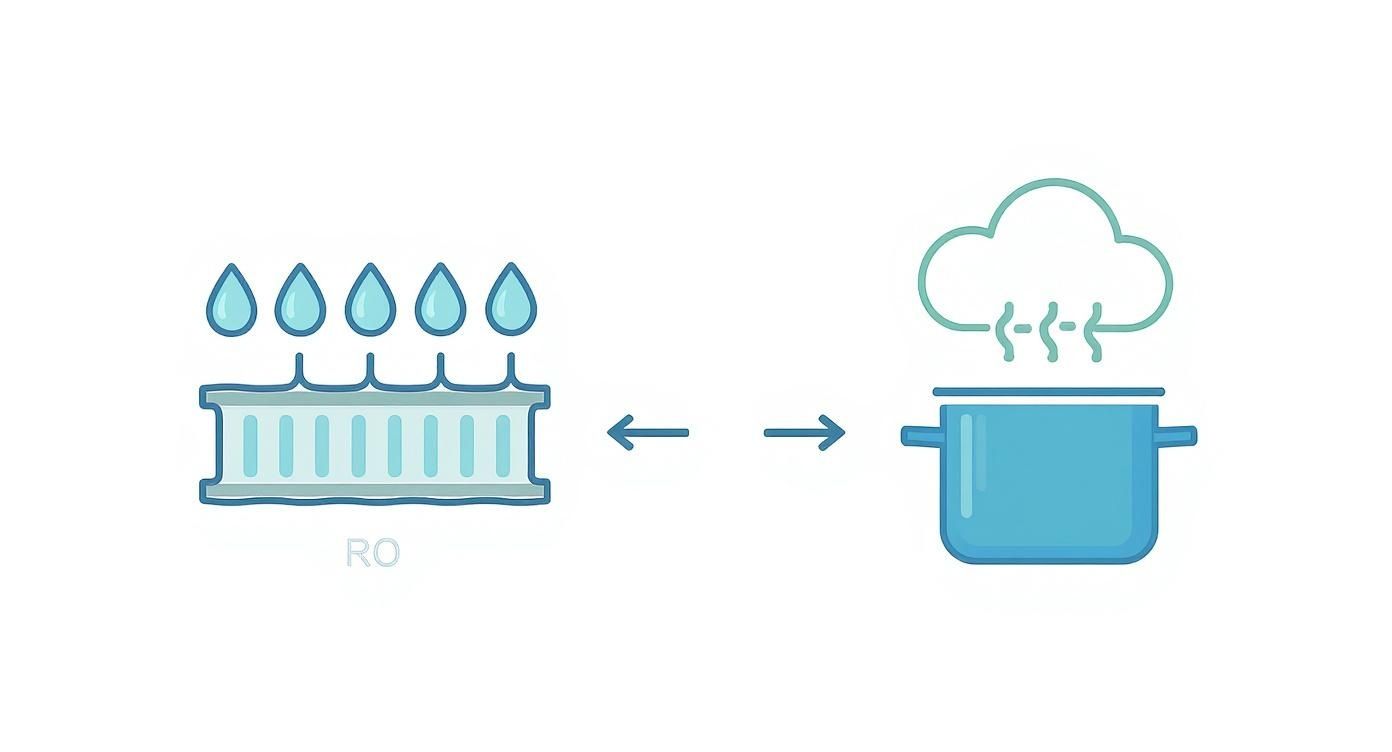
The diagram below shows the core difference in how these two processes work: RO uses a physical membrane barrier, while distillation uses a thermal, phase-change process.
Why This Matters for Your Home
The quest for pure water isn't just local; it's a global health priority. While many people around the world still lack access to clean water, advanced technologies like RO are making a huge difference by removing up to 99% of TDS and dangerous microorganisms. Even though both RO and distillation share the goal of making water safe, the right choice always depends on your specific needs—like cost, desired mineral content, and how much water you use.
For homeowners here in Southwest Florida, this means picking a system that can handle our unique water challenges without compromise. The superior taste, comprehensive contaminant removal, and overall versatility make a whole-house reverse osmosis system the most practical and beneficial choice for getting premium-quality water from every faucet in your home.
Choosing the Right Water for Your Home
Knowing the science behind water purification is great, but what really counts is how it applies to your everyday life. Deciding between reverse osmosis and distilled water for different tasks around the house can make a huge difference in results and even protect your expensive appliances. This is where the practical side of the debate comes into sharp focus.
When it comes to anything you'll eat or drink—sipping a glass of water, cooking a meal, or brewing your coffee—reverse osmosis water is the clear winner. The small amount of healthy minerals left behind gives it a pleasant, crisp taste. Distilled water, on the other hand, is often described as flat or sterile because it's been stripped of everything, making it less than ideal for consumption. RO water enhances the natural flavors in your food and drinks, while distilled water can actually dull them.

Everyday Excellence with RO Water
The advantages of RO water don't stop at the kitchen sink. Since it has incredibly low levels of total dissolved solids (TDS), it makes beautiful, crystal-clear ice cubes without the cloudy center you get from tap water. This same purity means your dishes and glasses come out of the dishwasher sparkling, free from annoying mineral spots.
A professionally installed whole-house reverse osmosis system extends these benefits to every tap in your home. This is about more than just having amazing drinking water; it's about protecting your entire property. Here in Southwest Florida, hard water is a constant problem. An RO system acts as a shield for your plumbing, water heater, and appliances, preventing the scale buildup that shortens their lifespan and kills their efficiency.
For homeowners, the choice is simple. Reverse osmosis provides a comprehensive, great-tasting water solution for daily life, while distilled water serves a few niche, technical purposes. An RO system is an investment in both your family's health and your home's infrastructure.
When Distilled Water Makes Sense
So, what is distilled water good for? Its total lack of minerals makes it the perfect fit for certain small appliances where even the slightest mineral deposit can cause clogs or malfunctions. Basically, you use it for any task where you need nothing but pure H₂O left behind.
- CPAP Machines: Using distilled water is critical to prevent mineral scale from gumming up the water chamber and tubing.
- Clothing Irons and Steamers: It keeps steam vents clear, so your iron glides smoothly and won't leave mineral stains on your clothes.
- Humidifiers: Prevents the unit from spraying a fine white mineral dust all over your furniture and into the air you breathe.
These are very specific, small-volume uses. For the constant, high-demand needs of a whole family—from drinking and cooking to bathing and laundry—a whole-house RO system is a much more practical and economical solution. And while a whole-home system is the ultimate goal, it's also important to think about the water from individual appliances; for example, you should be maintaining filtered water for appliances like your refrigerator. Our custom RO solutions are built to fit your lifestyle, so explore our system options to see how we can bring pure, delicious water to every corner of your home.
When you’re looking at a water purification system, the sticker price is just the beginning of the story. To really understand what you're signing up for, you need to look at the long-term costs and upkeep for both reverse osmosis systems and distillers. This is where you'll see some major differences in what it takes to keep them running.
The biggest financial drain, by far, comes down to energy. Distillation is a power-hungry process—it has to boil every single drop of water. RO systems, on the other hand, just use pressure to do their job, which makes them a much more efficient choice for everyday use.
Operational Costs: RO vs. Distillation
Let's break down the numbers. A typical distiller uses about 3 kWh of electricity to produce one gallon of water. At average US electricity rates, that’s roughly 30 cents per gallon. That might not sound like much, but for a family that needs pure water for drinking, cooking, and more, it adds up fast.
In contrast, RO systems sip electricity, making them the clear winner for a whole-house solution from a cost and sustainability perspective. For a more detailed breakdown of these costs, FreshWaterSystems.com offers a great comparison.
Water waste is another factor. Both systems produce wastewater, but modern high-efficiency RO systems have come a long way. They are much more resource-conscious than the older models many people still think of.
When you're talking about a whole-house system that purifies water at every tap, the lower cost-per-gallon of reverse osmosis makes it the only practical financial choice. Distillation simply can't compete at that scale.
Maintenance and Upkeep Requirements
The day-to-day maintenance couldn't be more different. A home distiller needs constant attention. You have to regularly scrape out the mineral scale left behind in the boiling chamber—a messy job called descaling. If you don't stay on top of it, the machine loses efficiency fast.
RO systems are much more hands-off. Their maintenance is all about scheduled filter changes. You’ll typically swap out the pre-filters every 6 to 12 months and the main RO membrane every two years or so. It's a predictable, "set-it-and-forget-it" kind of task that fits easily into a busy life.
At Water-Medic, we take that convenience a step further with our professional maintenance services. We handle all the filter changes for you, ensuring your system is always running perfectly. This not only protects your investment but guarantees you have consistently pure water without ever having to think about it. It’s the definition of a worry-free solution.
The Best Water Solution for Your Home
After diving deep into how each system works, what they remove, and what they cost over time, our recommendation is pretty straightforward. People often ask, "is RO water distilled?" and while they share some similarities in purity, the differences make one the clear winner for everyday home use.
For the vast majority of homeowners here in Southwest Florida, a whole-house reverse osmosis system is hands-down the most comprehensive and practical solution. It’s built to handle the specific water challenges we face in this region, giving you clean, fantastic-tasting water for drinking, cooking, bathing, and everything in between. RO simply strikes the right balance between high-level purification, convenience, and long-term value for a modern household.
Making the Final Choice
Sure, a small countertop distiller has its place. It can be a great tool for very specific, small-batch needs like filling a CPAP machine or certain medical devices. But when it comes to supplying an entire home with purified water, it’s just not a practical option.
Reverse osmosis, on the other hand, delivers that premium-quality water to every single tap. This doesn't just improve the water you drink; it protects your plumbing and appliances from scale and makes your daily routines, like showering or washing produce, that much better. The real decision isn't just about which method produces the purest water, but which one fits seamlessly into your life.
The only way to know for sure what your home needs is to get a professional water test. Every well and city water source is a little different, and a generic solution rarely gets the job done right. A system designed for your specific water chemistry is the key to performance and peace of mind.
Don't leave your family's water quality to chance. Let our team figure out the perfect water treatment setup for your home. You can start by learning more about our detailed water testing services.
Give Water-Medic a call today to schedule your free water quality consultation. You'll be amazed at the difference truly clean water makes in your home.
Common Questions About Water Purification, Answered
When you start digging into water purification, it's natural to have a lot of questions. We get them all the time from homeowners trying to make the best choice. Here are answers to a few of the most common ones we hear.
Is RO Water the Same as Purified Water?
Essentially, yes. Reverse osmosis water is one of the most effective types of purified water you can get. The term "purified water" is a broad category for any water that has had impurities, like chemicals and contaminants, removed.
Both RO and distilled water fit this description. As we've covered, though, reverse osmosis tends to produce a more balanced and better-tasting water for everyday drinking.
Does Reverse Osmosis Remove the Good Minerals?
This is a great question. A standard RO system will remove a large percentage of minerals—the good and the bad. Unlike distillation, which strips out nearly everything, a good RO system can still leave trace amounts of beneficial minerals behind.
For homeowners who want the best of both worlds, we often recommend our advanced systems. These come with a remineralization filter that adds a healthy balance of minerals like calcium and magnesium back into the water right after it's been purified.
The key takeaway is that you have control. With a modern RO system, you can achieve incredibly pure water and then perfect its mineral content to match your health and taste preferences, a level of customization distillation simply can't offer.
Can I Install a Whole-House RO System Myself?
While it might be tempting to tackle this as a DIY project, installing a whole-house reverse osmosis system is a job best left to the pros. It's a complex system that needs to be integrated perfectly with your home's plumbing.
Proper installation is what ensures the system runs efficiently, avoids leaks, and actually delivers the water quality you're paying for. Our certified technicians handle the entire process, making sure your system provides flawless performance for years to come. Trusting a professional protects your investment.
If you're ready for a professional look at your home's water quality, the experts at Water Medic of Cape Coral can help you find the perfect solution. Contact us today for a free consultation!