How to Treat Well Water for Safe, Clean Drinking Water
Treating well water isn't a one-size-fits-all job. It starts with getting a professional water test done. After that, it’s about our team picking the right mix of filtration, disinfection, and softening systems that specifically target the contaminants in your water.
The whole point is to match the solution—whether that's reverse osmosis, a UV purifier, or a water softener—directly to the problem. This is how we ensure you get water that doesn't just look clear, but is genuinely safe for your family to drink and use every day.
Why Treating Your Well Water Is Non-Negotiable
When you own a home with a private well, you're the one in charge of your water quality. It's a big responsibility. Unlike city water, which is constantly tested and treated by the municipality, a private well is entirely up to the homeowner. This makes proactive treatment a fundamental part of maintaining your home, not just a nice-to-have upgrade.
Just look at Virginia, where over 22 percent of the population relies on private wells. That's a huge number of people who need to be on top of their water safety.
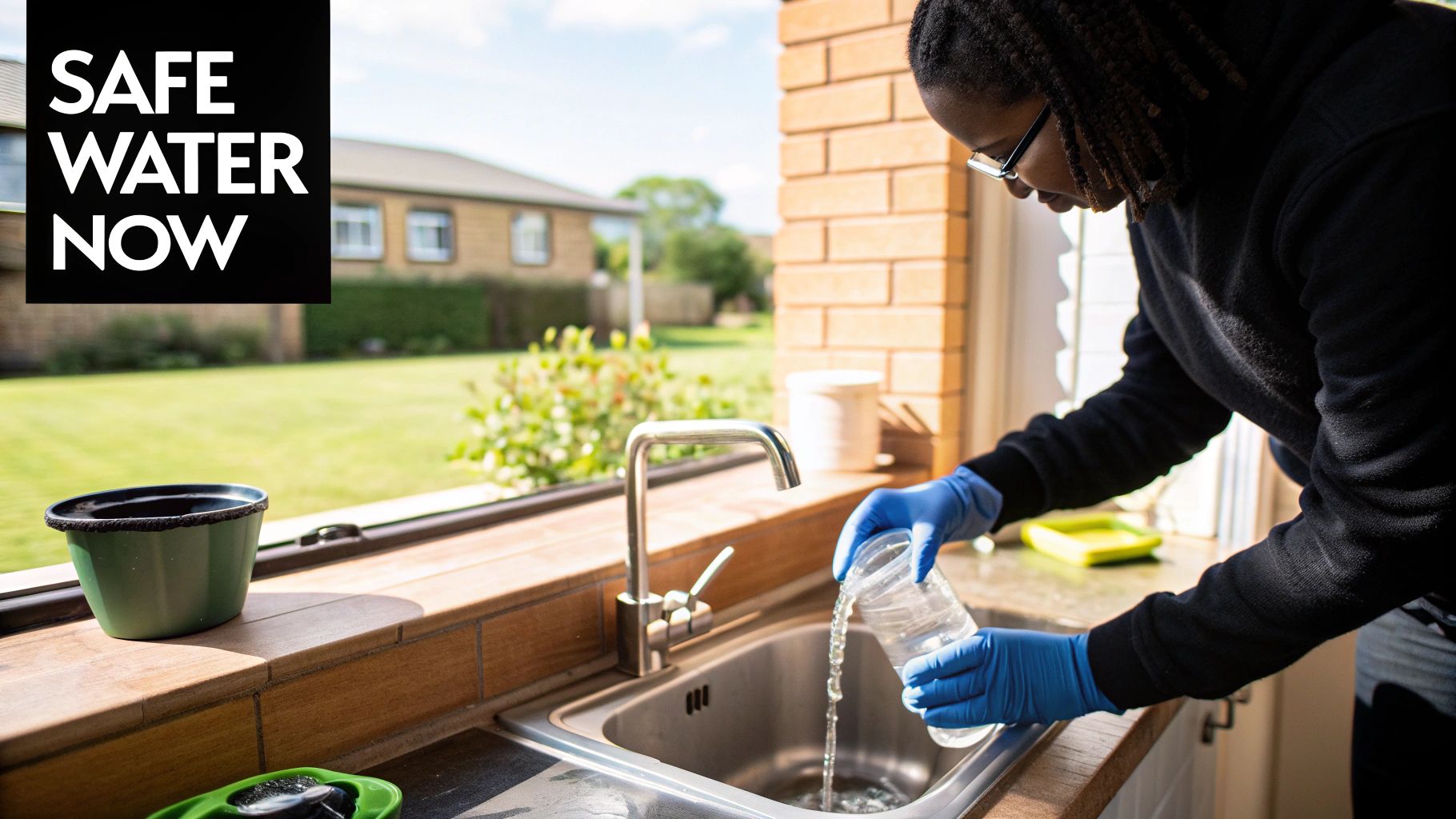
This guide is designed to take the mystery out of treating well water. We'll walk through the entire process in clear, straightforward stages, covering everything from getting an accurate test to choosing the right equipment and keeping it running for the long haul.
Understanding the Treatment Process
A solid well water treatment plan usually brings a few different methods together. The U.S. Environmental Protection Agency (EPA) often talks about a multi-barrier approach, which is just a way of saying that using a combination of filtration, disinfection, and sometimes other treatments is the most reliable way to get safe water.
Modern systems might use activated carbon to pull out organic compounds or reverse osmosis to remove tough contaminants like nitrates and heavy metals. It's all about layering the right technologies to address your specific water profile, a specialty of our expert technicians.
The biggest mistake I see well owners make is assuming that because their water looks clear, it must be clean. Many of the most dangerous contaminants—like bacteria, arsenic, and nitrates—are completely invisible and have no taste or smell.
Common Issues and Tailored Solutions
Every well is different, which means the problems you might face are unique, too. That’s why our first step is always to diagnose the specific issues with your water before we even think about recommending a solution. This approach keeps you from spending money on equipment you don't need and makes sure the real threats are dealt with effectively.
So, what are we usually trying to achieve with a treatment system?
- Removing Harmful Contaminants: This is about targeting the invisible dangers like bacteria, viruses, nitrates, and heavy metals that can seriously impact your health.
- Eliminating Nuisance Problems: We also tackle the things that make your water unpleasant, like hardness that causes scale buildup, iron that leaves red stains, and sulfur that creates that "rotten egg" smell.
- Protecting Your Home's Plumbing: The right system also prevents corrosion and scale that can wreck your pipes, water heater, and other appliances over time.
Thinking about these goals helps you see why a professional assessment is so valuable. You can find more general water treatment advice from other industry experts that reinforces how critical this first step is. Our team is ready to provide a comprehensive water analysis to get you started on the path to cleaner, safer water.
Figuring Out What's in Your Water with Accurate Testing
Before you can even think about treating your well water, you have to know exactly what you’re up against. Choosing a filter without a detailed water analysis is like a doctor prescribing medication without a diagnosis—it's a shot in the dark that almost never ends well. Honestly, this diagnostic step is the most important part of the entire process.
You can't solve a problem you haven’t properly measured. The reality is that many of the biggest threats in well water, like arsenic, nitrates, and certain bacteria, are completely invisible. They have no taste, color, or smell, yet they can pose serious health risks.
This is where accurate, professional testing becomes non-negotiable. It gives you the roadmap to create a treatment plan that targets your specific contaminants, making sure you invest in the right solution the first time.
Home Kits vs. Professional Lab Analysis
When it comes to testing, you really have two main paths: do-it-yourself (DIY) home kits or sending a sample to a certified laboratory for a professional analysis. While those DIY kits can be handy for a quick check on basic things like pH or water hardness, they have some pretty big limitations.
The simple test strips you buy at a hardware store often aren't sensitive enough to detect low—but still harmful—levels of certain contaminants. More importantly, they can’t test for many of the more dangerous substances at all, like volatile organic compounds (VOCs) or specific types of bacteria.
A professional lab analysis is the gold standard for a reason. It delivers a detailed, quantifiable report on a wide spectrum of potential contaminants, giving you the precise data needed to choose and set up the right treatment system. At Water Medic, our professional water testing services are designed to remove all the guesswork, giving you a crystal-clear picture of your water's health.
Decoding What Your Senses Are Telling You
Sometimes, your own senses can give you the first clues that something is off with your water. While this is absolutely no substitute for a real lab test, these signs can point you in the right direction and help you know what to look for.
Think of these as early warning signals from your well.
This quick reference table can help you connect the dots between what you're observing and the potential cause.
Common Well Water Contaminants and Their Signs
| Contaminant | Common Signs | Potential Health or Plumbing Effect |
|---|---|---|
| Iron | Red, brown, or orange stains on fixtures, laundry | Metallic taste; can clog pipes and appliances over time |
| Manganese | Black or dark brown stains; oily sheen on water surface | Can affect taste; plumbing and fixture staining |
| Hydrogen Sulfide | "Rotten egg" smell | Unpleasant taste and odor; generally not a health risk |
| Low pH (Acidic Water) | Blue-green stains on copper pipes and fixtures | Can corrode plumbing, leading to leaks and metal leaching |
| Hardness (Calcium & Magnesium) | Soap scum buildup; spots on dishes; dry skin/hair | Clogs pipes, damages water heaters and appliances |
| Turbidity | Cloudy, murky, or dirty-looking water | Can harbor microorganisms and reduce UV system effectiveness |
| Tannins | Yellow or brown tint, like weak tea; earthy odor | Aesthetic issue, stains laundry and fixtures |
| Bacteria (Coliform) | Often no signs—odorless, tasteless, and invisible | Can cause gastrointestinal illness and other infections |
Remember, this is just a starting point. The presence of these signs warrants a professional test, but their absence doesn't guarantee your water is safe.
The most crucial takeaway here is that you can't rely on your senses alone. The most dangerous contaminants are often the ones you can't see, smell, or taste. Making assumptions is a common and potentially dangerous mistake for well owners.
Many invisible threats are lurking, and bacteria are a major one. For a deeper dive into identifying bacterial presence in your well, from simple DIY kits to lab options, check out this excellent guide on how to test water for bacteria.
Making Sense of Your Professional Water Test Results
Once you get your lab report back, you'll be looking at a list of contaminants and their concentration levels, usually measured in milligrams per liter (mg/L) or parts per million (ppm). This is the data we live for—it's what allows us to design a system that actually works.
Let’s walk through a real-world scenario. A homeowner’s test results come back showing high levels of hardness, moderate iron, and the presence of coliform bacteria. A simple water softener would fix the hardness, but it would do absolutely nothing about the iron stains or, more critically, the dangerous bacteria.
This is a perfect example of why a multi-stage approach is so often needed. Based on those results, the right solution would be a complete system:
- First, a sediment filter to catch any dirt and particles.
- Next, a specialized iron filter or a water softener that’s also designed to handle both hardness and iron.
- Finally, a UV purification system to neutralize the bacteria without adding any chemicals to the water.
This tailored approach, driven by hard data, ensures every single problem is addressed. Without that initial detailed test, the homeowner might have just installed a softener, leaving their family unknowingly exposed to bacteria. Your water test isn't just a piece of paper; it's the blueprint for your family's safety.
Matching the Right Treatment System to Your Water
Okay, you've got your certified lab results. That means the guesswork is over, and now we can get down to business. This is the part we love—turning that scientific data into a practical, effective plan for your home's water. It’s not about just throwing money at the biggest, baddest filter out there. It’s about being smart and choosing the right tool for each specific problem your report flagged.
Think of it like this: you wouldn't use a smoke detector to stop a burglar, right? Same principle applies here. A water softener is a lifesaver against hard water scale, but it won’t do a thing about bacteria. A UV light is a beast when it comes to disinfection, but it can’t remove a single grain of sand.
This is where having a pro in your corner really pays off. We spend our days designing and installing custom combinations of these systems, making sure every piece of the puzzle fits perfectly to give you pure, safe water from every single tap.
Whole-House vs. Point-of-Use Systems
One of the first forks in the road is deciding whether you need to treat all the water coming into your house (a whole-house system) or just the water at a specific faucet, like in the kitchen (a point-of-use system). Your water test report pretty much makes this decision for you.
If your report is lit up with issues that affect your entire plumbing system—things like hardness, iron, sediment, or acidic pH—then a whole-house solution isn't just an option; it's a necessity. These contaminants wreak havoc on pipes, water heaters, and appliances. Treating the water as soon as it enters your home protects that entire investment.
On the flip side, maybe your main goal is getting that perfectly pure, crisp taste for drinking and cooking. In that case, a point-of-use system, like a reverse osmosis (RO) unit tucked under the kitchen sink, could be the perfect fit. A lot of homeowners we work with actually end up with both: a whole-house system as the first line of defense and a point-of-use system for that final polish on their drinking water.
I see this mistake all the time: someone tries to fix a whole-house problem with a small under-sink filter. If you have hard water, that little filter on your kitchen faucet won’t stop scale from choking out your dishwasher, washing machine, and showerheads.
The image below gives you a great visual of how different components can come together in a utility room to create a complete, custom solution for the entire home.
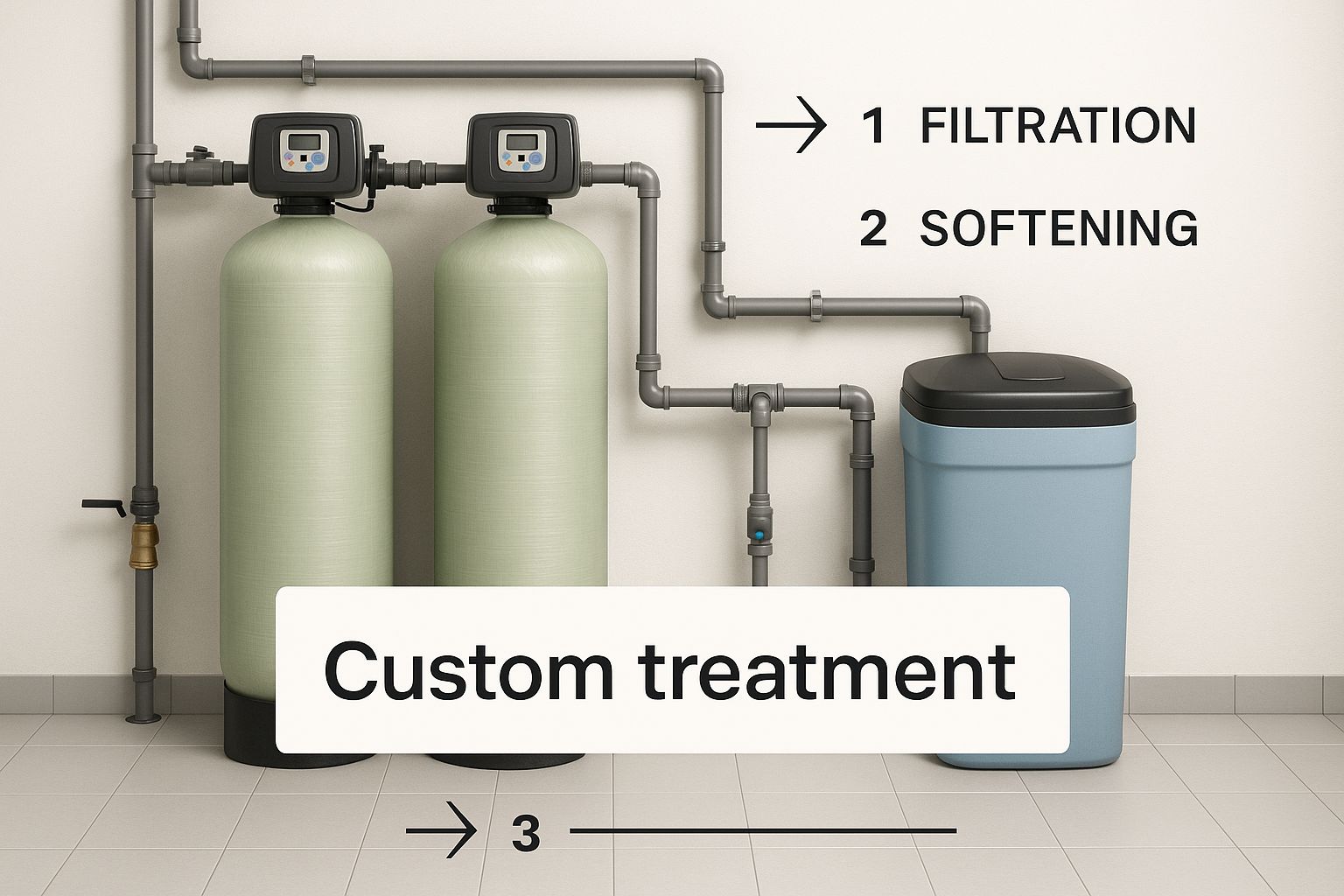
As you can see, a truly effective setup is often a sequence of different technologies, with each one doing its specific job before passing the water along to the next stage.
Targeting Specific Contaminants with the Right Tech
Let’s get into the nitty-gritty. Here are some of the most common water problems we see and the specific technology designed to knock them out. This is how we build a treatment "train" that’s perfectly matched to your water.
-
Hardness (Calcium & Magnesium): If your test came back with high hardness levels, a water softener is your go-to. It uses a process called ion exchange to literally swap the hard minerals for sodium ions. The result? No more scale buildup and soaps that actually lather up.
-
Iron & Manganese: Seeing those nasty reddish-brown or black stains in your sinks and toilets? That's iron and manganese. While a good softener can handle trace amounts, you often need a dedicated iron filter. These systems use oxidation to pull the minerals out of solution so they can be easily filtered away.
-
Bacteria & Viruses: For invisible threats like Coliform or E. coli, a UV purification system is the modern, chemical-free answer. It zaps microorganisms with ultraviolet light, destroying their DNA so they can't reproduce and make you sick. It's a fantastic, safe way to disinfect your water.
-
Bad Tastes & Odors (Chlorine, Chemicals): If your water has a chemical, earthy, or "swampy" taste, the culprit is usually organic compounds or residual chlorine. The best weapon against this is an activated carbon filter. The carbon acts like a sponge with a massive surface area, adsorbing all those funky taste-and-odor-causing compounds. You can learn more about how our professional-grade carbon filters transform water quality.
-
Low pH (Acidic Water): Those tell-tale blue-green stains on your copper pipes? That's a classic sign of acidic water, which is literally eating away at your plumbing from the inside out. An acid neutralizer is the fix. It uses a special media, like calcite, that slowly dissolves to raise the water's pH, making it non-corrosive.
-
Sediment, Sand & Silt: For water that's cloudy or gritty, a simple sediment filter is essential. This is almost always the first line of defense in a whole-house system. It traps all the physical gunk and protects the more sensitive and expensive equipment down the line.
A Real-World Treatment Scenario
Let's walk through a common situation. A homeowner in Cape Coral gets their water report, and it shows high hardness (15 GPG), moderate iron (1.2 ppm), and a positive hit for coliform bacteria. This is a classic trifecta of well water issues.
Here’s how we'd build their solution, step-by-step:
First, we'd start with a sediment pre-filter. This initial stage is crucial for catching any sand or grit before it can damage the more complex equipment.
Next in line would be a dedicated iron filter. Its sole job is to target and remove that 1.2 ppm of iron, which is the root cause of staining.
With the iron gone, a water softener comes next to tackle the 15 GPG of hardness. This protects all the plumbing, fixtures, and water-using appliances from damaging scale buildup.
Finally, just before the water heads into the house, we install a UV purifier. This is the final gatekeeper, providing instant, chemical-free disinfection to eliminate the coliform bacteria and ensure the water is safe to drink.
This multi-stage approach guarantees that every problem is solved in the correct order. Trying to fix this with a single, all-in-one gadget would be a recipe for failure, leaving the homeowner with unsafe water and damaged property. It’s a perfect example of why treating well water properly is about building a complete, data-driven solution.
The need for these precise, effective solutions is only getting bigger. The global market for water and wastewater treatment technologies was valued at around $350.7 billion in 2025 and is projected to climb to $591.2 billion by 2030. This boom is fueled by a growing public awareness of just how critical clean, safe water really is.
Why You Should Never DIY Your Water Treatment Installation
You’ve done the research, tested your water, and picked out the perfect combination of filters and purifiers for your home. That’s a huge step, but the job is only half done. The best water treatment system on the planet won't do you any good if it's not installed correctly. This is where professional installation stops being a "nice to have" and becomes absolutely essential.
Think of it this way: a proper setup isn’t just about connecting a few pipes. It’s a delicate process that often involves complex plumbing, electrical work, and a real-world understanding of how water flows through a home. Even a tiny mistake during installation can snowball into a massive headache, from a slow leak that damages your walls to a system that isn't even removing the contaminants you bought it to fight.
It's More Than Just Connecting Pipes
When our certified technicians install a whole-house system, they’re not just following a manual. It's a craft that combines technical skill with years of hands-on experience.
So, what does that actually look like on installation day?
- Finding the Right Spot: First, we’ll scout the perfect location for your equipment. We’re thinking about easy access for future maintenance, a nearby drain for backwashing cycles, and the best place to tap into your main water line. It’s all about planning ahead.
- Integrating with Your Plumbing: Our team will then carefully cut into your main water line to integrate the new system. A crucial part of this is building a bypass loop, which lets you temporarily route water around the system for service without turning off the water to your whole house.
- Getting the Flow Rate Right: We make sure your system is sized and installed to handle your family’s water needs, even at peak times, without a noticeable drop in pressure. This is one of the most common complaints we hear about DIY jobs.
This professional approach is all about preventing the expensive and frustrating problems that pop up from a rushed or inexperienced setup.
The Hidden Dangers of a DIY Installation
We get it—tackling a home improvement project can be incredibly satisfying. But when it comes to whole-house water treatment, the risks of doing it yourself almost always outweigh the rewards. These systems are more complex than they look, and small errors can have big consequences.
For instance, if you set the regeneration cycle incorrectly on a water softener, you could be wasting hundreds of pounds of salt and thousands of gallons of water. Or worse, it might not soften your water at all. A connection that isn’t perfectly sealed can lead to a slow, hidden leak that causes thousands of dollars in mold and rot before you even know it's there.
Here's something most homeowners don't realize: a DIY installation can instantly void the manufacturer's warranty on your brand-new equipment. Companies require certified installation to ensure their products work as intended, and they won’t cover damage caused by an improper setup.
Ultimately, investing in a professional installation is really an investment in your own peace of mind. It guarantees your system works perfectly from day one and keeps delivering safe, clean water for years. And if an issue ever does come up, our team is always ready to provide expert well water repair services to get things running smoothly again.
Calibrating for Peak Performance
The final, and arguably most important, step is calibrating the system. This isn't a "one-size-fits-all" setting. We program the system's control valve using the specific data from your water test—plugging in your exact water hardness, iron levels, and even your family's estimated water usage.
This detailed calibration ensures the system regenerates only when it needs to, which maximizes its efficiency and saves you money on salt and water. Once everything is up and running, we take one last water sample right from your tap to confirm the equipment is doing its job perfectly.
This level of precision is more important than ever. Innovations in the industrial water treatment market, which is expected to grow beyond $18.58 billion by 2034, are constantly trickling down to residential systems. These new technologies are more effective but often require expert handling. You can learn more about these market trends in water treatment. When you’re ready for an installation that delivers guaranteed results, you know who to call.
Keeping Your System Running with Smart Maintenance
You’ve made a smart investment in your home's water quality. But just like a car, your water treatment system needs a little regular attention to keep it running smoothly. Ignoring maintenance is a gamble—for a while, everything might seem okay, but eventually, performance will suffer, and you could be looking at a costly breakdown. Consistent care is the secret to getting the most out of your equipment and ensuring a steady supply of clean, safe water.
A well-cared-for system doesn't just deliver better water; it runs more efficiently and lasts years longer. Think about it: a clogged filter doesn't just slow down your water pressure. It makes the whole system work harder, putting a strain on every component and paving the way for premature failure. A little preventative maintenance goes a long way in protecting your investment.
Building a Practical Maintenance Schedule
So, what does that "little regular attention" actually look like? The good news is that staying on top of your system’s needs is pretty straightforward. Most of the essential tasks fit into a predictable schedule, and just knowing what to do—and when—is half the battle. This proactive approach helps you catch small issues before they snowball into expensive repairs.
Here are the core tasks that should be on every well owner's maintenance calendar:
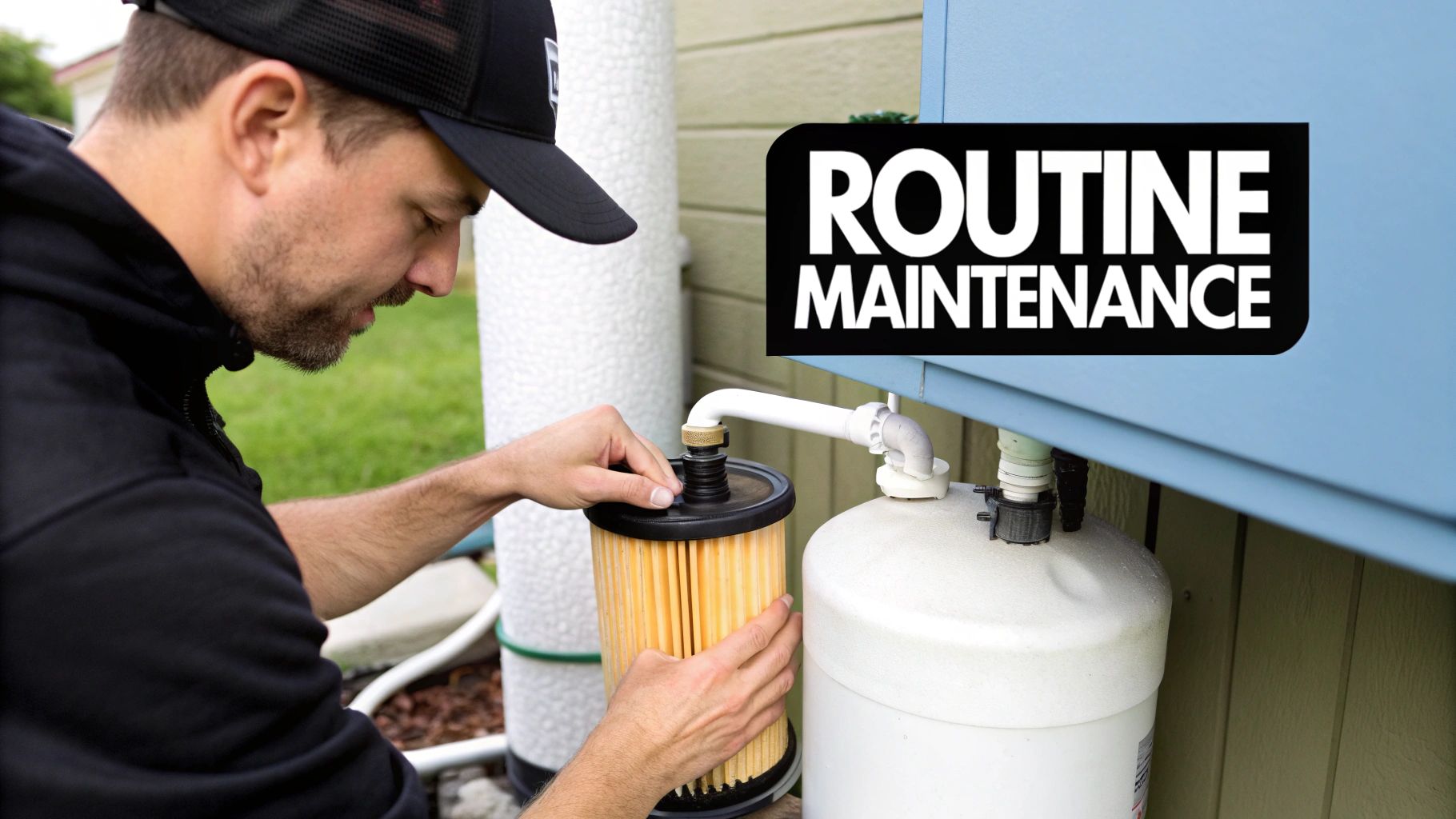
- Change Sediment and Carbon Filters: These are the workhorses of your system. Sediment filters catch the dirt and sand, while carbon filters tackle tastes and odors. Plan on replacing these every 3-6 months. If you let them get too clogged, you’ll not only lose water pressure, but you’ll also risk letting contaminants slip through to the rest of your equipment.
- Replenish Water Softener Salt: Your softener can't do its job without salt. It uses it to create the brine that recharges the resin beads, which are responsible for removing those hard water minerals. Peek inside your brine tank at least once a month and top it off. The key is to never let it run completely empty.
- Replace UV Lamp and Sleeve: If you have a UV system for disinfection, this is non-negotiable. The UV lamp is what neutralizes bacteria and viruses. Most lamps are effective for about one year (or 9,000 hours) and need to be replaced annually. Don't be fooled if the light is still on—its disinfection power fades over time. The quartz sleeve protecting the lamp also needs a good cleaning (or replacing) so the UV light can get to the water.
I always tell my clients to keep a simple log book next to their system. Just jot down the date every time you change a filter, add salt, or swap out the UV bulb. This tiny habit removes all the guesswork and ensures you never fall behind on critical upkeep.
Why Proactive Care Is the Smartest Choice
At its core, regular maintenance is about stopping problems before they start. Each task is directly tied to the health of your water and the lifespan of your system. For example, if you forget to change that UV lamp on schedule, your water might not be properly disinfected anymore. That’s a serious health risk that you wouldn't even see.
Likewise, letting your softener run out of salt means hard water is back in your pipes, building up scale inside your water heater, dishwasher, and faucets. It's precisely for these reasons that we've put together comprehensive plans for homeowners who'd rather not worry about it. Exploring our tailored monthly maintenance plans is the simplest way to keep your system in expert hands.
Think of it as a subscription to worry-free water. We'll handle the scheduling, the filter changes, the salt top-offs, and the technical check-ups. You already made the right call by investing in a quality treatment system; let us help you keep it running perfectly.
Your Well Water Questions, Answered
When you own a well, you become your own water utility manager, and that comes with a lot of questions. We get it. After decades in this business, we've heard just about everything. Let's clear up some of the most common things homeowners ask us so you can feel good about the water in your home.
How Often Should I Get My Well Water Tested?
Think of it like an annual check-up for your water. At a bare minimum, you should have your well water professionally tested at a lab once a year. This yearly test should screen for the big stuff: bacteria, nitrates, and anything else that's a known problem in your neck of the woods.
But don't just rely on the calendar. You should also get a test done anytime you notice something’s off—a weird taste, a funky smell, or a change in color. It's also a smart move to test after any repairs or service to your well system. Your senses and a regular testing schedule are your best defense against water quality issues.
Can I Just Install a Treatment System Myself?
Sure, you can probably handle a simple screw-on faucet filter. But a whole-house system? That's a whole different ballgame. These are not simple plug-and-play devices; they involve serious plumbing, electrical work, and careful calibration that really needs a professional touch.
Honestly, a small mistake during a DIY install can cause major headaches—we're talking leaks, water damage, or a system that doesn't actually do its job. More importantly, it will almost certainly void the manufacturer's warranty. Our certified pros make sure your system is installed correctly from the get-go, protecting your home, your investment, and ensuring it works as intended.
We've been called out to fix more DIY installations than I can count. I've seen brand-new water heaters ruined by improper flow rates and water lines cross-contaminated by incorrect plumbing. Paying for a professional installation isn't just buying labor—it's buying peace of mind that the job is done right.
Does a Water Softener Make My Water Safe to Drink?
This is a huge one, and the answer is no. A water softener is a specialist—its one and only job is to remove the hardness minerals (calcium and magnesium) that cause scale buildup in pipes and on fixtures. It's fantastic for that.
However, a softener does not remove harmful contaminants like bacteria, viruses, arsenic, lead, or nitrates. To make your water truly safe to drink, you often need a multi-stage approach. This might mean pairing a softener with a sediment filter and a UV light for disinfection, all based on what your water test tells you.
Should I Get a Whole-House System or Just an Under-Sink Filter?
This really boils down to your goals and your water test results.
-
A whole-house system is your first line of defense. It treats every drop of water coming into your house, protecting your entire plumbing system and all your water-using appliances from problems like hardness, iron staining, and sediment.
-
A point-of-use filter, like an under-sink reverse osmosis (RO) system, is like a finishing polisher. It provides an even higher level of purification right at the tap where you get water for drinking and cooking.
For complete coverage, many people choose both. This way, the whole-house system protects the home's infrastructure, while the RO system delivers the purest possible water right to your glass.
At Water Medic of Cape Coral, we believe your family deserves clean, safe water without the guesswork. Our team is here to provide expert testing, installation, and maintenance, making sure your system is a perfect fit for your home.
Ready to finally get the water quality you want? Contact us today for a free consultation.