
How to Remove Nitrates from Well Water: A Practical Guide
The easiest and most reliable way to get nitrates out of your well water is with a dedicated treatment system. You can't see, smell, or taste nitrates, so you'll need something like reverse osmosis or ion exchange to filter them out before the water ever gets to your tap. As Southwest Florida’s leading experts, our team at Water Medic can help you find the perfect solution for your home.
The Hidden Dangers of Nitrates in Southwest Florida Well Water
For a lot of us here in Southwest Florida, having a private well feels like a direct line to pure, natural water. But that’s not always the case. A silent, invisible contaminant—nitrates—could be lurking in every glass, and it poses a real risk to your family's health. This isn't some far-off problem; it's a local issue we at Water Medic of Cape Coral have been tackling for homeowners for over 25 years.
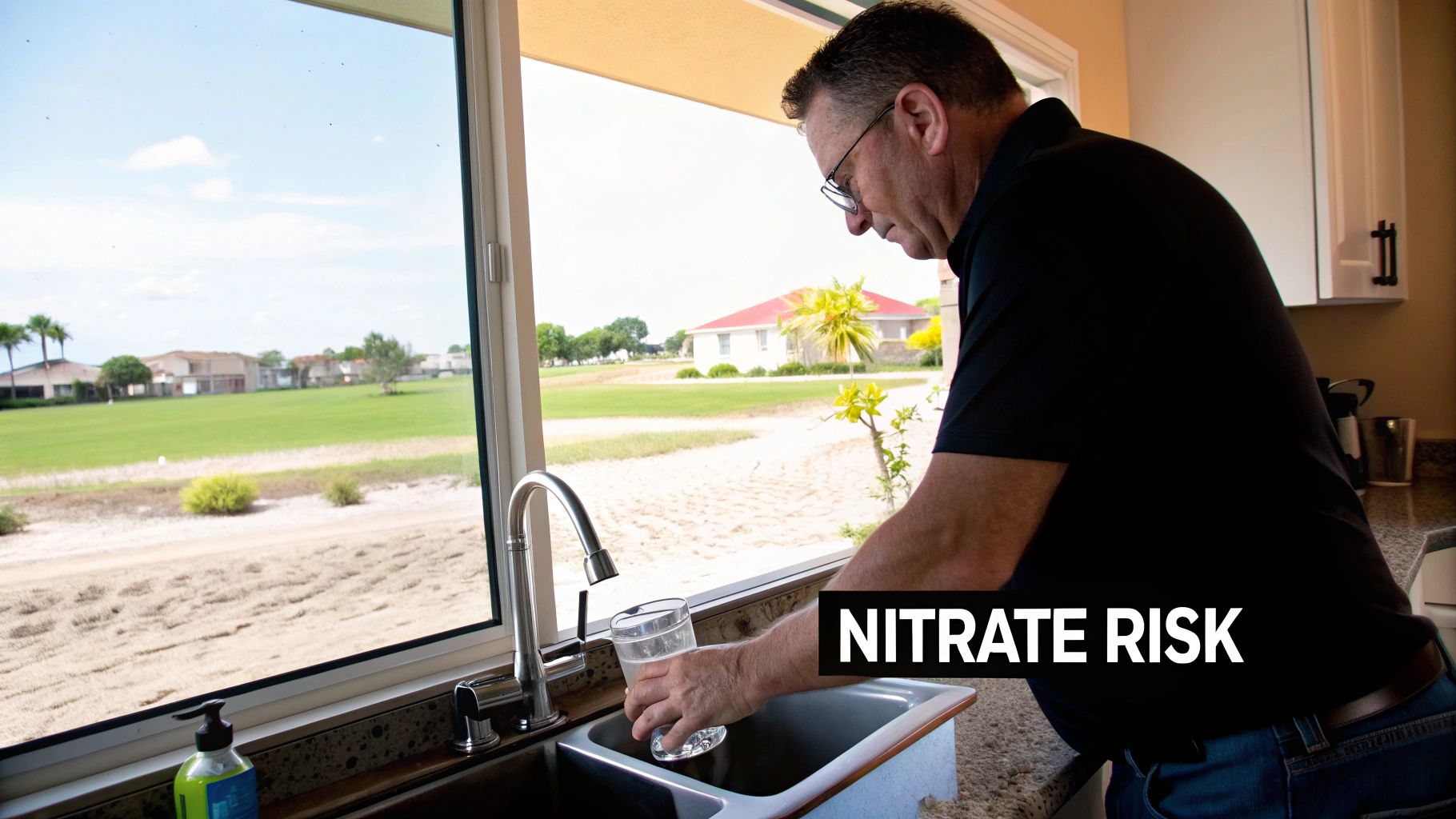
Where Do Nitrates Come From?
In communities like Cape Coral, Fort Myers, and Naples, the sources of nitrate contamination are practically in our backyards. Our region's sandy soil is great for the beach, but it also lets contaminants seep straight down into the groundwater that feeds our wells.
Some of the most common local culprits include:
- Agricultural Fertilizers: Runoff from nearby farms, groves, and nurseries can wash nitrogen-rich compounds directly into the aquifer.
- Septic Systems: A failing or poorly maintained septic tank is a major source of nitrate pollution, leaking waste into the ground.
- Lawn Care Runoff: All those fertilizers we use on our lawns and golf courses add up, contributing a surprising amount to the problem.
This mix of factors makes private wells in our area especially susceptible. We've seen it time and again: a homeowner taps into their well only to find it's pulling in nitrates from these very sources. It's a widespread issue, especially when you consider that over 65% of shallow wells in agricultural areas nationwide show elevated nitrate levels.
Data from the USGS shows that in high-risk zones, including our vulnerable Florida aquifers, nitrate concentrations in shallow wells can get dangerously close to the EPA’s strict 10 mg/L limit.
Why Nitrates Are a Serious Health Concern
The reason we're so serious about nitrate contamination is its direct impact on health, particularly for the most vulnerable members of your family. The U.S. Environmental Protection Agency (EPA) set a firm maximum contaminant level (MCL) of 10 milligrams per liter (mg/L) for nitrates in drinking water.
Anything above 10 mg/L is a serious warning. High nitrate levels can lead to methemoglobinemia, a dangerous condition also known as "blue baby syndrome," which stops the blood from carrying oxygen properly.
This condition is especially threatening for:
- Infants under six months old
- Pregnant women
- Adults with certain health conditions, like anemia or heart disease
Think about a scenario we see all too often: a young family buys a home with a well, assuming the water is fine. Soon after, their infant gets sick with no obvious cause. A quick water test reveals nitrate levels far exceeding the legal limit. This heartbreaking situation is completely preventable with the right testing and treatment from Water Medic.
Understanding what's in your well water isn't optional—it's essential for your family's safety. If you're worried about your well, you can find answers to common questions in our comprehensive well water FAQs. Taking action now is the only way to ensure the water flowing from your tap is as clean and pure as it should be.
How Do I Know if I Have Nitrates? Getting Your Well Water Tested
You can’t see, taste, or smell nitrates. They're invisible intruders, which means the only way to know for sure what's in your well water is to test it. Here in Southwest Florida, this isn’t something to put on the back burner; it’s a critical step for keeping your family safe. Guessing about your water quality is a risk you just don't want to take, especially when the EPA has set a strict safety limit of 10 mg/L.
Think of testing as an annual health checkup for your well. We always tell our clients to test for nitrates at least once a year. Why so often? Because levels can change dramatically with the seasons, after a heavy tropical storm, or even due to new construction or farming activity nearby. A test from a few years ago is ancient history when it comes to your water quality today.
Home Test Kits vs. a Certified Lab: What's the Difference?
You've got two main paths for testing, and they are not created equal. On one hand, you have the DIY test strips from the hardware store or online. They're cheap, fast, and give you a ballpark idea of your nitrate levels. They work kind of like a pool test strip—dip it in, and the color changes to give you a rough range.
But honestly, we don't recommend relying solely on these kits. Here’s why:
- You get a range, not a real number. Seeing a color that means "high" isn't nearly as useful as knowing your level is 12 mg/L, which is clearly over the legal limit and demands action.
- Accuracy is a real concern. It's easy to make a mistake reading the color chart, or maybe the strips are old. A bad reading can give you a false sense of security, which is the last thing you want.
- They're a one-trick pony. A nitrate strip won’t tell you a thing about other common well water problems like bacteria, iron, or hardness.
A DIY kit can be a decent first screening if you're just curious, but it should never be your final answer. For results you can actually trust to make decisions about your family's health, nothing comes close to a certified laboratory analysis.
A professional lab test, like the ones our team at Water Medic performs every day, gives you the hard data. We'll tell you the exact nitrate concentration in milligrams per liter (mg/L). Even better, we run a full diagnostic that checks for other contaminants that often travel with nitrates, like coliform bacteria. This gives you the complete, unvarnished truth about what’s coming out of your tap.
Making Sense of Your Water Test Results
Once you have your lab report, the key number you're looking for is that EPA limit: 10 mg/L, also known as the Maximum Contaminant Level (MCL).
Here's how to read your results:
- Below 1 mg/L: This is great news. These levels are considered natural and perfectly safe.
- Between 1 and 10 mg/L: This is a yellow flag. It tells us there's some contamination happening, probably from human activity in the area. It's time to start paying closer attention and maybe test a little more often.
- At or Above 10 mg/L: This is a red flag. Your water is unsafe to drink, period. This is especially dangerous for infants and pregnant women. You need to take immediate steps to install a treatment system.
Knowing your number is what gives you the power to act. It's the essential first move before you even start thinking about which filtration system is right for you. A professional analysis from Water Medic of Cape Coral arms you with the accurate data needed to solve the problem correctly from day one.
Ready to get the real story on your water? Schedule your professional water quality test with one of our experts today.
Choosing The Right Nitrate Removal System For Your Well
So, you've got your water test results back. That's the first and most critical step. Now comes the real decision: how to get those nitrates out of your water for good. When it comes to treating well water, you have a few solid options, but they are definitely not created equal.
Here at Water Medic, we've seen it all, and our job is to give you the straight scoop on what works best, especially for our unique Southwest Florida conditions. Let's walk through the pros and cons of the most common technologies so you can make an informed choice for your home.
This chart can help you visualize the path forward based on what your test results show.
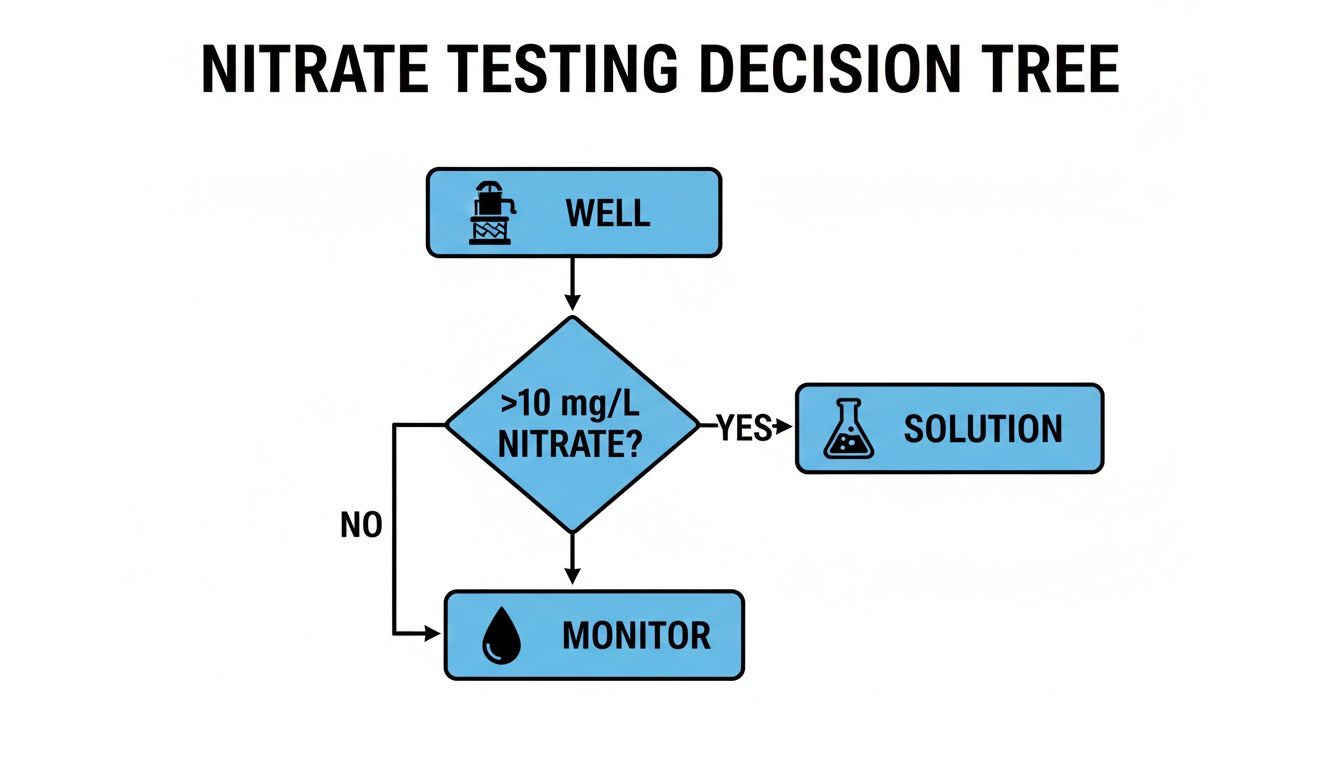
As you can see, if your levels are over the EPA's 10 mg/L maximum, it's time to act. Even if you're below that line, keeping a close eye on your water quality is just smart practice.
Reverse Osmosis: The Gold Standard in Water Purity
Hands down, Reverse Osmosis (RO) is the most effective and reliable way to remove nitrates from your well water. We consider it the gold standard for a reason.
An RO system works by pushing your household water through an incredibly fine, semi-permeable membrane. Think of it as a microscopic gatekeeper. Water molecules are small enough to pass through, but larger contaminants—like nitrate ions—are blocked and flushed away.
The effectiveness is remarkable, routinely removing 95-99% of nitrates. But that's not all it does. An RO system is a comprehensive purification powerhouse, also tackling a long list of other common well water headaches:
- Arsenic
- Fluoride
- Heavy metals like lead and mercury
- Total Dissolved Solids (TDS) that cause spotting and scale buildup
This is why we recommend RO so confidently. You're not just buying a nitrate filter; you're investing in a total solution for clean, safe water throughout your home.
The real beauty of reverse osmosis is its consistency. Other systems can degrade in performance over time, but a well-maintained RO unit from Water Medic provides a steady stream of pure water day in and day out. It's a dependable, long-term investment in your family's health and peace of mind.
If you want to start with a focused solution, our under-sink reverse osmosis systems are a great way to get purified drinking and cooking water right where you need it most.
A Head-to-Head Look at Your Options
Choosing the right system involves weighing factors like effectiveness, maintenance, and long-term costs. Here's a quick comparison to help you see how these technologies stack up against each other.
Nitrate Removal System Comparison
| Treatment Method | Nitrate Removal Rate | Pros | Cons | Best For |
|---|---|---|---|---|
| Reverse Osmosis (RO) | 95-99% | Highly effective; removes many other contaminants; reliable performance. | Wastes some water (brine); requires pre-filtration in some cases. | Homeowners seeking comprehensive, top-tier water purification for the whole house or drinking water. |
| Ion Exchange | 80-90% | Specifically targets nitrates; lower initial cost than some RO systems. | Requires ongoing salt refills; adds chloride to water; resin needs eventual replacement. | Situations where only nitrate is a concern and the owner doesn't mind regular maintenance. |
| Distillation | >99% | Extremely high purity; removes almost all contaminants. | Very slow process; high electricity usage; not practical for whole-home use. | Producing small, specific batches of highly purified water, not for daily household needs. |
As the table shows, while other methods can work, Reverse Osmosis offers the most complete and practical solution for the average homeowner dealing with well water issues.
Ion Exchange: A More Targeted Approach
Another technology you'll encounter is ion exchange. This system is basically a swap meet for ions. It uses a special resin coated in harmless chloride ions. As your nitrate-filled water flows through the tank, the resin snatches the nitrate ions and releases chloride ions to take their place.
Ion exchange is quite good at removing nitrates specifically. The catch? The resin eventually fills up with nitrates and needs to be "regenerated." This process involves flushing it with a saltwater solution from a brine tank to clean off the nitrates and recoat it with chloride.
For many people, having to constantly buy and lug heavy bags of salt is a major downside. It's an ongoing cost and a maintenance chore. Furthermore, the system adds a small amount of chloride (from the salt) back into your water, which can be a concern for anyone monitoring their sodium intake.
Distillation: Pure, But Wildly Impractical
Distillation is the oldest water purification trick in the book. You simply boil water, capture the steam (which leaves nitrates and other impurities behind), and cool it back down into pure liquid water.
While distillation is incredibly effective—it removes virtually everything—it's just not practical for a modern household. Here's why:
- It’s painfully slow. A standard countertop distiller might only produce a few gallons of water over a full 24-hour period.
- It’s an energy hog. Boiling water constantly takes a lot of electricity, and you'll definitely see it on your utility bill.
Because of these limitations, distillation remains a niche method, useful for specific applications but not a realistic solution for a family's daily water needs. The global scale of nitrate contamination is a serious issue, and understanding the broader context reinforces the need for effective home treatment. If you're interested in the technical side, you can explore various methods for water purification.
Why Whole House Reverse Osmosis Is the Definitive Solution
When you're dealing with well water problems, it's easy to get bogged down in temporary fixes. A filter under the kitchen sink might seem like a good first step, but it only addresses the water you drink. What about the water for showering, washing clothes, or running through your expensive dishwasher and water heater?
This is where a Whole House Reverse Osmosis (RO) system changes the game. It’s not a patch; it’s a complete, property-wide answer to nitrate contamination and a whole host of other water quality issues we see here in Southwest Florida.
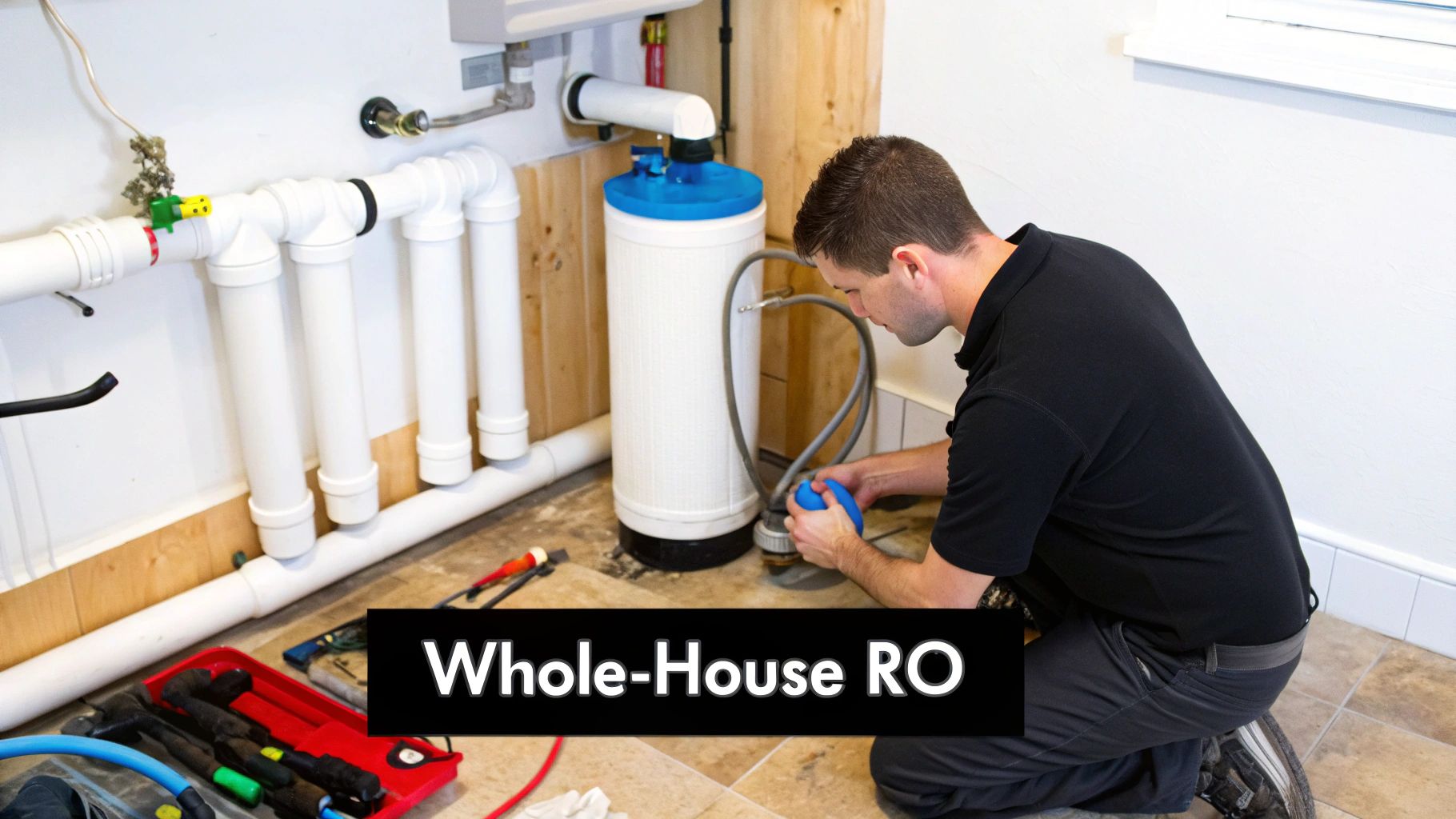
We're talking about moving beyond partial solutions to achieve total peace of mind. A whole house system purifies every single drop of water entering your home. This means that every faucet—from the kitchen to the master bath—delivers perfectly clean, safe water. It’s truly the definitive way to handle nitrates and protect your entire household.
The Cape Coral Scenario: A Real-World Transformation
Let me paint a picture for you, one we see all the time. A family here in Cape Coral has a beautiful home on a private well. A routine water test comes back with nitrate levels at 15 mg/L, well over the EPA's safety limit of 10 mg/L. Their first move? They install a small RO filter under the kitchen sink for drinking water.
Problem solved, right? Not quite.
While their drinking water was safe, other issues lingered. Their dishes were always spotty, their laundry felt stiff and scratchy, and the thought of bathing their young children in contaminated water was a constant worry. That under-sink filter was just a bandage on a much larger issue.
After we sat down with them at Water Medic, they decided to invest in a whole-house RO system. The change wasn't just noticeable; it was profound.
- Safe Water Everywhere: They could finally drink from any tap in the house without a second thought.
- Better Showers: The water felt incredibly soft, and they no longer had to worry about what chemicals their family was absorbing through their skin.
- Appliance Protection: Their dishwasher, washing machine, and water heater were now protected from the hard water scale and contaminants that drastically shorten appliance lifespan.
This is the real value of a whole-house solution. It's not just about filtration—it's about upgrading your home's entire water infrastructure and genuinely elevating your quality of life.
Beyond Nitrates: Comprehensive Purity for Your Home
While high nitrate levels are often what gets a homeowner to pick up the phone, a whole-house RO system is an investment that pays you back in many other ways. The same high-pressure semi-permeable membrane that rejects 98-99.9% of nitrates is also a powerful barrier against a long list of other unwanted stuff common in our local wells.
A whole-house reverse osmosis system is the only technology that creates a fortress around your home's water supply. It delivers a level of purity that targeted filters simply cannot match, protecting your family’s health and your property's value.
This comprehensive protection includes removing:
- Hardness Minerals: Finally say goodbye to that chalky, white limescale buildup on faucets and shower doors.
- Total Dissolved Solids (TDS): Enjoy spot-free dishes and crystal-clear ice cubes.
- Heavy Metals: Effectively removes dangerous contaminants like lead, arsenic, and mercury.
- Chemical Contaminants: Filters out pesticides and industrial runoff that can leach into groundwater.
Nitrate pollution is a persistent problem, not just here but globally. In Europe, for example, 14.1% of groundwater monitoring stations still exceed safety limits. For us in Southwest Florida, with booming development, lawn fertilizers, and aging septic systems, the threat is very real. With over 25 years of proven installations, the systems we build at Water Medic of Cape Coral are specifically designed for these challenges, including Florida’s notoriously hard water. For a deeper dive, you can read more about the findings on European groundwater contamination.
A Smart Investment in Your Family and Property
Looking at a whole-house RO system as just another expense misses the bigger picture. It's a strategic investment in your family's long-term health and your home's value. The peace of mind that comes from knowing your water is truly pure is priceless.
And when it comes time to sell? A professionally installed, high-quality water treatment system is a massive selling point, especially in an area where well water quality is a common concern. It shows potential buyers you’ve invested in the home’s fundamental infrastructure, making it a healthier and safer place to live.
When you're ready to see how a complete purification system can protect your household, our experts are here to help. Take a look at the lasting benefits of our Whole House Reverse Osmosis Systems and let's get you a solution built for your specific needs.
Getting Your System Installed and Keeping It Running Smoothly
Deciding to install a whole-house water system is a big deal, and honestly, it’s one of the best investments you can make for your family's well-being. But the process itself shouldn't be a headache. At Water Medic of Cape Coral, we handle everything so you don't have to worry, from the moment you first call us to the routine upkeep years down the road.
We don’t believe in high-pressure sales pitches. When you reach out, the first thing we do is schedule a free, no-obligation visit to your home. This is where we get to the bottom of what's really going on with your water. Our technician will perform a detailed water analysis right there on the spot, so you can see with your own eyes what contaminants are in your well.
Finding the Perfect Fit: Consultation and Sizing
Once we have your water test results, we'll talk through them with you and discuss your family's water habits. This is crucial because getting the right size system is everything.
A system that’s too small will constantly struggle to meet demand, leaving you with untreated water when you need it most. On the other hand, an oversized unit is just inefficient and a waste of money. We look at the number of people in your home, how many bathrooms you have, and your peak water demand to make sure the system we recommend is the perfect match.
This allows us to design a solution specifically for your home, whether that's one of our powerful Whole House Reverse Osmosis Systems or another technology better suited to your water profile. You’ll get a clear, upfront quote with no surprises.
The Installation and What Comes Next
After you’ve made your choice, our expert technicians take over. This isn't a side job for a general plumber; our team lives and breathes water treatment. They ensure every connection is rock-solid and every component is calibrated for peak performance, integrating it flawlessly with your home's plumbing.
A professional installation by a certified water treatment specialist is the most important factor in your system’s long-term performance. It’s what makes the difference between a system that just works and one that works perfectly for a decade or more.
Our job isn't done once the water is running, though. We’re here for the long haul to help you keep your water pure. We'll walk you through the simple, ongoing maintenance your specific system needs to stay in top shape.
Typically, this involves just a few things:
- Regular Filter Swaps: We'll teach you how to do the quick pre-filter changes yourself, or you can have us come out and handle it for you.
- Annual System Health Check: We suggest a yearly inspection to check pressures, re-test the water, and make sure every part is working as it should.
- RO Membrane Care: For reverse osmosis systems, the membrane is the heart of the unit. It needs some periodic attention to ensure it keeps removing nitrates and other contaminants effectively.
When you work with Water Medic, you're not just buying a piece of equipment. You're getting a partner with over 25 years of local, hands-on experience. We make sure that your quest to figure out how to remove nitrates from well water ends with a reliable, long-lasting solution you can count on.
Your Top Questions About Nitrate Removal, Answered
Deciding on the right water treatment system is a big deal. It's an investment in your home and, more importantly, in your family's health. It’s completely normal to have questions, and you deserve straightforward answers. Here are some of the most common things we get asked by homeowners here in Southwest Florida, to help you feel confident about your next steps.
What's the Real Cost of a Whole House Reverse Osmosis System?
This is usually the first question on everyone's mind, and the honest answer is: it depends. The final price tag for a whole-house reverse osmosis (RO) system is shaped by a few key factors:
- The size of your home and family.
- Your typical daily water consumption.
- The specific amount of nitrates and other junk we need to remove from your well.
It’s true that the upfront cost is more than a simple filter you'd stick under the sink. But you have to look at it as a long-term upgrade to your property and your health. A whole-house system protects you at every single tap—the water you drink, cook with, bathe in, and use for laundry is all purified.
At Water Medic of Cape Coral, we start with a free, no-pressure consultation. We'll test your water, understand your needs, and give you a clear, detailed quote. We also make sure to walk you through the long-term savings, like saying goodbye to bottled water for good and protecting your expensive appliances from mineral buildup.
Will a Reverse Osmosis System Hike Up My Water Bill?
This is a great question and a very valid concern. Many people have an outdated idea of RO systems being water-guzzlers. The good news is, today's systems are much more efficient than their predecessors.
The RO process works by pushing water through a membrane and flushing the rejected contaminants (like nitrates) down the drain. This "wastewater," or brine, is a necessary part of the purification process—it's what carries the harmful stuff away from your drinking water.
How much water is used depends on the system's efficiency and your home's water pressure. Our job at Water Medic is to size the system perfectly for your home to maximize its output and minimize waste. For most families, the trade-off is a no-brainer for getting perfectly clean, nitrate-free water from every faucet.
Can I Just Install a Nitrate Removal System Myself?
You might be handy, and for small point-of-use filters like a faucet attachment, a DIY approach can work. But a whole-house system is a completely different ballgame. We're talking about complex equipment that has to be integrated directly into your home's main water line.
Getting the installation right is absolutely critical. A small mistake can lead to big problems—leaks, poor filtration, low water pressure, or even serious damage to your plumbing.
When it comes to something as vital as your family's water supply, professional installation isn't just a recommendation; it's essential for your peace of mind.
Our technicians at Water Medic of Cape Coral bring over 25 years of hands-on experience to every job. We make sure your system is installed flawlessly so it performs exactly as it should from day one.
Does Reverse Osmosis Strip Out the Good Minerals Too?
Yes, it does. Reverse osmosis is incredibly thorough, which is why it's so effective. The membrane is so fine that it removes nearly everything dissolved in the water—that includes harmful contaminants and beneficial minerals like calcium and magnesium.
It's helpful to remember that we get the vast majority of our essential minerals from a healthy diet, not from our drinking water. The amount you get from water is tiny compared to what you get from food.
That said, many people prefer the taste and feel of water with minerals in it. We have a simple solution for that. For any homeowner who wants the best of both worlds, we can add a remineralization filter to the system. This filter sits after the RO membrane and adds a balanced amount of healthy minerals back into the purified water. You get water that's completely free of nitrates and other contaminants but still has that crisp, refreshing taste you love.
Figuring out the world of water treatment can feel like a lot, but you don't have to tackle it alone. The team at Water Medic of Cape Coral is here to answer your questions and design a system that delivers pure, safe water for your family. Contact us today to schedule your free water analysis and take the first step toward better water.