How to Remove Chlorine Taste from Water: A Quick Guide
That chemical tang in your drinking water is there for a reason, but the good news is you don't have to live with it. Simple tricks like letting your water breathe or using a good filtration system can make all the difference. The flavor itself comes from chlorine, the same stuff used in swimming pools, which your local utility adds to keep the water safe from harmful bacteria on its way to your tap.
Why Does My Tap Water Taste Like a Swimming Pool?
Ever fill a glass from the faucet and get a whiff of that familiar chemical smell? You're not alone. It's a common experience for millions, and it’s actually a sign that your water provider is doing its job. That distinct odor is the signature of a public health victory that’s been around for over a century: water disinfection.
Municipal water systems add disinfectants to the water to wipe out dangerous pathogens like bacteria and viruses. This is a critical step that ensures the water stays safe as it travels through miles and miles of pipes to reach your home. Without it, we'd face a much higher risk of waterborne illnesses.
The Two Main Culprits: Chlorine vs. Chloramine
The specific chemical used by your water utility plays a big role in how strong the taste is and how easily you can get rid of it.
-
Chlorine: This is the old standby, the most common disinfectant out there. It's a powerhouse at killing germs quickly, but it also has a tendency to evaporate from water fairly easily. That’s why a simple trick like leaving a pitcher of water in the fridge for a few hours can often do wonders for the "pool water" taste.
-
Chloramine: This is a more modern, stable compound created by mixing chlorine with ammonia. Many water utilities are switching to it because it lasts longer in the system, providing protection all the way to your tap. The downside? That stability means its taste and smell are much more stubborn and harder to remove with basic methods.
If you’ve tried letting your water sit out or used a standard pitcher filter with no luck, you’re probably dealing with chloramine. Figuring out which disinfectant is in your supply is the first step to solving the problem for good. This is where a professional water analysis can give you a clear answer and a path forward.
The key thing to remember is that while the taste can be unpleasant, its presence is a sign that your water is being protected. The goal is to get rid of that taste right at your faucet, after the chemicals have already done their job.
This is exactly why so many people want to know how to remove chlorine taste from water—they want the safety without the side effect. Our senses of taste and smell are incredibly sharp. Most of us can detect chlorine at levels far below the maximum safety limits set for drinking water.
For example, the EPA considers levels up to 4 parts per million (ppm) perfectly safe, but some people can taste it at concentrations as low as 0.3 ppm. You can learn more about water disinfection safety guidelines from the CDC. This just goes to show that the taste isn't a danger, but it can definitely get in the way of enjoying a simple, refreshing glass of water.
Easy Ways to Improve Your Water's Taste Right Now
You don't need to run out and buy an expensive system to start enjoying better-tasting water today. If you're tired of that swimming pool smell in your glass, a couple of simple, no-cost tricks can make an immediate difference. These are the go-to strategies for a quick fix before you commit to a bigger solution.
Think of it this way: the chlorine in your water has done its job disinfecting the supply lines. By the time it reaches your faucet, it's just an unwanted houseguest. Your job is to show it the door, and the two easiest ways to do that rely on the basic principles of heat and air.
Let Heat Do the Work: Boiling
One of the oldest tricks in the book is also one of the most effective: boil your water. The science here is simple. Chlorine is a volatile chemical, which is just a fancy way of saying it’s eager to turn into a gas and escape from the water. Adding heat gives it the push it needs to leave.
When you bring a pot of water to a boil, you're essentially forcing the dissolved chlorine gas to evaporate into the air. It’s a reliable method, and the longer you boil, the more chlorine you'll remove. Studies show that a quick 5-minute boil can knock out about 20% of the chlorine, but letting it go for a full 15-20 minutes can eliminate 50-80% or even more.
That’s usually more than enough to get the chlorine level well below the 0.3 ppm (parts per million) taste threshold set by the World Health Organization. Just bring your tap water to a rolling boil for about 15 minutes, then let it cool down completely before you drink it.
Let Your Water Breathe: Aeration
If boiling sounds like too much of a hassle, there's an even simpler method: aeration. Or, as I like to call it, just letting your water sit out. This works on the same off-gassing principle as boiling, but it uses time and air instead of heat.
The process couldn't be easier:
- Fill a pitcher or any open container with tap water.
- Leave it uncovered in the refrigerator.
- Let it sit for at least a few hours—overnight is even better.
This slow, passive method lets the chlorine naturally evaporate on its own. It's a fantastic quick fix, but its effectiveness can depend on factors like the water's surface area and initial chlorine level. For those looking for a more active approach, you can learn more about how our advanced aerators speed up this process to improve water quality.
Pro Tip: To speed things up, try pouring the water back and forth between two pitchers a few times. This increases the surface area exposed to the air and helps the chlorine escape much faster.
These simple methods are great starting points and work wonders for small amounts of drinking water. But let's be honest, they require daily effort. If you’re a busy family that wants consistently fresh-tasting water from every faucet without having to think about it, these manual fixes might start to feel like a chore.
When you're tired of boiling pots and chilling pitchers, it's probably time to look into a whole-house solution that takes care of it for you.
Choosing the Right Water Filtration System
If you're done with the daily routine of boiling water or letting it sit out, a filtration system is your best bet for a permanent, hands-off solution. Diving into the world of water filters can feel overwhelming, but once you understand the main types, you'll be able to find the perfect fit for your home and finally say goodbye to that chlorine taste for good.
This quick visual gives a nice summary of the simple, manual ways to deal with chlorine.
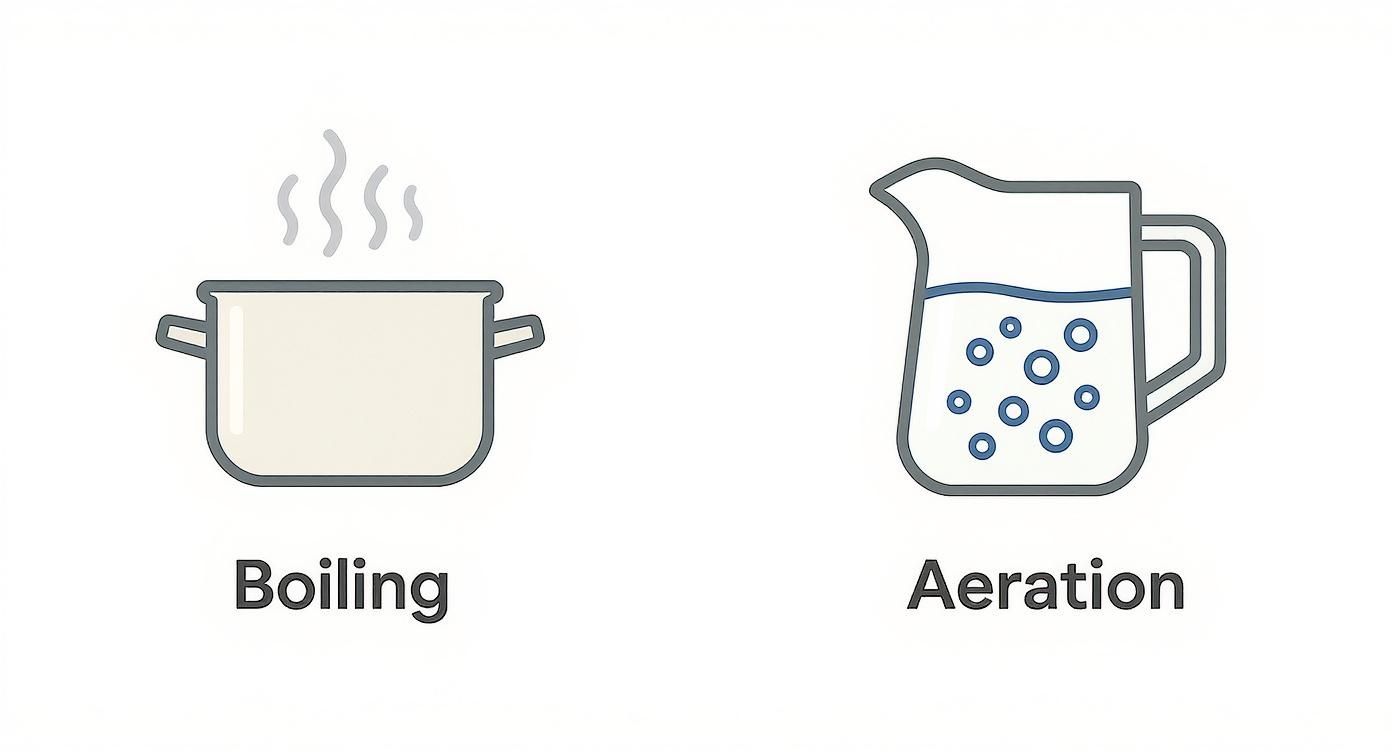
As you can see, methods like boiling and aeration definitely work, but they take time and effort day after day. It's no wonder so many people eventually upgrade to a filter for pure convenience.
Comparing Home Water Filtration Methods
Figuring out the best way to get clean, chlorine-free water at home means weighing your options. From simple pitchers to whole-house setups, each has its own set of pros and cons. To help you decide, we've put together a table comparing the most common filtration methods side-by-side.
| Filtration Method | Best For | Chlorine Removal Effectiveness | Typical Cost | Pros & Cons |
|---|---|---|---|---|
| Pitcher Filters | Individuals, renters, or small households on a budget. | Good | $20 – $50 | Pro: Inexpensive and portable. Con: Filters small amounts, requires frequent cartridge changes. |
| Faucet Attachments | Filtering water for cooking and drinking at a single tap. | Good to Very Good | $30 – $100 | Pro: Convenient, on-demand filtered water. Con: Can slow water flow, filters need regular replacement. |
| Under-Sink Systems | Dedicated, high-quality filtered water at the kitchen sink. | Very Good to Excellent | $150 – $500+ | Pro: High-performance, out-of-sight installation. Con: Requires installation, only treats one faucet. |
| Whole-House Systems | Comprehensive water treatment for the entire home. | Excellent | $800 – $3,000+ | Pro: Removes chlorine from every tap, shower, and appliance. Con: Higher upfront cost and professional installation needed. |
This comparison should give you a solid starting point. Pitchers and faucet mounts are great for dipping your toes in, but for a truly comprehensive fix, you’ll want to look at a system that integrates directly with your plumbing.
A Closer Look at Under-Sink and Whole-House Systems
When you're serious about getting rid of chlorine everywhere, not just in your drinking glass, under-sink and whole-house systems are the way to go. They’re installed right into your plumbing for a seamless supply of purified water.
An under-sink system is a fantastic middle-ground solution. Tucked away neatly beneath your kitchen sink, it delivers a high volume of expertly filtered water from a dedicated tap. The filters are much larger and more robust than what you'd find in a pitcher, meaning they last longer and do a much better job.
But for the ultimate peace of mind, nothing beats a whole-house water filter. This is the gold standard. It treats every single drop of water as it enters your home, stripping out chlorine before it ever reaches a tap, your shower, or the washing machine. If you or your family have sensitive skin, or you just want the absolute best water quality possible, this is the solution you’re looking for.
Choosing the right system isn't a guessing game. A professional assessment is the key. We can analyze your home's water usage, run tests for chlorine and other contaminants, and recommend a system that perfectly fits your needs and budget.
Most of these more advanced systems work their magic using powerful carbon filtration. If you're curious about the science, you can explore our guide on carbon filters to see exactly how this technology adsorbs chlorine and other impurities, leaving you with nothing but clean, crisp-tasting water.
While our main focus here is improving taste by removing chlorine, a complete water solution can sometimes involve other components. For instance, homes in rural areas might need different types of storage, like vertical water storage tanks, to manage their water supply. For homes on city water, however, the main goal is purification right where the water enters. That's our specialty—integrating the right filtration technology into your home's plumbing for a lasting fix that delivers pure water from every faucet, every time.
Tackling That Stubborn Chemical Taste: The Chloramine Problem
Have you ever tried boiling your water or using a standard pitcher filter, only to find that lingering chemical taste just won't budge? If that sounds familiar, you're probably not dealing with simple chlorine. More likely, the culprit is chloramine.
Many municipal water systems, especially here in Southwest Florida, have switched to chloramine. It's a more stable disinfectant made by combining chlorine and ammonia, which is great for keeping water safe all the way to your tap. The downside? That stability makes it a real pain to get rid of. Unlike chlorine, chloramine doesn't just evaporate if you let the water sit out.
Why Standard Filters Often Fall Short
The activated carbon filters you find in most pitchers and basic faucet attachments do a fantastic job of grabbing chlorine molecules. They're just not built to handle the tough chemical bond in chloramine. They might reduce the taste slightly, but they can't break that bond effectively.
To really knock out that taste and odor for good, you need a professional-grade system with more power. This is where specialized, more advanced filtration systems are essential.
We see this all the time. A homeowner is frustrated because their efforts to get clean-tasting water aren't working. The moment we test their water and find chloramine, it's a lightbulb moment. Identifying the real problem is the first step to finding the right solution.
The Heavy Hitters: Systems That Actually Eliminate Chloramine
When you're up against chloramine, two types of systems consistently deliver the best results. These aren't your typical hardware store filters; they are purpose-built for serious water purification.
- Catalytic Carbon Filters: Think of this as activated carbon that's been supercharged. The surface of catalytic carbon is specially treated to act as a catalyst, aggressively breaking the chloramine bond. It splits the ammonia and chlorine apart, allowing the carbon to trap them effectively. The result is remarkably clean and fresh-tasting water.
- Reverse Osmosis (RO) Systems: For the ultimate in purification, nothing beats an RO system. It pushes water through an incredibly fine semi-permeable membrane. This process strips out not only chloramine but a whole host of other impurities—we're talking heavy metals, dissolved solids, salts, and more. It’s the gold standard for pure drinking water, right at your sink.
So, which one is right for you? It really depends on your goals. An under-sink RO system is a fantastic, targeted solution for pristine water for drinking and cooking. If you want every drop of water in your home to be free of chloramine—from the kitchen to the shower—a whole-house catalytic carbon system is the way to go.
At Water Medic, we live and breathe this stuff. We know that guessing doesn't work, which is why we always start with a professional water analysis to see exactly what we're dealing with. Armed with that information, our certified technicians can recommend and install the perfect system to ensure your family enjoys the pure, great-tasting water they deserve.
Keeping Your Water Tasting Great for the Long Haul
Getting a quality filtration system installed is a huge win for better-tasting water. But the initial victory over chlorine flavor is just the beginning. The real secret to keeping that water pure and delicious day after day is consistent upkeep.
Without it, even the most expensive, top-of-the-line system will eventually let you down.
The absolute number one thing you have to do is change your filter cartridges on time. Think of a filter cartridge as a high-tech sponge. It’s designed to soak up chlorine and other contaminants, but it can only hold so much.
Once it's saturated, it stops working. Even worse, that old, clogged filter can become a breeding ground for bacteria, which can introduce entirely new off-tastes and smells into your water. You end up with a problem you didn't even have before.
Pushing a filter long past its expiration date means you're just running your water through a concentrated collection of all the gunk you were trying to remove. It completely defeats the whole purpose of having a filter in the first place.
Simple Habits for Fresh Water
Beyond the main system, a couple of easy habits can make a surprising difference in keeping your water tasting crisp and clean.
- Keep Your Containers Spotless: This is a big one people often overlook. We're talking about everything your water touches: pitchers, reusable bottles, and even the dispenser tray on your fridge. Biofilm and bacteria love damp environments and can build up quickly, creating a stale or musty taste. A simple scrub with soap and hot water is all it takes.
- Stick to the Schedule: Whether it's a whole-house unit or a basic pitcher filter, the manufacturer provides a recommended replacement schedule for a reason. Do yourself a favor and mark your calendar or set a recurring phone reminder the day you install a new filter.
Life gets hectic, and let's be honest, remembering to order and replace a water filter isn't always top of mind. This is often when that chlorine taste starts creeping back in. A hands-off approach is often the best way to guarantee your family always has clean, great-tasting water without adding another chore to your list.
Being proactive is the key to ensuring you never have to think about that chemical taste again. For anyone who wants a truly set-it-and-forget-it solution, our professional monthly maintenance plans take all the guesswork and hassle off your plate. Our techs handle everything, making sure your system is always running at peak performance so you get consistently pure water, year-round.
Your Chlorine Questions, Answered
If you're fed up with that swimming pool taste in your drinking water, you're not alone. It’s one of the most common complaints we hear. Getting straight answers is the first step to finding a real solution, so let's tackle the questions that come up most often.
Is the Chlorine in My Tap Water Actually Harmful?
In short, no. The amount of chlorine in municipal water is regulated by the EPA and is considered safe to drink. Its only job is to kill off dangerous bacteria and viruses while the water travels through the pipes to your home.
The reason most people want it gone is purely about taste and smell, not because of a direct health threat from the levels found in tap water.
How Can I Tell If It's Chlorine or Chloramine in My Water?
This is a great question, as the answer determines which filtration method will work best.
The most direct way is to check your local water utility's annual quality report. They are required to tell you what they use. For a quick at-home test, fill a pitcher with tap water and leave it on the counter for a few hours. If that chemical smell and taste mostly disappear, you have chlorine. If it lingers, you're almost certainly dealing with the more stubborn chloramine.
For a definitive answer, our professional water testing services can provide a precise analysis of your supply. This takes the guesswork out and points directly to the right solution for your home.
Does My Refrigerator's Water Filter Get Rid of Chlorine?
For the most part, yes. The activated carbon filters found in most refrigerators do a decent job of reducing standard chlorine and its associated taste.
However, they usually aren't robust enough to handle chloramine. The bigger issue is that their small size means they clog up fast and need to be replaced frequently to work properly—a maintenance step that's easy to forget.
Is It Safe to Take Chlorine Out of My Water?
Absolutely. Chlorine’s job is finished by the time water flows from your tap. Its purpose was to keep the water sanitized on its journey through the public system.
Removing it right at the point of entry into your home, or at the tap, is completely safe. In fact, it does nothing but improve the quality, taste, and smell of your water. A whole-house system is the ideal way to ensure every drop of water in your home is treated effectively.
Ready for consistently pure, great-tasting water from every tap? The experts at Water Medic of Cape Coral have over 25 years of experience designing and installing the perfect water treatment solutions for Southwest Florida homes. Contact us today for a free water analysis and consultation.