How to Reduce TDS in Water for Purer, Better Taste
The best way to tackle high TDS (Total Dissolved Solids) is with a serious purification system, like Reverse Osmosis (RO) or distillation. These aren't just filters; they actively remove the dissolved minerals, salts, and other compounds that basic filters can't touch, effectively purifying your tap water.
What High TDS in Your Water Really Means
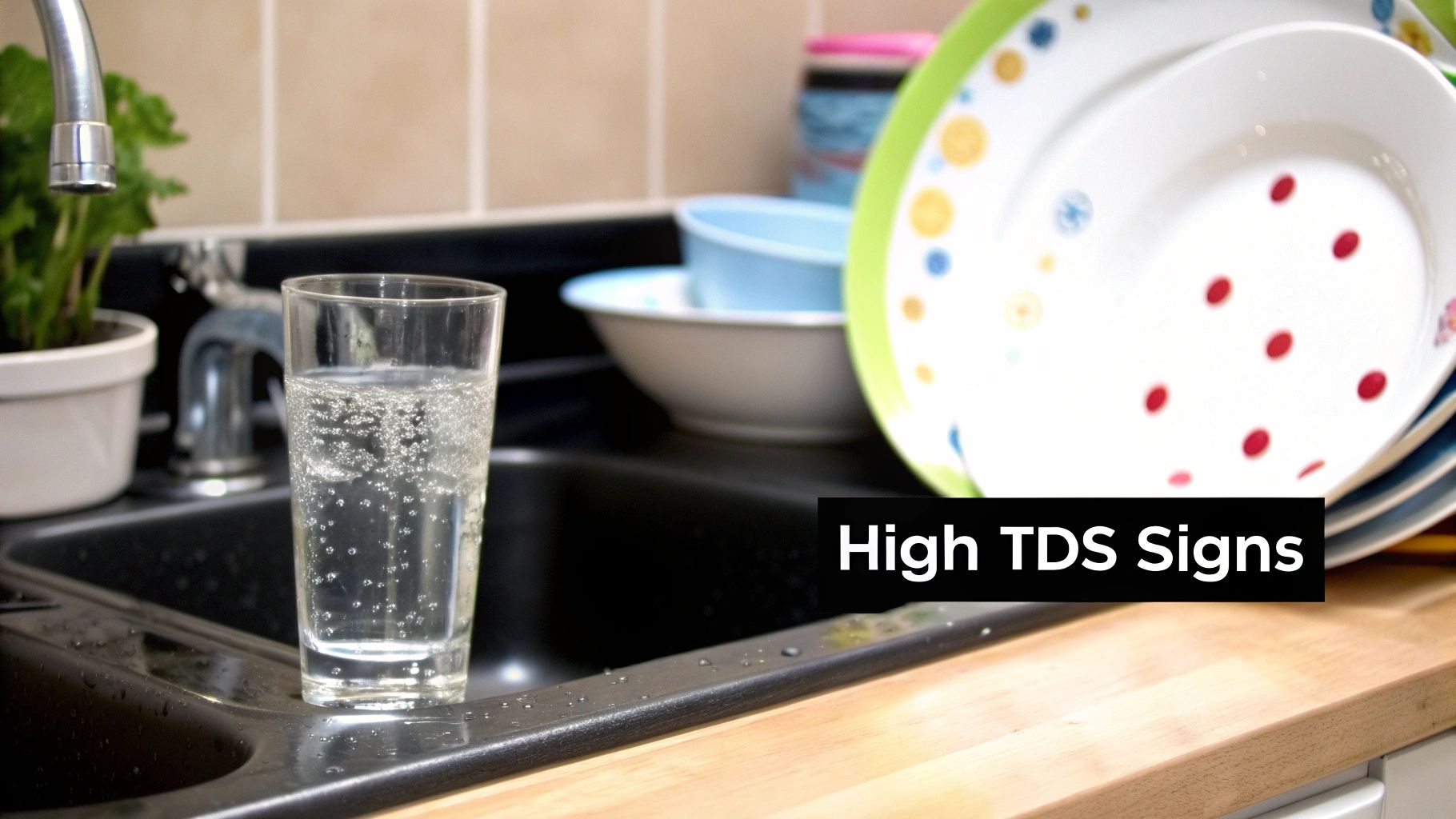
Before we get into the solutions, it’s important to understand what a high TDS reading actually means for your home. Total Dissolved Solids (TDS) is simply a measure of everything dissolved in your water—from good-for-you minerals like calcium and magnesium to less desirable salts and organic matter.
Imagine a single drop of water evaporating. Whatever is left behind is a dissolved solid. While high TDS isn't automatically a health risk, it's often the culprit behind a whole host of common frustrations around the house.
The Everyday Symptoms of High TDS
You're probably already seeing the effects of high TDS and just don't know it. These little annoyances are often the first clue that your water quality isn't what it should be.
Here are a few tell-tale signs:
- Off-tasting water or drinks: Does your water have a faint salty or metallic tang? Maybe your morning coffee just tastes a bit… bitter.
- Cloudy ice cubes: Water with a lot of dissolved solids freezes into opaque, cloudy cubes that seem to melt way too fast.
- Spotted dishes: You run the dishwasher, but your glasses and silverware come out with a milky film or white spots that just won’t wipe off.
These impacts are a direct result of minerals being left behind as water dries. If you're seeing these spots everywhere, learning how to remove stubborn water stains is a good first step, but a long-term fix is even better.
Beyond Taste and Appearance
The problems with high TDS go much deeper than what you can see or taste. Those same dissolved minerals are what cause scale buildup—that crusty, chalky deposit that clogs up your plumbing and appliances.
Think about your water heater. Mineral scale coats the heating element, forcing it to work harder and burn more energy just to heat your water. This constant strain drives up utility bills, leads to expensive repairs, and can drastically shorten the lifespan of the unit.
At Water Medic, we've seen countless dishwashers, coffee makers, and ice machines ruined by scale from untreated high TDS water. That’s why we see water treatment as protecting your investment in your home. A solution like a whole-house reverse osmosis system gets to the root of the problem, stopping scale before it ever starts and giving you cleaner, better water from every tap.
How to Accurately Test Your Water's TDS Level
So, you want to tackle the TDS in your water. Before you can even think about picking a filter, you need a baseline. What’s your starting point? Measuring your water's Total Dissolved Solids is that crucial first step, giving you a clear number to work from and pointing you toward the right solution.
Luckily, getting this number is pretty simple. You’ve got two main routes to go.
The fastest and easiest way by far is to use a digital TDS meter. These are little handheld gadgets you can find online or in home improvement stores for cheap. They’re dead simple to use, too. Just grab a clean glass of your tap water, switch the meter on, and stick the probe in. In a few seconds, a number pops up on the screen—that’s your TDS level in parts per million (ppm).
We often use these meters for quick checks. They're also fantastic for keeping an eye on an existing filter. You can test the water going in and the water coming out to see just how hard your system is working.
Deciding Between a Quick Check and a Deep Dive
A digital meter gives you the "what"—the total amount of dissolved stuff—but it doesn't give you the "who." It can't tell you if that number is made up of harmless calcium or something more concerning. For that level of detail, you'll need a professional lab test. This means sending a water sample off to a certified lab for a complete breakdown.
So, which one is right for you? Here’s how they stack up:
| Feature | Digital TDS Meter | Professional Lab Test |
|---|---|---|
| Speed | Instant results | Days or weeks |
| Cost | Low (one-time purchase) | Higher (per test) |
| Detail | Measures total amount only | Identifies specific solids |
| Best For | Quick checks & filter monitoring | Identifying potential contaminants |
If you have specific worries—maybe you suspect lead from old pipes, nitrates from nearby farms, or your water just has a weird taste or smell—a lab test is absolutely the way to go. Here at Water Medic, we almost always recommend a full lab analysis for anyone on a private well. It gives us the full picture we need to build a whole-house water treatment system that truly keeps your family safe.
Interpreting Your TDS Results
Okay, you’ve got your number. Now what does it actually mean? The EPA suggests keeping TDS below 500 ppm, but that's more of a guideline for taste and aesthetics, not a strict health rule. In our experience, the lower, the better, especially for the taste of your coffee and the lifespan of your appliances.
A Quick Guide to TDS Levels (in ppm):
- 0-50 ppm: Excellent. This is what you'd expect from purified water from a reverse osmosis system or a distiller.
- 50-150 ppm: Good. Think high-quality spring and mineral waters.
- 150-250 ppm: Fair. It's acceptable tap water, but some people might start to notice a slight taste.
- 250-500 ppm: Poor. You'll likely notice the taste, and it's definitely enough to cause scale buildup on faucets and inside pipes.
- Above 500 ppm: Unacceptable. This points to a high concentration of minerals and could signal other issues that need a closer look.
Once you have an accurate reading in hand, you’re no longer guessing. If your test comes back with a high TDS number, you can start looking at solutions like reverse osmosis with confidence, knowing you’re solving a real, measured problem.
Using Reverse Osmosis to Drastically Lower TDS
If you're serious about slashing the TDS levels in your water, there's really no better tool for the job in a home setting than Reverse Osmosis (RO). It's the gold standard for a reason. While your basic pitcher or faucet filter might pull out things like chlorine and some sediment, an RO system purifies water right down to the molecular level.
The process itself is surprisingly straightforward. An RO system uses the existing water pressure in your home to force tap water through a special, semipermeable membrane. This isn't just a simple screen; its pores are so tiny that they allow water molecules to pass through while physically blocking the larger dissolved solids—we're talking salts, minerals, and other contaminants. Those get left behind and simply flushed down the drain.
The result is water that's incredibly pure and clean. This is precisely why RO is the go-to solution for high TDS.
Why RO Is the Top Choice for TDS Removal
What truly sets Reverse Osmosis apart is its sheer effectiveness. Other filtration methods might make a small dent in your TDS reading, but an RO system is purpose-built for this task. The U.S. Environmental Protection Agency (EPA) actually mandates that RO systems must remove a minimum of 75% of TDS, but honestly, any decent modern system blows past that standard. It's common for quality units to achieve TDS reductions between 90% and 99%.
This isn't just a number on a meter; it's a difference you can taste and see. That slightly bitter or salty edge to your tap water? Gone. It's replaced by a crisp, clean taste that's perfect for drinking, making coffee, and cooking. You'll also notice your ice cubes are crystal clear, and those pesky white spots on your dishes will become a memory.
This infographic breaks down what to do after you get that initial TDS reading. It helps you decide whether a quick check is enough or if a deeper dive is needed.
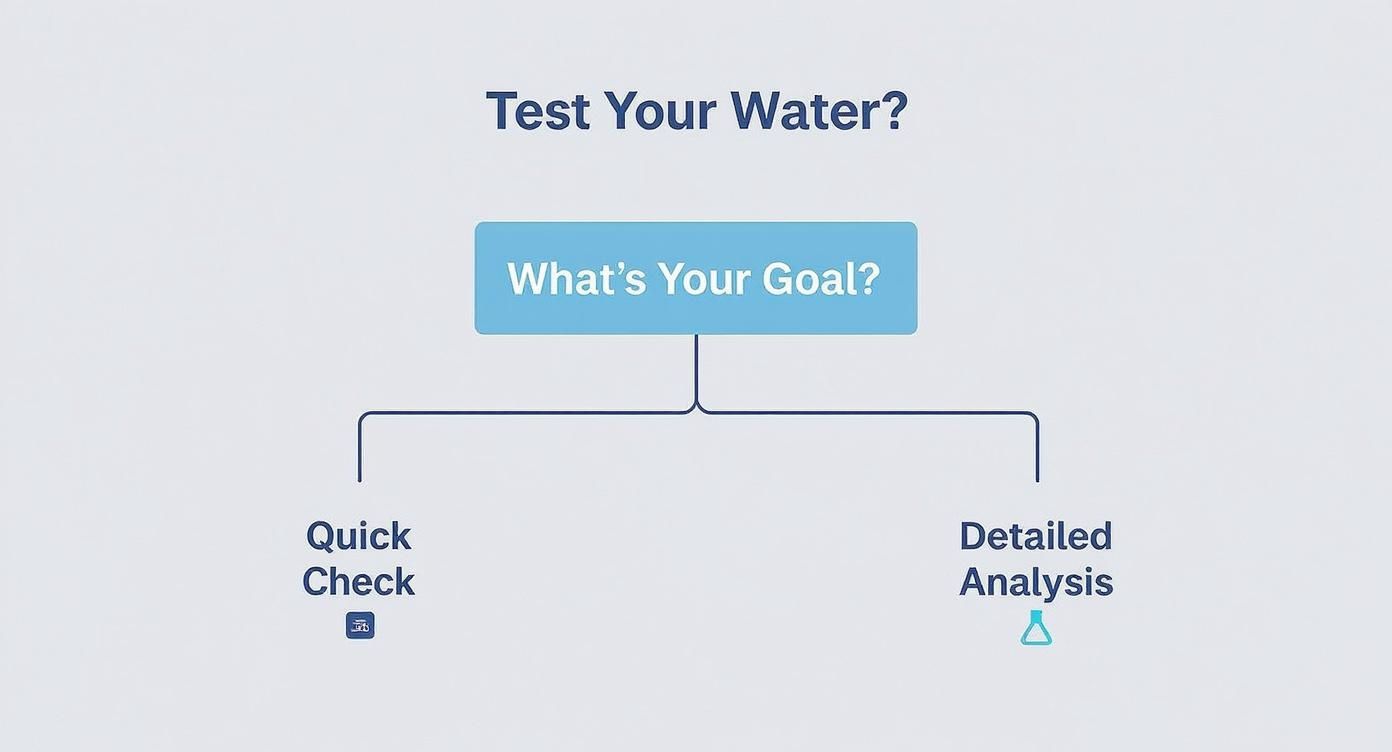
As you can see, a handheld TDS meter is fantastic for a quick snapshot. But for a complete picture of your water's chemistry—and to choose the absolute best system for your home—a full lab analysis is the way to go.
Finding the Right RO System for Your Home
One of the best things about RO technology is how adaptable it is. You don't need to replumb your entire house to get purified water.
The most popular option by far is an under-sink reverse osmosis system. These units are compact enough to fit comfortably in the cabinet under your kitchen sink. They connect to a small, dedicated faucet at your sink, giving you a convenient source of purified water right where you need it most.
For homeowners who want the ultimate solution, a whole-house RO system is the answer. Installed where the main water line enters your home, this system treats every drop of water you use. Every faucet, every shower, and every appliance—from your coffee maker to your washing machine—gets the benefit of low-TDS water. This not only improves the water you drink but also protects your entire plumbing system from the scale buildup that high TDS is notorious for causing.
Here’s a quick look at how the most common methods stack up against each other.
TDS Reduction Methods Compared
This table compares a few popular water purification technologies to give you a sense of their strengths and where they fit best.
| Method | TDS Reduction % | Best For | Average Cost |
|---|---|---|---|
| Reverse Osmosis (RO) | 90-99% | Best all-around for drastic TDS reduction and removing a wide range of contaminants. | $150 – $5,000+ |
| Water Distillation | 99%+ | Achieving the absolute purest water; ideal for medical uses or specific dietary needs. | $100 – $600 |
| Ion Exchange (Softeners) | 0-10% | Primarily targets hardness minerals (calcium, magnesium), not overall TDS. | $500 – $2,000+ |
| Carbon Filtration | 0% | Excellent for improving taste and odor by removing chlorine, but does not reduce TDS. | $20 – $200 |
As you can see, when the goal is lowering Total Dissolved Solids, RO provides the most practical and powerful solution for the average home.
At Water Medic, we've helped countless homeowners find the right RO solution for their unique situation. Whether you need a simple point-of-use system for your kitchen or a comprehensive whole-house setup, our experts are here to help you get it right. We'll make sure you end up with a system that solves your TDS problem and gives your family clean, great-tasting water for years to come.
Exploring Other Powerful Water Purification Methods
While a Reverse Osmosis system is the go-to solution for most homeowners, some situations demand an even higher level of water purity. When getting as close to pure H₂O as possible is the goal, two other methods come into play: distillation and deionization.
These techniques are definitely more specialized and not typically found under the kitchen sink, but for certain high-stakes applications, they are absolutely essential.
The Power of Distillation
For anyone who truly needs to know how to reduce tds in water to the lowest conceivable levels, distillation is a classic and incredibly effective process. It’s elegant in its simplicity, essentially mimicking the earth’s natural water cycle. Water is heated to a boil, converting it into steam and leaving behind nearly all dissolved solids, minerals, and other contaminants.
That pure water vapor is then captured and cooled, condensing back into liquid form. The result? Exceptionally pure water.
Distillation really shines in situations where even trace minerals can be a problem. We’re talking about things like medical devices (think CPAP machines) or delicate home aquariums where the water chemistry has to be perfect.
In fact, a good distillation system can boast a TDS reduction of over 99%, producing water with TDS levels as low as 1 ppm. This is precisely why it remains a critical tool where absolute purity isn't just a preference, but a requirement.
Achieving Ultimate Purity with Deionization
Another highly effective method for stripping water clean is deionization (DI). A DI system is all about chemistry, using special ion-exchange resins to literally grab mineral salts right out of the water. As water passes through, these resins swap out positively charged ions (cations) and negatively charged ions (anions) for hydrogen and hydroxyl ions, which combine to form pure water.
On its own, a DI system isn't very practical for treating all of a home's drinking water. Where it becomes a superstar is as a final "polishing" stage after a Reverse Osmosis system. This one-two punch—RO followed by DI—is the industry secret to achieving water that is virtually free of any dissolved solids, often hitting a perfect 0 ppm on a TDS meter.
This is the kind of ultra-pure water that serious car detailers use for a spot-free final rinse or that professional window cleaners rely on for a streak-free shine. It’s also the standard in many laboratory settings where the water itself cannot introduce any variables.
At Water Medic, we know that every home’s water situation is different. For the vast majority of families, a high-quality RO system strikes the perfect balance between incredible performance and everyday practicality. But if you have a specific need for ultra-pure water, we can help you explore these more advanced solutions.
Often, the best setup involves combining technologies. For example, pairing an RO system with specialized carbon filters to remove chlorine and other chemicals can create a comprehensive solution. Our experts are here to help you figure out if a multi-stage approach is the right fit, ensuring you get the exact water quality you're looking for.
Choosing and Maintaining Your Purification System
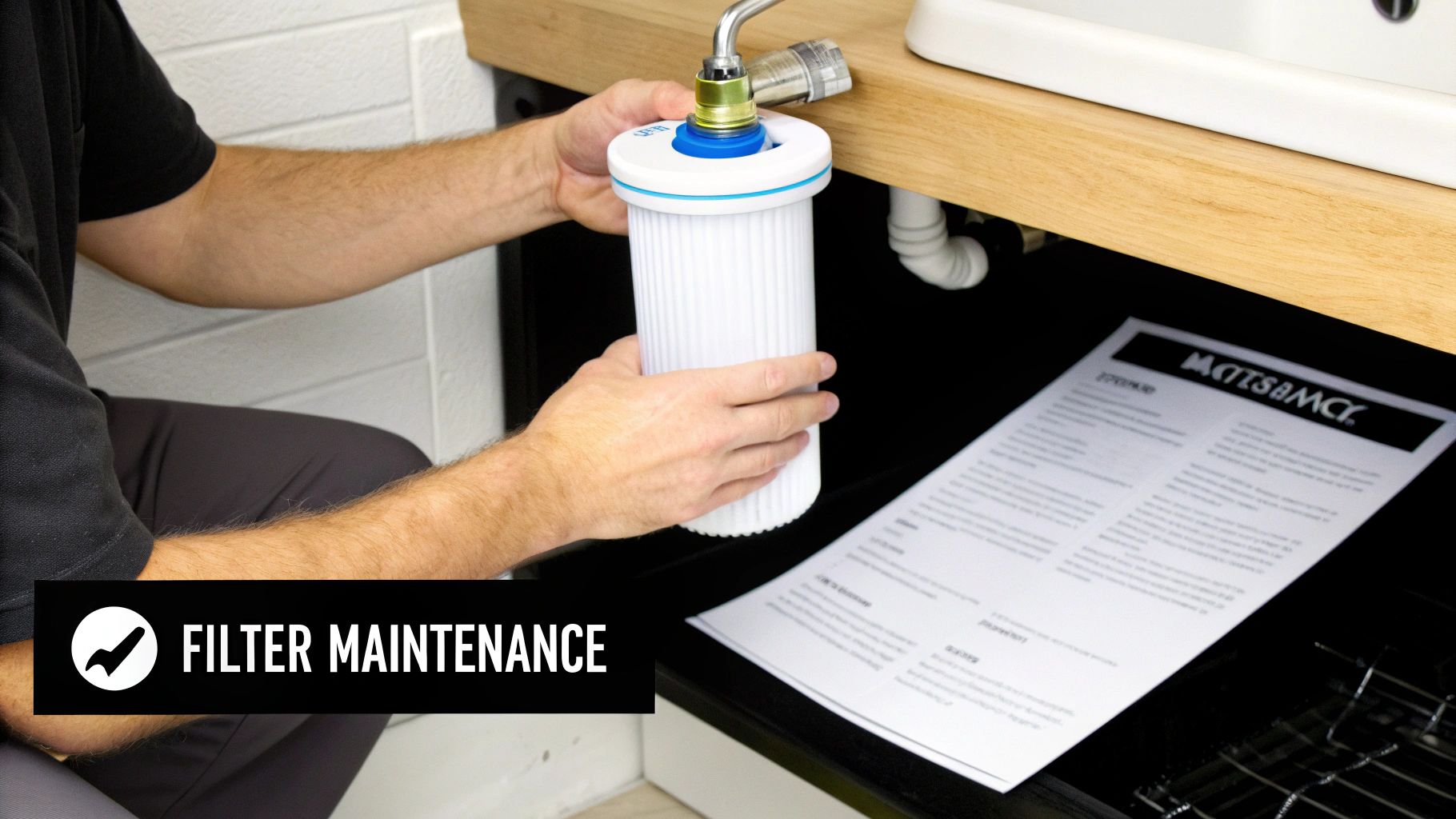
Choosing the right system to tackle the TDS in your water is a big decision, but it’s really just the starting line. The true secret to long-term success is keeping up with routine maintenance. An unmaintained system, whether it’s a top-of-the-line Reverse Osmosis unit or a simple distiller, will quickly start to lose its edge and could eventually just give up.
Think of your water purification system like you would your car—it needs regular tune-ups to keep running smoothly. If you skip this essential upkeep, you won't just see your water's TDS levels creep back up; you could also dramatically shorten the life of your equipment. What started as a smart investment can quickly become a frustrating and expensive headache.
Key Factors in Selecting Your System
Before we even get to maintenance, you have to pick the right unit for your home. It’s a decision that should come down to a few practical factors to make sure it fits your family’s needs and your wallet.
Here’s what our experts at Water Medic always suggest you think about:
- Your Water Usage: How much purified water does your household actually use? An under-sink RO system is often perfect for drinking and cooking. But if you're looking to protect all your plumbing and appliances from mineral buildup, a whole-house system might be a better fit.
- Initial TDS Levels: That initial water test gives you the most important piece of information—how hard the system will have to work. Water with very high TDS, say over 500 ppm, might need a more powerful system to get you down to that pure, clean taste you're after.
- Your Budget: Look at the whole picture. There's the upfront cost of buying the system, but don't forget the ongoing expense of replacement filters and parts. We can walk you through the options to find a solution that delivers fantastic results without breaking the bank.
Creating a Practical Maintenance Schedule
Once your new system is up and running, staying on top of maintenance is absolutely crucial. A little proactive care goes a long way in making sure you get that pure, low-TDS water every single day.
For a typical Reverse Osmosis system, the schedule is pretty straightforward. You have sediment and carbon pre-filters, which do the heavy lifting by protecting the main RO membrane from gunk and chlorine. These usually need to be swapped out every 6 to 12 months.
The RO membrane is the heart of the system, and it generally lasts for 2 to 3 years, though this really depends on your water quality and how much you use it.
Forgetting these simple tasks is the number one reason we see systems fail. A clogged pre-filter makes the whole unit work harder, putting a ton of strain on the membrane and weakening its ability to remove dissolved solids.
For homeowners who’d rather not worry about it, professional servicing is the easiest way to protect your investment. At Water Medic, we can take the guesswork completely out of the equation. Our technicians handle everything from filter changes to system check-ups, ensuring your equipment is always running flawlessly.
To make things even simpler, we offer convenient monthly maintenance plans designed to keep your system in peak condition without you having to lift a finger. This way, your family always has access to the purest water possible.
Common Questions About Lowering Water TDS
When you start digging into water purification, it's easy to feel a bit overwhelmed by the new terms and technology. It’s completely normal to have questions, and we hear a lot of the same ones from homeowners just like you. Let's clear up some of the most common points of confusion so you can feel confident in your next steps.
Will a Water Softener Reduce My TDS Level?
This is a great question, and probably the one we get asked the most. The short answer is no, a water softener won’t do the trick for lowering your TDS.
These systems are fantastic at what they're designed for: tackling hard water. They use a process called ion exchange to swap out the minerals that cause scale buildup, like calcium and magnesium, for sodium ions. While this is a lifesaver for your pipes and appliances, you're just trading one dissolved solid for another. The overall TDS reading stays pretty much the same.
To actually remove those dissolved solids, you need a true purification system like reverse osmosis.
What Is a Good TDS Level for Drinking Water?
Once people get their first TDS reading, their next question is always, "So, what number should I be aiming for?" The EPA has a secondary, non-enforceable guideline of 500 parts per million (ppm), but that’s really just for aesthetics—meaning, to avoid a weird taste or color.
In our experience, the sweet spot for great-tasting, pure drinking water is well below 150 ppm. A properly installed and maintained reverse osmosis system can get your water down to an incredible 10 to 50 ppm. That’s the level where water is truly crisp, clean, and refreshing.
Once you get a taste of water that pure, you'll never want to go back.
How Often Should I Change My RO System Filters?
Just like changing the oil in your car, regular maintenance is what keeps your Reverse Osmosis (RO) system running smoothly for years to come. How often you need to swap out filters really depends on your water quality and how much your family uses, but here’s a solid rule of thumb we follow.
- Pre-filters: These are your system's first line of defense. The sediment and carbon filters that protect the main RO membrane usually need to be replaced every 6 to 12 months.
- RO Membrane: This is the heart of the system, doing the real work of stripping out dissolved solids. You can expect it to last about 2 to 3 years.
Falling behind on this schedule is a common mistake. It forces the system to work harder, reduces its efficiency, and can even shorten its lifespan. To make it easy, we offer simple service and maintenance plans that take all the guesswork out of it for you.
At Water Medic of Cape Coral, our mission is simple: making sure every family has access to safe, clean, and fantastic-tasting water. Our team is ready to help you figure out the best way to lower your TDS and improve your home's water quality. Contact us today to schedule your free water analysis!