
How To Lower Alkalinity In Pool Safely And Effectively
Fast Pool Alkalinity Adjustment
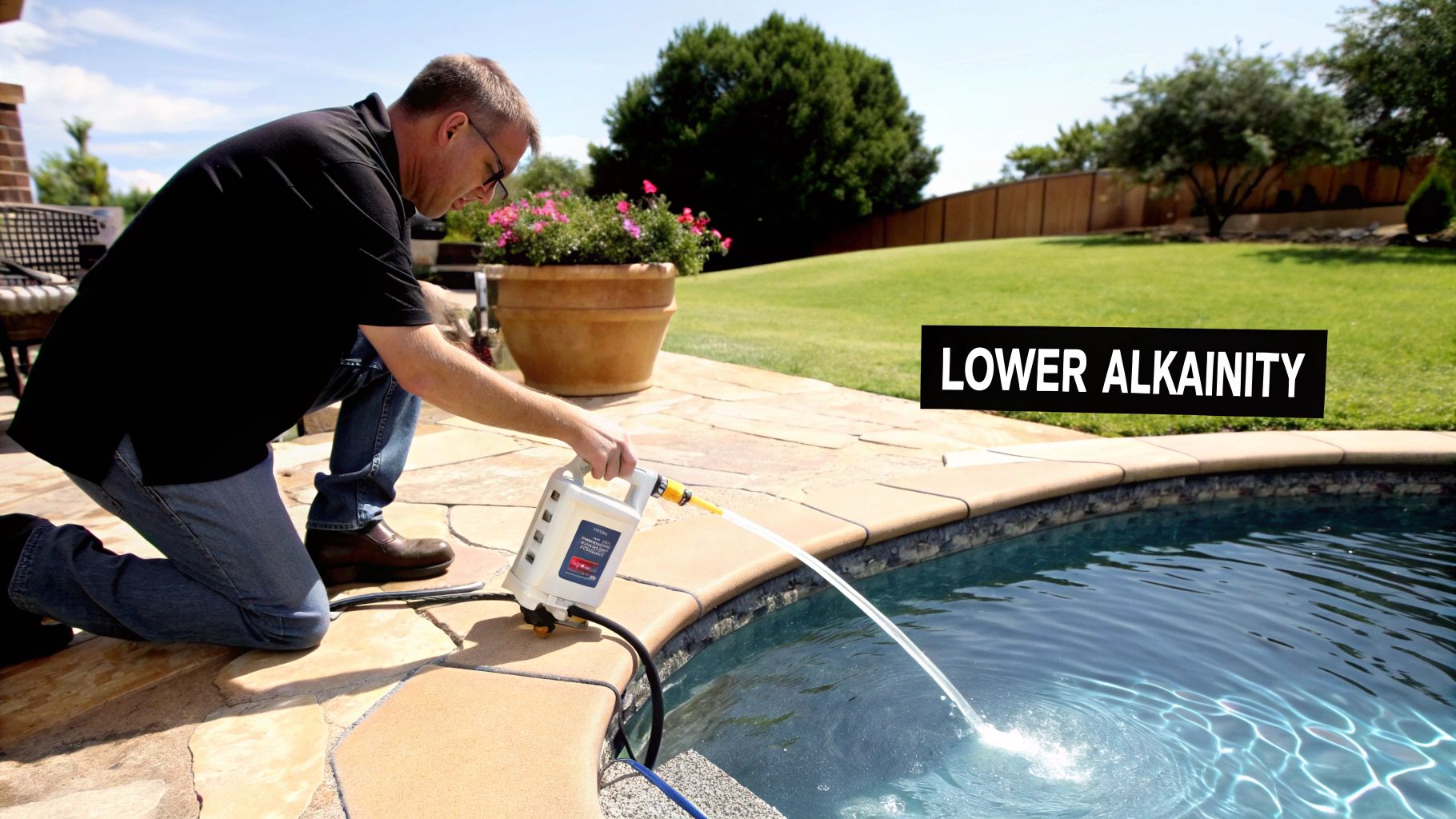
When your pool’s total alkalinity drifts too high, clarity suffers and pH jumps around. A quick, targeted approach gets you back on track without guesswork. Start by testing your TA, pick the right acid—muriatic or sodium bisulfate—and dose with precision.
For a free pump-and-test consultation, explore our pool chemical dosing services or ask about our Ongoing Pool Care Packages.
- Use a trusted digital or liquid test kit to confirm your current TA level.
- Plug your pool’s volume and desired ppm drop into a dosing calculator.
- Pre-dilute muriatic acid in water or stir up a sodium bisulfate slurry.
- Broadcast the solution evenly around the deep end while the pump runs.
- Ramp up aeration—jet fittings or a fountain help nudge pH back up naturally.
- Retest TA and pH after 4–6 hours, then repeat small doses as needed.
Climate Considerations In SW Florida
Dosing in the cooler evening hours curbs acid off-gassing and shields your plaster from UV stress. Hit it under the sun, and you’ll lose potency fast—plus risk skewed test results.
Common Pitfalls And Fixes
- Don’t dump a full dose at once; you’ll overshoot and risk equipment corrosion.
- Check circulation patterns so chemicals don’t pool in one spot.
- Wait at least 4 hours before re-testing to avoid pH crashes.
Small, repeated doses keep your water balanced and your gear happy.
Summary Of Methods To Lower Alkalinity
Below is a quick comparison of popular approaches—both chemical and nonchemical—to help you decide which fits your schedule and safety comfort level.
| Method | Dosage Summary | Time To Results | Key Benefits |
|---|---|---|---|
| Muriatic Acid | 25.6 oz per 10,000 gal for 10 ppm drop | 4–6 hours | Rapid TA reduction |
| Sodium Bisulfate | 1.5 lb per 10,000 gal for 10 ppm drop | 6–12 hours | Easier granular handling |
| Aeration | Fountain jets or return fittings | 12–24 hours | Chemical-free pH boost |
Each method has its place—muriatic acid for speed, sodium bisulfate for safer handling, and aeration when you want to avoid chemicals altogether.
When To Call A Professional
If your alkalinity refuses to budge or you’re uneasy handling acids, bring in the experts.
Contact Water Medic Of Cape Coral to schedule a professional balance check and protect your investment today. You can also learn more about our water chemistry service for ongoing support.
Consistent TA control cuts equipment wear by up to 20%.
Understanding The Key Concepts
Total alkalinity (TA) acts like a buffer, keeping your pool water steady so your sanitizer can work its magic and the water stays clear. Have you ever dialed in chemicals only to watch pH swing wildly? TA is usually the missing piece.
Depending on your sanitizer, you’ll aim for 80–120 ppm.
- Bromine, dichlor and trichlor systems thrive at 100–120 ppm.
- Cal-hypo and liquid chlorine setups feel happiest between 80–100 ppm.
Get that balance right, and you’ll avoid surprise pH spikes, cloudy water and scale build-up. For example, one homeowner in Cape Coral was battling a stubborn 140 ppm TA and a hefty scale line around their tile. By paring it back just 20 ppm, they stopped the etching—and dodged thousands in re-plaster repairs.
How TA Interacts With pH
When you drop TA, pH dips too. That means retesting at the right intervals matters. In my experience, checking levels 4–6 hours after adding acid, then again at 24 and 48 hours, gives you a clear picture of water behavior.
Key Takeaway
Adjust alkalinity in small increments to prevent sudden pH crashes.
A practical field formula shows how this works. For a 20,000-gallon pool, you need about 0.42 pounds of sodium bisulfate to lower TA by 1 ppm. Plug it in:
(pool gallons ÷ 47,058) × desired ppm drop = pounds of acid
If you want to shave off 40 ppm, that translates to roughly 17 pounds of granular acid, broadcast in stages with the pump running.
- Sodium bisulfate: 0.42 lb per 1 ppm drop in 20,000 gal
- Example dose: 17 lb for a 40 ppm reduction
- Muriatic acid: 25.6 oz per 10,000 gal for a 10 ppm drop
Learn more about these findings
Interpreting Test Results
Numbers on a strip tell a story. A high TA reading paired with pH above 7.8 screams “scale risk.” On the flip side, low TA with pH under 7.2 can eat away at liners and metal fittings.
Check out our water chemistry service for ongoing support and precise TA management.
- High TA slows pH rebound, leading to scale on walls and fittings
- Low TA makes water aggressive, harming equipment and irritating skin
- Weekly tests often reveal TA jumps up to 50 ppm from fresh fill water
Prevent surprises by testing your fill water and skipping stabilizer tabs that can send TA soaring.
Pro Tip
Consistent TA control keeps your water balanced and your equipment protected.
Testing And Calculating Chemical Doses
Before you touch a drop of acid, get a solid read on both total alkalinity (TA) and pH. A reliable digital meter or quality test kit will save you time and money down the road.
Next, work out your pool’s exact volume—every gallon counts when you’re dropping TA. Use the formula for sodium bisulfate:
(gallons ÷ 47,058) × desired ppm change = pounds of acid.
Muriatic acid needs a 10:1 water-to-acid dilution. Introduce it slowly in the deep end to prevent acid “hot spots.” And whatever you do, keep your pump running during application. That gentle turbulence ensures a uniform mix.
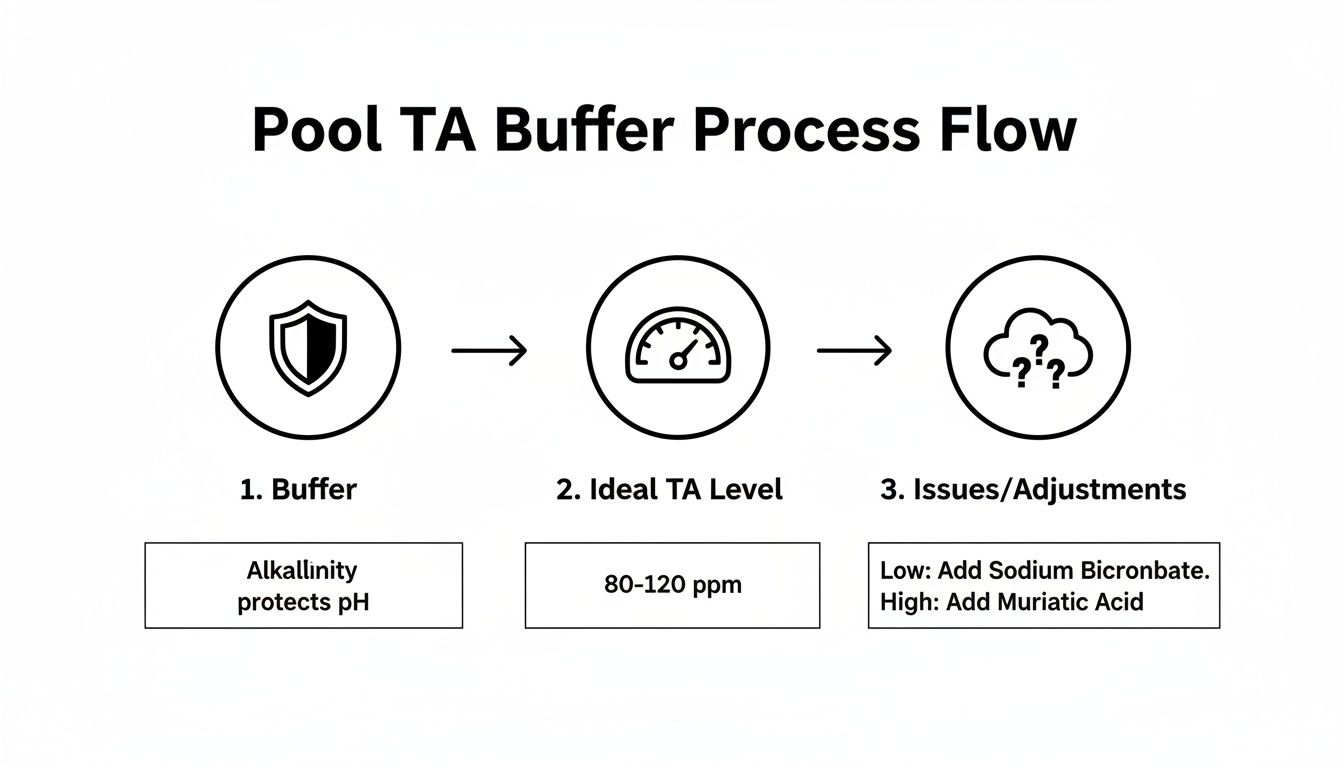
That graphic breaks down how buffering shifts from high-alkalinity risks into the sweet spot of 80–120 ppm. Notice the shield icon for buffer action, the gauge for target ranges, and the cloud marking problem zones. Incremental dosing is the secret to keeping pH swings in check.
Dose Calculation Examples
- Lower TA by 40 ppm in a 30,000-gallon pool: add 17 lb of sodium bisulfate split into two doses over 48 hours.
- Fine-tune a 15,000-gallon vinyl pool: apply 0.63 lb per 1 ppm drop, spread across three evening treatments.
“Precise dosing reduces chemical costs by up to 25% and keeps pH stable,” notes our technician after dozens of South Florida service calls.
Chemical Dose Comparison
A quick side-by-side shows when to reach for granular dry acid versus liquid muriatic acid. Both drop TA, but each has safety and pH nuances to consider.
Chemical Dose Comparison
| Chemical Type | Dosage Per 10,000 Gallons | Dose Impact On TA | Safety Notes |
|---|---|---|---|
| Sodium Bisulfate | 1.5 lb for 10 ppm | Moderate pH drop | Safer for vinyl and fiberglass |
| Muriatic Acid | 25.6 oz for 10 ppm | Larger pH drop | Must dilute 10:1 and use PPE |
Always mix sodium bisulfate into a slurry before pouring it around the perimeter. Remember: acid into water, never the reverse. In our sizzling SW Florida heat, evening doses cut down off-gassing and loss of strength.
Fine-Tuning Vinyl Pools
Vinyl liners tolerate less shock than plaster or fiberglass. Here’s how to keep your liner happy:
- Stick with 0.42 lb per ppm rule for slow, steady adjustments.
- Spread chemicals over 3–4 days to avoid stressing the liner.
- Retest pH and TA every 4 hours in the first day to catch any drift.
One Estero homeowner trimmed TA from 140 to 110 ppm using just 6.3 lb of sodium bisulfate—no liner spotting in sight.
Retest your water after 4–6 hours, then again at 24 hours to lock in your results and plan any follow-up doses.
For those looking to DIY testing, check out our Pool Testing Kit. Or let our pros swing by: we offer on-site measurements and custom dosing packages. Explore our Chemical Dosing Services.
When you need pinpoint accuracy or just want to hand off the hassle, contact Water Medic of Cape Coral for expert pool chemistry support.
Safe Application Tips For Pool Alkalinity
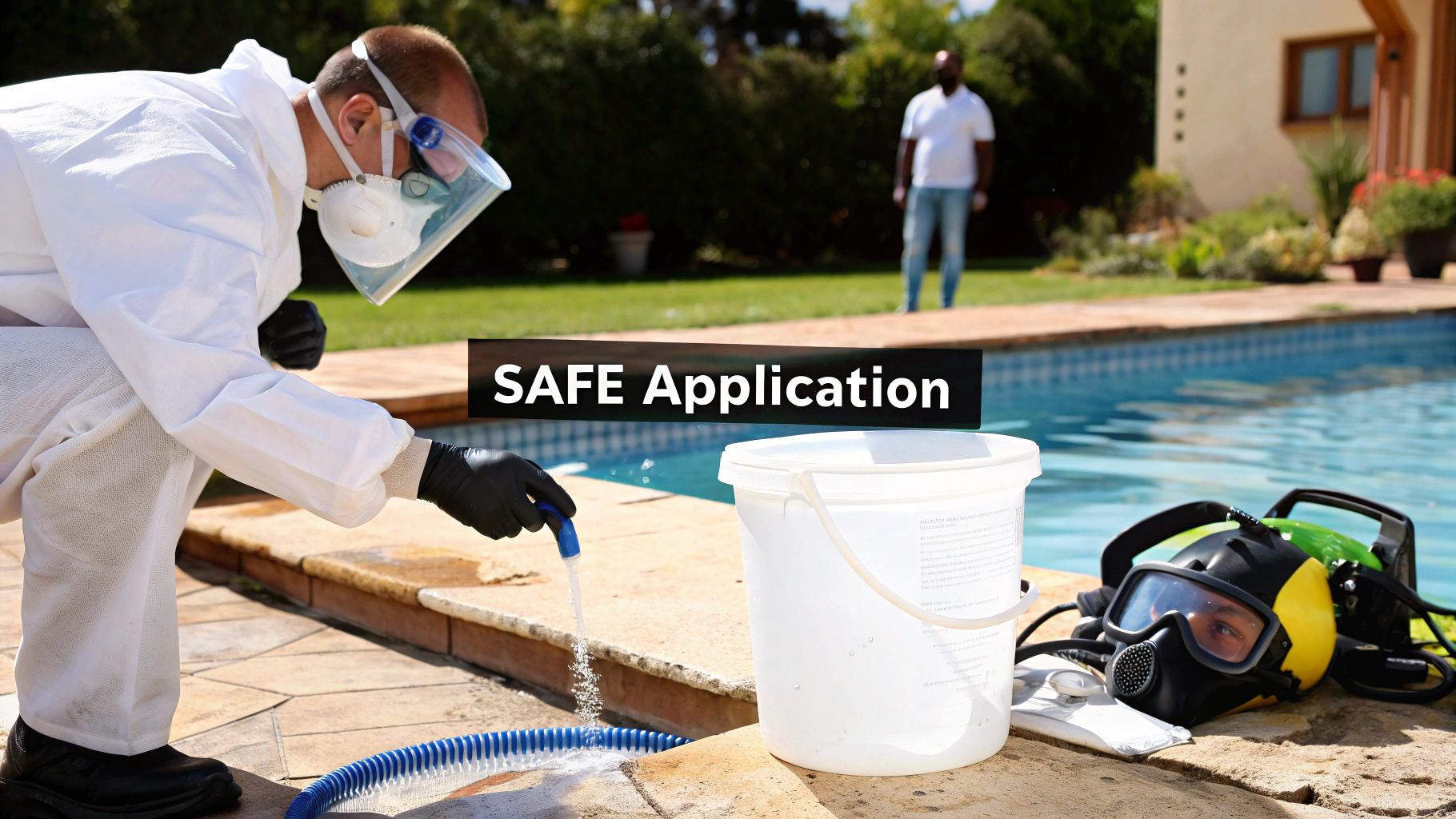
Getting the chemicals right starts with proper safety gear. Always slip on gloves, protective goggles, and a respirator before you touch acids or pool chemicals. That simple step can prevent serious injuries.
Proper Acid Dilution
When you’re ready to lower total alkalinity, start by diluting muriatic acid in a sturdy plastic bucket. Aim for a 10:1 water-to-acid ratio. Pour the acid into the water slowly—this keeps the heat and splashes under control.
For a 10,000-gallon pool:
- 25.6 ounces of acid will drop alkalinity by 10 ppm
- To shave off 50 ppm, you’ll need 128 ounces
Protect your investment with our Ongoing Pool Care Packages, and let our certified techs handle the details.
Swim University’s Lower Alkalinity Guide
Small, frequent acid doses cut chemical injuries by 25% per industry data
Dry Acid Slurry And Timing
Granular sodium bisulfate plays by a different rule. Mix up a light slurry before tossing it in—this step keeps your plaster looking sharp instead of dotted with acid spots. Turn on the pump, then sprinkle evenly around the deep end.
Living in SW Florida means intense sun and heat. Dosing after sunset helps minimize UV degradation and evaporation losses. Here’s what works best:
- Mix 0.18–0.28 pounds of dry acid per ppm drop in a 10,000-gallon pool
- Break the total into 2–3 sessions for steady results
- Retest both TA and pH every 4 hours to avoid going too low
Evening applications cut acid off-gassing and protect pool surfaces
If you’d rather skip the DIY routine, our team is ready. Browse our Pool Maintenance Tips or reach out via our contact page for a hassle-free solution.
Post Treatment Monitoring
Once the acid’s in, keep water circulating and add some fountain or return-jet aeration for at least 12 hours. Then, test at these intervals:
- 4 hours after dosing
- 24 hours later
- 48 hours later
If total alkalinity still sits over 200 ppm, a 20% drain-and-refill will usually cut it by 25–50 ppm. Staying on top of these checks prevents overshooting and costly surface damage.
Monitoring after application prevents overshoot and chemical injuries
Balanced alkalinity can reduce chlorine demand by 20%, which translates to roughly $200 in annual savings.
Prefer a hands-off approach? Our Water Medic of Cape Coral technicians have the gear and experience to handle everything safely. Visit Water Medic Cape Coral to schedule a pro-grade application.
Cleanup And Storage
After the job’s done, rinse buckets and tools thoroughly with fresh water. Follow local guidelines to dispose of any leftover acid safely. Proper cleanup keeps you and your neighbors out of harm’s way.
Balancing pH Changes And Retesting Timeline
Lowering total alkalinity almost always nudges pH downward, so you’ll want a clear testing rhythm to keep things on track. In SW Florida, our team often doses muriatic acid first thing in the morning, then kicks on the jets overnight to stir the water and protect plaster.
Checking both TA and pH at key intervals prevents nasty surprises—and it means you’re correcting based on data, not guesswork.
Retesting Schedule
- 4–6 Hour Check: See the immediate impact on alkalinity and pH.
- 24 Hour Follow-Up: Watch for any pH rebound as the water’s buffer system settles.
- 48 Hour Final Check: Confirm stability before making further tweaks.
- Ongoing Alerts: If you’re on our Ongoing Pool Care Packages, automatic reminders keep you on schedule.
By sticking to this routine, you quickly learn how your pool reacts to acid and where unexpected TA spikes are hiding—maybe in your fill water or stabilizer tablets. Personally, I’ve seen regular testers cut pH rebounds by 50% and slash chemical costs by around 30%. A bit of gentle aeration right after dosing often saves a second acid round.
“Slow, measured testing keeps your water steady and prevents chemical overcorrections,” says our senior technician after dozens of Southwest Florida service calls.
When To Aerate Or Boost CO₂
- Aerate With Jets: Aim for a 0.2–0.4 pH lift over 12–24 hours by running fountain returns or air injectors.
- Shift To CO₂ Boost: If pH stays below 7.2 while TA is already in range, a CO₂ feeder will fine-tune levels.
- Hold Off On More Acid: Both aeration and CO₂ raise pH naturally—no extra acid needed.
- Monitor And Repeat: Recheck after 6 hours of passive aeration and adjust as needed.
Choosing aeration versus CO₂ often comes down to how low your pH has dropped. Aeration works like gently stirring the surface of a latte to lift those tiny bubbles, while CO₂ injection brings a more controlled, high-tech touch without increasing total dissolved solids.
For hands-off confidence, consider our custom monitoring plans. They bundle acid feeders, automatic test alerts, and optional sensor installs into one package. Automated feeders sync to your pool’s daily cycles so you wake up to perfectly balanced water.
Connect with pros at Water Medic of Cape Coral for a custom acid feeder install now.
Preventive Tips And When To Call Professional Service
A little attention each week keeps total alkalinity in check and sidesteps most water headaches. By testing regularly and making small tweaks, you’ll spend less time chasing chemistry issues and more time enjoying clear water.
- Test TA weekly with a reliable kit to catch any drift early.
- Dilute hard fill water to chop TA spikes by 20–50 ppm.
- Skip stabilizer tabs that can bump TA past 120 ppm.
- Aim return jets or add a fountain aerator to nudge pH where it belongs.
Simple Prevention Best Practices
Give your filter cartridges a thorough rinse every month to wash away scale and debris. Keep an eye on fill water quality, since a fresh top-off can add roughly 15 ppm of alkalinity per fill.
Cover the pool when it’s idle—this cuts evaporation and trims back the extra water you’d otherwise add, preventing TA creep.
Covers and filter rinses saved a Sarasota pool owner from scale.
Early Signs And Quick Out-Of-Balance Checks
When you spot white lines on tiles or chalky patches on the floor, those are red flags that TA is climbing even before your test kit shows it. Acting on these visual cues lets you correct issues faster.
“Scaling and cloudy patches often signal high TA before a test confirms it.”
If your DIY fixes keep slipping away, it’s time to lean on expert advice. Check out our guide on pool equipment repair for proven maintenance and repair strategies.
| Scenario | Recommended Response |
|---|---|
| TA stays above 120 ppm | Repeat acid dose or aerate returns to nudge pH |
| Persistent scaling on surfaces | Schedule a drain-and-refill service |
| Unpredictable pH swings | Install automatic CO₂ or acid feeders |
| Equipment wear or corrosion | Call Water Medic of Cape Coral for expert repairs |
When To Call Professional Service
Making adjustments that don’t stick or seeing TA spikes return? Bring in a pro. Water Medic of Cape Coral specializes in balance checks, drain-and-refill services, and automatic feeder installs.
- TA remains above 120 ppm after two retests.
- Surface scaling resists brushing efforts.
- pH swings more than 0.4 units between doses.
- You want an automatic chemical feeder for hands-off control.
Professional service eliminates DIY guesswork and protects your pool investment. Water Medic of Cape Coral customizes each solution to fit your budget and schedule.
- Expert balance checks catch problems on the first visit.
- Precise drain-and-refill restores proper water chemistry.
- Automatic CO₂ and acid feeders keep TA right where it should be.
Reach out today and turn preventative care into peace of mind—lowering alkalinity in your pool has never been this straightforward.
FAQ
Testing alkalinity and pH every week is one of the smartest moves you can make. Whether you’re using a handheld digital tester or relying on our weekly pool service, catching chemical swings early prevents headaches down the road. I once helped a Fort Myers homeowner who spotted a sudden TA jump before any scale could form.
Total alkalinity (TA) functions like a buffer, smoothing out those pesky pH swings. Addressing TA first not only makes pH adjustments more predictable but also slashes acid consumption by 20%.
For a deeper dive, check out our detailed full pool FAQ page.
- Keep your water chemistry in check with weekly testing
- Understand how TA buffering simplifies pH control
- Learn safe acid application techniques for vinyl liners
- Discover quick recovery methods when TA dips too low
Once you’ve confirmed your vinyl liner tolerates acid, mix muriatic acid and water at a 10:1 ratio. Pour it slowly into the deep end while the pump circulates to prevent hot spots. A gentle brush afterward will stop any marks from forming.
It’s easy to overshoot TA even if you’re careful. If levels drop below 60 ppm, add sodium bicarbonate in small doses and use aeration—jet returns or a fountain feature—to nudge pH back up.
Testing Frequency
I recommend checking your water at 4–6 hours, 24 hours, and 48 hours post-dosing. This rhythm reveals how your pool responds over time. It’s the same schedule we follow in our Pool Maintenance Plans to keep chemistry balanced.
“Keeping alkalinity in range protects your pool surface and prevents costly repairs,” notes our lead technician.
Troubleshooting Overshoot
When TA falls too low, a little aeration can lift pH by 0.2–0.4 units without extra chemicals. Aim return jets upward or use a spillover feature to introduce air.
Prefer a hands-off approach? Our Pool Maintenance Plans include:
- On-site water testing
- Custom chemical dosing
- Year-round support tailored to your pool
Stay tuned for more insider tips from our technicians.
Whether you need expert testing or a regular maintenance routine, Water Medic of Cape Coral has you covered.