
how to increase water pressure in house: Easy DIY fixes
Is there anything more frustrating than a shower that feels more like a light drizzle than a powerful spray? When your faucet trickles and your washing machine takes forever to fill, it’s a clear sign of low water pressure. The good news is that the fix is often straightforward once you find the source of the problem. At Water Medic, we specialize in diagnosing and resolving these issues, ensuring your home's plumbing works for you, not against you.
Why Is Your Water Pressure So Low
Before you can fix weak water flow, you have to play detective. Low pressure isn't just an annoyance; it's often a symptom of a larger issue hiding somewhere in your plumbing system. The culprit could be as simple as a knob that got bumped, or it could point to something more complex lurking behind your walls.
Let's walk through the most common reasons your water flow has slowed to a crawl.
Common Culprits Behind Weak Water Flow
More often than you'd think, the problem is a main shutoff valve that isn't fully open. This can easily happen after a plumbing repair or even if it gets knocked by accident. You typically have two main valves: one near the street at your water meter and another where the water line enters your house. If either one is even partially closed, it creates a bottleneck that restricts flow to every fixture.
Another frequent offender is the pressure-reducing valve (PRV). This bell-shaped device is a must-have for protecting your pipes from high municipal pressure, but they don't last forever. When a PRV starts to fail, it can get stuck in a partially closed position, effectively choking off your home's water supply. Our expert technicians can quickly determine if your PRV is the problem.
A healthy home water pressure should sit between 40 and 60 PSI (pounds per square inch). Anything lower feels weak, and pressure creeping over 80 PSI can start damaging your pipes and appliances. Measuring your PSI is the first real step in diagnosing the problem.
External Factors You Can't Control
Sometimes, the issue has nothing to do with your home's plumbing. The problem could be with the municipal water supply itself. During peak usage times—like early mornings when everyone in the neighborhood is showering—the overall pressure can dip. A nearby water main break or construction can also cause a sudden, noticeable drop.
An easy way to check for this is to ask your neighbors if they're experiencing the same thing. If they are, the problem is likely on the city's end. To get a better sense of all the potential issues, it helps to understand what causes low water pressure and essential fixes before you start troubleshooting.
Pinpointing The Problem: DIY Checks vs. A Professional Eye
For homeowners, figuring out where to start can be the hardest part. Some issues are easy to spot, while others are nearly impossible to diagnose without the right tools and training. This table breaks down what you can safely check yourself versus when it's time to bring in an expert.
DIY Checks vs Professional Plumbing Solutions
| Symptom | Possible DIY Check | When to Call a Professional |
|---|---|---|
| Sudden drop in pressure everywhere | Check that your main water shutoff valves (at the meter and in the house) are fully open. | If valves are open but pressure is still low, the PRV may have failed or there could be a leak in the main line. |
| Low pressure at a single faucet | Unscrew the aerator from the faucet tip and clean out any mineral buildup or debris. | If cleaning the aerator doesn't help, the fixture's cartridge valve may be clogged or worn out. |
| Pressure drops when multiple fixtures are on | This can be normal, but if it's severe, it might signal an undersized system. | A professional can determine if your pipe diameter is too small for your home's needs or if a pressure booster is required. |
| Consistently low pressure (city water) | Ask neighbors if they have the same issue to confirm it's a municipal problem. | If the problem is only in your house, a pro needs to inspect for hidden leaks, clogs, or PRV failure. |
| Fluctuating pressure (well system) | Check the pressure gauge on your pressure tank; it might be a simple switch adjustment. | If the pressure switch and tank seem fine, the issue could be with the well pump itself, requiring specialized service. |
While a few checks are simple enough for a Saturday afternoon, many root causes of low water pressure are hidden. A failing PRV, a hidden leak, or deep-seated pipe corrosion aren't things you can spot with a visual inspection.
Here in Southwest Florida, we see it all—from mineral buildup caused by hard water to aging pipes in older homes. The team at Water Medic has the expertise to diagnose the problem quickly and accurately, saving you the headache of trial-and-error fixes.
Don’t let weak water flow disrupt your daily life. Schedule a Free Water Pressure Test with our experts, and we'll give you a clear, no-obligation diagnosis to get your water flowing powerfully again.
Easy Fixes You Can Tackle Yourself
Before you start picturing a major plumbing overhaul and dollar signs, let's roll up our sleeves. A lot of the time, weak water pressure comes from surprisingly simple issues you can find and fix in just a few minutes. Think of this as your initial diagnostic sweep—a few key checks that could save you a phone call and get your water flowing like it should.
First things first, let's get a real number. You don’t have to guess what your water pressure is; a simple water pressure gauge from any hardware store is all you need. This little tool is your best friend for figuring out exactly what's going on.
Just screw the gauge onto an outdoor hose bibb, turn the faucet on all the way, and see what it says. For most homes, a healthy reading is somewhere between 40 and 60 PSI. If your gauge shows a number well below that, you know you’re dealing with a system-wide problem. But if the pressure looks good at the source, the culprit is probably hiding somewhere inside.
Are Your Valves All the Way Open?
This might sound too obvious, but one of the most common culprits for low pressure is a valve that isn't fully open. It happens more than you'd think, especially after someone has done a repair or the handle just gets bumped. There are two main spots you need to look.
Start with the main shutoff valve for your house. You'll usually find it where the water line comes into your home—check the garage, basement, or a utility closet. Make sure that handle is turned completely counter-clockwise, as far as it will go.
Next, check the valve at your water meter, which is typically in a box near the street. That handle should be parallel to the pipe, indicating it's fully open. If either of these is even slightly closed, it's like a kink in a garden hose, choking off the water supply to your entire home.
Pro Tip: While you’re in detective mode, take a quick look at the smaller shutoff valves under your sinks and behind your toilets. A partially closed one won't affect the whole house, but it's a frequent cause of a weak flow at a single faucet or toilet.
Unclog Your Faucet Aerators and Showerheads
Did your pressure gauge show a healthy 40-60 PSI but your kitchen sink still delivers a pathetic trickle? The problem is almost certainly a clog right at the fixture. Over time, sediment and mineral scale (a common headache with Florida’s hard water) build up inside your faucet aerators and showerheads, creating a bottleneck.
Luckily, cleaning them out is a quick and incredibly satisfying fix.
- Unscrew the aerator from the tip of the faucet. Most come off by hand, but if it's stuck, use pliers. Just be sure to wrap the aerator in a rag first to avoid scratching the finish.
- Take it apart and rinse the little screens and washers to wash away any loose gunk. Keep track of how it goes back together!
- Soak all the parts in a bowl of white vinegar for a couple of hours. The mild acid works wonders at dissolving stubborn mineral deposits.
- Give everything a final scrub with an old toothbrush, rinse well, and put it all back together.
You can use the exact same vinegar-soaking method for your showerhead. Just unscrew it from the shower arm and let it soak. You'll be amazed at the difference this simple deep clean can make. If these steps don’t work, the issue may be a worn-out fixture that needs a professional touch.
If you’ve tried these simple fixes and the pressure is still low, it’s time to dig a little deeper into issues that might be affecting your entire plumbing system.
Finding and Fixing Common System-Wide Problems
So, you’ve cleaned the showerhead and the faucet aerators, but the water pressure is still frustratingly low. When the problem is everywhere—the kitchen sink, the bathroom shower, the outdoor spigot—it’s a clear sign the issue isn't just one fixture. The culprit is likely hiding deeper in your plumbing system.
This is where you graduate from simple clean-outs to some real plumbing detective work. Don’t let that intimidate you. Most system-wide pressure problems boil down to a few usual suspects: a failing pressure-reducing valve, clogged filters, or old, tired pipes. For those of us on a well, the pressure tank is another key player. Let’s walk through how to figure out what’s really going on.
The Role of Your Pressure-Reducing Valve
Many homes on city water have a pressure-reducing valve, or PRV. It’s usually a bell-shaped brass device found right where the main water line enters your house, often near the shutoff valve. Its job is to tame the high-pressure water coming from the street, dialing it down to a safe and steady 50-75 PSI for your home’s pipes and appliances.
But like any mechanical part, PRVs don't last forever. Over time, they can fail, often getting stuck in a partially closed position. This creates a permanent bottleneck, effectively choking off the water supply to your entire house. If your water pressure has been slowly dropping for months, or if it’s weak at every single tap, a bad PRV is one of the first things to suspect. While some can be adjusted, a failing valve is a ticking time bomb and should really be replaced by a pro.
This chart can help you quickly run through the initial checks.
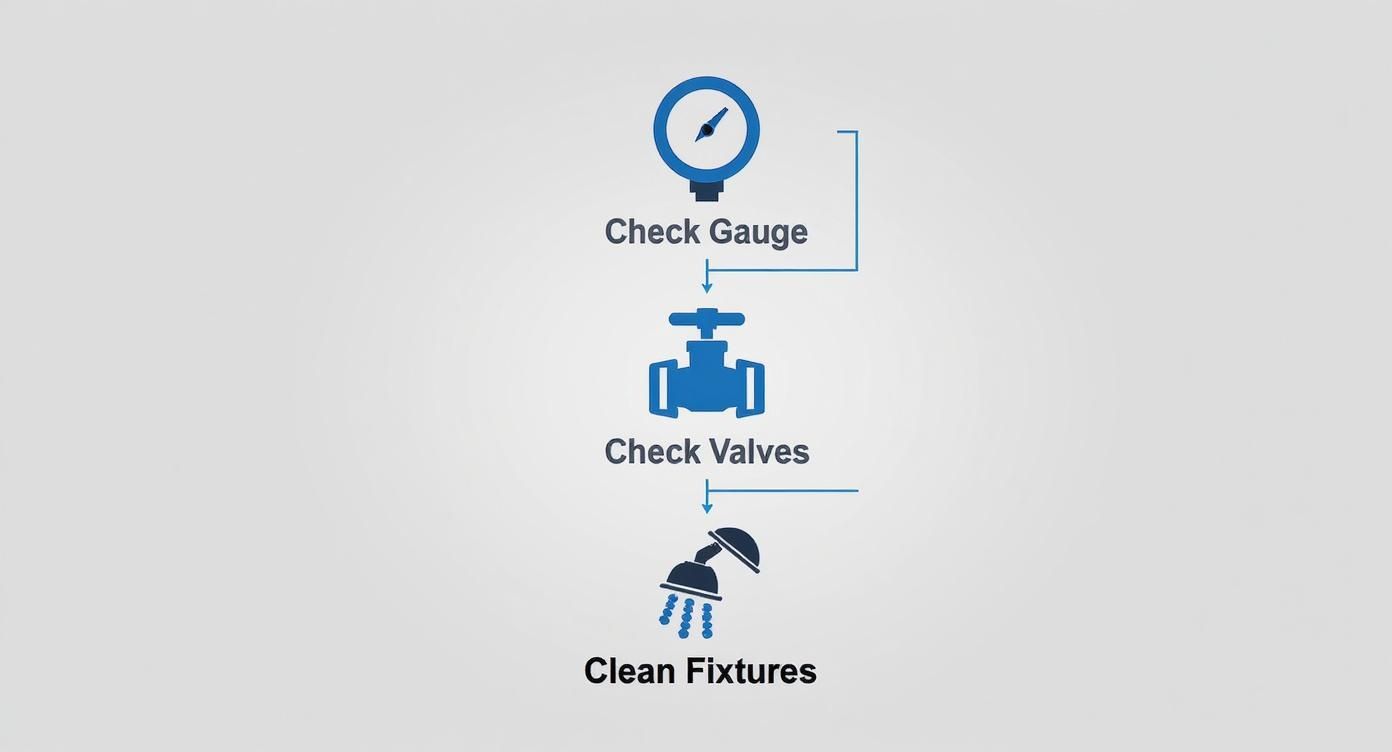
As you can see, once you've ruled out the simple stuff, the trail often leads to bigger components like the PRV or even the pipes themselves—jobs that typically need a professional eye.
Clogged Filters and Corroded Pipes
Do you have a whole-house water filter? These are fantastic for catching sediment, but they can become a major source of low pressure if neglected. As the filter does its job, it clogs up. Eventually, it gets so full of gunk that water can barely squeeze through. The fix is often as simple as swapping in a new filter cartridge. Check your manufacturer's recommendation and stick to that schedule!
In older homes, especially those built before the 1970s with galvanized steel pipes, the problem can be the pipes themselves. Over decades, corrosion and mineral buildup can narrow the inside of a pipe so much that it's like trying to drink a milkshake through a coffee stirrer.
If you’re in an older house and low pressure has been a problem for as long as you can remember, the plumbing itself may be the issue. This isn’t a quick fix and often points toward a larger job like repiping a section of your home.
A sudden, dramatic drop in pressure is a different kind of alarm bell. If you know the PRV and filters are fine, it could signal a hidden leak in your main water line. That’s when you need professional help right away. Our expert leak detection services can find the source of the trouble without having to dig up your entire yard.
Special Checks for Well Water Systems
If you get your water from a private well, you’re dealing with a different setup. Instead of a PRV, you have a pressure tank and a pressure switch. These two components work as a team to give you consistent water pressure, so your well pump doesn’t have to run every single time you turn on a faucet.
When a well system acts up, it's often one of these two things:
- Incorrect Pressure Tank Air Charge: Your tank has a bladder inside that's pre-charged with air. If that air pressure is off, it can cause the pump to cycle on and off rapidly, leading to sputtering faucets and fluctuating pressure.
- Failing Pressure Switch: This is the little box that tells the pump when to turn on (at low pressure) and off (at high pressure). If the contacts inside get corroded or the switch fails completely, the pump might not get the message to start, and your pressure will just fade away.
Working on well systems involves pressurized tanks and electrical components, so it's not something to tackle without experience. If you think the problem lies with your well equipment, give us a call. Our technicians have the tools and expertise to safely get your private water supply back to performing its best.
When a Water Pressure Booster Pump Is the Best Solution
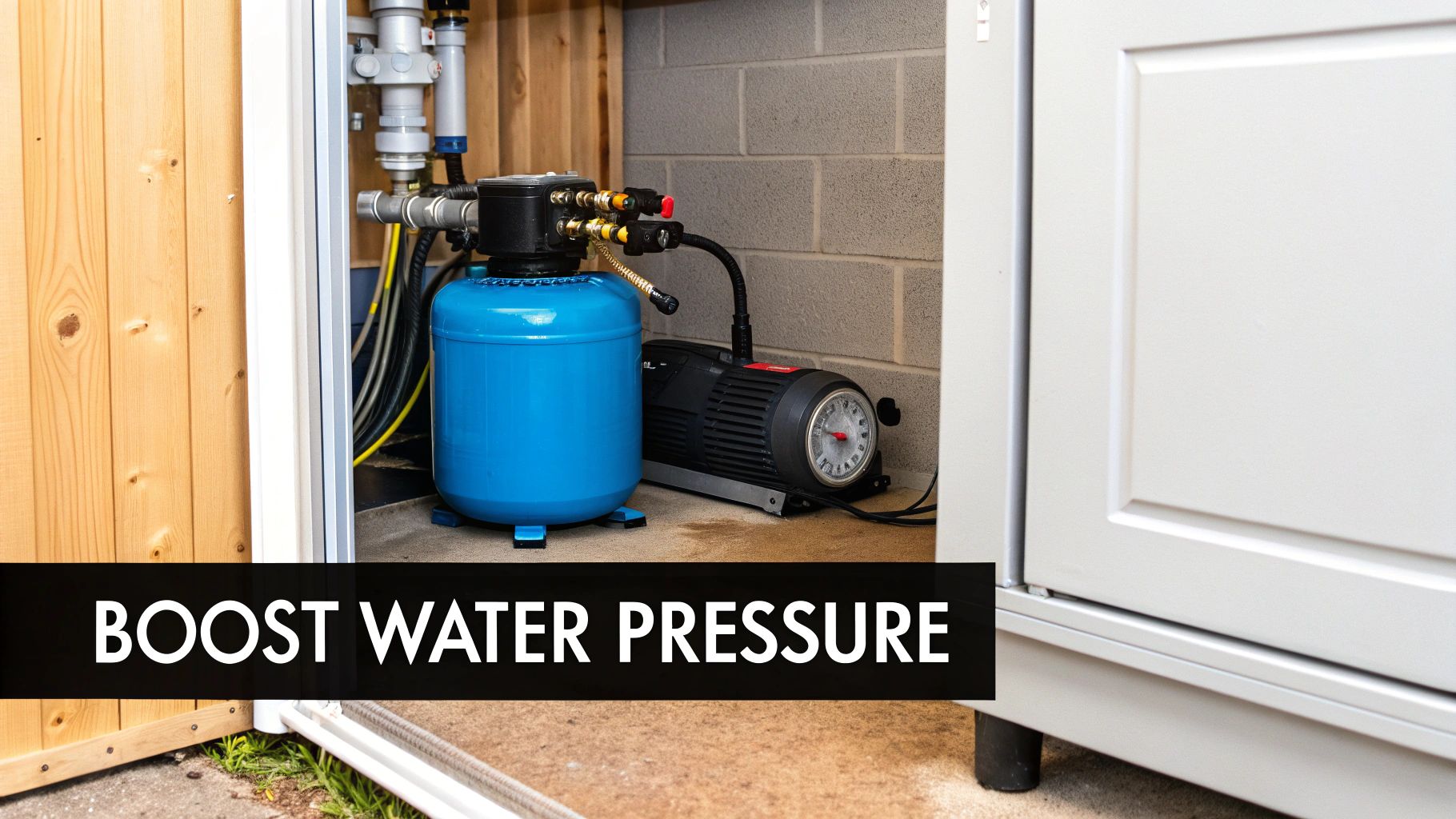
You've checked every valve, cleaned every faucet aerator, and you’re certain your pipes are clear, but your showers are still just a trickle. If you've exhausted all the simple DIY fixes and still aren't getting the flow you want, it’s probably time to look at a more powerful solution: a water pressure booster pump.
This isn't just another small adjustment. A booster pump is a serious upgrade that actively increases the force of the water entering your home. It’s installed on your main water line and, just as the name implies, gives the incoming water a significant "boost" before it travels through your pipes. For homeowners battling persistently low pressure from the city or dealing with a plumbing system that just can’t keep up, this is often the final, most effective answer.
Is a Booster Pump Right for Your Home?
Not every home needs one, but for some, a booster pump is the only path to truly satisfying water pressure. If your pressure gauge is consistently reading below 40 PSI and you've ruled out other problems, you're a prime candidate. This is especially common for houses at the end of a municipal water line, on a big hill, or in multi-story homes where gravity is working against you.
A booster pump is often the best fix in these situations:
- Low Municipal Pressure: Sometimes, the water coming from the city just isn't strong enough by the time it reaches your property.
- High-Demand Households: If you have multiple bathrooms, a large family, or several water-hungry appliances often running at once, the pressure can plummet. A booster pump solves this.
- Well System Limitations: Even well systems with their own pressure tanks can sometimes struggle to supply strong, consistent flow to a larger home. A booster can provide that extra oomph.
A properly installed pump can take that weak incoming pressure and crank it up to an ideal 50-80 PSI, completely transforming the water flow at every faucet and showerhead.
People often picture a booster pump as some huge, noisy industrial machine. The reality is that modern pumps are surprisingly compact, quiet, and designed to fit right into your existing plumbing, usually near where the main water line enters your house.
How a Booster Pump System Works
A booster pump isn't just a standalone motor; it works as part of a system with a pressure switch and often a small tank. The magic is in how it senses your needs. When you turn on a faucet, the pressure in your pipes drops. The switch detects this drop and instantly tells the pump to kick on, forcing more water into the system.
Once you turn the faucet off, the pressure quickly builds back up to the target level. The switch senses this, too, and signals the pump to shut down. This on-demand process means you get powerful water pressure the moment you need it, but the pump isn't running 24/7, which saves energy and extends its lifespan.
Many homes with a booster pump see a 40–60% improvement in their water pressure, which makes a world of difference in the performance of everything from your dishwasher to your shower.
Why Professional Installation Is a Must
While the concept behind a booster pump is simple, the installation is a job for a pro. This isn't a simple weekend DIY project. It requires cutting into your main water line, soldering or fitting pipes perfectly, and handling the electrical connections safely.
A small mistake during installation can lead to major leaks, damage to the pump itself, or even create dangerously high pressure that could burst your pipes or ruin your appliances.
Here at Water Medic, our team has installed countless booster pumps for homes all across Southwest Florida. We know how to evaluate your home's unique layout, size, and your family's water usage to recommend and install the perfect system. When you're ready for a permanent fix to your low water pressure, take a look at our professional booster pump installation services and see how we can give your home the powerful, reliable water flow it deserves.
Knowing When to Call a Professional Plumber
I’m all for rolling up your sleeves and tackling a home project. But when it comes to plumbing, some jobs are best left to the pros. Knowing when to put the wrench down is just as important as knowing how to use it. A simple fix can spiral into a costly nightmare—we’re talking major water damage, ruined drywall, and even serious building code violations.
A classic example? A suspected underground leak. If your water pressure suddenly tanks and you find a mysterious swampy spot in your yard (or get a jaw-dropping water bill), that’s a huge red flag. This isn't something you can dig up yourself. Professionals have specialized listening gear and cameras to pinpoint the break without turning your entire lawn into a trench.
Recognizing Problems Beyond a DIY Fix
Some issues hide in plain sight but require an expert touch. Take your pressure-reducing valve (PRV), for example. Giving the adjustment screw a small turn is one thing, but replacing the entire valve is a different ballgame. If you install it incorrectly, you could send dangerously high pressure surging through your pipes, risking a blowout that could flood your home and destroy appliances.
Then there's the problem of old, corroded pipes. This isn't just a simple clog you can snake out. Over decades, galvanized pipes can get so choked with rust and scale that it's like trying to get water through a coffee straw. A pro can run a camera through the lines to see exactly what's going on and tell you if a targeted repair will work or if it's time to consider repiping.
The bottom line is this: if a fix involves cutting into your main water line, messing with the complex electrical controls on a well, or tracking down a hidden leak, it's time to call for backup. The peace of mind that comes with a guaranteed, professional repair is invaluable.
The Dangers of Unlicensed Plumbing Work
Trying to save a few bucks with a major DIY plumbing job can backfire spectacularly. Many projects, like moving a water line or replacing a water heater, require permits to ensure they meet local safety codes. Mess this up, and you could run into major headaches when you try to sell your house. Worse, your homeowner's insurance might deny a claim if they find the damage was caused by unpermitted work.
Even a small mistake can cause a domino effect. A poorly soldered copper joint might hold for a few weeks before developing a slow drip behind a wall. By the time you notice the problem, you could be dealing with thousands of dollars in mold remediation and structural repairs. Here in Southwest Florida, our humidity makes that a particularly scary thought.
If you've tried all the DIY fixes and you're still stuck with a weak shower, it’s time to bring in an expert. You can find trusted local home repair services that specialize in diagnosing and solving these exact kinds of stubborn plumbing issues.
Your Local Experts for Southwest Florida Plumbing
Here at Water Medic, we live and breathe Southwest Florida's unique plumbing challenges. From dealing with the mineral buildup left by our hard water to understanding how the summer heat strains older plumbing systems, we’ve seen it all. Our licensed and insured technicians have the right tools and experience to find the real source of your low water pressure fast.
Don't let a tricky plumbing problem stress you out or risk damaging your home. Whether you need a PRV replaced, a booster pump installed, or something more complex, our team handles it with the professional care your home deserves.
When you're ready for a real diagnosis and a lasting solution, Schedule a Service with Water Medic. Let us take the guesswork out of it and get your water flowing strong again.
Got Questions About Your Water Pressure? We’ve Got Answers.
Even after walking through the common culprits of low water pressure, it’s natural to have a few more questions. Plumbing can feel like a mystery, but getting the right information is the first step toward getting your flow back.
We hear these same questions from homeowners all over Southwest Florida. Let's clear up some of the most common concerns so you can feel confident about what to do next.
Is My Water Softener Killing My Water Pressure?
It absolutely could be. It's actually a pretty common issue we run into. Think about how a softener works: it pushes all your household water through a tank filled with resin beads to trap minerals. Over time, that resin bed can get gunked up with sediment, essentially creating a traffic jam for your water.
This is especially a problem with older units or systems that were undersized for the home to begin with. If you noticed your pressure started to dip after the softener was installed, or it’s been getting progressively worse, that’s a big red flag. Sometimes, a good maintenance cycle will clear it up, but if it's an ongoing problem, the unit might need a professional service, a full replacement, or an upgrade to one that can handle your home's needs.
What’s It Going to Cost to Fix Low Water Pressure?
This is the million-dollar question, and the honest answer is: it completely depends on what’s causing the problem. The fix could cost you nothing but a little time, or it could be a significant investment.
- DIY Fixes: If it's just a clogged faucet aerator or a gunked-up showerhead, you're looking at $0 and a few minutes with some vinegar.
- Mid-Range Repairs: A failing pressure-reducing valve (PRV) is a common culprit. Replacing one usually costs a few hundred dollars, factoring in the part and a plumber's time.
- Major Work: The most expensive scenario is discovering old, corroded pipes that need to be replaced. Repiping even a section of your home is a major undertaking, and the cost can run into the thousands depending on the scope of the work.
This is exactly why guessing is a bad idea. A professional diagnosis saves you from throwing money at solutions that won't work. We can find the real source of the problem and give you a clear, upfront cost to fix it for good.
If I Boost My Water Pressure, Could It Damage My Pipes?
Yes, it's a real risk if you don't know what you're doing. While you want strong pressure, too much of a good thing is dangerous for your plumbing. Anything over 80 PSI is considered excessive and puts a massive strain on everything—pipe fittings, joints, and all your appliances. Your dishwasher, washing machine, and water heater just aren't built to handle that kind of constant stress.
Pushing the pressure too high is asking for a leak or, worse, a burst pipe. A professional plumber never just cranks up the pressure. We use a gauge to dial it in perfectly, usually setting it to a safe and effective range of 50 to 60 PSI. This gives you the powerful shower you want without putting your entire system at risk.
Could Low Pressure Mean I Have a Leak?
It’s definitely a possibility, especially if the pressure drop happened suddenly. If you’ve checked that all your shut-off valves are fully open and there are no obvious clogs in your fixtures, a hidden leak is the next logical suspect.
Be on the lookout for other clues. Is your water bill suddenly through the roof? Do you hear the faint sound of running water when everything is turned off? Have you noticed a perpetually soggy spot in your yard? These are classic signs of a leak in your main water line. Don't ignore it—that water waste adds up fast and can even cause damage to your home's foundation over time. If you suspect a leak, it's time to call in a pro right away.
Don't let guesswork guide your plumbing decisions. The experts at Water Medic of Cape Coral have the experience to diagnose and solve any water pressure problem, big or small. Contact us today for a professional assessment and a lasting solution to restore powerful water flow to your home. Learn more at https://watermedic.com.