
Using Baking Soda in Pool Water for Perfect Balance
That box of baking soda tucked away in your kitchen pantry? It's one of the best-kept secrets for easy pool maintenance. It’s the simplest, most effective way to manage your pool’s total alkalinity, which is the key to preventing those wild, frustrating swings in your pH levels.
When your alkalinity is dialed in, your pH tends to stay put. This makes your chlorine work better, keeps the water sparkling clear, and even protects your expensive pool equipment from corrosion.
Your Kitchen’s Secret to a Healthier Pool
Forget about complicated chemical formulas for a minute. Using baking soda is a straightforward fix for a very common problem. Just think of total alkalinity as the anchor for your pool's water chemistry—get that right, and you'll save yourself a ton of money and headaches.
If alkalinity drops too low, the water becomes acidic and corrosive. Our team has seen this eat away at pool heaters, pump seals, and even vinyl liners and plaster surfaces. But when it's stable, everything else just falls into line so much easier.
Baking Soda vs Soda Ash What’s the Difference?
A common point of confusion is the difference between baking soda (sodium bicarbonate) and soda ash (sodium carbonate). While they sound similar, they serve very different purposes in pool care. Baking soda is your go-to for raising alkalinity with minimal impact on pH. Soda ash, on the other hand, is designed to raise pH significantly.
Here’s a quick breakdown:
| Chemical | Primary Purpose | Impact on pH | When to Use |
|---|---|---|---|
| Baking Soda | Raises total alkalinity | Minimal | When alkalinity is low but pH is in a good range. |
| Soda Ash | Raises pH | Significant | When pH is low, and you need a big upward adjustment. |
Choosing the right one is crucial. Using soda ash when you just need an alkalinity bump will send your pH through the roof, creating a whole new set of problems. Stick with baking soda for alkalinity control.
Why Sodium Bicarbonate Works
Baking soda is just the common name for sodium bicarbonate. Its job in your pool is to raise the Total Alkalinity (TA). The sweet spot for TA is between 80 and 120 ppm (parts per million). Keeping it in that range is critical.
Low alkalinity creates corrosive water that can damage everything from your metal ladder to your pump. A good rule of thumb is that it takes about 1.5 pounds of baking soda per 10,000 gallons of water to raise the alkalinity by 10 ppm.
The biggest mistake we see pool owners make is constantly chasing their pH levels while completely ignoring the alkalinity. Get your alkalinity stable first, and you’ll find the pH becomes a breeze to manage. It truly is the foundation of balanced water.
Here at Water Medic, we’ve seen this simple fix turn a problem pool around time and time again. It’s a cornerstone of smart DIY pool care and a fundamental part of the professional pool cleaning services we provide.
And if you appreciate using simple, effective solutions for your pool, you might also be interested in finding the best non-toxic cleaning products to keep your home just as fresh and clean.
Before you even think about tossing a scoop of baking soda into your pool, you need to know exactly what you're working with. Just guessing is the fastest way to get frustrated, waste money, and create a chemical cocktail that’s anything but balanced. The first—and most important—step is getting an accurate read on your pool's total alkalinity.
You’ve got a couple of options here: standard test strips or a liquid reagent kit. Both get the job done, but consistency is key to getting a reliable reading. We always tell our clients to take their water sample from at least elbow-deep, somewhere in the middle of the pool. Stay away from the return jets, as the water there won't give you a true picture of the overall chemistry.
What Do Your Test Results Mean?
Once you have your number, you need to know what it’s telling you. The sweet spot for total alkalinity is between 80 and 120 ppm (parts per million).
If your test comes back at, say, 60 ppm, that’s a red flag. It means your water is leaning acidic and has lost its ability to buffer pH. You’ll see wild pH swings, and your chlorine will be a lot less effective. This isn’t just a number; it’s a direct look into your pool's overall health.
Getting an accurate alkalinity reading is foundational. If your measurement is off, every calculation you make afterward will be wrong, and you'll just be chasing your tail trying to get the water balanced.
Keeping a close eye on these levels isn't a one-and-done thing. Regular testing, whether with simple strips or a digital reader, is what keeps your water safe and comfortable. It also goes a long way in protecting your pool liner, pump, and other equipment from corrosion. For a deeper dive, you can always explore more detailed guides about pool maintenance.
If you’d rather skip the DIY chemistry and get a guaranteed, precise reading every time, our professional water analysis services are the way to go. Our pros use high-end equipment to figure out exactly what your pool needs, taking all the guesswork out of your hands.
Calculating How Much Baking Soda to Add
When it comes to balancing your pool water, precision is key. Just dumping in baking soda without a plan is a recipe for frustration. Add too little, and you won't solve the low alkalinity problem. But add too much, and you'll likely end up with cloudy water and a pH level that's shot through the roof.
Let's work through a common scenario to make this crystal clear.
A Real-World Example
Imagine you own a 20,000-gallon pool. You've just tested the water, and the alkalinity reading comes back at 50 ppm. Since the ideal range is usually around 100 ppm, your goal is to raise it by 50 ppm (100 ppm – 50 ppm).
So, how much baking soda do you need?
The go-to formula among pool pros is this: 1.5 pounds of baking soda will raise the total alkalinity of 10,000 gallons of water by about 10 ppm.
Your pool is 20,000 gallons, so you'd need twice that amount (3 pounds) to get that same 10 ppm increase. But your goal is a 50 ppm increase, which is five times larger than 10 ppm.
Simple math from here:
3 pounds x 5 = 15 pounds of baking soda.
Getting these calculations right is crucial, and it often comes down to a good grasp of basic math and understanding percentages to nail the dosage.
Before you even open the box of baking soda, make sure you've followed a solid testing procedure.
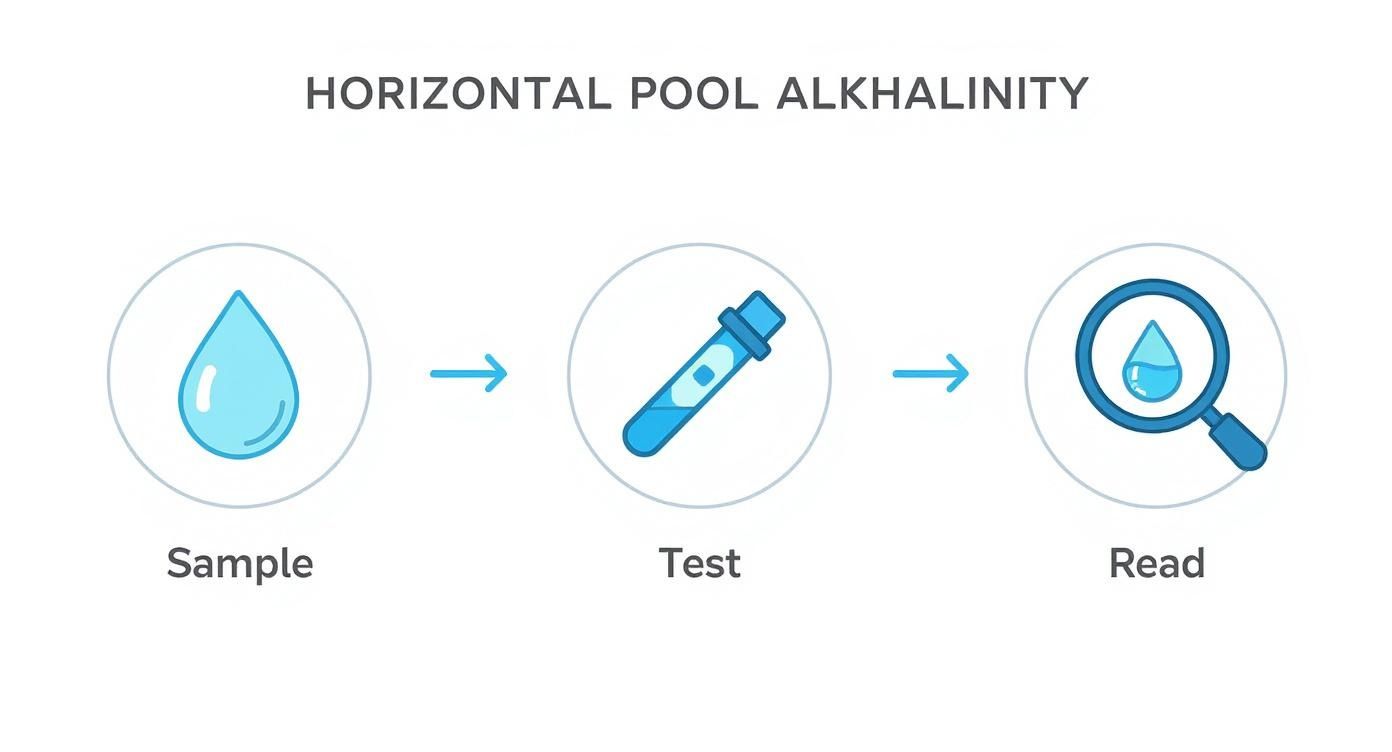
This graphic really drives home the point that your calculations are only as good as your initial test results. A bad sample or a misread strip will send you down the wrong path from the start.
Expert Tip: If your math calls for a large amount of baking soda (say, more than 10 pounds), don't add it all at once. We always recommend adding half the calculated amount first. Let the pump run and circulate it for at least six hours, then test the water again. It's far easier to add a little more than to deal with the headache of overshooting your target.
Of course, if you'd rather skip the math and chemistry lessons altogether, our professional pool maintenance plans can take care of it for you. We'll keep your water perfectly balanced so you can just enjoy the swim.
How to Add Baking Soda to Your Pool the Right Way
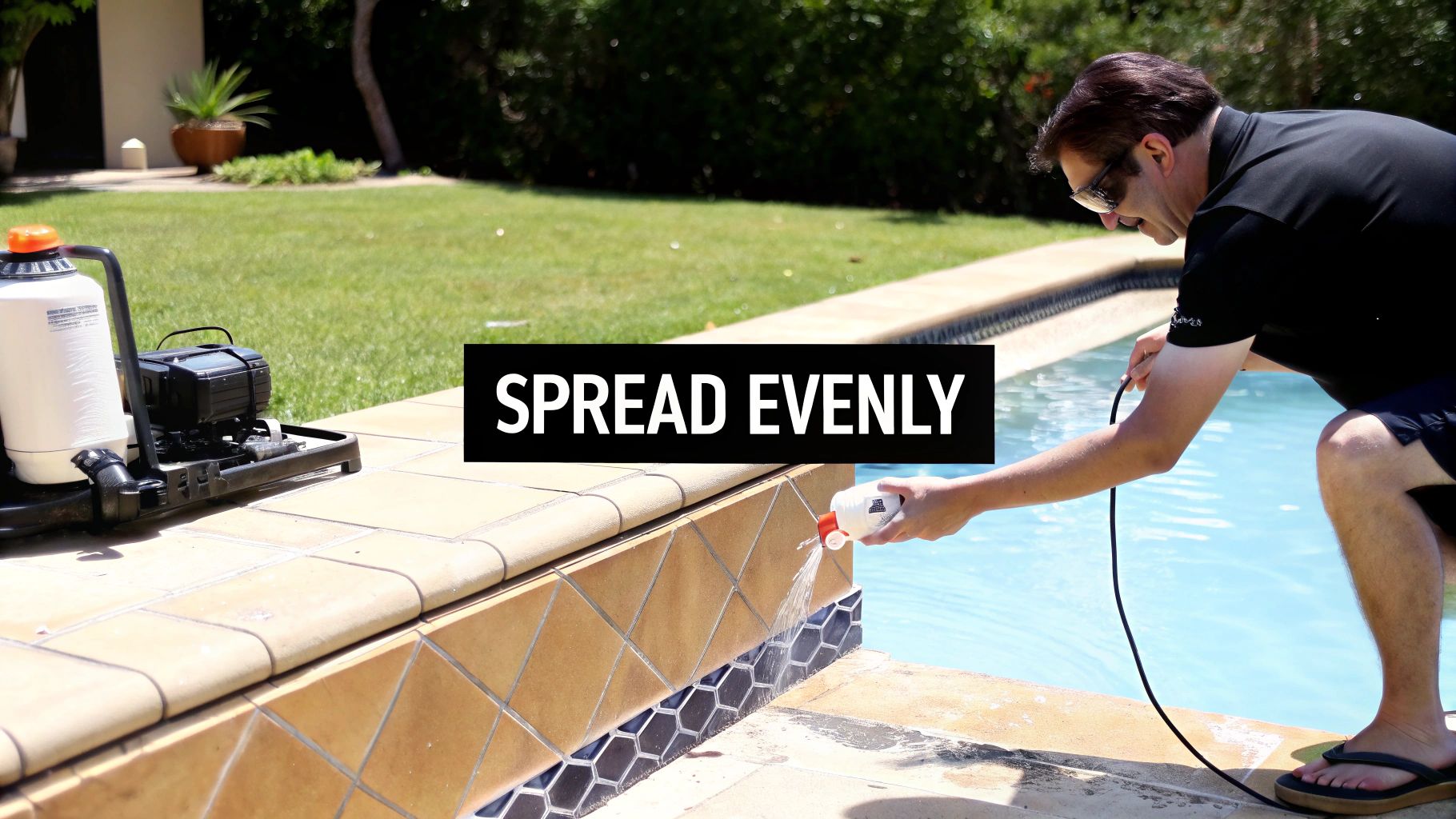
You've done the math, measured out your baking soda, and now you're ready to add it. But how you add it is just as important as how much you add. A lot of pool owners make the mistake of dumping it all in one spot or, even worse, pouring it directly into the skimmer. This can create cloudy water and prevent the baking soda from dissolving evenly.
First things first, get your pool pump running. This is a crucial step. You need that water circulating to help mix and dissolve the sodium bicarbonate as you add it.
The Broadcast Method
Once the pump is on, take your pre-measured baking soda and start walking around the edge of the pool. As you move, toss the powder out across the water's surface. You're aiming for a wide, even spread—kind of like you're feeding chickens. This simple technique spreads the baking soda over a larger surface area, which helps it dissolve much more quickly and effectively.
Don't panic if the water looks a bit hazy right after you're done. A little cloudiness is completely normal and temporary. Pool experts agree that broadcasting the baking soda helps it dissolve faster and more safely, and the haze usually clears up within a few hours as your filter does its thing. Sometimes, it might take up to a day to fully clear. You can get more details on what to expect when adding chemicals on backyardboss.net.
The biggest problem with just dumping it in is concentration. Pouring it all into the skimmer sends a highly concentrated slug of alkalinity straight through your plumbing and equipment. That's never a good idea. Broadcasting is always the gentler and more effective way to go.
This careful approach is a core part of our weekly pool service. Our technicians are trained to add every chemical perfectly to get the best results, so you never have to deal with cloudy water or worry about getting the dosage wrong. It’s the simplest way to keep your pool perfectly balanced without lifting a finger.
Now, What Happens After You Add the Baking Soda?
So you've added the baking soda. Great! But don't put your test kit away just yet. The most important part is confirming your work actually paid off.
Let the Water Circulate
First things first, you need to let your pump do its job. After you’ve broadcast the baking soda across the pool's surface, let the pump run for at least six hours. This is non-negotiable.
This circulation period is what ensures the baking soda dissolves completely and mixes evenly throughout the entire pool. If you test too soon, you'll be pulling a sample from a "hot spot," which will give you a completely skewed and useless reading.
Retest to Verify Your Levels
After six or more hours have passed, it's time to grab your test kit again. You're going to retest both your total alkalinity and your pH.
What you're looking for is a total alkalinity reading that has settled nicely into that 80-120 ppm sweet spot. That's your primary goal.
You’ll also want to keep a close eye on your pH. Baking soda is alkaline, so it will naturally nudge your pH upward. Just double-check that your pH is still in the ideal 7.4 to 7.6 range. If it crept up a bit too high, a small, careful dose of pH decreaser will bring it right back down.
Don't ever skip this final test. It's the only way to know for sure that your pool chemistry is dialed in and the water is safe and comfortable for swimming. Think of it like a chef tasting their dish before sending it out—it's just good practice.
This kind of ongoing testing and tweaking is the secret to a healthy, sparkling pool. If you'd rather spend your time swimming than playing chemist, our monthly maintenance packages can take all the guesswork out of the equation, ensuring your pool is always perfectly balanced and ready to enjoy.
Got Questions About Using Baking Soda in Your Pool?
If you're a pool owner, you've probably heard about using baking soda, and it's natural to have questions. We hear the same ones all the time, so let's clear things up and save you from some common (and sometimes costly) mistakes.
One of the biggest points of confusion is whether baking soda and soda ash are interchangeable. They are definitely not. Think of them as two different tools for two different jobs. Baking soda (sodium bicarbonate) is your go-to for gently raising total alkalinity without causing a huge spike in your pH. On the other hand, soda ash (sodium carbonate) is a much more potent base you'd use to aggressively raise pH when it's really low.
Will Baking Soda Clear Up My Cloudy Pool?
This is another popular question, and the straightforward answer is no, at least not directly. Baking soda isn't an algaecide or a clarifier. Its real job is to get your water chemistry in balance, specifically by stabilizing the total alkalinity.
So, how does that help? When your alkalinity and pH are in their sweet spot, your chlorine can finally do its job effectively. A balanced pool is a healthy pool, and that stability is what lets your sanitizer knock out algae and get rid of cloudiness. Baking soda is the supporting actor that makes your chlorine the star of the show.
While baking soda itself doesn't kill algae, keeping your alkalinity and pH balanced is crucial for maintaining stable chlorine effectiveness. This is the cornerstone of preventing algae in the first place, a concept you can explore further by seeing how experts balance different chemicals at Swim University.
How Often Should I Be Adding It?
Adding baking soda isn't something you do on a weekly schedule. You should only reach for it when your test kit tells you the total alkalinity has dipped below 80 ppm. It's a corrective measure, not a routine maintenance chemical. For more specific scenarios, you can always check our own pool FAQs page.
And yes, you can absolutely add too much. Going overboard is a classic rookie mistake that creates more headaches than it solves. An overdose can send your pH through the roof, leading to frustratingly cloudy water and scale buildup on your pool surfaces and equipment. That's a problem that can be tough, and expensive, to reverse.
Fixing an overdose isn't simple; it's a delicate rebalancing act that often requires a professional touch. Our technicians have the experience to diagnose the problem correctly and get your water chemistry back in line, saving you from the stress of chasing numbers and risking damage to your pool.
Stop guessing with your pool chemistry. Let the pros at Water Medic of Cape Coral provide the expert care your pool deserves. Visit us at https://watermedic.com to schedule a service and enjoy a perfectly balanced pool all season long.