
Remove sulfur well water: Quick Guide to Odor-Free, Safe Water
If you turn on your tap and are hit with that nasty rotten egg smell, you're not alone. It’s a common complaint we hear from well water users all over Southwest Florida. That odor is a dead giveaway for hydrogen sulfide gas, which is often produced by sulfur-reducing bacteria that have made a home in your plumbing.
To get rid of that smell for good, you first have to know exactly what you're up against. Pinpointing the source is the single most important step, which is why we always start with a professional diagnosis before recommending any equipment. Our expert technicians ensure you invest in the right solution, saving you time, money, and frustration.
Why Your Well Water Has That Rotten Egg Smell

That unmistakable rotten egg odor is more than just a nuisance—it’s a big, smelly red flag signaling a problem with your water quality. After years of helping homeowners from Cape Coral to Fort Myers, we’ve seen that this smell almost always comes back to hydrogen sulfide (H2S). This gas can either be dissolved in the groundwater itself or, more frequently, be created by bacteria.
Figuring out which one you have is everything. Why? Because the treatment for naturally occurring gas is completely different from the method needed to get rid of living bacteria. This is where many DIY attempts go wrong, leading to a temporary fix instead of a lasting solution. Our professional approach guarantees we solve the root cause, not just the symptom.
Hydrogen Sulfide Gas vs. Sulfur Bacteria
So, is the smell coming from the water itself or from something living in it? That's the first question our technicians answer when they arrive.
Use this quick comparison to help identify the source of the sulfur smell in your well water.
| Symptom | Hydrogen sulfide Gas | Sulfur Bacteria |
|---|---|---|
| Smell Origin | Consistent from both hot and cold taps. | Often stronger from the hot water side. |
| Slime | No slime present. | A black, white, or gray slime may coat pipes or toilet tanks. |
| Source | Naturally dissolved gas in the aquifer. | Microorganisms creating gas as a byproduct. |
While this table offers a good starting point, the only way to be certain is with proper testing. Distinguishing between the two can be tricky, but it's a vital part of our diagnostic process to ensure we recommend the right system from day one.
Expert Insight: A common mistake we see is homeowners buying a water softener to fix a sulfur smell. A softener is built to remove minerals like calcium and magnesium—it does nothing for dissolved gases like hydrogen sulfide. In fact, sulfur can ruin the resin inside a softener, leading to an even bigger, more expensive problem. Let our experts guide you to the correct solution.
The Problem Beyond The Smell
While the odor is what gets your attention, unaddressed sulfur issues can cause real, tangible damage to your home. Hydrogen sulfide is corrosive, and it will slowly eat away at metals.
Over time, you might start to notice:
- Ugly black or gray stains on your silverware, laundry, and sinks.
- Corrosion on copper, brass, and iron plumbing, which can lead to pinhole leaks.
- Your expensive appliances, like water heaters and dishwashers, failing years before they should.
These issues show why it's so critical to treat the root cause instead of just covering up the smell. A proper solution doesn't just give you better-tasting water; it protects your home's entire plumbing system and every appliance connected to it.
At Water Medic, we start with a free water analysis to get to the bottom of your sulfur problem, giving you a clear path forward to clean, odor-free water.
That rotten egg smell is unmistakable. If you're dealing with it in your Southwest Florida home, you know how frustrating it can be. But before you rush out and buy a water treatment system, let's take a step back. The single most expensive mistake we see homeowners make is trying to solve a sulfur problem without knowing exactly what’s causing it.
Getting the diagnosis right from the start is the foundation for a real, lasting solution. It’s the difference between wasting money on the wrong equipment and fixing the problem for good. The fix for sulfur in your well itself is completely different from the fix for a problem inside your water heater. Let's walk through how we pinpoint the source.
The First Clue: A Simple Sniff Test
You can get your first major clue right now, without any special tools. It's a quick diagnostic we call the "sniff test," and it immediately helps us narrow down where that hydrogen sulfide smell is coming from.
Go to any sink in your house. First, run only the cold water for about a minute. Take a sniff. Now, turn it off and run only the hot water. What do you notice?
- Smell from Cold Water Only? If you get that sulfur smell when you first turn on the cold tap but it fades away, we’re likely looking at sulfur bacteria. This bacteria can live in your well or even your plumbing, creating the gas as a byproduct.
- Smell from Hot Water Only? When the smell is exclusive to the hot water, the problem is almost always your water heater. This is a classic sign of a reaction with the unit's magnesium anode rod, which can create hydrogen sulfide gas inside the warm tank.
- Smell from Both Hot and Cold? A strong, persistent smell from both taps is the tell-tale sign of dissolved hydrogen sulfide gas in your groundwater. The gas is already in the water before it even enters your home.
This simple test gives us a solid starting point. But to design a system that will actually work, we need hard data.
Why Professional Water Testing Is a Must
The sniff test points us in the right direction, but it can't tell us the concentration of the problem. That's where a professional water test becomes non-negotiable. It's the only way to get the exact measurements needed to select and size the right equipment.
Hydrogen sulfide is the gas that creates that rotten egg odor, and your nose is incredibly sensitive to it. You can smell it at concentrations as low as 0.03 parts per million (ppm). Besides the awful smell, it leaves ugly black stains on fixtures, corrodes copper and brass pipes, and feeds sulfur bacteria that can clog your plumbing with a nasty slime.
A professional water analysis is like a blueprint of your water's unique chemistry. Without it, you’re just guessing. It’s the single most important step to guarantee that the system we install will work effectively for years to come.
Looking for Visual Evidence
Beyond the smell and the lab report, our technicians are trained to spot the physical evidence of a sulfur problem. These are clues that many homeowners might not notice but are clear indicators to a trained eye.
We're always on the lookout for:
- Black or Gray Stains: That hydrogen sulfide gas reacts with metals, leaving dark tarnish on silverware, black stains on plumbing fixtures, and even graying your laundry.
- Slimy Buildup: Sulfur bacteria often produce a black, gray, or sometimes reddish-brown slime. The easiest place to spot this is inside your toilet tanks or on faucet aerators.
- Corroded Pipes: During an on-site inspection, we check visible plumbing for any signs of corrosion. Hydrogen sulfide is particularly damaging to copper and brass pipes and fittings.
By combining these visual cues, the results of the sniff test, and the hard data from a professional water analysis, we get a complete picture. This thorough diagnostic process is how we ensure that when you invest in a solution from Water Medic, it's the right one—the first time.
For more answers to common questions we get from clients, check out our extensive well water FAQs.
Choosing the Right Sulfur Removal System
Once you've pinpointed the source of the sulfur smell, it's time to select the right equipment to get rid of it for good. This isn't a one-size-fits-all decision. The system that works perfectly for your neighbor might be completely wrong for your well, which is why matching the solution to your specific water test results is so critical.
With over 25 years of experience solving water problems for homeowners across Southwest Florida, we’ve pretty much seen it all. Let’s walk through the most reliable systems we recommend and install daily. My goal here is to help you understand your options so you can feel confident in your choice.
This decision tree is a great starting point, showing the initial diagnostic steps we take. It helps you figure out if the problem is coming from your hot water heater, the cold water lines, or both.

Simply put, this chart answers the first questions we always ask: Is the smell in the hot water, the cold, or everywhere? The answer points us directly toward the likely culprit and the best way to fix it.
Oxidation-Based Filtration Systems
By far, the most common and effective way to remove sulfur from well water involves a process called oxidation. It’s a simple concept: we convert the hydrogen sulfide gas (the source of the smell) into a solid particle of sulfur. Once it’s a solid, it's easy to filter out.
There are a few excellent ways to do this, and the best choice really depends on just how much sulfur is in your water.
Aeration Systems
Aeration is the most straightforward form of oxidation. It works by forcing oxygen into the water, which then reacts with the hydrogen sulfide gas. Think of it like shaking a bottle of soda to get the fizz out—aeration does something very similar to release the sulfur gas.
- How It Works: Water is sprayed through an air pocket inside a tank. This lets the sulfur gas escape while the water absorbs fresh oxygen.
- Best For: Lower levels of hydrogen sulfide, usually in the 4-6 ppm (parts per million) range or less.
- Pros: It's a chemical-free process that is low on maintenance and works wonders for mild to moderate odor problems.
Air Injection Filters
For the moderate-to-high sulfur levels we frequently see here, we almost always recommend an air injection filter. This is a much more advanced and powerful version of aeration, all neatly contained within a single tank.
These systems are a true game-changer for many homeowners. As water enters the tank, it passes through a pocket of compressed air at the top. This "air bubble" instantly oxidizes the hydrogen sulfide into solid particles, which are then immediately trapped by a specialized filter media in the bottom of the same tank. To see exactly how it's done, you can learn more about our air injection systems.
From our experience at Water Medic, a properly sized air injection system is the sweet spot for performance and efficiency, especially for the water conditions in Cape Coral, Fort Myers, and nearby areas. It's a powerful, self-cleaning solution that tackles sulfur, iron, and manganese all at once.
Chemical Injection Systems
Sometimes, we encounter wells with extremely high levels of hydrogen sulfide—often 10 ppm or more—or cases with stubborn sulfur bacteria that won't go away. When the problem is that severe, we need a more aggressive approach. This is where chemical injection systems really shine.
These systems use a small feed pump to inject a precise, controlled amount of an oxidizing chemical directly into your water line.
Chlorine Injection
Chlorine is a powerful, time-tested, and cost-effective oxidizer. It has been used in municipal water treatment for over a century for good reason: it works. It instantly neutralizes the rotten egg smell and provides the added benefit of killing sulfur bacteria and other unwanted microorganisms.
- How It Works: A pump injects a chlorine solution into your water. The water then flows into a "contact tank," which gives the chlorine enough time to work its magic. Afterward, a carbon filter removes any residual chlorine, so your water comes out tasting fresh and clean.
- Best For: High sulfur levels, serious sulfur bacteria issues, and situations where full disinfection is a priority.
- Cons: You'll need to refill the chemical solution tank periodically. The system also has more components than a simple air injection filter.
Hydrogen Peroxide Injection
For homeowners who prefer a non-chlorine solution, hydrogen peroxide is a fantastic alternative. It’s an even stronger oxidizer than chlorine and has the unique advantage of breaking down into just oxygen and water, leaving absolutely no chemical byproducts behind.
- How It Works: The setup is virtually identical to a chlorine system, but it uses hydrogen peroxide instead.
- Best For: High sulfur levels where a homeowner wants to avoid chlorine entirely. It’s incredibly effective but is generally a more expensive option than chlorine.
To make comparing these options a bit easier, we've put together a table that breaks down the most common treatment systems we use.
Comparing Sulfur Removal Treatment Options
| Treatment System | How It Works | Best For | Maintenance Level | Estimated Cost |
|---|---|---|---|---|
| Aeration System | Introduces oxygen to convert sulfur gas to a filterable solid. | Low sulfur levels (under 6 ppm). | Low | $$ |
| Air Injection Filter | Oxidizes and filters sulfur, iron, and manganese in a single tank. | Moderate to high sulfur levels. The most common solution in SWFL. | Low (Self-Cleaning) | $$$ |
| Chlorine Injection | Injects chlorine to oxidize sulfur and disinfect water, followed by a carbon filter. | Very high sulfur levels (10+ ppm) or severe bacteria issues. | Medium (Refill solution) | $$$$ |
| Hydrogen Peroxide Injection | Injects peroxide to oxidize sulfur; leaves no chemical residue. | High sulfur levels; for those wanting a non-chlorine alternative. | Medium (Refill solution) | $$$$$ |
Ultimately, the right choice for your home depends on the data from your free water analysis. We look at everything—hydrogen sulfide levels, pH, the presence of iron or manganese—and we also listen to you and your family’s daily water habits.
Armed with that information, we don't just sell you a piece of equipment. We design a complete water treatment solution that will deliver clean, odor-free water for years to come. It’s this expert-guided process that ensures you get it right the first time, giving you total confidence and peace of mind.
The Hidden Costs of Untreated Sulfur Water
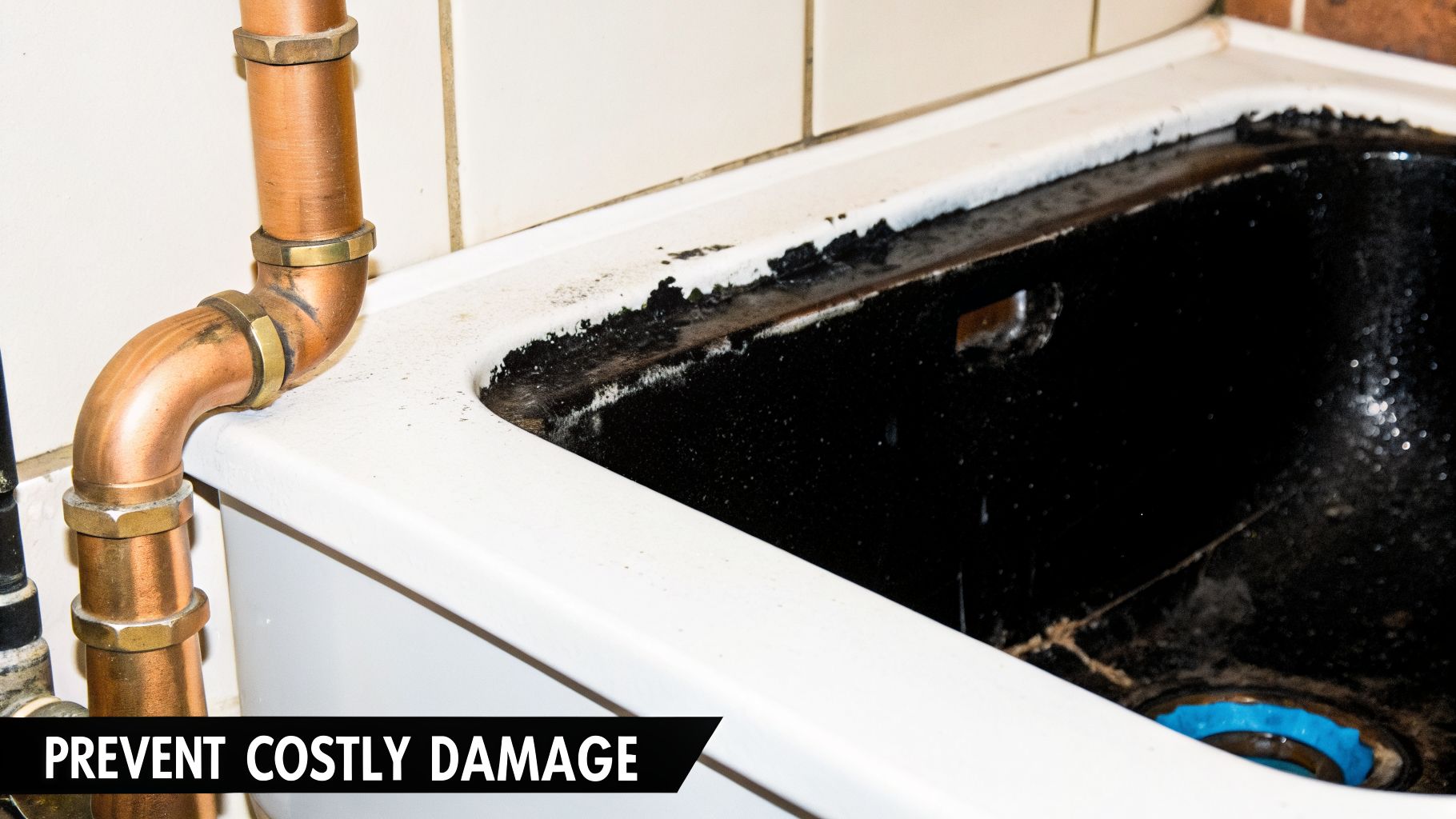
That rotten egg smell is what gets everyone's attention, but believe me, it's only the beginning of the problem. While the odor is what finally drives most Southwest Florida homeowners to call us, the real trouble with sulfur water is what you can't see—at least, not until the damage is already done.
Simply trying to ignore it is one of the most expensive mistakes you can make. The issues caused by hydrogen sulfide and high sulfates go way beyond your nose, affecting your family's well-being, your home's plumbing, and eventually, your bank account.
More Than Just an Odor: Health and Comfort
While the low concentrations of hydrogen sulfide that create the smell aren't a direct health risk, the high sulfate levels that often come with it are a different story. High sulfates are well-known for causing a laxative effect, which is especially disruptive for people who aren't used to drinking the water.
This can be a real issue for young children and elderly family members. Even your house guests might experience some pretty unpleasant digestive surprises. The EPA suggests that sulfate levels in private wells should stay below 500 mg/L. Once you get above 600 mg/L, the laxative effect can become much more pronounced, creating a bigger concern for more vulnerable people. You can find more detail on these health guidelines on nmtracking.doh.state.nm.us.
The Silent Destroyer: Hydrogen Sulfide's Corrosive Power
Here's where the real, long-term financial damage comes in. Hydrogen sulfide gas is incredibly corrosive, and it wages a quiet war on all the metal components in your home. This is where the decision to not remove sulfur well water can turn into a massive financial headache.
Think of it as a destructive force working 24/7 inside your pipes and appliances.
We see the results of this corrosion every day:
- Damaged Plumbing: Hydrogen sulfide is especially aggressive toward the copper and brass pipes found in countless Florida homes. Over time, it creates pits and pinhole leaks that are a nightmare to locate and repair.
- Appliance Graveyard: Your most expensive appliances are directly in the line of fire. We’ve seen water heaters, dishwashers, and washing machines fail years ahead of schedule because their internal metal parts were eaten away by sulfur.
- Ugly Staining: That stubborn black tarnish on your silverware and the ugly stains in your sinks, toilets, and bathtubs? That's the sulfur gas at work, and those stains are nearly impossible to get out, hurting your home's appearance and value.
A professional water treatment system from Water Medic isn't just about making your water smell better. It's an investment in protecting your home itself—preventing thousands in future repair bills and preserving your property value.
For most homeowners we talk to, the cost of replacing a high-end dishwasher or calling a plumber for a mystery leak is far more than the one-time cost of a proper sulfur removal system. When you fix the root cause, you're not just buying peace of mind; you're safeguarding your home from expensive, premature failures.
Keeping Your Water Clear: Long-Term Care for Your Sulfur Removal System
Putting in a quality sulfur removal system is the best thing you can do to get rid of that rotten egg smell for good. But like any important piece of home equipment, it needs a little TLC to keep it working perfectly. Protecting your investment means you’ll keep that clean, odor-free water flowing for years.
Think of it like the A/C unit that keeps your Florida home cool—you wouldn't just ignore it and hope for the best. A little preventative maintenance goes a long way in preventing surprise breakdowns and guaranteeing your family always has great-tasting water on tap.
What Routine Maintenance Looks Like
The specific upkeep your system needs will really depend on what kind you have and the unique water chemistry coming from your well. We always aim to install systems that are as low-maintenance as possible, but every setup has a few key tasks.
Here’s a quick rundown of the most common systems we work with in Southwest Florida:
Air Injection Filters: These are workhorses for a reason. They're highly effective and do most of the work themselves by automatically backwashing every few days. We still strongly recommend a yearly professional service call to make sure the air injector is clear and the filter media is still in good shape.
Chemical Injection Systems: If your setup uses a solution like chlorine or peroxide, your main job is simply to keep the tank full. Depending on how much water your family uses, this could be a quick monthly or quarterly task. It’s also a good idea to peek at the injection point every so often to make sure it isn't getting clogged.
A Pro Tip From the Field: For homes dealing with stubborn sulfur bacteria, we often suggest a shock chlorination of the well itself from time to time. This process uses a high dose of chlorine to eliminate bacteria living in the well and your home's plumbing, essentially giving your treatment system a fresh start.
The Peace of Mind of a Professional Maintenance Plan
While many homeowners can handle the basics, having a professional check on your system is a smart investment in its longevity. Our technicians have spent years in the field, so we can spot the subtle signs of wear that might otherwise go unnoticed until it's a bigger problem.
It's why we created our monthly maintenance plans. We wanted to give our customers an option where they never have to think about their water quality again. We handle everything—refilling solutions, testing water, checking pressures, and fine-tuning the settings so it’s always running at peak performance.
A properly maintained system isn't just another bill; it's a shield for your home. This kind of vigilance is especially important here. Groundwater quality is affected by decades of history, and sulfur is a big part of that story. For instance, sulfur dioxide emissions in the U.S. actually hit their peak way back in 1973. That long history of industrial emissions has contributed to the sulfates that accumulate in our local aquifers over time. This background helps explain why professional water treatment has become so essential for well owners in Southwest Florida.
When you work with Water Medic, you’re not just getting equipment. You’re getting a partner who is genuinely committed to the health and safety of your home's water. We make sure your system does its job flawlessly, so you don't have to.
Why Your SWFL Neighbors Choose Water Medic
When you're dealing with that rotten egg smell in your water, you need a partner who understands exactly what you're up against. Choosing the right team is a big deal, and for homeowners across Southwest Florida, that choice is often Water Medic. Why? Because after 25 years of working with wells in this region, we've seen it all—especially when it comes to the frustrating task of having to remove sulfur from well water.
We know it's about more than just a bad smell. It's about protecting your pipes and appliances from corrosive sulfur gas and ensuring the water your family drinks and bathes in is genuinely clean. Our goal isn't to sell you a temporary fix; it's to provide a real, lasting solution that solves the problem for good.
"Our well water had a terrible rotten egg smell. Water Medic came out, tested our water for free, explained the problem clearly, and installed a system that completely fixed it. The difference was immediate. We finally have clean water we can trust." – A recent customer review.
We’re Your Local Water Quality Specialists
Big national chains often apply one-size-fits-all solutions, but Southwest Florida's water is different. Our team lives and works right here in Cape Coral, Fort Myers, and the surrounding communities. We know the local aquifers and the specific mineral and bacterial issues that are common in our area.
This on-the-ground experience means we diagnose the problem correctly the first time. You won't have to worry about the cost and headache of installing the wrong equipment, because we know exactly which systems hold up and perform best right here in SWFL.
Let's Get That Sulfur Smell Handled for Good
Tired of that sulfur smell? The first step toward fixing it is simple, and it won't cost you a thing.
Here’s what you can expect when you call us:
- A Free, No-Strings-Attached Water Test: We’ll visit your home, run a complete analysis of your water, and show you exactly what’s going on.
- Honest, Clear-Cut Advice: You'll get a straightforward explanation of the results and a practical recommendation that fits your home's needs and your budget. No jargon, no pressure.
Getting clean, great-smelling water is easier than you think. Schedule your free water analysis with Water Medic today and let our experts show you what a difference the right solution can make.
Frequently Asked Questions About Sulfur Water
When that rotten egg smell hits your nose every time you turn on the tap, you’re bound to have questions. Here in Southwest Florida, we've pretty much heard them all. Let's walk through some of the most common ones we get from homeowners who are ready to remove sulfur well water for good.
Our job is to give you the real-world information you need to make a smart decision for your home and family. We find that a homeowner who understands their water is a homeowner we can best serve.
How Quickly Will a New System Remove the Sulfur Smell?
You'll notice the difference immediately. The moment a properly sized and professionally installed system from Water Medic is up and running, that rotten egg smell is gone. Gone.
The system treats water right as it comes into your house, which means every single faucet—from the kitchen sink to the shower—will deliver fresh, clean, odor-free water from the very first use. That instant relief is genuinely one of the best parts of what we do.
Will a Standard Water Softener Fix the Rotten Egg Smell?
This is a big one, and the answer is a hard no. A standard water softener is only designed to do one thing: remove "hard" minerals like calcium and magnesium through ion exchange. It simply isn't built to handle dissolved gases like hydrogen sulfide, which is the source of the sulfur smell.
Trying to use a softener to fix a sulfur problem is a common and expensive mistake we see all the time. Not only will it fail to get rid of the odor, but the sulfur gas can actually destroy the softener's resin bed over time. That leads to a much bigger, more costly replacement down the line. You need a dedicated system designed specifically for sulfur.
Expert Takeaway: While the low levels of hydrogen sulfide causing the odor are not generally seen as a direct health risk, that smell is a huge red flag for your water's overall quality. We always recommend getting a professional water test. Sulfur can point to other issues, like high sulfates or even certain types of bacteria, so it's critical to know exactly what's in your water.
Is It Safe to Drink Water That Has a Slight Sulfur Smell?
For the most part, yes. The tiny concentrations of hydrogen sulfide gas that your nose can detect aren't considered harmful to drink. The real issue is that the smell often travels with other, more problematic contaminants.
For example, high levels of sulfates (a related but different compound) can have a pretty unpleasant laxative effect. This is especially true for young children or even guests who aren't used to drinking your water. More importantly, the very conditions in your well that create sulfur can also be a breeding ground for certain bacteria. That's why we don't just put a band-aid on the smell; we diagnose and fix the root cause. You can learn more about our proven solutions, from air injection systems to our full-service maintenance plans, right on our site.
Ready to get that sulfur smell out of your life once and for all? Let the team here at Water Medic of Cape Coral give you a free, no-pressure water analysis. We'll find out exactly what’s causing the problem and map out a solution that lasts. Visit us at https://watermedic.com to schedule your appointment today.