How to Remove Arsenic from Water: A Practical Guide for Safer Drinking
Getting arsenic out of your water isn't as simple as just boiling it. Since it has no taste or smell, you need specialized treatment to deal with it, and the right approach really comes down to the specific kind of arsenic you're facing and how much of it is in your water. Technologies like reverse osmosis, adsorption media, and ion exchange are the heavy hitters here, designed to physically remove or capture arsenic particles. At Water Medic of Cape Coral, we specialize in identifying the exact problem and engineering the perfect solution for your home.
The Invisible Threat Hiding in Your Water
Here’s the unsettling part: arsenic could be in your tap water right now, and you’d never know it. Whether you're on a private well or city water, it's completely undetectable by taste, sight, or smell. This is why so many homeowners in Southwest Florida and beyond are caught off guard—they simply have no idea it's there until a professional water test reveals the problem.
Arsenic is a naturally occurring element in the earth's crust, so its presence isn't unusual. The danger lies in its concentration, which can spike in certain areas due to local geology, seeping from rocks and soil into the groundwater that feeds our wells and aquifers.
Arsenic III vs. Arsenic V
When we talk about arsenic in water, it's not a one-size-fits-all issue. It shows up in two main forms, and knowing the difference is absolutely crucial for choosing the right filtration system.
- Arsenic V (Arsenate): This is the oxidized form. The good news is that it's less toxic and much easier for most treatment systems to grab and remove.
- Arsenic III (Arsenite): This is the one you really need to watch out for. It's more toxic and notoriously difficult to filter. Most systems can't touch it without a pre-treatment step, like oxidation, to convert it into the much more manageable Arsenic V first.
Figuring out which type you have isn't optional—it's the most important first step. A filter that works great on Arsenate could be completely useless against Arsenite, leaving your family with a false sense of security. This is why our expert analysis is so critical.
How Arsenic Contaminates Water Supplies
Arsenic finds its way into groundwater through a few different pathways. While natural geological deposits are the main culprit, agricultural and industrial runoff can make things worse by introducing arsenic from old pesticides or wood preservatives into the water table.
This is a huge concern for anyone on a private well. Unlike city water, well water isn't under the same federal microscope for testing. If your well's casing or structure is compromised, it's even more vulnerable to contamination from the surrounding soil. If you suspect any kind of issue, looking into professional well water repair should be at the top of your list.
This problem is more common than you might think. Millions of Americans, especially those on private wells, could be drinking water with unsafe arsenic levels. A U.S. Geological Survey study found that at least 7 percent of wells they tested across the country had arsenic levels above the 10 parts per billion (ppb) standard set by the EPA. To get a sense of the global scale, the World Health Organization has some eye-opening facts. Protecting your home starts with understanding the bigger picture, which is why comprehensive water management solutions are so important.
The only way to know for sure what's in your water is to test it. Guesswork isn't an option when it comes to your family's health and safety.
The point isn't to scare you, but to arm you with the facts. The great news is that there are proven, effective ways to remove arsenic and make your water safe again. It all starts with recognizing the risk and getting an accurate, professional water test from a trusted team like ours.
Getting a Clear Picture with Accurate Water Testing
Before we can even talk about removing arsenic from your water, you have to know what you're dealing with. Guessing is not an option when your family's health is on the line. The only way to know for sure what’s in your water—and how much of it—is through precise, professional testing. This first step is the bedrock for every decision you'll make from here on out.
You might see DIY test strips at the hardware store and be tempted to grab one. For arsenic, I can tell you from experience they are notoriously unreliable. These simple tests just aren't sensitive enough to pick up on low—but still dangerous—levels of arsenic. Critically, they can't tell the difference between Arsenic III and Arsenic V, which is information you absolutely need to choose the right treatment system.
The Gold Standard: Certified Lab Analysis
For a truly accurate reading, there's no substitute for sending a water sample to a certified laboratory. This is the only process we trust and use here at Water Medic of Cape Coral. When our technicians come out to perform professional water testing, we follow an incredibly strict protocol to guarantee the sample is pure and the results are dead-on.
This isn't just about scooping some water into a vial. It involves a careful collection process to prevent any cross-contamination, which could easily throw off the entire reading. From there, the sample goes directly to an accredited lab that uses highly specialized equipment to pinpoint the exact type and concentration of arsenic in your water.
When the report comes back, you’ll see the arsenic level measured in parts per billion (ppb) or micrograms per liter (µg/L). The U.S. Environmental Protection Agency (EPA) has set the safety limit—the maximum contaminant level (MCL)—for arsenic at 10 ppb. Anything over that number is considered unsafe for long-term drinking.
Knowing your exact ppb level isn't just a detail; it's everything. A reading of 15 ppb requires a different game plan than a reading of 50 ppb, and the specific type of arsenic present will dictate the technology needed to get rid of it.
This isn't just a local concern. New Hampshire, for example, took the proactive step of lowering its state-level limit to 5 ppb, half the federal standard. The World Health Organization (WHO) also recommends a guideline of 10 µg/L, showing a global agreement on how serious this is. These standards really drive home why regular, accurate testing is so crucial for protecting your health. You can explore more on the health effects of arsenic via the NIEHS for a deeper dive.
Interpreting Your Water Test Results
Think of your lab report as a roadmap to a solution, not just a set of numbers. We sit down with our clients and walk them through the results, explaining what each value actually means for their home and their family.
Here’s what to focus on in your report:
- Total Arsenic Level: This is the big-picture number, showing the combined amount of all arsenic forms in your water.
- Speciation (As III vs. As V): A proper lab test will break this down for you, showing the percentage of each. This is essential because Arsenic III is the trickier one to filter out.
- Other Contaminants: The report will also list other elements like iron or manganese. High levels of these can actually interfere with certain arsenic removal systems, so it's good to know what you're up against.
With this detailed information in hand, you can finally move forward with confidence. The data from your water test directly points to the most effective and efficient filtration technology for your home, ensuring your investment truly delivers the safety and peace of mind you're looking for.
Choosing the Right Arsenic Removal System for Your Home
With your professional water test results in hand, you're now armed with the crucial data needed to choose the right defense for your home. I know the world of water filtration can seem complex, but when it comes to arsenic, it really boils down to a few proven technologies. Let's walk through how each one works so you can make a confident decision for your family.
We're going to look at the four heavy hitters for residential arsenic removal: Reverse Osmosis (RO), Adsorption Media, Ion Exchange, and Oxidation paired with Filtration. Each has its place, and the best fit for your home in Southwest Florida depends entirely on your specific water chemistry—especially the type and amount of arsenic you're dealing with.
This chart helps visualize that critical first step: getting your water tested properly.
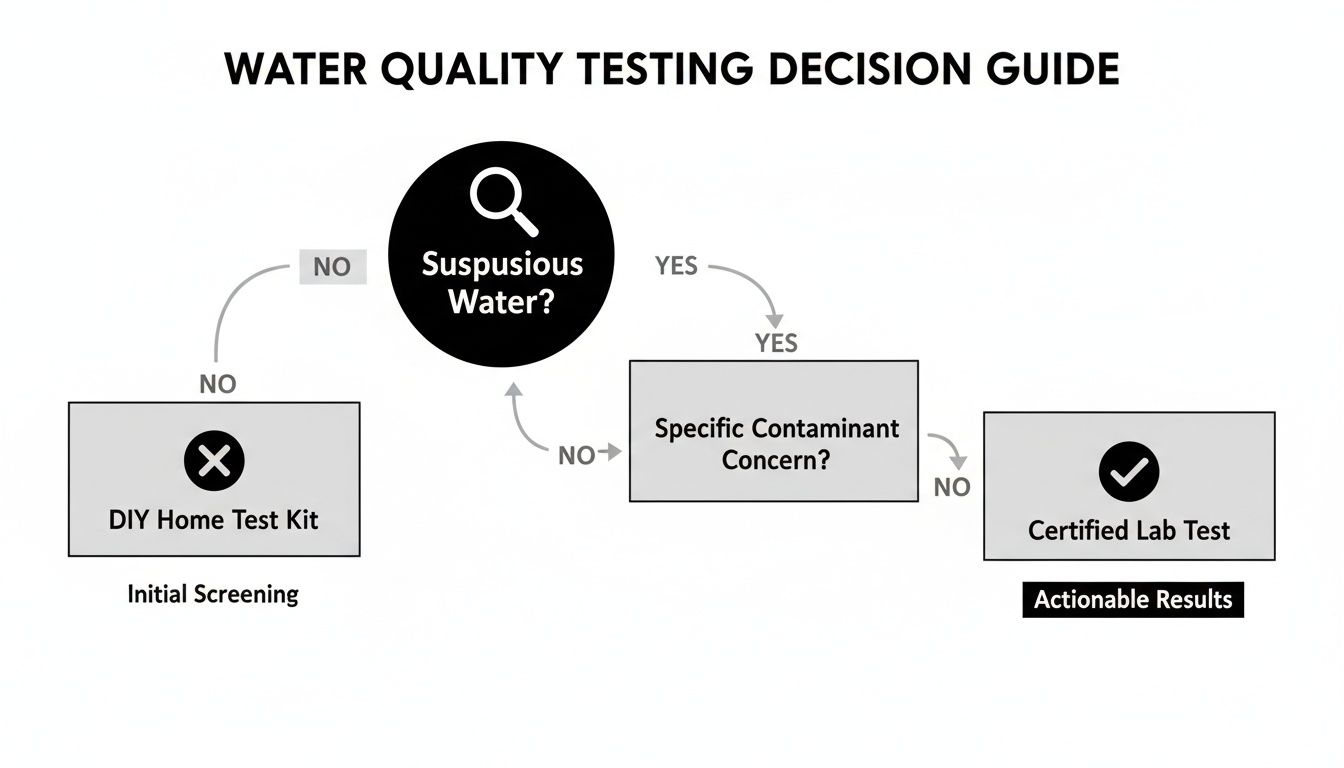
As you can see, a certified lab analysis is the only reliable way to pinpoint contaminants like arsenic. DIY kits just don't provide the accuracy you need for a health-related concern like this.
Reverse Osmosis: The Gold Standard for Purity
When customers ask for the most effective and reliable solution for arsenic in their drinking water, my answer is almost always Reverse Osmosis, or RO. The best way to think of it is as an incredibly fine molecular sieve. Your water pressure pushes water through a special semipermeable membrane with pores so tiny that only pure H₂O molecules can squeeze through.
Arsenic ions, along with a whole host of other unwanted guests like lead, nitrates, and dissolved solids, are simply too large to pass. They get blocked and flushed down the drain, leaving you with exceptionally clean, safe drinking water.
Why We Recommend RO: Reverse Osmosis stands out because it's one of the few technologies that reliably removes both forms of arsenic—Arsenic V (arsenate) and, to a very high degree, the more dangerous Arsenic III (arsenite). Its ability to tackle so many contaminants at once makes it a superior all-in-one solution for total water purity.
It's tough to overstate the effectiveness of a quality RO system. You're not just solving an arsenic problem; you're putting up a powerful barrier against a wide spectrum of impurities. For homeowners seeking the ultimate peace of mind at the tap, an under-sink reverse osmosis system is a fantastic investment in their family’s health.
Adsorption Media: A Targeted Approach
Adsorption media systems work kind of like a chemical magnet. Inside a tank, there's a specialized granular material, usually an iron oxide-based media. As your water flows through it, arsenic ions are attracted to and stick onto the surface of this media.
This method is highly effective, but it comes with a big "if": it only works on Arsenic V. If your water test reveals a significant amount of the trickier Arsenic III, you'll need a pre-treatment step (like an oxidation system) to convert it into Arsenic V before it gets to the adsorption tank.
Because of this, we often use adsorption as one part of a larger, multi-stage treatment plan rather than as a standalone fix. It’s a powerful tool, but it has to be matched perfectly to your water’s chemical profile to do its job.
Ion Exchange: The Swapping Method
Ion exchange operates on a simple principle of substitution, much like a standard water softener. The system has a tank filled with a special resin that's covered in harmless chloride ions. When water containing arsenic (specifically, Arsenic V) flows through, the arsenic ions are drawn to the resin and "swap places" with the chloride ions.
In short, the system grabs the arsenic and releases a tiny, harmless amount of chloride into the water.
Like adsorption, this technology is only effective against Arsenic V. It also needs careful planning, because other things in the water, like high levels of sulfates, can compete with the arsenic for a spot on the resin, making the system less efficient over time.
Oxidation Plus Filtration: A Two-Step Strategy
This isn't a single piece of equipment but rather a two-step strategy, specifically designed to deal with the hard-to-remove Arsenic III.
First, an oxidizing agent like chlorine or ozone is introduced into the water. This forces the Arsenic III to change its chemical state into the much easier-to-capture Arsenic V. Once that conversion happens, the water then flows through a secondary filtration system—like an adsorption tank or even an RO unit—which can now easily remove the Arsenic V.
This combination is a fantastic solution for well water with high levels of Arsenic III. However, it’s a more complex setup that absolutely requires professional design and installation to work safely and correctly. With over two decades of experience, we at Water Medic of Cape Coral specialize in engineering these precise systems for Florida homes.
Comparing Arsenic Water Treatment Technologies
Choosing the right technology involves balancing effectiveness, cost, and ongoing maintenance. This table breaks down the key differences between the most common arsenic removal methods to help you see how they stack up.
| Treatment Method | Effectiveness (As V) | Effectiveness (As III) | Typical Cost | Maintenance Needs |
|---|---|---|---|---|
| Reverse Osmosis (RO) | 90-99% | 70-90% | $$ | Semi-annual/annual filter and membrane replacement. |
| Adsorption Media | 90-99% | Poor (requires pre-oxidation) | $$$ | Media replacement every 3-5 years, depending on usage. |
| Ion Exchange | 90-99% | None (requires pre-oxidation) | $$$ | Regular salt/brine regeneration; resin replacement every 5-10 years. |
| Oxidation + Filtration | N/A (converts As III to As V) | 90-99% | $$$$ | Maintenance of both the oxidation system and the subsequent filter. |
Each system has its pros and cons, and the "best" one is always the one that's tailored to your specific water test results, your budget, and how much hands-on maintenance you're comfortable with. Our team excels at guiding you to the most practical and effective solution.
Whole House vs. Point-of-Use Filtration Systems
So, you've figured out which technology will get the arsenic out of your water. The next big question is where to treat it. Are you targeting just the kitchen sink for drinking and cooking, or do you need to protect every tap in the house? This is the classic whole-house versus point-of-use decision, and it’s not a one-size-fits-all answer.
Choosing the right scope is all about balancing total protection against your budget and practical needs. Let’s walk through the pros and cons with some real-world examples to make the choice crystal clear.
Defining Your Filtration Strategy
First, let's nail down the lingo. It’s pretty straightforward and just describes where the magic happens in your plumbing.
- Point-of-Use (POU) Systems: Think small and specific. These are compact units that treat water at a single outlet, like an under-sink system that feeds a special, dedicated faucet right next to your main one.
- Point-of-Entry (POE) Systems: These are the big guns, also known as whole-house systems. We install these right where the main water line enters your home, ensuring that every drop of water—from the shower to the washing machine—is treated.
To decide which is right for you, we need to look at your water test results and how you live your life.
When a Point-of-Use System Makes Sense
For many people, a POU system is the perfect, targeted solution. Let's say your water test shows arsenic levels just slightly over the 10 ppb EPA limit. Your main worry is what you and your family are ingesting—the water you drink, make coffee with, or use to cook rice.
In this common scenario, an under-sink reverse osmosis system is a fantastic and cost-effective choice. It gives you incredibly pure water precisely where you need it most, without the larger investment of a whole-house setup. You get total peace of mind about your drinking water, which is always the top priority.
The Case for Whole-House Protection
Now, picture a different homeowner. A family here in Cape Coral on a private well gets a water test back showing 30 ppb of arsenic. At that concentration, the concern is no longer just about drinking it.
Arsenic can actually be absorbed through the skin during a long, hot shower. Worse, certain contaminants can become airborne in the steam, meaning you could inhale them.
For this family, a whole-house (POE) system isn't a luxury; it's a necessity. It guarantees that the water for showering, bathing the kids, washing clothes, and even rinsing lettuce is completely safe. This is about eliminating every possible path of exposure and creating a truly safe haven in your home.
A whole-house system isn't just about filtering drinking water; it's about creating a safe water environment for your entire family. When dealing with higher contamination levels, especially from a private well, this is the definitive solution.
It's also worth remembering that tap water isn't the only concern. Studies have shown arsenic can be present in foods and even some bottled water brands above the legal limit. This really drives home the value of treating all the water you use for cooking and washing produce. You can explore the full scope of arsenic contamination sources to get a better picture.
If you're still weighing the options, the easiest next step is to schedule a free consultation. One of our water specialists can look at your test results and help you find the perfect solution for your home.
Installation, Maintenance, and Long-Term Performance
Think of your water treatment system like any other major appliance in your home. It’s a serious investment in your family’s health and your property's value. To make that investment count, you have to look beyond the initial purchase. Proper installation and consistent maintenance are what truly guarantee safe, arsenic-free water for the long haul.
The job isn’t done once the system is installed. In many ways, it’s just beginning. The long-term success of any arsenic removal system, whether it’s a whole-house unit or a simple under-sink filter, absolutely depends on getting the setup right and sticking to a maintenance schedule.
Why Professional Installation Is a Must
I get the appeal of a good DIY project, but this isn't the time to test your plumbing skills. Arsenic removal systems are complex pieces of equipment that have to be integrated perfectly into your home's water supply. One wrong connection can lead to major headaches—leaks, a significant drop in water pressure, or even a system bypass that sends contaminated water right past the filter and into your tap.
On top of that, nearly every manufacturer’s warranty will be voided if the system isn't installed by a licensed and certified technician. Our team at Water Medic of Cape Coral handles this every day. We make sure every fitting is tight, every setting is calibrated, and the system is running at peak performance from day one. That professional touch protects both your home and your warranty.
Understanding Your Ongoing Maintenance Checklist
Every water treatment system needs regular attention to keep doing its job. The specific tasks and how often you need to do them really come down to the type of system you have and how much water your family uses.
Here’s a realistic look at what to expect from the most common systems:
- Reverse Osmosis (RO) Systems: These are the most hands-on. The pre-filters, which catch sediment and chlorine before they reach the main membrane, will need to be swapped out every 6 to 12 months. The RO membrane itself—the heart of the system—usually has a lifespan of 2 to 4 years.
- Adsorption Media Systems: The special media that grabs and holds onto the arsenic will eventually get saturated. Depending on your arsenic levels and water usage, you’ll need a complete media replacement every 3 to 5 years.
- Ion Exchange Systems: These work a lot like a standard water softener. Your main job is simply keeping the brine tank filled with salt so the system can regenerate its resin and continue removing arsenic.
Skipping maintenance on your water system is like never changing the oil in your car. Sooner or later, things will clog up, stop working, and fail. The worst part is you might not even realize it’s happening until arsenic is already back in your water.
We know life gets busy. That's why we offer plans that take all the guesswork out of it. By checking out our professional monthly maintenance services, you can let us handle the scheduling, parts, and technical work, so your system is always protecting your family.
A Transparent Look at Long-Term Costs
It's crucial to budget for more than just the equipment and installation. The true cost of ownership includes all the ongoing expenses—replacement filters, new media, bags of salt, and service calls. A reverse osmosis system might look cheaper upfront than a big whole-house adsorption tank, but its annual filter costs need to be part of your financial planning.
We're big believers in full transparency. When we sit down with you, we'll give you a clear, honest breakdown of the initial investment and the estimated annual maintenance costs for any system we recommend. This way, you can make a truly informed choice that fits your family's safety needs and your budget for years to come.
Your Arsenic Removal Questions Answered
After digging into the tech and strategies for getting arsenic out of your water, it's completely normal to have a few more questions pop up. Let's tackle some of the most common ones we hear from homeowners right here in Southwest Florida to make sure you're confident about what to do next.
Can I Just Use a Standard Water Pitcher Filter?
This is a big one, and the answer is a firm no. Those common carbon filters in your fridge or a standard pitcher are great for making your water taste better by pulling out things like chlorine. They do absolutely nothing for arsenic.
To truly get rid of arsenic, you need a system built for the job. We're talking about specialized technology like an under-sink reverse osmosis system that is specifically certified to reduce arsenic. Don't rely on a simple pitcher filter for this kind of contaminant.
How Often Should I Get My Water Tested Again?
Once you have a good system in place, don't just set it and forget it. We always tell our clients to re-test their water once a year. This is especially crucial if you're on a private well, as the groundwater here can change with the seasons, rainfall, or even what's happening on a neighbor's property.
Annual testing does two key things:
- It proves your equipment is still working exactly as it should be.
- It gives you that continued peace of mind that your arsenic levels are well below the EPA's 10 ppb action level.
Is This a DIY Installation Job?
While you might see some point-of-use filters advertised for DIY installation, I’d strongly advise against it for a whole-house arsenic treatment system. Proper installation is everything. Get it wrong, and you could be dealing with leaks, low water pressure, or a system that isn't even removing the arsenic correctly.
A botched installation can void your warranty and, more importantly, it means you're not getting the protection you paid for. Having a certified pro from Water Medic of Cape Coral handle the install ensures it’s done right from the start, safeguarding your investment and your family's health.
Ready to make sure your water is safe? The team at Water Medic of Cape Coral has the local expertise for professional testing, system design, and installation. Schedule your free water analysis today!