How to Choose a Water Softener for Your Florida Home
If you’re fed up with spotty dishes, laundry that feels like cardboard, and a never-ending battle with soap scum, you’re not alone. That’s just life with Florida’s notoriously hard water. But figuring out how to choose a water softener is about more than just convenience—it’s about protecting your home's most vital systems from slow, expensive damage.
Why a Water Softener Is a Necessity in Florida
Living in Southwest Florida has its perks, but the water isn't one of them. Our unique limestone geology means our groundwater is packed with calcium and magnesium. While these minerals are safe to drink, they’re absolute murder on your home.
This is the real reason behind so many common household headaches. That chalky film on your shower door? Limescale. The brand-new coffee maker that’s already struggling? Mineral deposits are probably choking its internal parts, killing its efficiency and shortening its lifespan.
The Silent Damage to Your Home's Infrastructure
The stuff you can see is annoying, sure. But the real trouble is brewing where you can’t see it—inside your pipes, your water heater, and your appliances. Every time you turn on the tap, hard water leaves behind rock-like scale that builds up, layer by layer.
Eventually, this leads to some serious problems:
- Reduced Water Flow: The scale literally chokes your pipes, leading to frustratingly low water pressure.
- Appliance Failure: Your water heater, dishwasher, and washing machine have to work much harder to do their jobs, which means they break down sooner.
- Skyrocketing Energy Bills: Get this—a scale layer just one-sixteenth of an inch thick in your water heater can jack up its energy use by as much as 15%.
When you look at it that way, a water softener stops being a luxury and starts looking like a smart investment. It’s about protecting your home from the inside out. A good system removes those hardness minerals right where the water comes in, preventing damage before it ever has a chance to start.
Investing in a Professional Solution
Homeowners are catching on. The global water softener market, recently valued at around USD 3.3 billion, is expected to more than double, hitting USD 6.8 billion by 2034. That kind of growth shows people understand that proper water treatment is essential. For a deeper dive into these numbers, you can check out the full research on water softener industry growth.
Choosing the right water softener isn’t just about making your soap lather better. It’s about asset protection. You’re safeguarding your plumbing, extending the life of your appliances, and ultimately, maintaining your home's value.
For those of us in Florida, a big-box store solution rarely cuts it. Our water conditions, especially for homes on a well, bring unique challenges that require real expertise. That’s where getting professional advice makes all the difference. At Water Medic of Cape Coral, we don’t just sling boxes. We start with a detailed analysis of your water to design a solution that actually works for your home. We know the specific mineral profiles in our area and can recommend a system built to handle it, keeping your home protected for the long haul.
Start by Understanding Your Home's Water Quality
Jumping straight into buying a water softener without knowing what’s actually in your water is a classic rookie mistake. It's like buying a new set of tires without knowing your car's model—you might get lucky, but you'll probably end up with something that doesn't fit. To make the right choice, you first need a clear picture of your home's unique water chemistry.
You've probably already seen the tell-tale signs of hard water. That stubborn white crust on your faucets and showerheads? The sticky soap scum that never seems to rinse away? That dry, itchy feeling on your skin after a shower? Those are all clues that your water is loaded with dissolved minerals, mostly calcium and magnesium.
Getting a Precise Measurement of Water Hardness
Noticing the signs is a good start, but a hunch won't help you pick the right equipment. Water hardness is officially measured in Grains Per Gallon (GPG). You can grab a simple DIY test kit from any hardware store to get a ballpark GPG reading, and that's a decent first step.
But here’s the thing: those kits often miss the bigger picture. Especially here in Southwest Florida, hardness is just one piece of the puzzle. Our water sources can be a cocktail of other unwelcome elements that a basic strip test will never detect.
- Iron: This is the usual suspect behind those ugly reddish-brown stains in your sinks, toilets, and laundry.
- Chlorine: While necessary for municipal treatment, high levels can leave your water tasting and smelling like a swimming pool.
- Sulfur: If your water has that distinct "rotten egg" smell, you can thank sulfur. It's especially common in well water around here.
A generic test kit won't flag these problems, which means you could easily spend good money on a system that only solves half the issue.
Why a Professional Water Analysis Is Crucial
This is where a professional analysis really proves its worth. Our comprehensive water tests go far beyond a simple GPG measurement. We pinpoint the exact levels of hardness minerals, iron, chlorine, tannins, and other specific contaminants we see every day in Cape Coral and the surrounding areas.
For homeowners on private wells, this step isn't just important—it's non-negotiable. Well water chemistry can change dramatically from one property to the next and might contain bacteria or other elements you won't find in city water. If you have questions about your well, we put together a guide covering many common well water FAQs.
Getting a detailed breakdown of your water's chemistry is the single most important step. It ensures you don't just buy a water softener, but the right water treatment solution for every issue your water presents.
Local water conditions play a huge role in this. The United States water softening systems market is growing at a CAGR of 6.5%, and that growth is supercharged in places with naturally high mineral content. Regions like the Midwest and Southwest—including our home state of Florida—have some of the hardest water in the country. For homeowners here, this isn't just a "nice-to-have." Our hard groundwater and the constant risk of saltwater intrusion make effective water treatment essential for protecting our homes and appliances. Understanding these local quirks is key to choosing a system that’s sized and configured correctly for the job. You can find more market insights on the water softening systems market on FutureMarketInsights.com.
Ultimately, a professional water analysis takes all the guesswork out of the equation. Instead of crossing your fingers and hoping a generic system will work, you'll have a precise roadmap to clean, soft water. When you schedule an analysis with us, we deliver a clear, actionable report on your water quality, setting the stage for a solution that truly meets your home's needs.
Picking the Right Water Softener for Your Home
Alright, so you've tested your water and know what you're up against. Now comes the fun part: figuring out which machine will actually solve your hard water problem. The market is flooded with options, but they are absolutely not created equal, especially when dealing with the kind of water we have here in Southwest Florida.
Choosing the right system means picking one that tackles your specific issues head-on. To do that, it really helps to understand the mechanics of water softeners and why some systems physically pull minerals out while others just change their behavior.
Salt-Based Ion Exchange: The Gold Standard
Let's start with the classic: the salt-based ion exchange water softener. This is the workhorse of the industry for a very good reason—it’s the only technology that physically removes the hard minerals, calcium and magnesium, from your water.
Here’s how it works: Water passes through a tank filled with resin beads. These beads grab onto the hardness minerals and swap them out for harmless sodium ions. The result? Genuinely soft water that stops scale in its tracks, protects your pipes, and makes your appliances last longer.
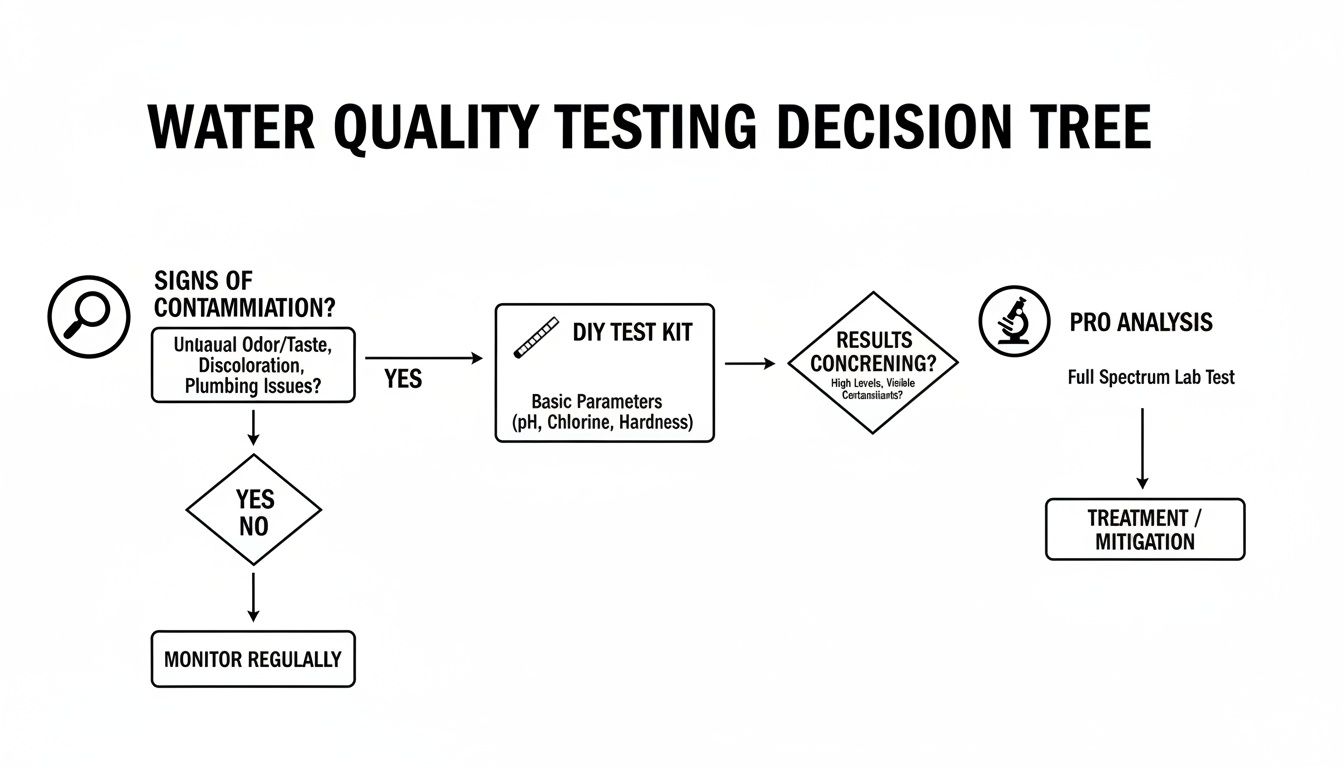
This flowchart shows that while seeing the signs of hard water is a good start, getting a professional analysis is the surest way to find the right long-term solution.
Salt-Free Systems: A Different Approach
Then you have salt-free systems, which are often called "water conditioners." It's a critical distinction. These systems don't actually remove the hardness minerals. Instead, they use a process like Template Assisted Crystallization (TAC) to change the minerals' structure, making them less likely to stick to surfaces and form scale.
While they can reduce some scale buildup, they don't give you the other benefits of truly soft water. You won't get that silky feeling in the shower, your soap won't lather as well, and your appliances won't be fully protected. For the moderate to severe hardness common in Cape Coral, a salt-free conditioner often just doesn't cut it. For certain applications, however, they can be a fit. You can learn more about this technology by exploring the benefits of our ScaleNet Salt-Free Water Conditioner.
Salt-based systems solve the root problem by removing hardness minerals entirely. Salt-free systems only manage a symptom—scale—without actually softening the water. For complete protection, removal is always the better choice.
Dual-Tank and Other Alternatives
What if you have a big family or really, really hard water? A dual-tank water softener might be the answer. These systems have two resin tanks. When one tank needs to regenerate (clean itself), the other one kicks in. This guarantees you have a continuous, 24/7 supply of soft water, which is perfect for a family of five or a home with high water demand.
You might also come across magnetic water softeners. These gadgets claim to use magnetic fields to prevent scale. While the idea is interesting, their effectiveness is still widely debated and can vary dramatically depending on your specific water chemistry.
To help you sort through this, here’s a quick comparison of the most common technologies.
Water Softener Technology Comparison
| System Type | How It Works | Best For | Maintenance Level |
|---|---|---|---|
| Salt-Based Ion Exchange | Physically removes hardness minerals (calcium & magnesium) and replaces them with sodium ions. | Homes with moderate to severe hardness; homeowners wanting all the benefits of soft water (no scale, better soap lather, appliance protection). | High. Requires regular salt refills and occasional service. |
| Salt-Free Conditioner | Alters the structure of hardness minerals to prevent them from forming scale. Does not remove them. | Homes with low to moderate hardness where scale reduction is the only goal. | Low. No salt or electricity needed. The media needs to be replaced every 3-5 years. |
| Dual-Tank Softener | A salt-based system with two resin tanks for a continuous, uninterrupted supply of soft water. | Large households, homes with very high water usage, or properties with extremely hard water. | High. Same salt requirements as a single-tank system, but offers more convenience. |
| Magnetic "Softener" | Uses magnets to alter the properties of water. Effectiveness is debated and not scientifically proven. | Homeowners looking for a low-cost, experimental option. Not recommended for serious hard water issues. | Very Low. No salt or media replacement required. |
Ultimately, the goal is to find a system that’s proven to work where you live.
After 25 years of dealing with the specific water challenges here in Southwest Florida, we’ve found that salt-based ion exchange systems consistently deliver the most reliable and effective results. We stand by them because they offer a real, long-term solution to protect your home and improve your day-to-day life.
How to Calculate the Right System Size and Capacity
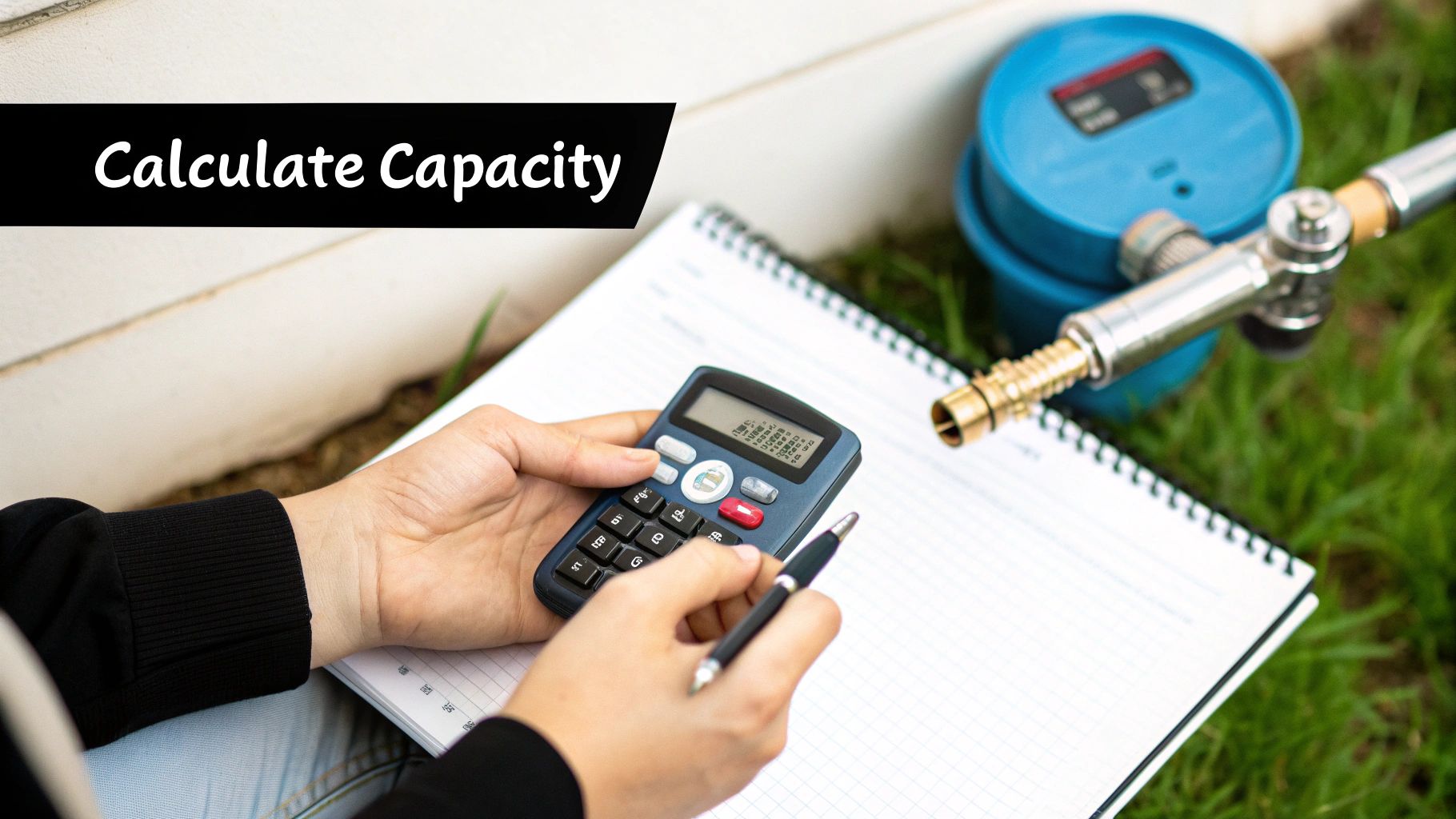
Picking the right size water softener isn’t just a small detail—it's everything. Get it wrong, and you’re in for a world of frustration. A system that’s too small will constantly be running to catch up, burning through salt and water. Go too big, and you’ve just overpaid for capacity you’ll never use.
The goal is to hit that sweet spot. Luckily, you don't need a math degree to get a solid estimate of what your home needs. It all boils down to a pretty simple calculation.
The Sizing Formula Explained
To figure out the right capacity, we need to calculate your home's daily softening requirement. This is just a fancy way of saying we need to know how many "grains" of hardness your softener has to pull out of the water each day before it needs to clean itself (a process called regeneration).
Here’s the straightforward formula the pros use:
(Number of People) x (Daily Water Use) x (Water Hardness in GPG) = Daily Grains to Remove
Let's break down each part so you can see exactly how it works.
Step-by-Step Calculation
First off, how many people live in your house? Easy enough.
Next is daily water usage. While every family is different, a reliable industry benchmark is 80 gallons per person, per day. This number gives us a great starting point, accounting for showers, laundry, dishes, and everything in between.
Finally, you’ll need the hardness level of your water in Grains Per Gallon (GPG), which you should have from your water test. This is the key number that tells us what we're up against.
Let’s run the numbers for a typical Cape Coral family:
- Family Size: 4 people
- Daily Water Use: 80 gallons per person
- Water Hardness: 20 GPG (a common reading in our area)
Now, we just plug those into the formula:
4 people x 80 gallons/person x 20 GPG = 6,400 grains per day
So, this family's softener needs the capacity to remove 6,400 grains of hardness minerals every single day.
A correctly sized water softener should regenerate about once a week. This is the ideal rhythm for balancing salt efficiency, water usage, and the long-term health of the system.
Understanding Grain Capacity
With that daily number in hand, you can now shop for a system with the right grain capacity. This is the big number you see in the model name—like a 32,000-grain or 48,000-grain system. It tells you the total amount of hardness the unit can remove before it has to regenerate.
For our example family needing to remove 6,400 grains daily, a 32,000-grain system is a great fit. It would go about five days between regeneration cycles (32,000 ÷ 6,400 = 5), which is very efficient.
What happens if they choose the wrong size?
- An undersized 24,000-grain unit would have to regenerate every 3-4 days, wasting a ton of salt and water over its lifespan.
- An oversized 64,000-grain unit would only regenerate every 10 days. This might sound good, but letting the resin bed sit for that long can cause problems, and you've paid a premium for capacity you aren't using.
While this math gets you in the ballpark, nothing beats a professional assessment. Our experts at Water Medic of Cape Coral can perform a detailed on-site evaluation to dial in your exact needs, ensuring you invest in a solution—like one of our whole house reverse osmosis systems—that's perfectly matched to your home for peak efficiency and savings.
Evaluating Long-Term Costs and Professional Installation
It’s easy to get fixated on the sticker price when you're shopping for a water softener. But trust me, that initial number is just the first chapter of a much longer story. The real cost—or the real savings—reveals itself over the next decade as you live with the system day in and day out.
The upfront purchase is just one piece of the puzzle. You have to think about the ongoing expenses that keep it running smoothly. For most people with salt-based systems, that means salt. How much salt you'll go through depends entirely on how efficient your unit is and how much water your family uses.
This is where getting some expert advice really pays off. A professional can size and calibrate a system that sips salt and water during its cleaning cycles, which has a direct impact on your budget. On the flip side, a poorly chosen or badly configured unit can become a constant, quiet drain on your wallet.
The True Cost of a DIY Installation
I see it all the time: homeowners trying to save a few hundred bucks by installing the system themselves. While it might seem doable if you're handy, it’s a gamble that almost never pays off in the long run. One tiny mistake with plumbing can spiral into a huge, expensive disaster.
Picture this: an improperly installed drain line. Instead of flushing the salty brine safely outside, it leaks or, even worse, backs up. Now you’re not just dealing with a water softener; you’re dealing with a flooded garage and the nightmare of water damage remediation. That "savings" just evaporated.
Here are a few very real risks of going the DIY route:
- Voiding Your Warranty: Most manufacturers are pretty clear that their warranty is only valid with professional installation. If you do it yourself, you could be completely on your own for any future repairs or parts.
- Wasting Salt and Water: A pro will program your system based on your actual water test results. A DIY job usually means leaving it on the factory default settings, which almost guarantees it will use more salt and water than necessary.
- Breaking Local Codes: Your local plumbing codes have specific rules for how a softener must be installed, especially the drainage. A non-compliant setup can become a major headache when you eventually sell your home.
Why Professional Installation Is a Long-Term Investment
Hiring a certified technician isn’t just another expense; it’s an investment in your home’s efficiency and your own peace of mind. Our team at Water Medic of Cape Coral does more than just connect a few pipes. We make sure every component is perfectly integrated with your home’s plumbing, dialed in for peak performance, and fully compliant with all local regulations.
That professional touch guarantees your system runs at its best from the very first day, which minimizes your operating costs and helps the unit last longer. We take care of all the technical headaches so you can get right to enjoying the benefits of great water.
A professionally installed system is more than a convenience—it's your best defense against surprise repairs, wasted money, and the costly fallout of an installation gone wrong.
Don't Overlook System Certifications
As you compare different models, keep an eye out for logos from independent organizations like the NSF (National Sanitation Foundation) and the WQA (Water Quality Association). These seals of approval aren't just marketing fluff.
They mean the system was put through a battery of tough tests to prove it actually does what the manufacturer claims. A WQA Gold Seal, for instance, tells you the system is proven to reduce water hardness and that the materials it's made from are safe for drinking water. Choosing a certified system is how you know you're getting a quality product that meets high standards for both performance and safety.
Ultimately, making a smart choice means looking beyond the price tag. When you factor in the long-term running costs, invest in a quality professional installation, and pick a certified system, you’re setting yourself up for a reliable, cost-effective solution for years to come. Many of our customers also find that automating the upkeep makes life easier. Our convenient salt delivery service ensures you never have to think about it, keeping your system running in top condition without any effort.
Common Questions About Choosing a Water Softener
Alright, let's tackle some of the common questions that pop up when you're getting close to a decision. After all the research, it's the practical, day-to-day stuff that really matters. We’ve been helping homeowners in Southwest Florida for over 25 years, and believe me, we’ve heard just about everything. Here are the straight answers to the questions we get asked most often.
Will a Water Softener Make My Drinking Water Salty?
This is probably the number one myth we have to bust, and I'm happy to clear it up: absolutely not. A properly working salt-based softener doesn't make your water taste like the ocean. It doesn't add salt (sodium chloride) at all; it adds a tiny, tiny amount of sodium.
Here’s how it works. The system performs an ion exchange, swapping out the "hard" minerals like calcium and magnesium for sodium ions. To put it in perspective, the amount of sodium in a full quart of softened water is often less than what’s in a single slice of white bread. For most people, it's completely unnoticeable and not a health concern.
However, if you're on a very strict low-sodium diet or just want the absolute purest drinking water, we often pair a softener with a reverse osmosis system under the sink. That gives you the best of both worlds.
How Often Will I Need to Add Salt to the System?
This really depends. The need to lug those heavy bags of salt is a big deal for a lot of homeowners, and the frequency comes down to a few things: your system's efficiency, your family's water usage, and just how hard your water is to begin with.
An old, inefficient, or undersized unit might feel like it's constantly hungry for salt, needing a new bag every month. It gets old fast.
But a modern, high-efficiency system that we've sized and calibrated specifically for your home is a completely different animal. For a typical family of four here in Florida, one of our systems might only need a new bag of salt every 6 to 8 weeks. Our goal is to find that sweet spot between performance and convenience, so you're not constantly thinking about maintenance.
A common mistake is thinking all softeners have the same appetite for salt. A professionally installed, modern system is designed for efficiency, saving you both time and money on ongoing maintenance.
Can I Install a Water Softener Myself?
I get why people ask this. It looks like a straightforward way to save some money. But honestly, this is one of those DIY projects that can go wrong in a hurry if you don't have serious plumbing experience. We almost always advise against it.
A professional installation isn't just about connecting a few pipes. It’s about protecting your investment and your home. Here’s what a pro handles that a DIY job often misses:
- Warranty Protection: Most manufacturers will flat-out void their warranty if the system isn’t installed by a certified professional.
- Optimal Programming: We don't just use factory defaults. We program the regeneration cycles based on your water test results, which is key to cutting down on salt and water waste.
- Code Compliance: We make sure every connection, especially the drainage line, meets all local Cape Coral building codes. This is crucial for safety and for avoiding headaches if you ever sell your house.
A bad install can lead to everything from annoying leaks and pressure loss to catastrophic water damage. It’s just not worth the risk.
What Is the Difference Between a Water Softener and a Water Filter?
This is a fantastic question because they solve two very different problems, even though they often work together as a team.
Here's the simplest way I can put it: a water softener protects your home, and a water filter protects your body.
A water softener has one very specific job: to remove the hardness minerals (calcium and magnesium) that cause that crusty, destructive scale buildup in your pipes, water heater, and appliances.
A water filter, on the other hand, is all about removing contaminants that affect your water's taste, smell, and safety—things like chlorine, sulfur, pesticides, and sediment.
For most homes in our area, the ideal solution involves both. We often design a complete system with a water softener to guard the home’s plumbing and a whole-house filter or a reverse osmosis system for crisp, clean drinking water. It all starts with knowing exactly what's in your water. If you’re ready to figure out the perfect setup for your home, contact Water Medic of Cape Coral. Our experts are here to walk you through it.
Ready to finally solve your hard water problems and protect your home? The team at Water Medic of Cape Coral has over two decades of experience designing and installing the perfect water treatment solutions for Southwest Florida residents. Schedule your free water analysis today!