Finding Well Water Testing Near Me in Southwest Florida
If you've got a private well here in Southwest Florida, you're smart to be thinking about what's in your water. We've seen a huge spike in searches for "well water testing near me," and for good reason. Getting your water professionally tested by our team at Water Medic isn't just an extra precaution anymore—it's an essential step for protecting your family's health. This is all about finding hidden threats before they can cause real problems, and we have the expertise to help.
The Rising Tide of Concern Over Well Water Quality
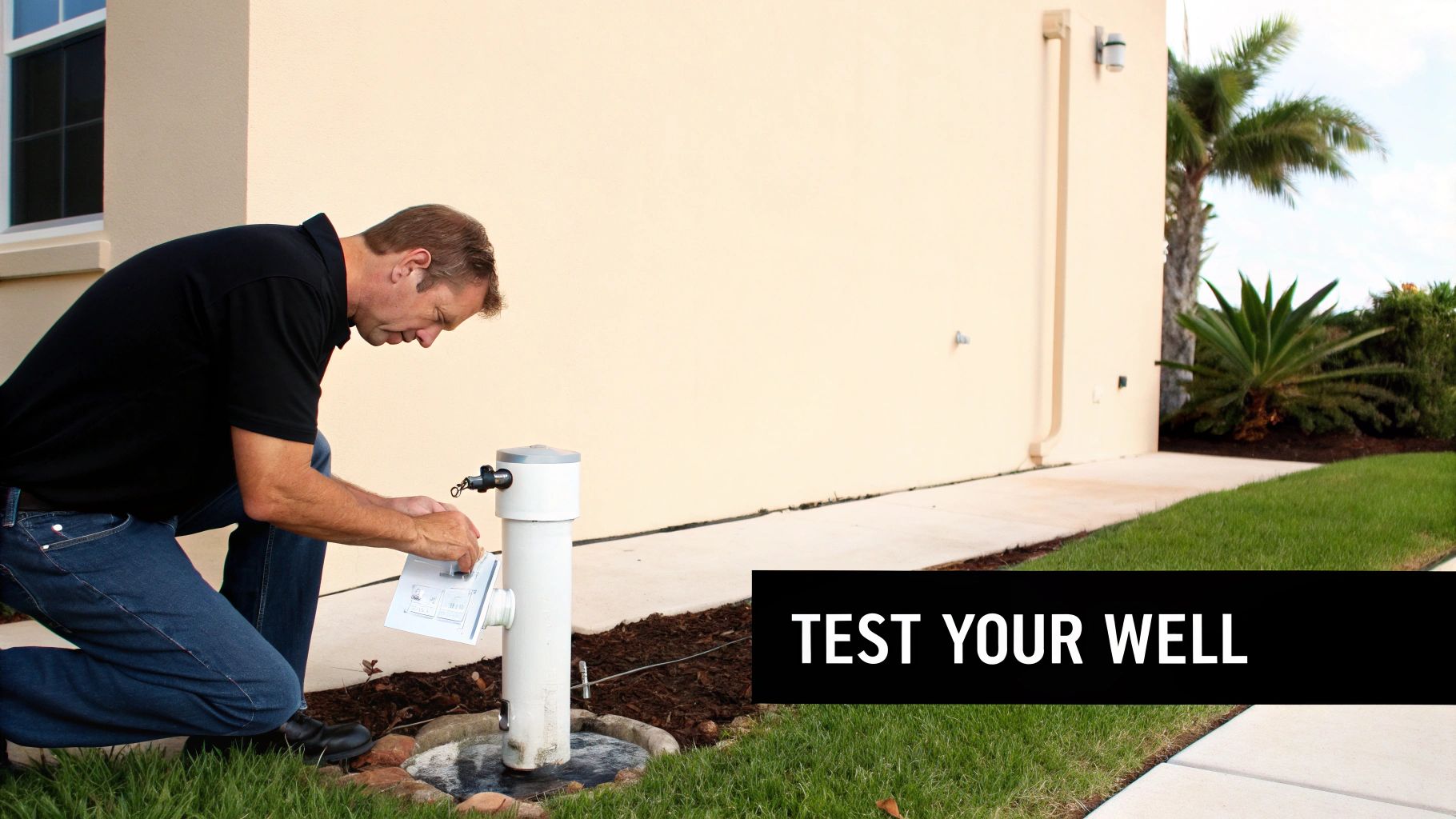
The days of assuming your well water is safe just because it looks and tastes fine are definitely over. More and more homeowners are realizing that water can look perfectly clear but still be loaded with contaminants that are bad for your health and your home's plumbing.
This isn't just a hunch; the numbers back it up. A recent survey found that nearly 9 in 10 Americans are worried about their water quality. The concern over new threats like "forever chemicals" (PFAS) has actually quadrupled since 2020, making it a major fear for a lot of people.
Local Factors Affecting Your SW Florida Well
Here in Southwest Florida, our environment throws a few curveballs at well owners. Your water's safety is directly tied to our local geology and land use, so identifying the specific risks is the first move toward protecting it with the right solutions.
We see a few common issues time and again:
- Agricultural Runoff: Pesticides and nitrates from farming operations can easily find their way into the groundwater and, ultimately, your well.
- Septic System Proximity: If you're in a more developed area, a neighbor's failing septic tank could be leaking harmful bacteria into the shared water supply.
- Saltwater Intrusion: This is a big one for coastal communities like Cape Coral and Fort Myers. As we pull more fresh water from the ground, saltwater can creep in, making your water corrosive and salty.
- Natural Mineral Deposits: The ground beneath us is rich in certain minerals. That often means high levels of iron, sulfur, and hardness in well water, leading to stained sinks, rotten-egg smells, and scale buildup in your pipes.
For homeowners in our area, routine well water testing is the only reliable way to confirm your water is free from these localized threats. It provides a precise snapshot of your water's chemical and biological makeup, which we use to design the perfect solution for you.
Many of these issues are tied to broader environmental health. It's helpful to understand the bigger picture and learn about real solutions for stopping water pollution that affect everyone.
Below is a quick overview of what homeowners are most worried about when it comes to their water.
Top Water Contaminant Concerns for Homeowners
This table highlights the primary contaminants homeowners are worried about and the potential risks they pose, reinforcing the need for comprehensive testing.
| Contaminant | Top Concern For | Potential Health or Home Impact |
|---|---|---|
| Bacteria (Coliform, E. coli) | Families with children/elderly | Gastrointestinal illness, serious infections |
| Nitrates/Nitrites | Homes near agricultural areas | "Blue baby syndrome" in infants, health risks for adults |
| Lead & Heavy Metals | Older homes with dated plumbing | Neurological damage, developmental delays |
| Hardness Minerals (Calcium, Magnesium) | Anyone with home appliances | Scale buildup, reduced appliance efficiency, soap scum |
| Iron & Manganese | Aesthetic-conscious homeowners | Orange/black staining, metallic taste, laundry discoloration |
| "Forever Chemicals" (PFAS) | Anyone near industrial sites or airports | Links to cancers, immune system issues, and hormonal disruption |
Seeing these risks laid out makes it clear why testing is so important.
Ultimately, the best thing you can do is schedule a professional test with us. It takes you from worrying about what might be in your water to having a clear, actionable plan. With solid results in hand, you can put the right water treatment solutions in place and finally get the peace of mind that comes with knowing your water is safe, clean, and tastes great.
How to Choose a Local Well Water Testing Expert
When you search for "well water testing near me," you'll get a flood of options. But how do you sift through them to find someone who genuinely knows what they’re doing and has your best interests at heart?
Choosing the right expert is every bit as important as the test itself. The accuracy of your results, and more importantly, the effectiveness of any solution, rests on the provider you select. Not all services are created equal.
When you start vetting local companies, it’s about more than just finding the cheapest price. You’re looking for real expertise, proper credentials, and a transparent process. A true professional will welcome your questions and give you straight answers.
Key Questions to Ask Any Potential Provider
Before you let anyone near your well, get them on the phone and ask a few direct questions about their qualifications and how they work.
Here are a few things you absolutely need to know:
- What specific certifications does your lab hold? You want to hear about state or national accreditations. NELAP (National Environmental Laboratory Accreditation Program) is a big one—it’s a sign that the lab meets rigorous quality standards.
- Do you perform the analysis on-site, or use a third-party lab? While some basic field tests for things like pH or chlorine are fine, the most reliable results for serious contaminants come from a certified lab.
- Can you explain the difference between a basic screening and a comprehensive analysis? A real expert will steer you toward the tests that make sense for Southwest Florida's unique water challenges, not just a generic, one-size-fits-all package.
Pay close attention to their answers. If they’re vague, dismissive, or can’t explain their process clearly, that’s a huge red flag.
The goal is to find a partner who not only takes a water sample but also understands the local hydrogeology. An expert familiar with Cape Coral, Fort Myers, and Naples knows what to look for, from saltwater intrusion to agricultural contaminants.
The Advantage of Deep Local Roots
There’s a massive difference between a national chain and a company that’s been on the ground here for years.
A provider like Water Medic, with decades of experience right here in Southwest Florida, has an unmatched understanding of the regional water table. We’ve seen firsthand how local conditions—from seasonal rains to nearby development—impact well water quality. We’ve built our water treatment services to solve the exact problems we see every day in this area.
That local knowledge means we often know what to look for before the test even begins. We don’t just hand you a lab report full of numbers; we give you context, explain what it all means, and lay out a clear path forward to a custom solution.
When you choose a local expert, you’re not just another sample number. You’re a neighbor, and your family's safety is our top priority.
What Should You Test Your Well Water For in Southwest Florida?
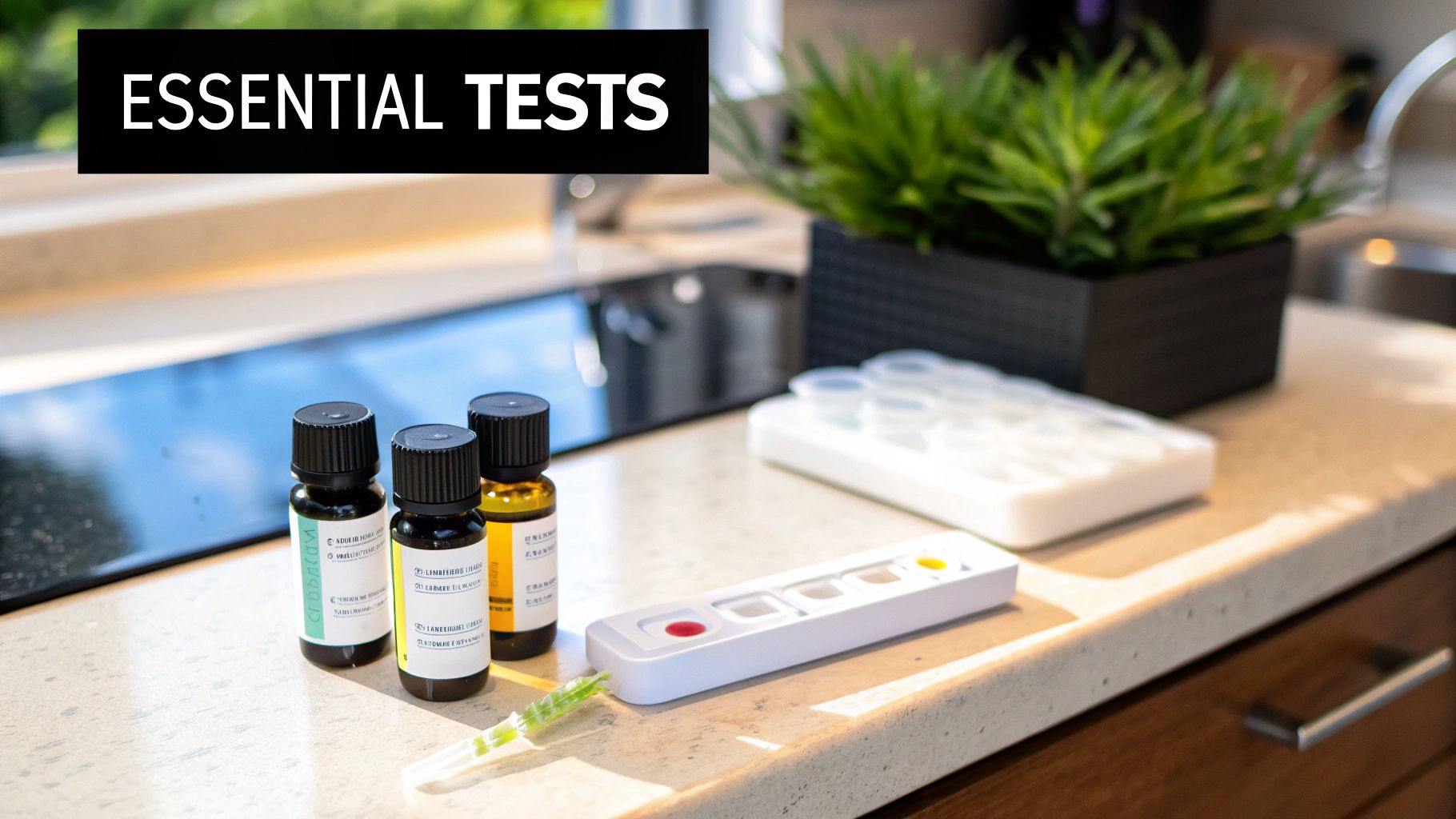
A generic, one-size-fits-all water test just doesn't cut it here in Southwest Florida. Our unique coastal environment means your well faces different challenges than a well just a few hours inland. To get results that actually mean something, you need a professional team to test for the specific contaminants common to our region.
Think of it like going to the doctor; you wouldn't want them to skip a crucial test just because it isn't part of a "standard" panel. The same goes for your water. Choosing the right tests is the only way to catch potential problems before they impact your family's health or your home's plumbing.
The Foundational Tests Every Well Owner Needs
No matter where you are in the Cape Coral area, some tests are simply non-negotiable. These are the fundamentals that create a baseline for your water's safety and should be part of any initial analysis. We consider these the absolute must-haves.
These tests screen for immediate health risks and give us a solid overview of your water's general chemistry.
- Total Coliform and E. coli: This is the big one. It's the most critical test for any private well. Coliform bacteria are an indicator that surface contaminants could be seeping into your well. The presence of E. coli is a definite sign of fecal contamination and means you need to take action right away.
- Nitrates: High nitrate levels are a serious health risk, especially for infants and pregnant women. The usual suspects are agricultural runoff from fertilizers or leakage from a nearby septic system.
- pH Level: This tells us how acidic or alkaline your water is. Water that’s too acidic can be corrosive, eating away at your pipes and fixtures and potentially leaching harmful metals like lead and copper into your drinking water.
You should be testing for bacteria and nitrates at least once a year. Think of it as an annual check-up—it's your best defense against the most common and dangerous threats to your well water. We can help you set up a regular testing schedule.
Going Deeper: Critical Tests for Southwest Florida's Unique Water
Beyond the basics, our local geology and proximity to the coast require us to look for specific minerals and chemicals. Ignoring these can lead to expensive plumbing repairs, ruined appliances, and even long-term health issues. When you're searching for "well water testing near me," you need a professional who understands these regional risks.
Here’s what we always recommend testing for in Southwest Florida:
- Iron: Seeing those ugly reddish-brown stains in your sinks, toilets, and showers? High iron is almost always the culprit. While it's not a direct health threat, it makes your water taste metallic and can permanently stain your laundry and fixtures.
- Hardness: This is a measure of calcium and magnesium. High levels cause "hard water," which leads to chalky buildup (scale) in your pipes, soap scum on your shower doors, and dramatically reduced efficiency for appliances like your water heater and dishwasher.
- Total Dissolved Solids (TDS): This measures all the dissolved stuff in your water—minerals, salts, you name it. A high TDS level can point to excessive mineral content or, more alarmingly, saltwater intrusion, which is a growing concern for coastal wells in our area.
- Arsenic: This is a naturally occurring element found in Florida’s groundwater, and it’s a known carcinogen. Since arsenic is completely odorless and tasteless, testing is the only way to know if it's in your water at unsafe levels.
By building a test panel that includes these specific parameters, you're moving beyond guesswork. You get a clear, accurate picture of your water quality, which is the essential first step toward finding the right solution. Our team can help you interpret these results and design a system, like a whole-home reverse osmosis unit, to give you complete peace of mind.
Making Sense of Your Well Water Test Results
When your lab report finally arrives, it can feel like you’re trying to read a foreign language. It's often a dense page of acronyms, chemical names, and numbers that don't mean much on their own.
Don't let it intimidate you. You don’t need a chemistry degree to get the gist, and understanding this report is the most important step in protecting your family’s health. Let's break down how to read your results with confidence.
Decoding the Language of Your Lab Report
First, let's get a handle on the jargon. There are a few key terms you'll see on almost every water analysis, and knowing what they mean is half the battle.
- PPM (Parts Per Million): This is just a way to measure concentration. Think of it like this: one drop of a substance in a full bathtub is about 1 PPM. It’s used for common things like minerals and nitrates. For really potent contaminants, you might see PPB (Parts Per Billion), which is a thousand times smaller.
- MCL (Maximum Contaminant Level): This one is critical. The EPA sets MCLs as the legal limit for contaminants in public drinking water. Now, these rules don't legally apply to private wells, but they are the gold standard for safety. It's the benchmark we use to judge whether your water is truly safe.
When you get your report, the very first thing you should do is scan the page and compare the numbers in your "results" column to the "MCL" column. Any number that’s higher than the MCL is an immediate red flag that needs a closer look.
Think of your test results as a health report for your well. A clean report brings peace of mind. But if certain levels are high, it’s like a doctor’s warning—a clear signal that it’s time to take action with the right treatment from an experienced provider like Water Medic.
Health Threats vs. Nuisance Issues
Your results will likely show a mix of different elements, and it's vital to know which ones are genuine health risks and which are just annoying "nuisance" problems.
A health concern is anything that can actually make you sick. The most urgent red flags to look for are:
- Positive for Coliform Bacteria or E. coli: This means your well has been contaminated, often by surface runoff or a failing septic system. This requires immediate action.
- Nitrates above 10 PPM: This is especially dangerous for infants and pregnant women, as it can lead to a serious condition called "blue baby syndrome."
- Arsenic or Lead: Honestly, any detectable amount of these heavy metals is a serious problem that needs to be addressed right away.
An aesthetic issue, on the other hand, is more likely to damage your home than your health. These are the "nuisance" contaminants that cause stains, smells, and scale buildup. High levels of hardness, for instance, are the reason you see crusty white residue on your fixtures and spots on your dishes.
When interpreting your well water test results, understanding the levels of minerals like calcium and magnesium is crucial for identifying mineral deposits like calcium and magnesium that plague so many homes in our area.
Navigating these results can feel overwhelming, but you're not alone. The team at Water Medic can walk you through your report line by line. We’ll explain what each number means for you and your home, and lay out the most effective, no-nonsense solutions to get your water right.
Matching Your Test Results to The Right Treatment System
Getting your water test report back is a crucial step. Think of it as a diagnosis—now we can find the cure. This is where your online search for "well water testing near me" pays off, giving you a clear roadmap to finally getting safe, clean water for your family.
You've got the data. The next step is connecting the specific contaminants found in your report to a targeted, effective solution. Here in Southwest Florida, we often deal with a unique mix of issues, from microscopic bacteria to the high mineral content that's so common in our local groundwater.
The growing demand for clean water is a big deal globally. The water testing market is projected to reach an incredible $6.02 billion by 2030, and a big reason for that is rising concern over pollutants like PFAS and lead. For well owners, these aren't just statistics; they're real risks. Untested wells can easily harbor bacteria (a top worry for 23% of people) or even lead (26%).
From Diagnosis to A Custom-Built Solution
Your lab results are essentially the blueprint for designing the perfect water treatment system. There’s no magic one-size-fits-all filter out there; different contaminants require different removal methods. At Water Medic, our job is to dive deep into your specific results and engineer a system that solves the exact problems your well water has.
Here are a couple of real-world scenarios we see all the time around Cape Coral and the solutions we typically recommend:
- You've Got Bacteria (like coliform): This is a red flag and needs to be handled immediately. The best tool for the job is an Ultraviolet (UV) Purification System. It uses powerful UV light to zap bacteria, viruses, and other nasty microorganisms, all without adding a single chemical to your water.
- You're Dealing with Hard Water and Iron Stains: This is probably the number one complaint we hear in SW Florida. A modern, high-efficiency Water Softener is the fix. It pulls out the minerals that create crusty scale buildup and the iron responsible for those ugly orange stains, saving your pipes and appliances in the long run.
This chart breaks down the decision-making process after you get your report, guiding you on what to do if your water is safe versus when it has specific contaminants.
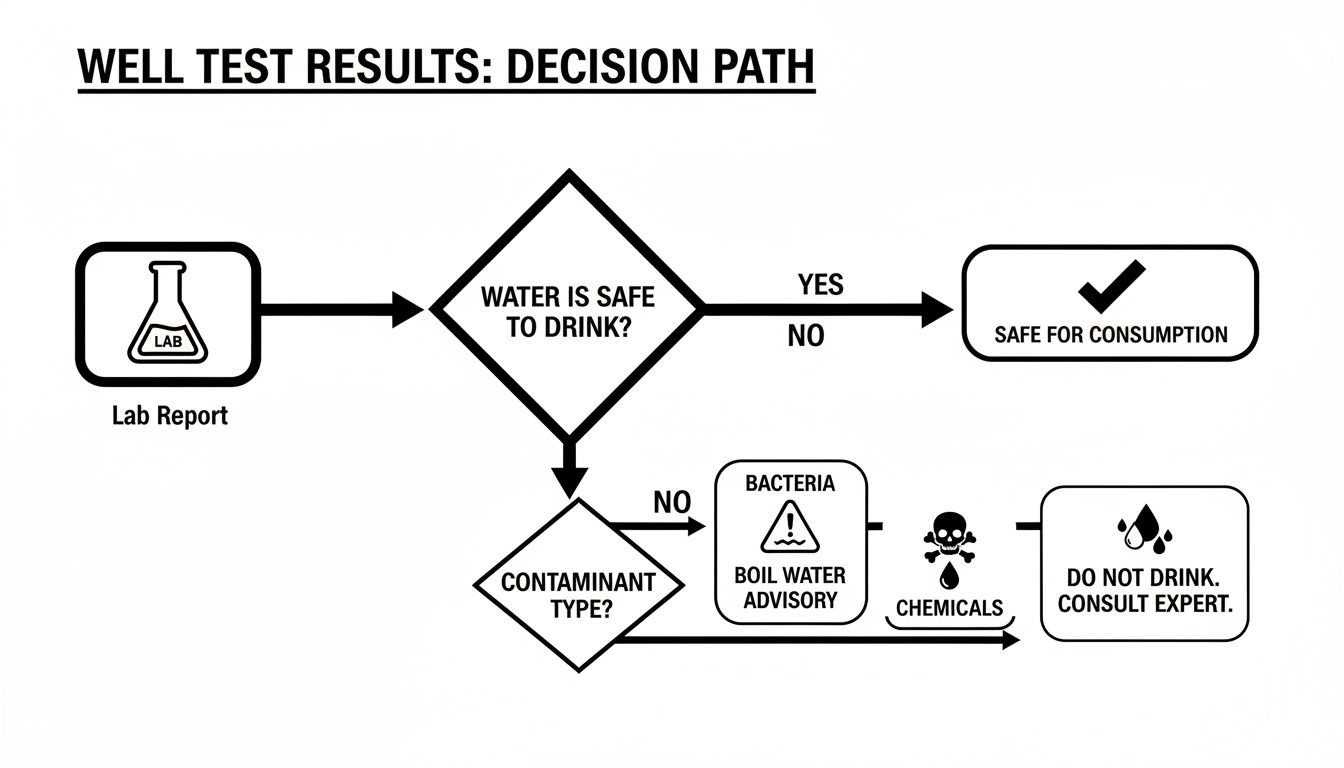
As you can see, an "unsafe" result doesn't just mean "bad"—it points you toward a specific treatment path based on what exactly was found.
Matching Water Problems to Treatment Solutions
To make things even clearer, we've put together a simple table that connects common water issues directly to the systems designed to fix them.
| Common Problem Detected | Primary Contaminant(s) | Recommended Water Medic Solution |
|---|---|---|
| Hard Water (scale, soap scum) | Calcium, Magnesium | High-Efficiency Water Softener |
| Rotten Egg Smell | Hydrogen Sulfide Gas | Aeration Filter or Chlorination System |
| Orange/Brown Staining | Iron, Manganese | Iron Filter or a Water Softener |
| Bacteria, Viruses, Cysts Present | E. Coli, Coliform | UV Purification System |
| High TDS, Salty Taste, Chemical Traces | Dissolved Solids, Nitrates, etc. | Whole-Home Reverse Osmosis System |
This table gives you a starting point for understanding how we approach different water quality challenges, ensuring you get the right technology for your home.
The Ultimate Protection For Your Home
Sometimes, a water test reveals a whole cocktail of problems—maybe you have high TDS, hard water, and traces of chemical contaminants all at once. For these complex situations, or for homeowners who simply want the absolute purest water possible, a simple filter just won't cut it.
For comprehensive purity and total peace of mind, a whole-house reverse osmosis system is the gold standard. It addresses a wider spectrum of contaminants than any other single technology.
This advanced system uses pressure to force water through a very fine membrane, stripping out up to 99% of all dissolved solids. We're talking salts, heavy metals, arsenic, nitrates—you name it. The result is pristine, purified water flowing from every single tap in your home. You can learn more about how our whole-home reverse osmosis systems provide the ultimate safeguard for your family's health. This is where testing turns into definitive action, giving you pure water from a solution designed just for you.
Your Well Water Testing Questions, Answered
Let's wrap up by tackling some of the questions we hear all the time from Southwest Florida homeowners about their wells. Getting straight answers from someone who deals with this every day can make the whole process feel a lot less intimidating.
How Often Should I Really Be Testing My Well Water in Florida?
As a general rule, you should get your well tested at least once per year. This annual check-up should cover the basics: bacteria, nitrates, pH levels, and Total Dissolved Solids (TDS).
But here in Southwest Florida, things are a little different. We strongly advise testing after any major storm or hurricane, as flooding can introduce all sorts of contaminants. You should also get a test done immediately if you notice any change in your water’s taste, how it smells, or what it looks like.
If you have young kids, elderly parents living with you, or anyone with a compromised immune system in the house, more frequent testing is a smart move for that extra peace of mind.
Are Those DIY Home Testing Kits Any Good?
Honestly, while those do-it-yourself kits from the hardware store can give you a rough idea about simple things like water hardness, they are no substitute for a professional lab analysis.
Those little strips and color-changing droppers just aren't sensitive or accurate enough to detect the really dangerous stuff—the invisible contaminants like arsenic, pesticides, or specific strains of bacteria. You can't rely on them to confirm your water is truly safe.
When you need results you can actually trust to make decisions about your family's health, professional testing through a certified lab is the only way to go. It takes the guesswork out of the equation.
What's the Typical Cost for Well Water Testing Around Cape Coral?
The price really hinges on how deep you want to go with the analysis. A basic test just for bacteria is pretty inexpensive. On the other hand, a comprehensive panel that screens for a whole list of things—heavy metals, volatile organic compounds (VOCs), and agricultural chemicals—is going to be a larger investment.
We’re big on transparency. We’ll help you choose a testing package that makes sense for your specific situation and concerns, without trying to sell you on tests you don't need. Think of it as an investment in your health and your home's value. The cost of not knowing what's in your water could be much, much higher.
This isn't just a local issue; ensuring water safety is a growing global concern. While some industries get more headlines, the demand for reliable water analysis is booming. The global water testing market is projected to jump from $4.59 billion in 2025 to $6.02 billion by 2030. With Florida’s unique geology and challenges like saltwater intrusion and farm runoff, having local experts is crucial. You can learn more about the growing water testing service market and see why this is becoming so important for homeowners everywhere.
We've hit the main points here, but we know you might have more questions about your specific well. For a much deeper dive, check out our extensive list of answers to common well water questions on our website.
When you need clear, definitive answers about your water quality, you need to talk to the team that knows Southwest Florida’s water. The experts at Water Medic of Cape Coral are here to provide professional testing and design a custom solution that ensures your water is pure, safe, and tastes fantastic. Contact us today to schedule your consultation at https://watermedic.com.