
Best Time to Run Pool Pump for Maximum Savings
Figuring out the best time to run your pool pump here in Southwest Florida almost always comes down to running it during off-peak electricity hours. For most of us, that means overnight. Making just this one change can seriously slash your energy bills, but saving money is only part of the equation for keeping your pool in perfect shape.
Why Your Pool Pump Schedule Matters
Let's be honest, finding the "best" time to run your pump isn't just about flicking a switch. It’s a delicate balancing act that hits your wallet and the health of your pool water. A generic, set-it-and-forget-it schedule is a recipe for wasted electricity and, worse, a potential algae bloom, especially with our year-round heat.
A poorly timed schedule often means you're paying the highest prices for electricity, basically tossing money down the drain every single month. It’s a common mistake, but an easy one for our professionals to fix.
For years, the gold standard has been to find that sweet spot between energy efficiency and water quality. Utility companies in our area often use time-of-use (TOU) pricing, making electricity much cheaper during off-peak hours—think late at night, usually somewhere between 9 PM and 6 AM. Simply shifting your pump’s runtime into this window can make a huge dent in your annual energy costs. If you want to dive deeper into the numbers, Jackery.com has a great breakdown of how timing affects your energy costs.
Key Factors for an Optimal Schedule
To dial in your schedule and move past the basics, you really need to look at a few key things. Each one plays a critical role in getting that crystal-clear water without an eye-watering electric bill.
To keep it simple, here are the main factors we look at when creating a custom pump schedule for our clients.
Quick Guide to Pool Pump Timing Factors
| Factor | Why It Matters | Optimal Strategy |
|---|---|---|
| Cost Savings | Aligning pump runtime with off-peak electricity hours is the quickest win for lowering your monthly bill. | Run the pump overnight or whenever your utility's rates are lowest. Check your bill for specific TOU hours. |
| Water Clarity | The goal is at least one full "turnover" a day—where all the pool water passes through the filter. | Calculate your pool's turnover rate and set a runtime that meets or slightly exceeds that target. |
| Pump Technology | A single-speed pump has a completely different scheduling strategy than a modern variable-speed pump (VSP). | VSPs can run longer at lower speeds for superior filtration and energy savings. Single-speed pumps need shorter, timed runs. |
| Local Climate | The intense sun and heavy rains in SWFL break down chlorine and introduce debris, demanding more filtration. | Increase runtime after heavy rain or during peak summer heat to keep the water clean and balanced. |
Thinking through these points is the first step toward a schedule that truly works for your pool, not just a generic one.
Here at Water Medic, we live and breathe this stuff. We build custom pump schedules that account for all these variables, taking the guesswork out of it for you. Our goal is to make sure your pool is not only beautiful but runs as efficiently as possible.
Calculating Your Pool's Turnover Rate
Figuring out the best time to run your pool pump isn't about guesswork; it's about math. The magic number you need is your pool’s turnover rate—the time it takes for your pump to cycle every last drop of water through the filter. Nail this, and you've got the foundation for a crystal-clear pool and a reasonable electric bill.
For most backyard pools, a single turnover each day is the bare minimum to keep the water clean and safe. But here in Southwest Florida, with our relentless heat and humidity, we always tell our clients to aim for two turnovers, especially in the thick of summer. It’s the best defense against algae and ensures your chemicals are doing their job everywhere in the pool.
First, You Need Your Numbers
To get this right, you need two things: your pool's volume in gallons and your pump's flow rate.
- Pool Volume: How much water are you working with? For a standard rectangular pool, the formula is straightforward: Length x Width x Average Depth x 7.5 = Total Gallons. If you have a freeform pool, getting an accurate volume can be a bit more challenging.
- Pump Flow Rate: Check the label on your pump or its manual for its flow rate, which is measured in gallons per minute (GPM). This tells you how much water your pump is designed to move.
Once you have these two figures, you can stop guessing and start calculating the exact runtime your pool needs. It's the difference between cloudy water and a shockingly high power bill.
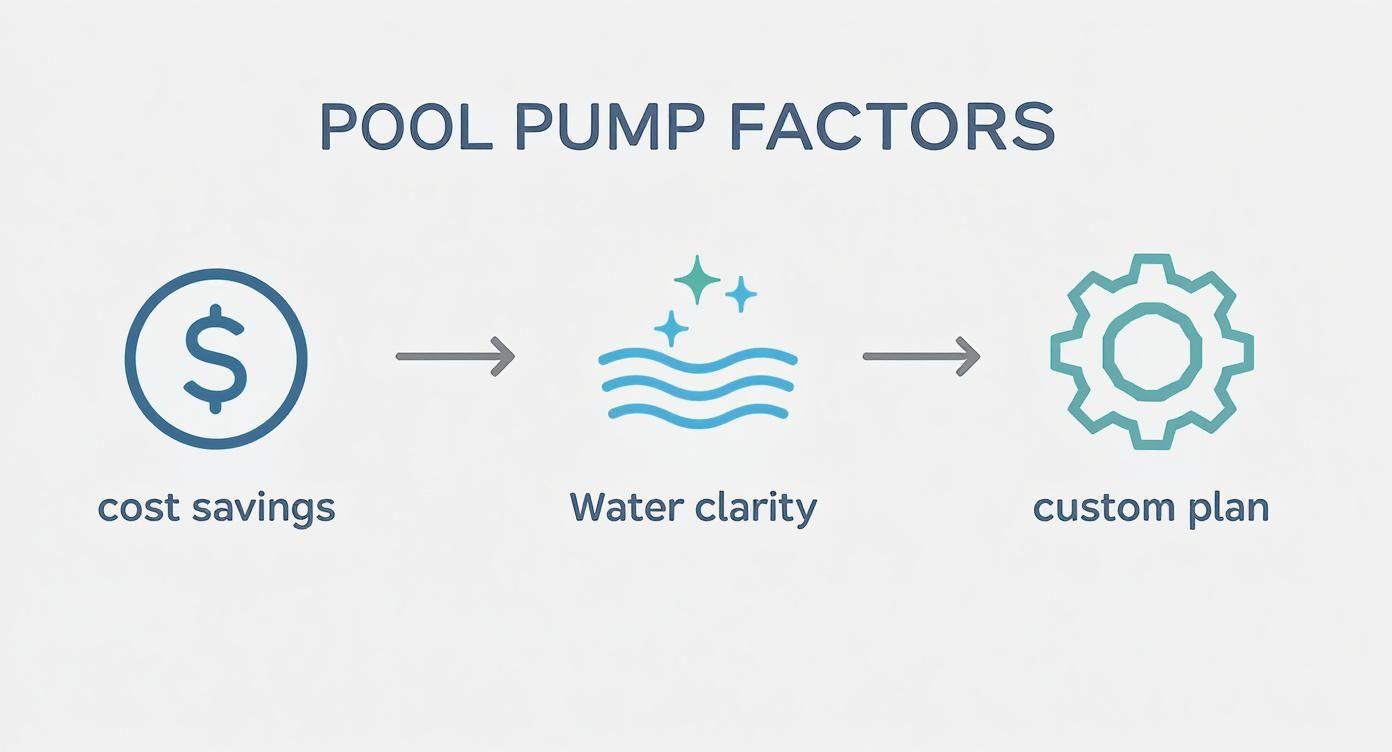
As you can see, getting the timing right is a balancing act between cost, clarity, and creating a plan that works for your specific pool.
Let's Do the Math with a Real-World Example
Let's say you have a pretty common 15,000-gallon pool in Fort Myers, and your pump moves water at a rate of 50 GPM.
Here’s how we'd figure out the runtime for one turnover:
First, find the total time in minutes by dividing the pool's volume by the pump's flow rate.
15,000 gallons / 50 GPM = 300 minutes
Next, convert that to hours.
300 minutes / 60 minutes per hour = 5 hours
So, for that pool, it takes 5 hours to complete a single turnover. During a brutal Naples summer, you'd likely want to double that to 10 hours a day to keep things sparkling.
A Quick Word of Caution: Your pump's GPM on the label is its ideal performance. Things like a dirty filter, clogged skimmer baskets, or long plumbing runs create resistance and can slow that flow down. Your calculated time is a great starting point, but real-world conditions matter.
If you're scratching your head trying to figure out your pool's true volume or your pump's actual flow rate, don't sweat it. Our technicians can perform a full hydraulic analysis to get precise numbers and take all the guesswork out of the equation. You can learn more when you Schedule a Professional Pool Audit Today.
Navigating Southwest Florida Electricity Rates
https://www.youtube.com/embed/m3p-EUXY908
That monthly bill from FPL or LCEC isn't just an expense—it's actually a roadmap to cutting your pool's running costs. Here in Southwest Florida, most of us are on Time-of-Use (TOU) plans. In simple terms, this means electricity costs more at certain times of the day, known as "peak" hours.
These peak periods almost always fall on weekday afternoons and early evenings. It's when everyone gets home from work, cranks up the A/C, and starts making dinner, putting a huge strain on the power grid. Running your pump during these hours can easily double what you pay compared to running it late at night.
Finding Your Peak and Off-Peak Windows
So, the first thing you need to do is figure out your specific rate windows. The easiest way is to grab your latest utility bill or log into your online account. You're looking for terms like "On-Peak" and "Off-Peak."
For most homeowners in our area, peak hours typically land somewhere between noon and 9 PM on weekdays. The exact times can vary, so it's worth confirming. The good news? Weekends and major holidays are usually considered off-peak all day long, giving you another great opportunity for cheaper filtration. Getting a handle on your provider's pricing is crucial, and if you want to dig deeper, this is a great resource for understanding peak and off-peak electricity tariffs.
It's always a surprise for new clients when we show them the cost difference. Just by shifting an 8-hour pump schedule from the afternoon to overnight, we see savings of $30-$50 per month on a standard single-speed pump. Sometimes even more.
A Clear Cost Comparison
Let’s put some real numbers to this. Imagine your electricity costs $0.28 per kilowatt-hour (kWh) during peak hours but drops to just $0.14 per kWh during off-peak.
If your pump uses 2 kWh, running it for eight hours during the day costs $4.48. But run that same pump for the same amount of time overnight, and the cost is only $2.24.
That's a 50% savings every single day just by changing the time. Over a month, that simple adjustment can save you nearly $70 without changing a single other thing about how you care for your pool.
Syncing your pump's schedule with off-peak hours is hands-down the easiest and most effective way to shrink your monthly bill. It doesn’t require any new equipment—just a few minutes to reprogram your timer. If you're not sure how to do it or just want an expert eye to confirm you're running at the cheapest times, our technicians are happy to help. In fact, we check this as a standard part of our weekly pool maintenance to make sure our clients are always saving the most money possible.
Adjusting Your Schedule for Florida's Weather
Living in Southwest Florida means your pool is constantly battling the elements. We're talking intense sun, relentless humidity, and sudden, torrential downpours that can pop up any afternoon. Each of these weather events throws a wrench into your pool's chemistry and clarity, which is why a "set it and forget it" pump schedule just doesn't work here.
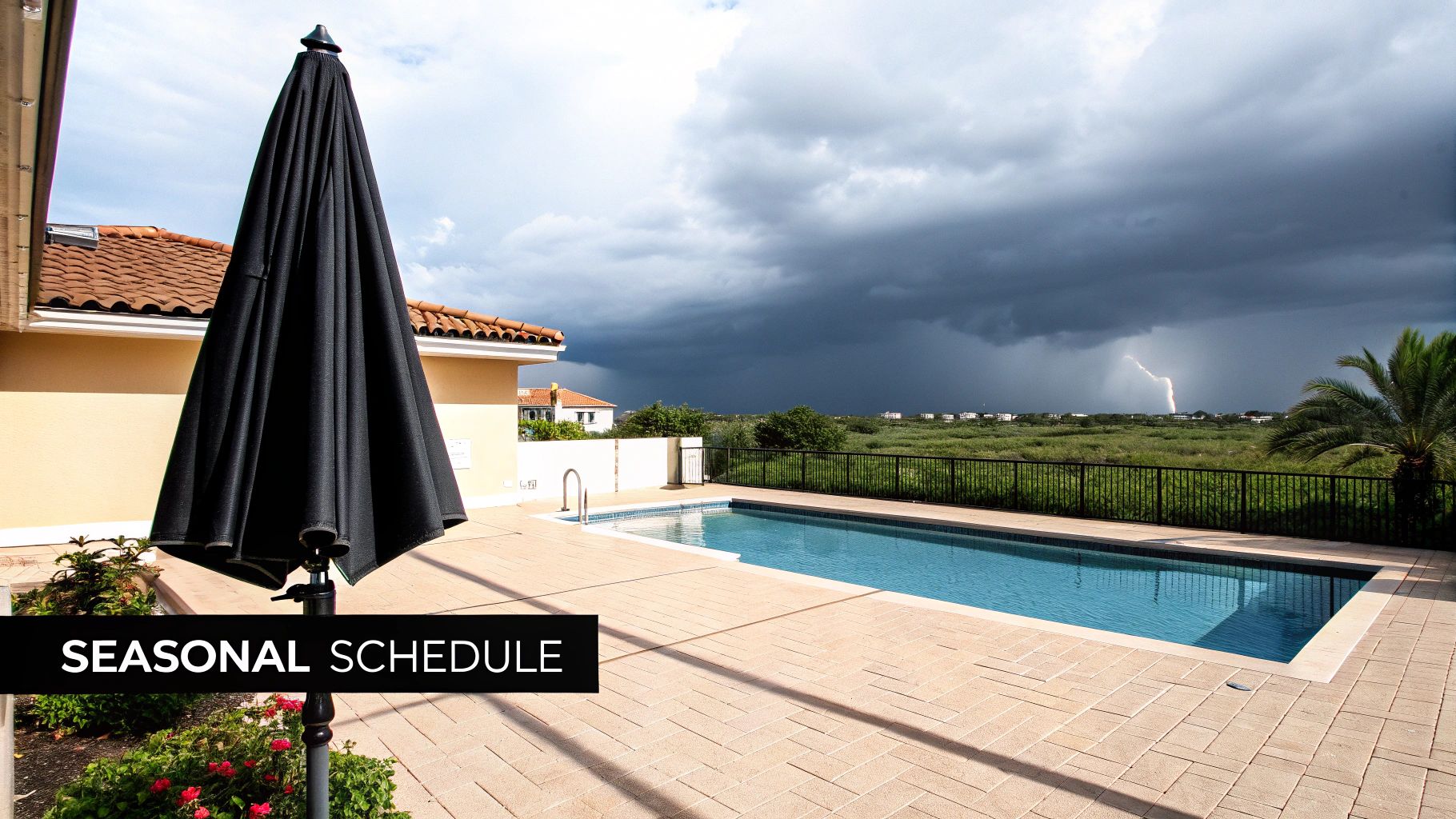
The summer sun is public enemy number one for your chlorine. Those strong UV rays burn off your sanitizer much faster than you’d think, and the warmer water creates the perfect environment for algae to bloom. To have any chance of winning this fight, your pump needs to run longer to keep properly treated water circulating.
Now, you might have heard a general rule of thumb to run your pump for 8 hours a day. And that’s not bad advice—for most places. National research, like studies from the American Council for an Energy-Efficient Economy (ACEEE), often lands on 8 hours as a good balance between clean water and energy savings. They've found that dropping below 6 hours is asking for cloudy water, while running it much longer doesn't always give you a better result for the money. You can actually read more about these pool pump efficiency findings on nrel.gov.
But Florida isn't "most places."
Adapting to Summer Heat and Storms
From June to September, when the heat is at its peak, we almost always recommend bumping up the runtime for a single-speed pump to somewhere between 10 and 12 hours. That extra circulation is what you need to evenly distribute chemicals and filter out all the extra organic gunk before it has a chance to turn your pool into a science experiment.
And then there are the afternoon thunderstorms. A heavy downpour does a lot more than just top off your pool. It washes in a ton of debris, pollen, and acidic rainwater that can send your pH and alkalinity levels spiraling.
A great rule of thumb is to run your pump for an extra few hours after a big storm. This helps filter out all the new contaminants and gives any balancing chemicals you add a chance to mix in properly. I’ve seen countless pools turn cloudy or green overnight simply because this step was skipped.
Proactive Management is the Secret
Let's be honest—manually tweaking your pump timer for the summer heat and then running out to change it again after every storm is a huge pain. It's one of those little details of pool ownership that’s easy to forget, but it’s absolutely essential for keeping the water healthy and ready for a swim.
This is exactly where having a professional in your corner makes all the difference.
Our weekly service is about so much more than just skimming leaves and checking chlorine. We're constantly adjusting your pump's schedule based on the season and what the weather has been doing. This ensures your pool gets the precise amount of filtration it needs to stay crystal clear and perfectly balanced, no matter what the forecast throws at it. If you're tired of guessing, you can Learn About Our All-Inclusive Maintenance Plans and let us handle the details for you.
Advanced Savings with Variable Speed Pumps
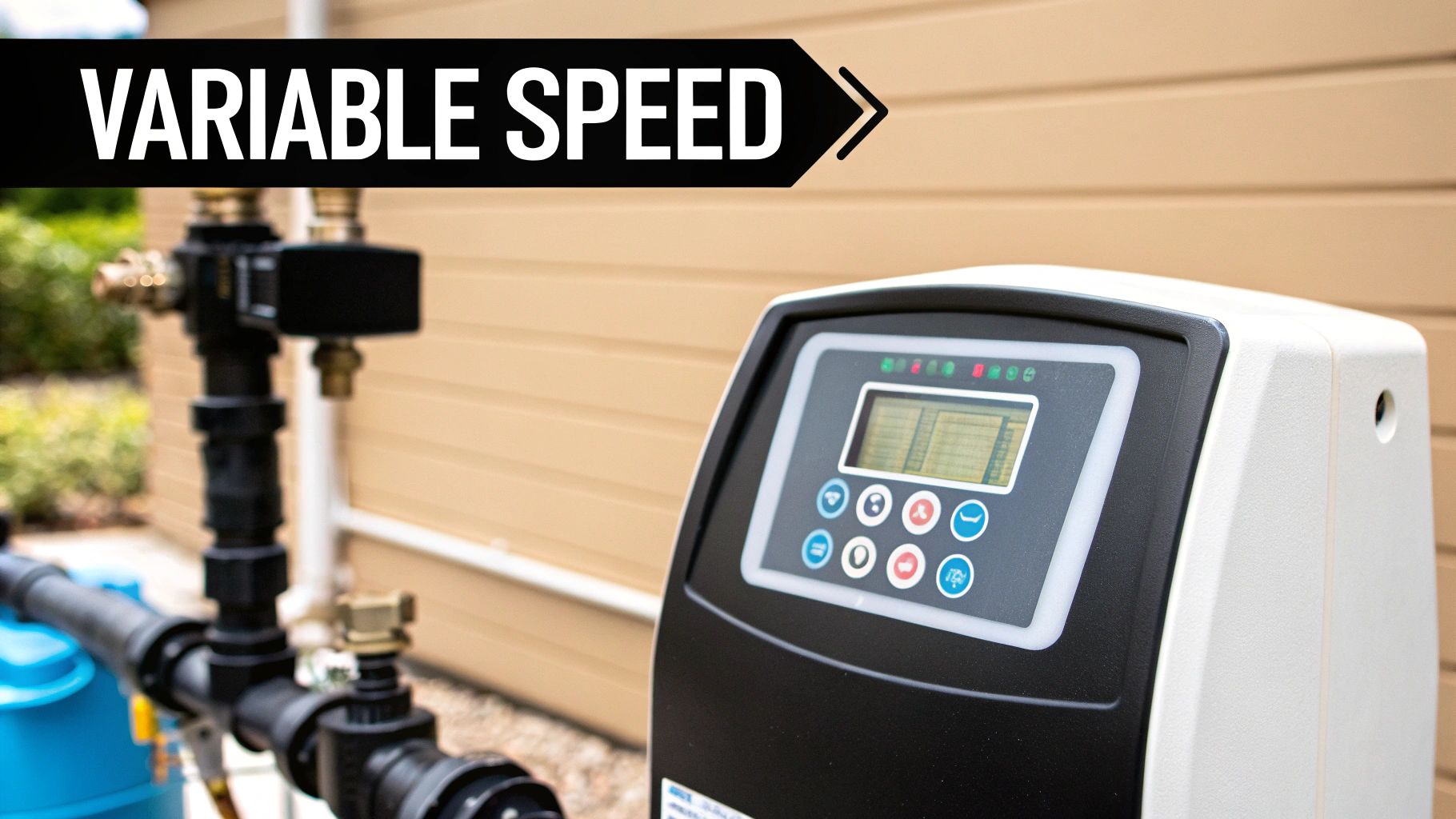
If you've got a modern variable-speed pump (VSP) running your pool, you can pretty much throw the old rulebook out the window. The entire strategy for scheduling your pump changes. We're no longer thinking in terms of short, high-power blasts like you would with an old single-speed pump. VSPs operate on a completely different—and far more efficient—principle.
The secret to the massive energy savings is running the pump for much longer, but at a very low speed. Think of it like a car's fuel economy: you burn way less gas cruising on the highway for an hour than you do flooring it from stoplight to stoplight. The VSP's slow-and-steady approach keeps water circulating constantly, providing superior filtration while sipping electricity. You get pristine water for just pennies on the dollar.
Programming for Maximum Efficiency
The real magic of a VSP is in its programmability. Instead of a simple "on/off" switch, you can dial in different speeds for different jobs, creating a truly custom schedule that squeezes every last drop of efficiency out of your system.
A strategy we use all the time for our clients looks something like this:
- A long, low-speed filtration cycle: We'll often program a VSP to run for 12, 18, or even 24 hours a day at an incredibly low RPM (revolutions per minute). This constant, gentle flow is amazing for water clarity and keeping your chemicals evenly distributed.
- A short, high-speed cleaning cycle: You still need that extra power sometimes. We’ll program a brief, one- or two-hour cycle at a higher speed to run your automatic pool cleaner, spa jets, or other water features.
This might sound complex, but it’s an absolute game-changer for your electric bill. A properly programmed VSP can slash your pump-related energy costs by as much as 90% compared to an old single-speed hog.
Our team lives and breathes VSP programming. We don't just bolt the pump on; we analyze your pool's unique plumbing and needs to calibrate it perfectly. That's how we ensure you're saving hundreds of dollars every single year.
Is a VSP Right for Your Pool?
I get it—upgrading to a new VSP can feel like a big expense upfront. But the long-term savings are undeniable. The most important part is getting the right pump for your pool's size and features, and—critically—having it programmed correctly from day one. An improperly set VSP can easily wipe out any potential energy savings.
If you're thinking about an upgrade or just want to make sure your current pump is running as efficiently as possible, checking out professional-grade variable-speed pumps is the perfect place to start. Our technicians can give your whole system a look and show you exactly what the financial benefit of making the switch would be, making sure you get a fantastic return on your investment.
Let Us Handle the Math and Save You Money
Figuring out the perfect schedule for your pool pump can feel like a part-time job, right? You're juggling turnover rates, the crazy FPL and LCEC electricity costs, and our wild Southwest Florida weather. One wrong setting and you could be wasting hundreds of dollars a year or, even worse, fighting a losing battle with algae.
It's a headache you just don't need. At Water Medic, we believe smart pool care is about more than just chemicals—it starts with making your equipment work for you, not against you.
We Create Your Custom Savings Plan
When we take on a pool, we do a full system audit. This isn't just a quick look-over. We get into the nitty-gritty, analyzing your pump's real-world efficiency and cross-referencing it with your specific utility's Time-of-Use rates.
With that data, we build a custom pump schedule designed to save you the most money while keeping your water crystal clear. This detailed optimization is a standard part of our monthly maintenance because we want you to get the most value out of our service and your pool.
Leaving a pump on the factory or "pool guy" default settings is one of the biggest money-wasters we see. A professional audit almost always uncovers easy ways to cut back on electricity costs.
Let our pros handle the technical details. We'll dial in the perfect runtime, so all you have to do is enjoy a sparkling, low-maintenance pool that doesn't burn a hole in your wallet. It's time to stop guessing and start saving.
Give Water Medic a call and let's talk. We'd love to show you how our professional service leads to a healthier pool and a lower energy bill. We make pool care simple, leaving you with nothing but pure enjoyment.
Common Questions About Pool Pump Runtimes
I get a lot of the same great questions from pool owners all over Southwest Florida. When you're trying to figure out the best schedule for your pump, a few things always come up. Here’s what people ask most often.
Is It Better to Run My Pool Pump at Night or During the Day?
If you're purely looking to save money on your electric bill, running the pump at night during off-peak hours is almost always the answer. This is the best way to take advantage of lower Time-of-Use rates from providers like FPL and LCEC.
That said, if your pool gets a lot of action during the day, running it for a few hours in the afternoon makes a huge difference. It clears out sunscreen, sweat, and other contaminants much faster, keeping the water quality high. We often help clients create a hybrid schedule—a little in the afternoon, a little at night—to get the best of both worlds.
The best schedule isn't always one long block. Splitting the runtime prevents water from sitting stagnant, which means better chemical circulation and filtration around the clock.
How Many Hours a Day Should a Pool Pump Run in Florida's Summer?
Down here in Southwest Florida, from Naples to Cape Coral, the summer heat is no joke. For a standard single-speed pump, we always recommend running it for 8 to 12 hours a day during the hottest months. The intense sun and warm water are a perfect recipe for algae, so you need that extra circulation and filtration to keep your pool clear and safe.
Can I Split My Pump's Runtime into Two Shorter Cycles?
You bet. Splitting the runtime is actually a fantastic strategy. A schedule like four hours in the early morning and another four late at night keeps the water moving and prevents those long, stagnant periods where problems can start. This is especially helpful when it's warm.
The key is to make sure the total time is still enough to achieve at least one full turnover of your pool's water each day. If you have more questions like these, you can explore our extensive collection of answers to common pool questions.
Trying to juggle turnover rates, variable-speed settings, and local utility costs can feel like a headache. Let the pros at Water Medic of Cape Coral take the guesswork out of it. We can design a custom pump schedule that saves you money and keeps your pool looking perfect. Contact us today for a free consultation!