Best Water Softener Systems for Well Water
When you’re on well water here in Southwest Florida, finding the right treatment system isn’t about picking the “best” product off a shelf. It’s about being a good detective and accurately diagnosing your water's specific problems. Our local groundwater is often a tricky cocktail of extreme hardness, iron, and sometimes sulfur—a combination that basic, off-the-shelf softeners just aren't built to handle. You almost always need a more specialized approach.
Choosing the Right Well Water Softener System
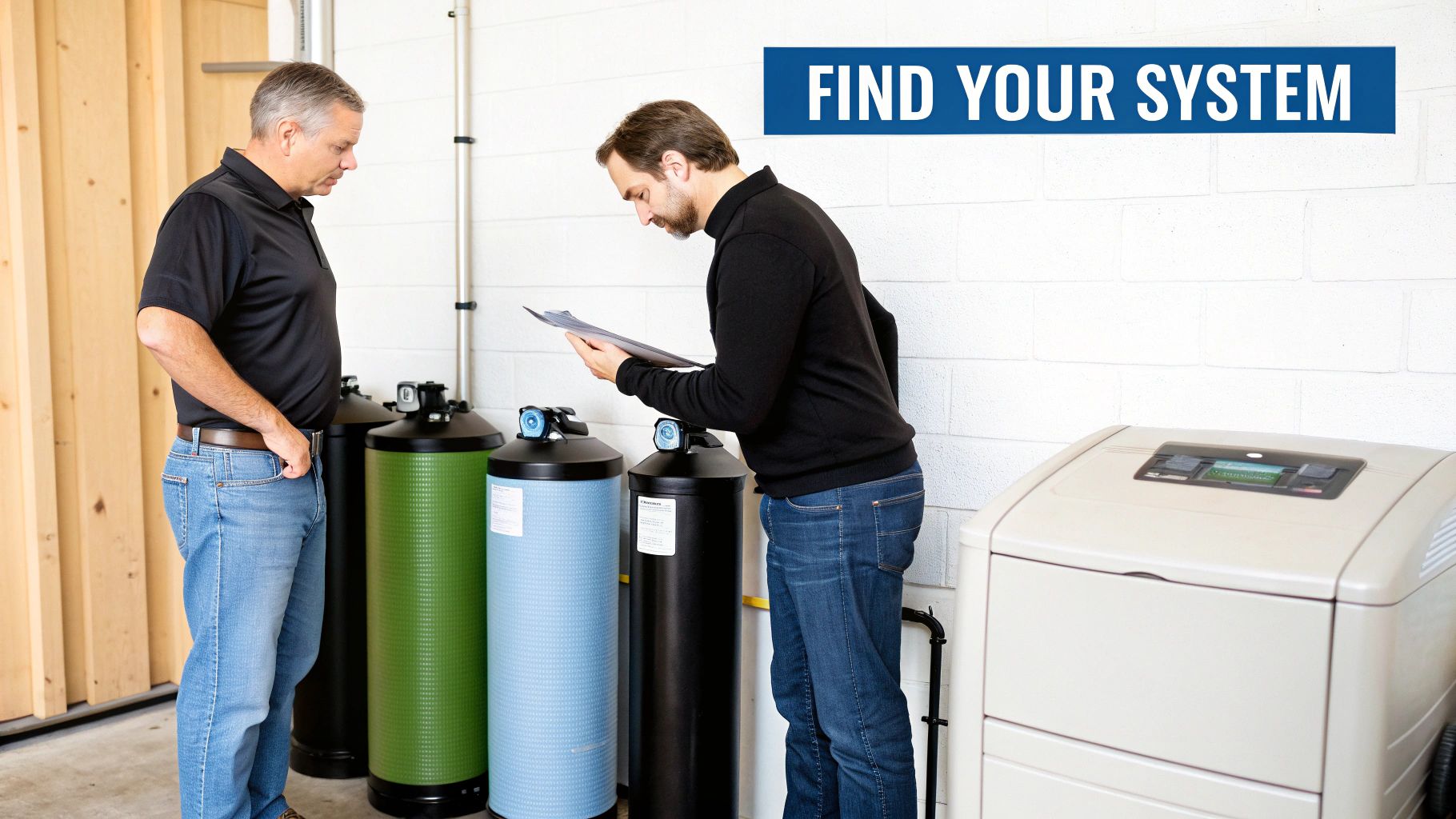
If you're seeing the classic signs of well water trouble—those ugly reddish-brown rust stains in sinks, a faint "rotten egg" smell from the tap, or laundry that feels stiff and scratchy—you already know a generic fix won't work. Your water comes straight from the ground, packed with minerals and contaminants that city water treatment facilities normally filter out.
This is precisely why a professional's eye is so important. Homeowners are more aware of water quality than ever, and it shows. The global market for water softeners has swelled to USD 3.3 billion, with homes like yours making up a huge chunk—nearly 45.7%—of that demand. People are investing in better water.
Understanding Your Options
Diving into the world of water treatment can feel complicated, but it all boils down to matching the right technology to your specific issue. For example, we all know how hard water wreaks havoc by causing scale buildup in pipes and appliances. A proper softener doesn't just make your water feel better; it actively protects your home's plumbing and can significantly reduce the need for water heater repair.
Here’s a quick rundown of the main types of systems we use to solve the unique water challenges in Southwest Florida:
- Salt-Based Water Softeners: This is the tried-and-true workhorse. It's the most effective way to physically remove the high concentrations of calcium and magnesium that cause that stubborn scale buildup and soap scum.
- Salt-Free Water Conditioners: If your primary goal is just to stop scale from forming inside your pipes and appliances without adding salt, this is a solid alternative. Just know that it doesn't actually remove the hardness minerals, so the water won't feel "soft."
- Specialized Iron & Sulfur Filters: These are non-negotiable when your biggest complaints are rust stains from iron or that nasty rotten egg smell, which is caused by hydrogen sulfide gas.
Here's the most important piece of advice I can give you: Start with a professional water analysis. Without knowing the exact levels of hardness, iron, and anything else lurking in your water, you’re just guessing. A proper test gives us the hard data we need to build a system that will actually work for you.
At Water Medic of Cape Coral, our process always starts with a comprehensive, free water analysis. It’s how we get to the bottom of your water problems and design a custom solution that brings clean, pure water to every tap in your house.
Quick Guide to Well Water Treatment Systems
To help you get a clearer picture, this table breaks down the most common systems we install for well water, what they do, and which specific problems they're designed to fix right here in Southwest Florida.
| System Type | Primary Function | Best For Solving |
|---|---|---|
| Salt-Based Ion Exchange | Removes hardness minerals | Scale buildup, soap scum, stiff laundry |
| Salt-Free Conditioner | Prevents mineral scale | Clogged pipes and appliance inefficiency |
| Dedicated Iron Filter | Oxidizes and removes iron | Rust stains on fixtures and appliances |
| Sulfur Removal System | Eliminates hydrogen sulfide gas | "Rotten egg" odor in water |
Each of these systems has a distinct job. Often, the best solution for well water is actually a combination of systems working together to tackle multiple issues at once.
Why Southwest Florida Well Water Demands a Different Game Plan
If you're dealing with well water in Southwest Florida, you already know that a simple "water softener" from a big-box store just won't cut it. While most standard systems are built to tackle calcium and magnesium—the minerals that cause chalky buildup and scale—our local groundwater is a completely different beast. What we pull from the ground here is a complex mix of minerals and contaminants that generic systems are simply not designed to handle.
Unlike city water, which is treated before it ever reaches your home, your well is a direct line to the local aquifer. That means whatever is in the surrounding soil and rock formations is what comes out of your tap. For homeowners in Cape Coral, Fort Myers, and our neighboring communities, this often creates a triple-threat of water problems that go way beyond simple hardness.
It's Far More Than Just Hard Water
The issues we see every day aren't just about protecting your pipes from scale. It's the frustrating, day-to-day problems that homeowners notice first.
- Iron Stains: This is the big one. High iron is the culprit behind those ugly, reddish-brown rust stains that plague sinks, toilets, tubs, and even your freshly washed clothes. It also gives your water an unpleasant metallic taste.
- Rotten Egg Smell: If you're hit with that unmistakable "rotten egg" odor every time you turn on the faucet, you're dealing with hydrogen sulfide gas. Beyond the awful smell, it can tarnish your silverware and corrode your plumbing.
- Yellow or Brown Water: Caused by tannins from decaying vegetation, this issue can give your water a dingy, tea-like color. While it's usually not harmful, no one wants to drink, cook with, or bathe in brownish water.
A standard water softener is completely outmatched by these issues. An ion-exchange system might pull out a small amount of iron, but it will quickly get overwhelmed and "fouled," leading to a complete system breakdown. And it does absolutely nothing for the rotten egg smell or the discoloration caused by tannins.
Understanding the specific chemistry of your well is the absolute first step. Installing a system without a proper diagnosis is like taking medicine without knowing your symptoms—it’s a shot in the dark that rarely works and often wastes money.
The Make-or-Break Role of Professional Water Testing
Because our groundwater chemistry can change so dramatically—sometimes even between you and your next-door neighbor—a professional water analysis is non-negotiable. This isn't a sales pitch; it's the foundation for any system that will actually work long-term. A detailed test gives us the hard data: the precise levels of hardness minerals, iron, sulfur, tannins, and anything else lurking in your water.
With that information, an expert can determine exactly what you need. Is it:
- A heavy-duty salt-based softener built for high hardness and some iron?
- A dedicated iron filter that works alongside a softener?
- An aeration system to get rid of that nasty sulfur smell?
- A special filter with organic scavenging resin to remove tannins?
Trying to fix all these problems with a single, one-size-fits-all unit is the most common mistake we see homeowners make. It's a recipe for frustration, wasted money, and water that never gets better. If you want to see what your neighbors are asking about their own systems, you can find great information in our guide to well water FAQs.
Here at Water Medic of Cape Coral, our process always starts with a free, no-obligation water analysis. This essential first step ensures we pinpoint the real cause of your water issues and recommend the right equipment to bring clean, soft, and pure water to every tap in your house.
Comparing Water Softener Technologies for Local Wells
When you're dealing with well water in Southwest Florida, you can't just grab any softener off the shelf. You need a system that can handle our unique water chemistry, and that means looking beyond the slick marketing. Let's break down the different technologies head-to-head to see which one really solves the problems you're facing.
A good starting point is to pinpoint the main issue with your water. Is it rust stains? A funky smell? That chalky buildup on everything?
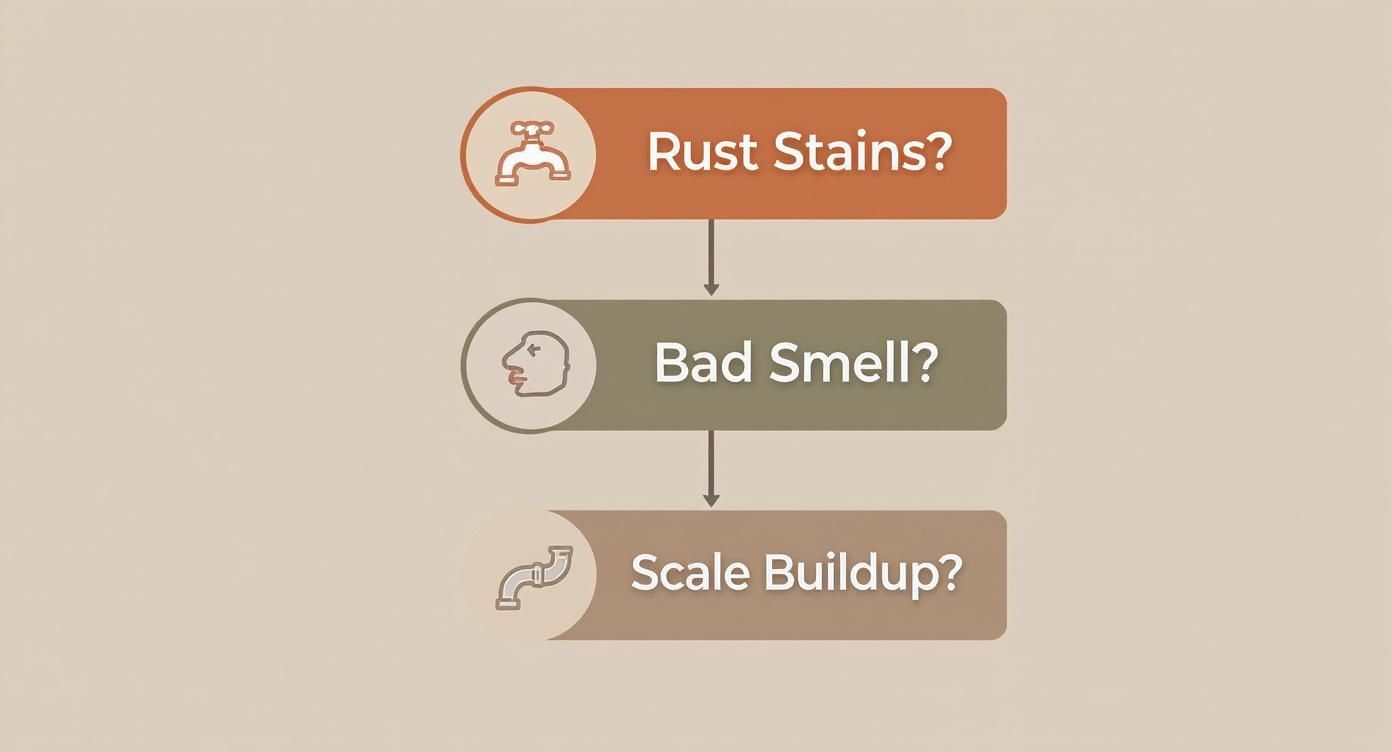
This flowchart nails the big three issues we see all the time. Chances are, one or more of these problems looks very familiar.
Salt-Based Ion Exchange Systems: The Gold Standard for Hardness
When it comes to getting rid of seriously hard water, nothing beats a classic salt-based ion exchange system. These are the workhorses that physically pull out the calcium and magnesium—the minerals causing all that scale, stiff laundry, and soap scum. They're the only systems that give you genuinely "soft" water.
It’s no surprise they continue to dominate the market, holding a massive 58.7% to 68.24% revenue share. For the kind of mineral-heavy well water we have here, their performance is just in a different league.
But they do have an Achilles' heel: iron. A good salt-based unit can manage a little bit of iron, but if your levels are high (over a few parts per million), it will quickly clog the resin media. This kills the system's efficiency and leads to an early breakdown, which is exactly why a water test is non-negotiable before you buy.
Salt-Free Conditioners: A Targeted Solution for Scale
Salt-free conditioners, sometimes called descalers, take a completely different tack. They don't remove the hardness minerals. Instead, they use a process to crystallize them so they can’t stick to your pipes, faucets, or the inside of your water heater.
This makes them a great, zero-maintenance option if your only goal is to protect your plumbing and appliances from scale buildup. Just know that the water won't have that slippery-soft feel, and you won't see the rich lather you'd get from a traditional softener.
When considering a salt-free conditioner, the goal is prevention, not removal. This technology is ideal for managing scale buildup efficiently and without salt, but it won't solve issues like soap scum or that slippery-soft water feel.
One of the most proven and reliable salt-free options is ScaleNet. You can learn more about the benefits of ScaleNet technology, which uses Template Assisted Crystallization (TAC) to offer a powerful, salt-free way to stop scale in its tracks. It's a fantastic fit for homes with moderate hardness where the owner simply doesn't want to deal with salt.
To help you see the differences at a glance, here's how these systems stack up against a dedicated iron filter.
Feature Comparison of Well Water Treatment Systems
This table outlines the core functions and best-use cases for the most common solutions we install for Southwest Florida well water issues. It helps clarify what each system actually does.
| Feature | Salt-Based Ion Exchange | Salt-Free Conditioner | Dedicated Iron Filter |
|---|---|---|---|
| Primary Function | Removes hardness minerals (calcium & magnesium) | Prevents scale buildup by altering mineral structure | Removes iron and hydrogen sulfide (rotten egg smell) |
| Best For | Eliminating scale, soap scum, and dry skin/hair | Protecting pipes & appliances from scale without salt | Fixing rust stains and bad odors |
| "Soft Water" Feel? | Yes, provides the classic slippery feel | No, water chemistry remains unchanged | No, it is a pre-filter, not a softener |
| Iron Removal | Limited (Typically < 3 ppm) | None | Excellent (Can handle > 10 ppm) |
| Maintenance | Requires periodic salt refills | Virtually maintenance-free | Requires occasional media regeneration or replacement |
| SWFL Use Case | Homes with high hardness but low-to-moderate iron | Homes with moderate hardness where scale is the only concern | Essential pre-treatment for wells with high iron/sulfur |
As you can see, there isn't one "best" system—there's only the best system for your specific water problems.
Specialized Iron and Sulfur Removal: The Problem Solvers
If your top complaints are those ugly orange stains in your sinks or that unmistakable "rotten egg" smell every time you turn on the tap, a water softener alone isn't going to cut it. Those problems call for a specialist: a dedicated system built to go after iron and hydrogen sulfide gas.
These systems work by oxidizing the iron and sulfur, turning them into physical particles that can be easily filtered out. They are always installed before a water softener to act as a bodyguard, protecting the softener's sensitive resin from getting fouled up.
For a huge number of wells in Southwest Florida, a one-two punch is the only real solution:
- An Iron/Sulfur Filter: This unit goes first, knocking out the staining and odors.
- A Salt-Based Softener: This unit comes next to handle the hardness and prevent scale.
This two-stage approach guarantees that every issue is met with the right tool for the job, giving you clear, soft, and great-smelling water from every faucet. While we're focused on softeners here, it's helpful to be aware of the various water filtration systems available, as a total solution can involve more than just softening.
Ultimately, you can't make the right call without knowing exactly what's in your water. Our team at Water Medic of Cape Coral provides a free water test to identify the specific contaminants and their concentrations. With that data in hand, we can recommend the perfect system—or combination of systems—to solve your water problems for good.
How to Size Your System for Maximum Efficiency

When it comes to water softeners for Southwest Florida well water, picking the right size is just as critical as picking the right type. It's a common mistake to think bigger is always better, or that a smaller unit will save money. The truth is, both can cost you.
An undersized system is always playing catch-up. It runs regeneration cycles constantly, struggling to keep pace with your family's water use. This not only causes hard water to "break through" into your pipes but also puts a ton of premature wear on the system itself.
On the flip side, a system that's too large is just plain inefficient. It might regenerate less often, but when it does, it's using more salt and water than your home actually needs. Sizing isn't a ballpark guess; it's a simple calculation based on real data about your home and your specific well water.
Getting this right is the only way to ensure your system runs efficiently for years to come. That’s why a professional sizing from Water Medic of Cape Coral is the best route to guarantee you’re not wasting money or dealing with poor performance down the road.
Step 1: Calculate Your Daily Softening Needs
First things first, we need to figure out just how much work your softener will need to do every day. We do this by calculating your "daily grain load"—a number that represents the total amount of hardness minerals your household uses in a 24-hour period.
It’s a straightforward calculation. We just need to multiply the number of people in your home by the average daily water usage. While this can fluctuate, a good, conservative industry standard is 75 gallons per person per day. This figure covers everything from showers and laundry to dishwashing and toilet flushes.
- Example Calculation: For a family of four, the math looks like this: 4 people x 75 gallons/person = 300 gallons per day.
Step 2: Determine Your Water Hardness Level
Next, we need the most important piece of the puzzle: your water's hardness level, measured in grains per gallon (GPG). You simply can't guess this number. It has to come from an accurate, professional water test.
Here in Southwest Florida, well water hardness can be all over the map, from a moderately hard 10 GPG to an extremely hard 30 GPG or more. This number dictates how tough the job is.
But for well water, we can't stop there. Iron is almost always part of the equation, and it places extra demand on the softener's resin. To account for this, we add a "hardness equivalent" for the iron.
The rule of thumb is to add 3 GPG to your hardness number for every 1 part per million (ppm) of iron in your water. This ensures the system you choose is robust enough to tackle both minerals without skipping a beat.
Step 3: Put It All Together
Now we just combine the numbers. We’ll multiply your home's daily water usage by your total compensated hardness level to find the daily grain requirement.
Let's stick with our example family of four using 300 gallons of water a day. Imagine our free water analysis shows their well has 25 GPG of hardness and 2 ppm of iron.
- Calculate Compensated Hardness: 25 GPG (from minerals) + (2 ppm iron x 3) = 31 GPG total hardness.
- Calculate Daily Grain Requirement: 300 gallons/day x 31 GPG = 9,300 grains per day.
That number, 9,300 grains, is the absolute minimum amount of hardness the softener must remove every single day to deliver consistently soft water to every faucet in the house.
Choosing the Right Grain Capacity
Water softeners come in standard sizes based on their "grain capacity"—you'll see models rated as 32,000-grain, 48,000-grain, or 64,000-grain. This number tells you the total amount of hardness the unit can remove before it needs to run a regeneration cycle.
Ideally, you don't want the system regenerating every day, as that's inefficient. A good target is to have it regenerate about once a week.
- Weekly Requirement: 9,300 grains/day x 7 days = 65,100 grains per week.
Looking at this, a 64,000-grain system is just a bit too small; it would be regenerating more often than we'd like. The right move here would be to step up to the next size, likely an 80,000-grain system. That unit would regenerate roughly every eight days, hitting that sweet spot of salt efficiency, water conservation, and reliable performance. This is exactly why a detailed, professional sizing is so critical to getting it right the first time.
Understanding Installation and Long-Term Maintenance
Picking the right water softener is a huge first step, but how it's installed and cared for over the years is what really dictates its performance. You can have the best system on the market, but if it's installed poorly, you're setting yourself up for headaches. On the flip side, a properly maintained unit can give you clean, soft water for 10-15 years or more.
The installation itself is more than just hooking up a couple of pipes. Our certified technicians at Water Medic of Cape Coral have this down to a science. We start by finding the perfect spot for the unit—somewhere it’s easy to get to for service, has a power source nearby, and can drain properly during regeneration cycles.
Tying it into your home's existing plumbing has to be done just right. We make sure the system is plumbed to treat all the necessary water lines without tanking your water pressure or creating new places for leaks to start. A professional installation means every single component, from the bypass valve to the brine line, is working exactly as intended from day one.
The Realities of System Ownership
Once your system is up and running, what comes next? The day-to-day responsibilities are pretty straightforward, but they are important. The type of system you have will determine what you need to do to keep it happy.
- Salt-Based Systems: These require the most hands-on attention, but it's still pretty minimal. Your main job is topping off the brine tank with salt pellets. If your system is sized correctly, you might only have to do this every few months, but it's a task you can't ignore.
- Salt-Free Conditioners: These are about as "set it and forget it" as you can get. No salt, no electricity, no drain lines. They are virtually maintenance-free.
- Iron & Sulfur Filters: Depending on the model, you might need to replace the filter media or refill certain chemicals every so often to keep them oxidizing contaminants effectively.
A common mistake I see is homeowners thinking their water system is invincible once it's installed. Regular check-ups are the key to catching small issues before they snowball into expensive repairs. This is what keeps your water quality high and your equipment running for the long haul.
Protecting Your Investment with a Maintenance Plan
For many homeowners here in Southwest Florida, the peace of mind that comes with professional oversight is priceless. Consistent upkeep does more than just prevent surprise breakdowns; it ensures your system is running at peak efficiency, which saves you money on salt and water. It's the smartest way to manage one of your home’s most important assets.
This is exactly why we offer service plans tailored to your specific equipment. Our technicians can handle everything—checking salt levels, cleaning out the brine tank, testing your water quality, and even reprogramming the control valve if your water conditions change. To see how a hands-off approach can guarantee top performance, you can explore the benefits of our professional water softener monthly maintenance plans. It’s the easiest way to keep your system running smoothly and protect your home for years to come.
Let Water Medic Handle Your Well Water Solution
You shouldn't have to become a water chemist just to get clean, soft water in your home. We've walked through all the complexities of Southwest Florida's well water, from the stubborn iron and sulfur to the intense hardness levels. Figuring all that out is our job, and here at Water Medic of Cape Coral, we make the solution simple and effective.
We'll take care of the entire process for you, start to finish. It all begins with an accurate, professional water test to see exactly what’s in your supply. From there, we design a system recommendation that’s just for you, making sure you get the right equipment without paying for bells and whistles you don't need. Finding the best water softener systems for well water truly hinges on getting this first step right.
Your Local, All-in-One Water Experts
Our job doesn't stop once we've given you a recommendation. We manage the professional installation from A to Z and stick around to provide reliable support, keeping your system running like new for years to come. Think of us as your go-to local partner, completely focused on delivering pure water and total peace of mind.
Your journey to better water doesn't have to be complicated or stressful. It starts with one easy step: a conversation with a local expert who gets the unique water challenges in our community.
We've designed our entire process to be straightforward so you can get back to enjoying pristine, softened water. Forget the guesswork and the risk of buying the wrong system. Our team has the hands-on experience and local knowledge to solve your well water problems correctly the first time.
Take the First Step Today
Ready to finally transform your home's water quality? Clear, great-tasting water is just a phone call away.
Get in touch with Water Medic of Cape Coral today to schedule your free, no-obligation consultation and water analysis. Let us show you just how easy it can be to get the high-quality water your family deserves.
Common Questions About Well Water Softeners
Diving into the world of well water treatment can feel a little overwhelming, and it's only natural to have a lot of questions. As local experts here in Southwest Florida, we’ve pretty much heard them all. This section is all about giving you clear, direct answers to the things homeowners ask us most, so you can feel confident you're choosing the right system.
Let's cut through the noise and get you the straightforward information you need for your home and family.
How Do I Know If My Well Water Needs a Softener?
The first clues are usually right in front of you. Think about those stubborn rust stains in your sinks and tubs, or how your soap just won't lather up properly. You might also notice your laundry coming out feeling stiff and scratchy, or that your "clean" dishes are always covered in spots.
While those signs are a dead giveaway, the only way to be absolutely certain what's going on with your water is to get it tested. A professional water test is the essential first step. It gives us the hard data we need to see exactly what contaminants are present and at what levels, telling us if you need a softener, a separate iron filter, or a combination of the two to truly fix the problem.
Will a Water Softener Remove the Rotten Egg Smell?
That's a great question, and the answer is no, not really. A standard water softener is built for one main job: removing hardness minerals like calcium and magnesium through ion exchange. It's simply not designed to tackle the sulfur gas that causes that awful "rotten egg" smell.
Sure, a softener might accidentally reduce a tiny amount of sulfur if the level is very low, but that's not its purpose. To get rid of that odor for good, you almost always need a dedicated iron and sulfur filter. Based on the results from your professional water analysis, we can map out the right strategy for your home.
It's a common misconception that a single piece of equipment can solve all well water problems. In reality, a multi-stage approach is often necessary, with each component targeting a specific issue like hardness, iron, or sulfur for a complete solution.
What Is the Lifespan of a Quality Water Softener System?
When you invest in a high-quality, professionally installed water softener, you can expect it to last for 10 to 15 years—sometimes even longer if it's well-maintained. A few key things influence how long any unit will hold up.
The build quality of the system itself is huge, but so is the severity of your water issues. Extremely hard water, for instance, puts a lot more strain on the equipment day in and day out. The most important factor, though, is consistent upkeep. Just sticking to the manufacturer’s recommended service schedule makes a world of difference. Our systems are built to last, and we back them up with comprehensive service and maintenance plan options to keep them running smoothly for years to come.
Choosing the right system can feel complex, but you don't have to figure it out alone. The experts at Water Medic of Cape Coral have over 25 years of hands-on experience solving Southwest Florida's toughest well water challenges. Schedule your free water analysis today and take the first step toward pure, clean, and soft water.