Your Guide to Safe Well Water for Drinking
The short answer? Yes, your well water can be perfectly safe to drink. But there's a catch. Unlike the water that flows to city homes, its safety isn't guaranteed by a municipality. As a well owner, that responsibility rests squarely on your shoulders.
Think of it this way: you’re the manager of your own private water utility. The quality of what comes out of your tap is a direct result of the care and attention you put into the source. At Water Medic, we are your expert partner, ensuring you have the tools and support to manage that responsibility with confidence.
The Journey From Ground to Glass
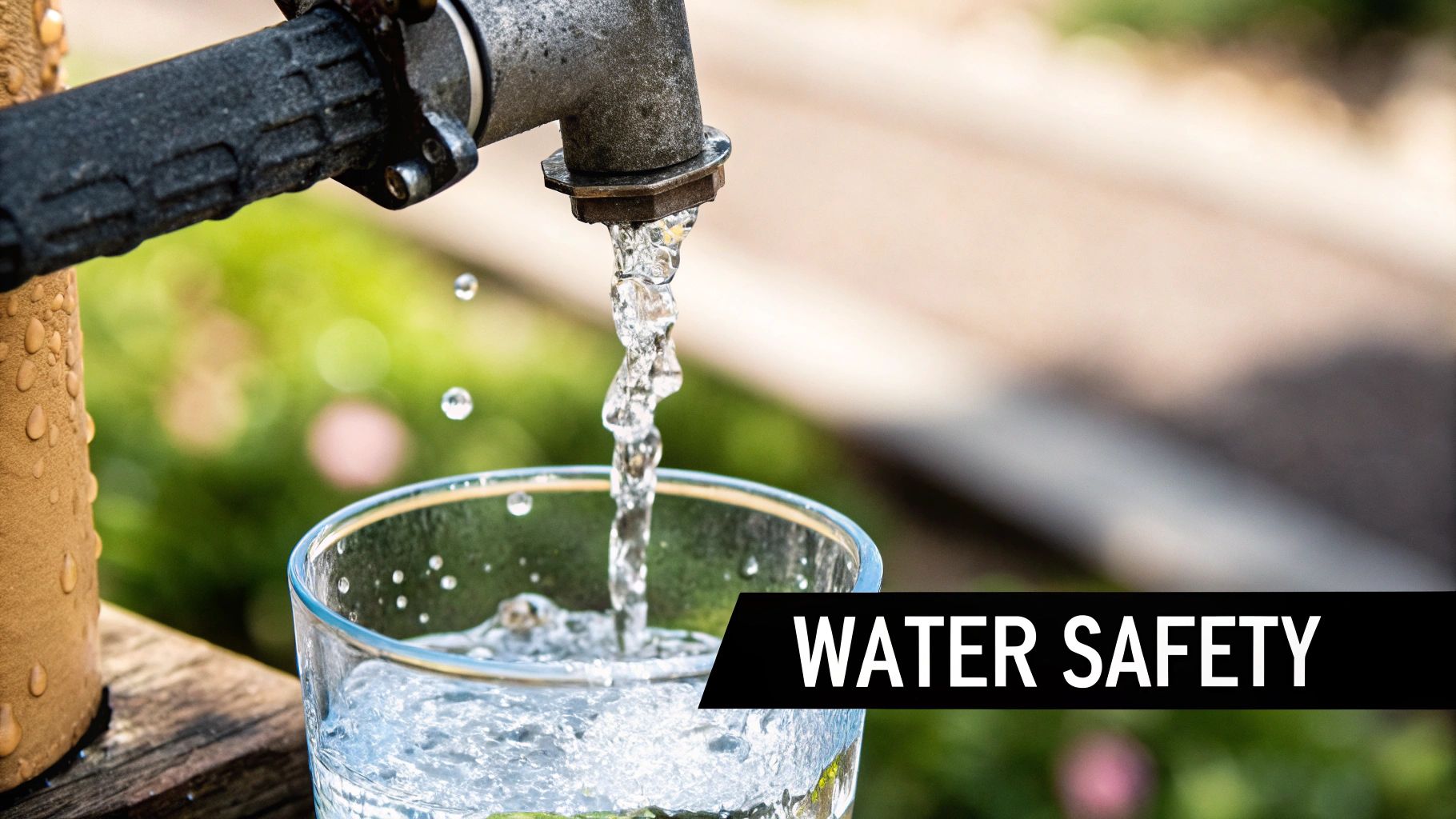
Having a private well is an incredible thing. It connects your home directly to the earth's natural water supply, giving you a fresh, independent source of water. But with that independence comes the critical job of ensuring its purity. The journey your water takes from a deep underground aquifer to your kitchen faucet is a natural process, but it's one with several potential points where contaminants can sneak in.
Municipal water gets treated and tested over and over before it ever reaches a city tap. Well water, on the other hand, is completely unregulated. This means potential problems with bacteria, nitrates, heavy metals, or other minerals can fly under the radar. Water that looks, tastes, and smells completely fine can still hide unseen threats that could impact your family’s health over time.
Why Your Vigilance Matters
Your role as a well owner is absolutely crucial. The safety of your water is a moving target, influenced by your well's construction, its location near potential pollution sources (like septic systems or agricultural runoff), and even the local geology. Because these conditions can—and do—change, regular monitoring isn't just a good idea; it's essential for your peace of mind.
This isn't just a local issue. Globally, over two billion people depend on wells. In 2022, an estimated 296 million people were drawing water from unprotected sources, which underscores the widespread risk of contamination. You can read more about these global water safety challenges to see the bigger picture.
Your private well gives you amazing self-sufficiency, but it also makes you the sole guardian of your water quality. This is a big responsibility, but it's one we can help you manage with total confidence.
Taking Control of Your Water Quality
The first step toward guaranteeing safe well water for drinking is simply understanding your role. Proactive management really boils down to knowing what to look for, when to test, and how to respond. This guide is designed to walk you through exactly that—from spotting common contaminants to choosing the right treatment solutions.
Here’s a simple way to think about taking charge of your well's safety:
- Awareness: First, accept that your water quality isn't static. It can change over time and requires your regular attention.
- Testing: Next, commit to routine, professional analysis. It's the only way to get a clear, accurate picture of what’s really in your water. Our comprehensive well water testing services give you the data you need to make informed decisions.
- Action: Finally, use those test results to implement the right treatment and maintenance plan to keep your water pure.
Use this quick checklist to understand the key factors that determine if your well water is safe for drinking and the next steps you should take.
Quick Well Water Safety Checklist
| Factor | Key Consideration | Recommended Action |
|---|---|---|
| Location | Is your well uphill and at least 50-100 feet away from septic tanks, animal pens, or chemical storage? | Visually inspect the wellhead area regularly for potential sources of runoff or contamination. |
| Well Condition | Is the well cap sealed tightly? Is the casing free of cracks or visible damage? | Perform a physical check of the wellhead at least twice a year, especially after major storms. |
| Water Appearance | Is the water consistently clear? Or is it sometimes cloudy, colored, or have floating particles? | Any change in appearance, taste, or smell is an immediate red flag. Test your water right away. |
| Testing History | Has the water been tested for bacteria, nitrates, and other local contaminants in the past year? | Schedule annual tests for bacteria and nitrates. Test for other concerns every 3-5 years. |
By following this approach, you can turn uncertainty into confidence. You'll know that every glass of water from your tap is as clean, safe, and healthy as it can possibly be for your family. Now, let’s dig into what might actually be lurking in your water.
What's Really in Your Well Water? A Look at Common Contaminants

Here’s the biggest challenge when it comes to having safe well water for drinking: the most dangerous threats are often completely invisible. Water that looks crystal clear, smells fresh, and tastes great can still contain contaminants that pose serious health risks. The point isn't to scare you, but to empower you to take control.
Your well water is essentially a liquid snapshot of the ground it comes from. Everything happening in your local environment—from a nearby farm to the age of your home’s pipes—can affect what’s in it. This is why we generally group potential contaminants into three main categories.
Understanding what might be lurking in your water is the only way to find the right fix. That's why professional testing is so critical. It takes you from guessing to knowing, giving you a clear roadmap for what to do next.
Microbiological Intruders
This is the world of unseen living organisms—bacteria, viruses, and protozoa that can find their way into your water supply. These are the contaminants that can make you sick fast, often leading to nasty gastrointestinal illnesses.
So where do they come from? Usually, the source is closer to home than you'd think. A failing septic system, runoff from animal waste, or even surface water leaking into a poorly sealed well can introduce nasty bacteria like E. coli or coliform. A well that's been perfectly safe for decades can become contaminated overnight after a heavy storm or flood.
Since you can't see, smell, or taste these microscopic threats, they are one of the biggest reasons we recommend annual water testing. Our specialized well water testing services are designed specifically to hunt for these biological risks and give you peace of mind.
Chemical Contaminants
Chemical contaminants are substances, both natural and man-made, that dissolve into water, usually without leaving a trace. Over time, they can build up to levels that become harmful to your health, which is why a broad-spectrum analysis is so important.
Here are a few of the most common chemical culprits we see:
- Nitrates: Think of nitrates as an invisible fertilizer in your water. They often seep into groundwater from agricultural runoff or leaky septic tanks. High nitrate levels are especially dangerous for infants and pregnant women because they can affect the blood's ability to carry oxygen.
- Heavy Metals: Lead and arsenic are two of the worst offenders. Lead is a silent threat, often leaching from older pipes, solder, and fixtures right inside your home, and it’s particularly toxic to a child’s developing brain. Arsenic, on the other hand, is a natural element found in the earth that can dissolve into aquifers, posing serious long-term health risks.
- Pesticides and Herbicides: If you live in an agricultural area, the chemicals sprayed on crops can eventually migrate down into the groundwater, making their way into your well.
Identifying the specific chemical profile of your water is like getting a detailed diagnostic report for your well. It’s the only way to ensure you're using the right treatment to remove the exact contaminants present.
Radiological Elements
This is a less common, but no less serious, category of contaminants. These are naturally occurring radioactive materials found in certain types of rock and soil. As groundwater flows through these underground formations, it can pick them up and carry them into your well.
The most common radiological contaminant we find is radon, a colorless and odorless gas. Most people know radon as an indoor air problem, but it can also be dissolved in groundwater. When you run a shower or do dishes with radon-contaminated water, the gas gets released into the air in your home, creating an inhalation risk. Drinking it also poses a long-term health concern.
Finding these hidden threats isn't a DIY job; it takes sophisticated lab equipment and professional analysis. By pinpointing exactly what's in your well—whether it’s microbiological, chemical, or radiological—you get the power to choose the right solution and make sure every glass your family drinks is truly safe.
Your Guide to Professional Well Water Testing
Since you can't see, taste, or smell most of the dangerous contaminants lurking in groundwater, regular testing is the only real way to know if your well water for drinking is truly safe. Think of it as a routine checkup for your water supply—a vital piece of home maintenance that protects your family's health.
Waiting until you notice a strange taste or foul odor is a gamble you don't want to take. By then, your family could have already been exposed to something harmful. Staying ahead of potential problems with a proactive testing schedule is your best defense against those invisible threats.
When Should You Test Your Well Water?
Public health experts generally agree on a simple rule of thumb: test your well water annually. At the very least, a yearly test for common culprits like coliform bacteria and nitrates should be a permanent fixture on your home maintenance calendar.
But sometimes, you need to act sooner. Certain events should trigger an immediate call for a professional water test. Be sure to schedule one right away if you notice any of these red flags:
- Changes in Your Water: Is there a sudden shift in the water's taste, smell, or color? That’s a clear signal that something has changed down in your well.
- Recent Well Work: Any time your well pump is replaced or the system is repaired, it's a good idea to test afterward to ensure the water hasn't been compromised.
- Nearby Disturbances: New construction, farming activity, or flooding near your well can all introduce new contaminants into the groundwater.
- Household Health Issues: If family members are dealing with recurring stomach problems, your water could be the hidden source.
- A New Baby on the Way: Infants are especially vulnerable to contaminants like nitrates, so testing is essential before bringing a newborn home.
DIY Kits vs. Professional Lab Analysis
Wandering through a hardware store, you’ve probably seen do-it-yourself water testing kits. They seem convenient, but how do they stack up against a professional lab analysis?
A DIY kit is a bit like taking your own temperature. It can tell you if you have a fever, but it can’t diagnose what’s actually causing it. In contrast, professional lab testing is like getting a full diagnostic workup from a doctor. You receive precise, quantifiable results that identify specific contaminants and their exact concentration levels—critical details you need to select the right water treatment solution.
Relying solely on a DIY kit can create a false sense of security. Professional analysis from our certified experts gives you the definitive answers needed to take effective action and truly protect your family's health.
This need for reliable data isn't just a local issue. It reflects a major global challenge. Despite recent progress, 1 in 4 people worldwide still lack access to safely managed drinking water, leaving them vulnerable to diseases from untreated sources. You can learn more about this from the global safe water access report by the World Health Organization.
The Power of a Professional Report
When you choose our professional testing services, you get much more than a page of raw data. We provide a clear, easy-to-understand report that translates the complex science into practical information you can actually use. We don’t just tell you what’s in your water; we explain what it means for your health and guide you toward the most effective fix.
Our entire process is designed to give you complete confidence:
- Simple Scheduling: We make it easy to book a test at a time that works for you.
- Proper Sample Collection: Our technicians follow strict protocols to ensure samples are collected correctly, preventing contamination and guaranteeing accurate results.
- Certified Lab Analysis: We use state-of-the-art equipment to test for a wide array of potential contaminants.
- Clear, Actionable Results: We'll walk you through your report, answer your questions, and provide expert recommendations for treatment if it's needed.
Don’t leave your family’s health to chance. Getting definitive answers about your water quality is the most important step you can take as a well owner. To learn more or to schedule your professional water test, please check out our Frequently Asked Questions About Well Water or get in touch with us today.
Choosing the Right Water Treatment System
Once your professional test results are in hand, you have the most powerful tool a well owner can possess: knowledge. That detailed report is your personalized roadmap, pointing directly to the specific contaminants that need to be addressed to make your well water for drinking perfectly safe. Now, it's time to connect those problems to real, reliable solutions.
Navigating the world of water treatment systems can feel a little intimidating at first, but it's simpler than you might think. Each system is a specialized tool designed to solve a specific type of problem. Your goal is simply to match your unique water quality issues—as laid out in your lab report—to the right technology.
Demystifying Your Treatment Options
Think of a water treatment system as a dedicated guardian for your home's water. Some systems stand guard at the point of entry, treating every drop of water that comes into your house. Others work at a specific tap, like the kitchen sink, to purify just the water you'll be drinking and cooking with.
Let's break down the most common and effective solutions we install for well owners right here in Southwest Florida. Each one acts like a different kind of security guard, trained to stop a specific type of intruder.
-
UV Purifiers: Imagine this system as a microscopic gatekeeper. It uses ultraviolet light to zap and neutralize bacteria, viruses, and other living microorganisms. It doesn't actually remove anything from the water, but it renders these harmful pathogens completely harmless, preventing them from ever making your family sick.
-
Water Softeners: This system is like a mineral magnet. It specifically targets the "hard water" minerals like calcium and magnesium that cause so many headaches. By pulling these minerals out, a water softener protects your pipes from scale buildup, extends the life of your appliances, and just makes your water feel better for bathing and cleaning.
-
Reverse Osmosis (RO) Systems: This is the ultimate filtration powerhouse. An RO system forces water through an incredibly fine membrane that acts like a microscopic sieve, trapping a huge range of contaminants. It can remove everything from heavy metals like lead and arsenic to dissolved solids, nitrates, and even some chemicals.
Matching your water test results to the correct treatment technology isn't just about clean water—it's about making a smart, cost-effective investment in your home and your family's long-term health. Our experts specialize in designing the perfect system for your specific needs.
This visual guide gives you a quick side-by-side look at these three key systems, highlighting what they do, what they need, and how they're installed.
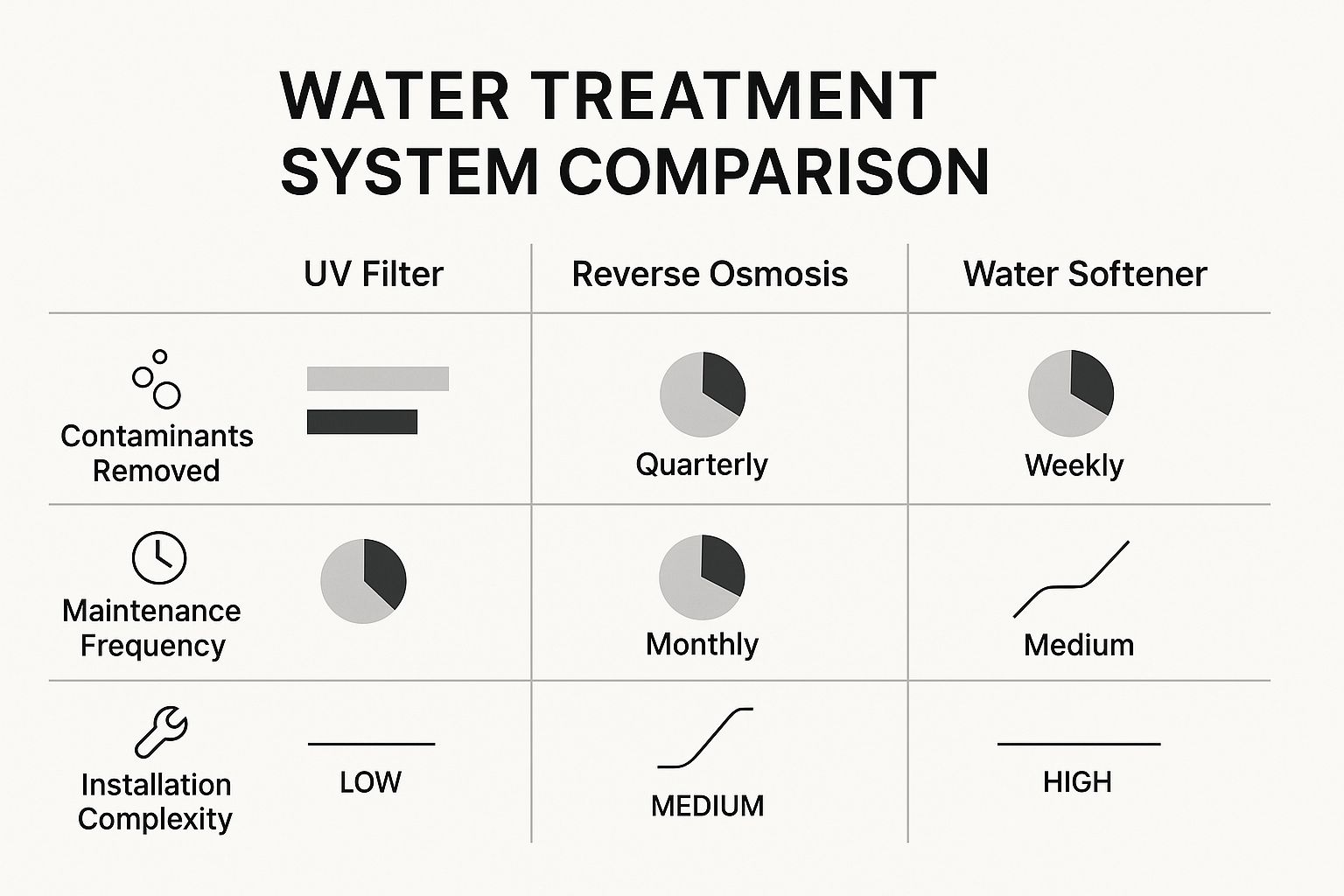
As you can see, each system really excels at a different task, from the targeted microbiological defense of a UV filter to the broad-spectrum purification of a reverse osmosis unit.
Matching Contaminants to Treatment Solutions
Here’s a quick-reference table to help you connect the dots between common well water problems and the systems designed to fix them.
| Common Contaminant | Recommended Treatment System | How It Works |
|---|---|---|
| Bacteria (Coliform, E. coli) | UV Purifier | Uses ultraviolet light to scramble the DNA of microorganisms, making them harmless. |
| Hard Minerals (Calcium, Magnesium) | Water Softener | Exchanges "hard" mineral ions for "soft" sodium ions through a process called ion exchange. |
| Heavy Metals (Lead, Arsenic) | Reverse Osmosis (RO) | A semi-permeable membrane physically blocks and filters out dissolved metals. |
| Nitrates/Nitrites | Reverse Osmosis (RO) | The RO membrane is fine enough to effectively reject and remove nitrate molecules. |
| Dissolved Solids (TDS) | Reverse Osmosis (RO) | Forces water through a membrane, leaving a wide range of dissolved solids behind. |
| Viruses | UV Purifier | The powerful UV-C light instantly inactivates viruses, preventing them from replicating. |
This table makes it easy to see the direct line from a specific contaminant found in your test to the technology that solves the problem.
Now, let's put this into practice. If your test results came back with high levels of coliform bacteria, a UV purifier is your first line of defense. It’s the most direct and effective way to guarantee microbiological safety without adding chemicals to your water.
What if your report flagged high nitrates or arsenic? This is where you need a more powerful filter. Because these contaminants are dissolved in the water, you need a system that can physically separate them out. For many homeowners, the perfect solution is a dedicated under-sink reverse osmosis system, which provides incredibly pure water for drinking and cooking right at the kitchen tap.
And if your main issue is that tell-tale scale buildup in your pipes and on your appliances, a whole-house water softener is the clear winner. It directly addresses the aesthetic and mechanical problems caused by hard minerals, saving you real money on repairs and energy costs down the road.
Often, the very best approach involves a combination of systems. For instance, a well with both bacteria and hard water might need a water softener followed by a UV purifier for a complete, worry-free solution. Our job is to look at your results and design a system that tackles every single concern, giving you total peace of mind with every drop.
Proactive Well Maintenance for Long-Term Purity
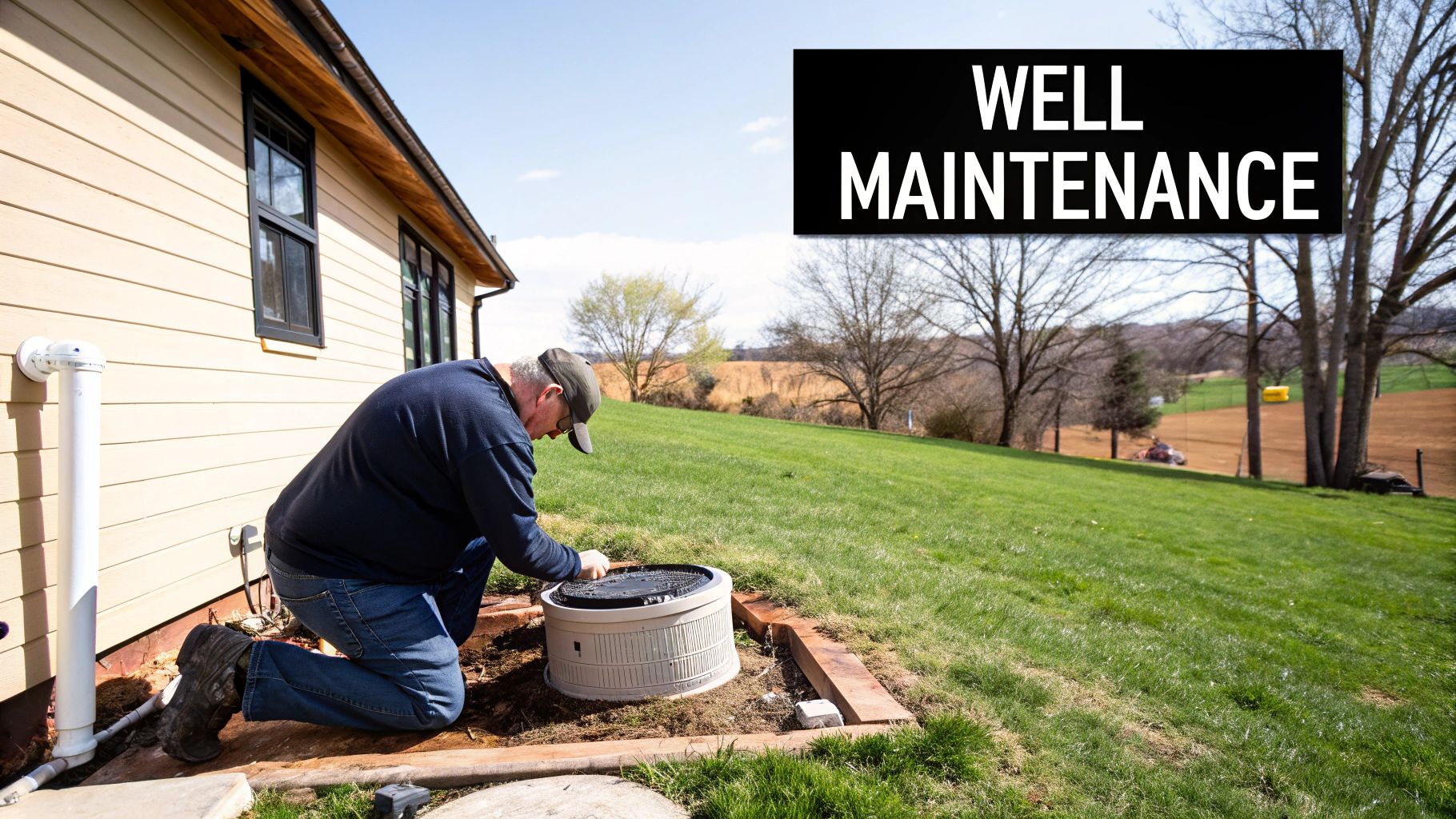
Keeping your well water for drinking safe and pure isn't something you do just once. It's a continuous process, a commitment to protecting your family's health and the significant investment you have in your home's water system.
Think of it like changing the oil in your car. A little proactive care prevents small issues from snowballing into costly, system-wide breakdowns. This shift from reacting to problems to actively preventing them is the cornerstone of long-term water purity and your own peace of mind.
Your Annual Homeowner Checklist
As the well owner, you are the first line of defense. Simple visual checks can help you catch potential trouble before it escalates. We recommend running through this quick list at least once a year and after any significant storms.
- Inspect the Well Cap: Is the cap on tight and secure? Look for any cracks or damage. A broken seal is an open door for insects, rodents, and contaminated surface water to find their way into your well.
- Clear the Surrounding Area: Make sure the area around the wellhead is free of overgrown vegetation, leaves, and other debris. Keeping at least a two-foot clear radius helps prevent pests from nesting and ensures water drains away from the well, not towards it.
- Look for Ground Settling: Check for any sinking ground or signs of erosion around the well casing. This could signal a failing seal, creating a fast track for unfiltered surface water to contaminate your supply.
These simple steps are a huge part of maintaining a safe water source. But for the more complex stuff, you'll need to call in an expert.
When to Call the Professionals
While your own inspections are invaluable, the mechanical and sanitation components of your well system require a trained eye and specialized tools. These are definitely not DIY projects. Trying to tackle them without the right know-how can lead to serious damage or even introduce new contaminants into your water.
Think of a professional well service as your system's specialist doctor. We have the diagnostic tools and deep expertise to address the complex inner workings of your well, ensuring it operates safely and efficiently for the long haul.
Here are a few key tasks that are always best left to certified technicians:
- Annual Pump and Pressure Tank Service: We'll check the pump's performance, test the pressure tank, and make sure all the electrical components are working safely. This one routine service can dramatically extend the life of your equipment.
- Shock Chlorination: If a water test comes back positive for bacteria, a professional shock chlorination is the only way to properly disinfect the entire well and plumbing system. We use precise concentrations and proven methods to eliminate the threat without harming your equipment.
- Well Casing and System Integrity Checks: Our team can perform in-depth inspections to spot potential leaks or structural problems that you simply can't see from the surface.
The physical integrity of your plumbing is also a critical piece of the puzzle. For a helpful guide to repairing water pipes, this is a great resource.
Partnering with a trusted pro for annual maintenance is the smartest move you can make to protect your well. Our team offers expert well water repair and maintenance services designed to keep your system running without a hitch. By being proactive, you can avoid the headache of unexpected breakdowns and ensure your family always has a continuous supply of clean, safe water.
A Few Common Questions About Well Water
Having a private well is a fantastic asset, but it naturally comes with questions. As a homeowner, you need straight answers to make sure the well water you drink is safe and clean. We get a lot of the same questions from well owners, so we've put together this section to give you practical advice for managing your home's water.
Think of this as your quick-reference guide. The answers here all circle back to the core ideas of smart well ownership: test regularly, get professional maintenance, and use the right treatment when you need it.
How Often Should I Really Test My Well Water?
This is probably the most important question we get, and the answer is simple. Health experts like the CDC recommend testing your well water at least once a year. Think of this annual check-up as your baseline for safety, ensuring that common troublemakers like coliform bacteria and nitrates haven't found their way into your system.
But sometimes, you need to act faster. It's time to schedule a test immediately if:
- You notice any change in your water's taste, odor, or color.
- Someone in your house is pregnant, or you have a newborn.
- Your well has been covered by floodwaters.
- You've just had work done on your well pump or plumbing.
- You hear about groundwater contamination problems in your area.
Regular testing is the only way to go from hoping your water is safe to knowing it is. A professional analysis gives you the hard data you need to make the right decisions.
My Water Suddenly Tastes or Smells Funny. What Should I Do?
A sudden change in taste or smell is your well's way of waving a red flag—don't ignore it. The very first thing to do is stop drinking the water. Switch to bottled water until you figure out what’s going on.
The specific scent or flavor can give you some clues:
- A "rotten egg" smell almost always points to sulfur bacteria or hydrogen sulfide gas. It's usually harmless but definitely unpleasant.
- A metallic taste might mean high levels of iron or manganese. It could also signal more serious metals like lead leaching from old pipes.
- An earthy or musty odor often comes from organic matter or certain types of harmless bacteria in the water.
- A detergent or chemical smell is a major warning. This could mean contamination from a nearby septic system or chemical runoff.
When your water's taste, smell, or look changes, it's a clear signal to take action. It means something has shifted in your well's environment, and only a professional test can pinpoint the cause.
The only way to know for sure what's behind the change is to get a comprehensive water test. Our technicians can diagnose the problem and recommend the exact treatment to get your water back to normal.
What Is the Difference Between a Whole-House System and an Under-Sink Filter?
This is a great question that really gets to the heart of water treatment strategy. The biggest difference is what they're designed to do. A whole-house system is installed where the main water line enters your home, so it treats every single drop you use—for showering, laundry, cooking, you name it. Water softeners and large sediment filters are good examples.
An under-sink filter, on the other hand, is a "point-of-use" solution. It's installed right under a specific faucet (usually the kitchen sink) to deliver highly purified water just for drinking and cooking. Reverse osmosis (RO) systems are the most common type.
So, which one do you need? It all comes down to your water test results.
- If you have a problem that impacts your entire home, like hard water minerals that clog pipes and ruin appliances, a whole-house system is the solution.
- If your main goal is to remove specific contaminants from your drinking water, like arsenic, lead, or nitrates, a targeted under-sink system is a perfect and often more affordable choice.
In many cases, the best approach is a combination of both. A homeowner might install a whole-house water softener to protect their plumbing and then add a reverse osmosis system for that extra layer of purity at the kitchen sink. We've put together answers to many more common questions, which you can find in our complete guide to well water FAQs.
Is Cloudy Well Water Dangerous to Drink?
Cloudy or murky water, sometimes called turbidity, isn't always dangerous on its own, but it's a warning sign you can't afford to ignore. That cloudiness is caused by tiny suspended particles like silt, clay, or sand. While these bits of debris are often harmless, their presence suggests your well might be open to more serious contaminants.
Here’s the real risk: those little particles can act as hiding spots for bacteria and other pathogens, shielding them from disinfection. If your water suddenly turns cloudy, especially after a heavy rainstorm, it's critical to get it tested for microbes. The key is to find and fix the root cause, which could be anything from a damaged well screen to surface water seeping in. A simple sediment filter can often clear the water up, but not before you've confirmed there isn't a bigger bacterial problem lurking behind the scenes.
Your well is a valuable asset, giving your family its own independent source of water. With the right information and a partner you can trust, you can keep it running safely for years. At Water Medic of Cape Coral, we specialize in the testing, treatment, and maintenance you need for total peace of mind. To schedule a consultation and take control of your water quality, visit us at https://watermedic.com.