
How to Backwash Pool Filter: Easy Step-by-Step Guide
Knowing how to backwash your pool filter is one of those non-negotiable skills for any pool owner. It's a straightforward process that reverses the water flow through your sand or DE filter, flushing out all the gunk and debris it has trapped. If you can master this simple task, which usually takes just a few minutes, you'll keep your filtration system humming and your water crystal clear.
Why a Clean Pool Filter Is So Important
Think of backwashing as more than just a routine chore; it's a vital health check for your pool's entire circulation system. When that filter gets clogged with dirt, leaves, dead skin, and other contaminants, the water flow slows to a crawl. This not only forces your pump to work overtime—driving up your energy bill—but it also messes with the circulation of essential chemicals like chlorine.
Proper filtration is truly your first line of defense against cloudy water and nasty algae blooms. A clean filter is a happy filter, efficiently grabbing all those tiny particles that would otherwise hang around and make your pool look murky. To keep your pool looking its best, you really need a solid grasp of understanding swimming pool filtration.
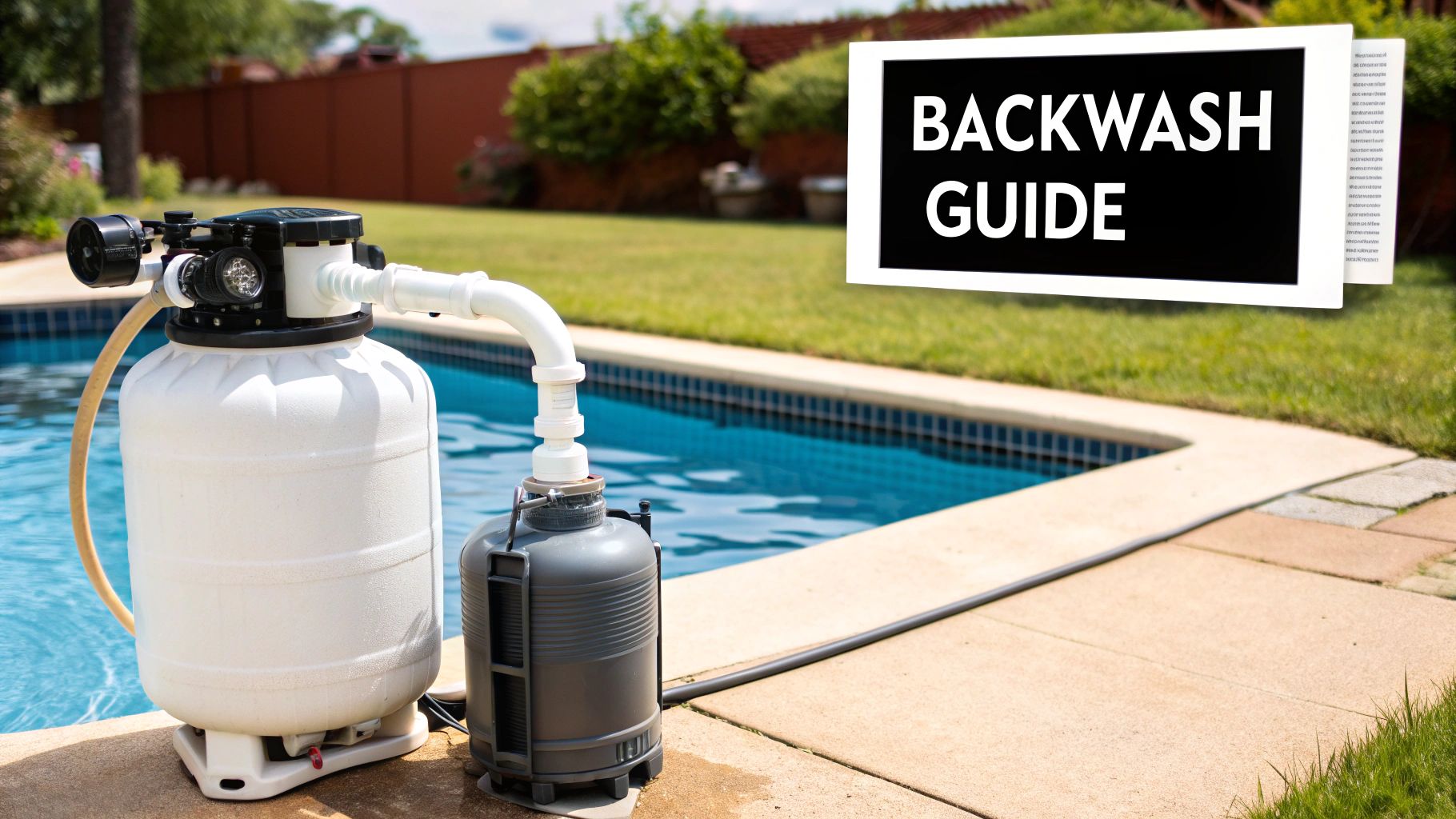
Reading the Signs: When to Backwash
Knowing when to backwash is just as critical as knowing how to do it. Your most reliable tool for this is the filter's pressure gauge. The first thing you should do after a fresh cleaning is check the pressure reading and jot it down. This is your "clean" baseline.
Pro Tip: When the pressure gauge climbs 8-10 PSI (pounds per square inch) above that clean baseline, it's a clear signal to backwash. That pressure increase means the filter is loaded with debris, and water is having a tough time pushing through.
There are a few other visual cues that scream "it's time to backwash!" I always tell clients to look out for these signs when they're near the pool.
The table below breaks down the key indicators that it's time to give your filter a good cleaning.
Key Indicators It's Time to Backwash
| Indicator | What to Look For | Why It Matters |
|---|---|---|
| Pressure Gauge | A reading that is 8-10 PSI higher than your clean baseline pressure. | This is the most accurate sign that debris is restricting water flow. |
| Reduced Water Flow | The water coming from your return jets feels weak or sluggish. | A clogged filter is the most common cause of poor circulation. |
| Cloudy Water | The pool water looks hazy or dull, even after chemicals are balanced. | Your filter is too full to effectively trap fine particles, leaving them suspended in the water. |
These are the big three. If you notice any of them, it's definitely time to schedule a backwash.
While backwashing is a task many pool owners can handle themselves, doing it incorrectly can risk damaging your equipment. For pool owners in Southwest Florida looking for professional, hands-off maintenance, our team is here to help. We offer a https://watermedic.com/swimming-pool/ service that covers everything, including filter maintenance, to protect your investment and keep your pool perfect all year.
Getting Ready for a Safe and Effective Backwash
https://www.youtube.com/embed/DZDflsibD7o
Before you even think about touching that multiport valve, a little prep work is in order. I always tell pool owners to think of it like a pilot’s pre-flight checklist. Taking a few minutes to get everything in place now can save you a world of headaches later. This isn't just about doing the job right; it’s about protecting your expensive equipment and, more importantly, yourself.
The absolute first thing you must do is kill the power to your pool system. And I don't mean just flipping the timer off. You need to head over to your home's main circuit breaker and shut down the power to the pump completely. This is the number one safety rule. An unexpectedly-starting pump is a serious hazard when you're working on the system.
Assembling Your Tools and Gear
With the power safely off, let's get your gear together. The good news is you don't need a massive toolbox for this. You really just need a backwash hose and a solid clamp to connect it.
- Backwash Hose: Give your hose a quick once-over. Make sure it's long enough to reach a good drainage spot and doesn't have any surprise cracks or holes. A leaky hose makes a real mess.
- Hose Clamp: Don't skimp here. A reliable clamp is what keeps that hose from flying off under pressure and spraying dirty pool water all over your yard.
- Safety Gear: I usually throw on a pair of gloves. They keep your hands clean and give you a better grip, especially if things are a bit wet.
Go ahead and attach that backwash hose to the waste port on your multiport valve. Cinch it down tight with the clamp. Next, unroll the hose completely, making sure there are no kinks. Run it out to a spot where the water can drain away safely. You want it far from your home's foundation, delicate plants, and definitely away from your neighbor's property line. It's always a good idea to check local rules on pool water discharge, too.
A critical part of maintenance is minimizing the debris that gets into your filter in the first place. Managing the area around your pool can significantly impact how much debris enters the filter. For example, considering a professional fake turf install around pools can reduce the amount of grass and dirt that ends up in your water.
Performing a Quick Equipment Check
Now, just take a quick walk around your equipment pad. Look for any obvious red flags like cracks in the filter tank or leaky plumbing fittings. The handle on your multiport valve should move without a fight (but don't change its position just yet!). It's also a great habit to glance at the O-ring on your pump lid to check its condition. A tired pump or a bad valve can turn a simple backwash into a real problem.
If something looks wrong—maybe the pump motor sounds strained or you see drips around the seals—it's best to hit the brakes. Don't proceed until you've sorted it out. For anyone not comfortable diagnosing these kinds of issues, that's what we're here for. You can get a better handle on the heart of your pool's system by learning about different pool pumps and what they need to stay healthy. Our team can give your whole system a clean bill of health, so you can tackle maintenance with total confidence.
Getting It Done: The Backwash Process for Sand and DE Filters
Alright, let's get down to the nuts and bolts of actually backwashing your sand or Diatomaceous Earth (DE) filter. The process for both is nearly identical because they share the same brain of the operation: the multiport valve. Think of this valve as the traffic cop for your entire filtration system. Knowing how to direct that traffic correctly is the difference between a clean filter and a costly mistake.
The whole procedure is a carefully choreographed dance between turning the pump on and off and switching the valve settings. If you get the sequence wrong—like trying to turn that valve handle while the pump is running—you can seriously damage the valve's internal gasket or even the valve itself. It's a common (and expensive) rookie error.
This is exactly the kind of detailed work where a bit of expert guidance goes a long way. While the steps aren't complicated, getting them perfect every time is what keeps your equipment running smoothly for years.
First, Get to Know Your Multiport Valve
Before you touch anything, take a look at your multiport valve. You’ll notice a handle that locks into several distinct positions, each with a specific job. For backwashing, we only care about three of them:
- Filter: This is your everyday, normal operation setting. Water gets pulled from the pool, pushed through the filter media, and sent back sparkling clean.
- Backwash: This is the setting that does the heavy lifting. It reverses the flow of water, blasting it backward through the filter media to knock all the trapped gunk loose and flush it out the waste line.
- Rinse: This is a quick but crucial step that many people skip. After backwashing, the Rinse setting pushes water through the filter in the normal direction but sends it out the waste port. This resettles the sand or DE and flushes out any leftover debris before you go back to filtering.
The infographic below shows a pretty standard multiport valve handle, giving you a clear look at the key settings you'll be working with.
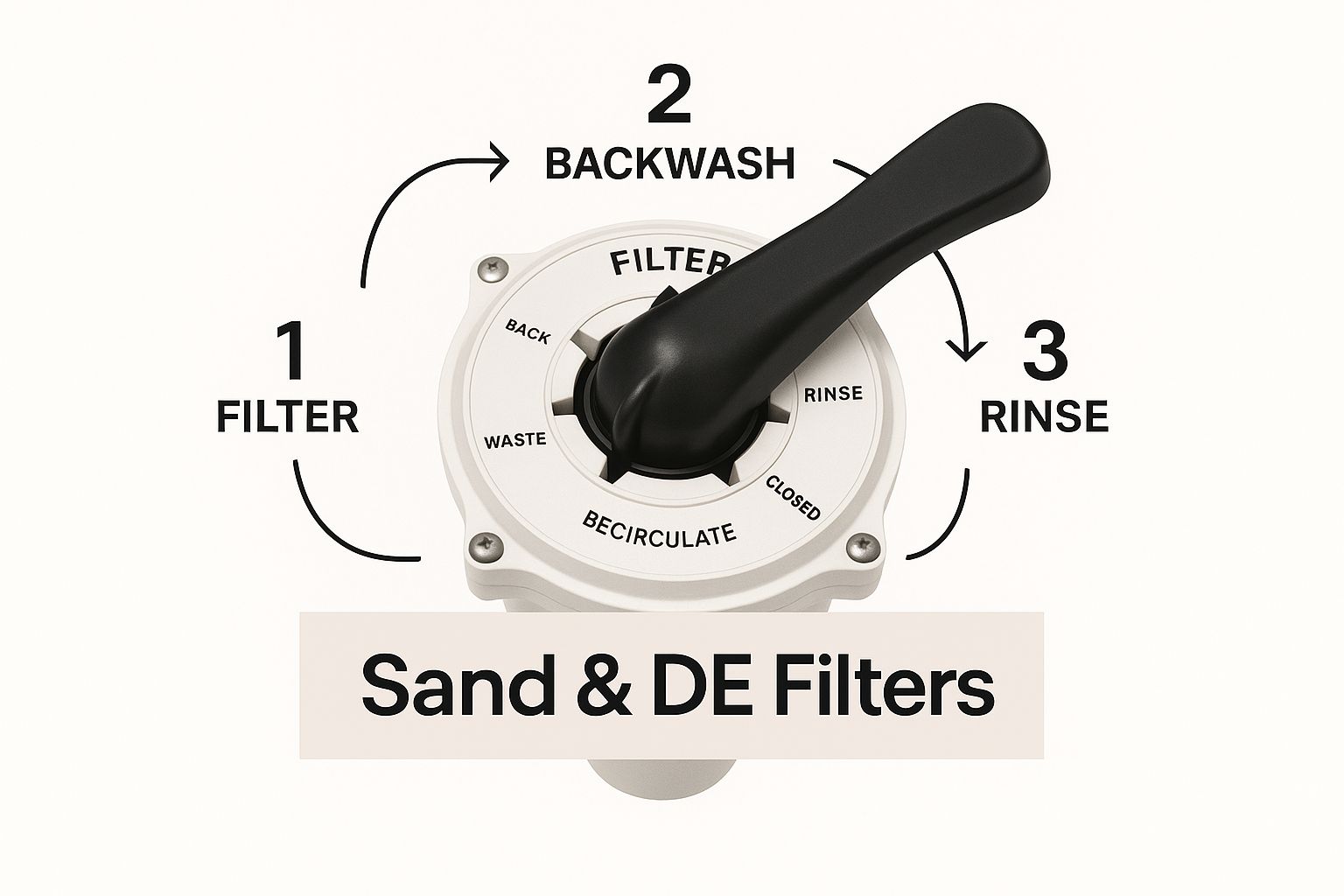
Having this visual in your head is helpful as you move through the steps. It really is the command center for this whole process.
The Backwash and Rinse Cycle: A Step-by-Step Guide
Okay, you've got your backwash hose connected and rolled out. The very first thing you do is turn the power OFF at the circuit breaker. Now, push down firmly on the multiport valve handle and turn it from 'Filter' to the 'Backwash' position until it clicks securely into place.
With the valve set, go ahead and turn the power back on. The pump will roar to life, and you'll see a surge of water coming out of your backwash hose. It’s going to look pretty nasty at first—cloudy, dirty, maybe even a bit green. Don't worry, that's a great sign! It means you're successfully flushing out all that trapped debris.
Now, find the sight glass on your filter system; it’s usually a small, clear plastic dome on the multiport valve. Keep the backwash running until the water you see flowing through that glass turns from cloudy to clear. This usually takes about 2 to 3 minutes.
Once that water is running clear, kill the power to the pump again. I can't stress this enough: always turn the pump off before moving the valve handle. Now, push the handle down and switch it over to the 'Rinse' position. Turn the pump back on and let it run for just 30 to 60 seconds. This little step is what prevents a cloud of sand or DE from shooting back into your pool when you're done.
After rinsing, turn the pump off one last time. Move the valve handle back to its home base—the 'Filter' position—and turn the power back on. You're back in business! Take a moment to check your pressure gauge and make a mental note of the new, lower reading. That's your "clean filter" pressure.
For DE Filters: Don't Forget to Recharge
If you're working with a DE filter, you have one final, critical step. The backwash process didn't just remove the dirt; it also flushed out all the old DE powder that was coating the filter grids. You have to replace it.
To do this, mix the correct amount of new DE powder with water in a bucket until it forms a milky slurry. With the pump running in its normal 'Filter' mode, slowly pour this slurry right into the skimmer closest to your equipment pad. The pump will suck the mixture into the filter tank, where it will perfectly recoat the internal grids, getting them ready to trap more contaminants. If you’re ever unsure about how much DE to use or the best way to add it, our pool services cover all aspects of DE filter care.
Performing a proper backwash is fundamental to your pool's health. It’s a key piece of maintenance in the global pool filters market, which was valued at around $2.72 billion in 2023 and is on track to hit $4.26 billion by 2032. Keeping that filter running efficiently is what delivers the crystal-clear water everyone wants, a crucial factor for any pool, especially commercial ones where happy guests are the top priority. You can learn more about the growing pool filter industry trends and see why this matters.
Finishing the Job: Water Chemistry and Final Checks
You’ve finished the backwash and rinse, and the heavy lifting is over. But don't walk away just yet. These last few steps are what really lock in the benefits of a clean filter and keep your pool sparkling. It’s all about getting your system back online correctly and, just as importantly, rebalancing your water chemistry.
With the pump still off, push the multiport valve handle down and turn it back to the 'Filter' position. You should feel it lock firmly into place. Once you're sure it's secure, go ahead and flip the circuit breaker back on. The pump will kick on, and you’ll hear the familiar sound of water flowing back to the pool.
Recalibrate and Rebalance
The very first thing I do after turning the system back on is walk over to the pressure gauge. Take a look at the reading—that's your new "clean" pressure. I always tell my clients to jot this number down on a piece of tape and stick it right on the filter tank. This is your new baseline. From now on, you'll know it's time to backwash again when the pressure climbs 8-10 PSI above this number.
Now for the water chemistry. Backwashing just sent hundreds of gallons of treated pool water down the drain. When you top the pool off with fresh water from the hose, you're massively diluting all the chemicals you've carefully maintained.
This is a classic rookie mistake. People backwash the filter and then wonder why they have an algae bloom three days later. They forget that adding all that fresh water throws the chemistry completely out of whack.
Testing and adjusting your water after a backwash isn't optional; it's a must-do.
Your Post-Backwash Chemical Checklist
Grab your test kit, because it's time to see where your levels are. You’ll want to check everything, but pay special attention to these three:
- Chlorine/Sanitizer: This is your pool's immune system. Its concentration will definitely be lower after adding fresh water, so you’ll almost certainly need to add more.
- pH and Alkalinity: These two work hand-in-hand to keep your water stable and comfortable. Adding a large volume of tap water can send them swinging in either direction.
- Salt Levels (for saltwater pools): If you have a salt system, you literally just washed away a good chunk of your salt. You'll need to add more to make sure your generator can keep producing chlorine effectively.
Trying to get all these chemicals back in sync can feel like a high-school science experiment. It’s precisely why many pool owners opt for professional help. Our monthly pool maintenance plans take the guesswork out of it, with thorough water testing and balancing after every visit.
This attention to detail is part of a massive industry. The global market for something as simple as a pool backwash hose is expected to hit around $350 million by 2033, all driven by the need for better materials that can stand up to pool chemicals and sun exposure. Learn more about the market for pool maintenance equipment and see how innovation is still shaping even the most basic parts of pool care.
Common Backwashing Mistakes to Avoid
Even the most seasoned pool owners can make a few classic blunders when it comes to filter maintenance. Knowing the right steps for how to backwash a pool filter is half the battle; knowing what not to do is the other half. Getting it wrong can lead to a half-baked cleaning job, frustratingly cloudy water, or worse, some seriously expensive equipment damage.
Let’s start with the absolute biggest, most important rule of all: never, ever move the multiport valve handle while the pump is running. I can't stress this enough. It’s like trying to slam a car into reverse while you're doing 60 on the highway.
Doing this even once can cause a violent pressure surge that can shred the valve's internal gasket. The result? Leaks, a valve that won't seal properly, and a repair bill that can easily run into the hundreds. Always turn the power off first.
The Problem With Over-Cleaning
This one feels a bit backward, but stick with me: backwashing your filter too often is a real problem. A filter that's just a little bit dirty actually works better at grabbing tiny particles than one that’s squeaky clean. Think of that initial layer of gunk as a pre-filter that helps trap even smaller contaminants.
The real indicator for a backwash isn't the calendar; it's your pressure gauge. When that needle climbs 8-10 PSI above the filter's clean, baseline pressure, that’s when it's time. Jumping the gun just wastes water and makes your filter less effective.
This is one of those areas where having a professional eye really helps. Our technicians can spot the true signs your system needs service, which saves a lot of unnecessary wear and tear in the long run.
Don't Skip the Rinse
After you've finished the backwash, all that sand or DE inside the tank is churned up and unsettled. That's where the "Rinse" setting comes in. It only takes about 30-60 seconds, but it's a crucial step. Rinsing resettles the filter media and sends any leftover debris straight out the waste line instead of back into your pool.
If you skip this and switch directly from "Backwash" to "Filter," you’re guaranteed to shoot a cloudy puff of dirt and sand right back into the water you just cleaned. It’s a rookie mistake that can instantly mess up your hard work.
It’s these small but critical details that make all the difference. In fact, the market for self-cleaning backwash filters is expected to double, hitting $700 million by 2033. This boom shows just how much focus is being put on efficient, reliable filtration. Proper maintenance is key to getting the most out of these systems. You can read more about the rise of advanced filtration systems to see where the industry is headed.
For pool owners here in Southwest Florida, if you'd rather not worry about the risks, our expert team can handle it. We make sure every step is done perfectly to protect your pool and your equipment.
Answering Your Backwashing Questions
Even after you've done it a few times, backwashing can still bring up some questions. Getting the hang of the little details will make you a pro at pool maintenance, but don't ever hesitate to call in an expert if you run into a real head-scratcher.
How Often Should I Really Backwash My Pool Filter?
This is probably the most common question I hear. Forget the calendar—your pool's pressure gauge is the only thing you need to listen to.
The golden rule is to backwash only when the gauge shows a pressure that's 8-10 PSI higher than its normal reading when the filter is clean. It's a classic rookie mistake to backwash too often, like once a week. Believe it or not, a filter with a little bit of dirt in it actually does a better job of catching the super-fine particles.
For most pools, this works out to be about every 4-6 weeks during the swimming season, but again, always let that pressure gauge be your final authority.
Why Is the Rinse Cycle So Important?
Skipping the rinse cycle is a shortcut you'll immediately regret. Think about what backwashing does: it violently churns up the sand or DE inside your filter to knock all the gunk loose. The rinse cycle's job is to let everything settle back into place.
By running the "Rinse" setting for about 30-60 seconds, you're flushing out any leftover debris and preventing loose sand from getting blasted back into your pool. If you skip this step, the moment you turn the filter back on, you’ll see a cloudy puff of dirt shoot right back into your crystal-clear water.
Can I Backwash a Cartridge Filter?
That's a definite no. The term "backwashing" is specifically for sand and DE filters because they're built with a special multiport valve that can reverse the flow of water.
Cartridge filters are a whole different ballgame. Cleaning them means taking the system apart, pulling out the physical cartridges, and hosing them down manually. If you're not sure which type of filter you have, one of our technicians can spot it in a second and show you the proper way to keep it clean.
When your pool maintenance feels more like a chore than a quick task, Water Medic of Cape Coral is ready to step in. Our pros handle everything from routine filter cleanings to complex system diagnostics, making sure your pool is perfect when you're ready to dive in. For dependable, expert pool care in Southwest Florida, check us out at https://watermedic.com.