
What Is the Real Cost to Install a Water Softener
If you're a homeowner in Southwest Florida, you know the daily battle with hard water all too well. It leaves behind stubborn soap scum on your shower doors and causes damaging scale buildup in your appliances. A water softener is the clear solution, but the big question is always the same: what's the investment going to look like?
Typically, the cost to install a water softener lands somewhere between $1,500 and $3,500. This range depends on the quality of the system you choose, your home's unique plumbing setup, and whether you bring in a professional for the installation.
Your Guide to Water Softener Installation Costs
Hard water isn't just a minor inconvenience; it's a problem that quietly works against your home's most important systems. Those mineral deposits can clog up your pipes, make your water heater less efficient, and even shorten the lifespan of your dishwasher and washing machine. For anyone living in Cape Coral and the surrounding areas, a good water softener isn't a luxury—it's a smart investment in protecting your home and making daily life a little easier.
To make an informed decision, you need to understand the full picture of the cost. The final price you'll pay is a mix of two key things: the water softener unit itself and the expert labor needed to get it installed correctly.
A National Perspective on Costs
Looking at the bigger picture, costs can vary quite a bit across the country. National data shows that the total price to install a water softener system can run anywhere from $200 to $6,000, with the average homeowner spending around $1,500.
Just for the labor, you can expect to pay between $150 and $1,000, depending on how complex the job is. For a broader look at what to expect, it’s always helpful to review general plumbing cost estimates to see how this type of work fits in.
Bringing in a pro ensures your system is perfectly integrated with your existing plumbing. This helps prevent expensive leaks down the road, makes sure the unit runs at peak efficiency, and keeps your manufacturer's warranty intact—benefits that easily justify the upfront labor cost.
Choosing the right team for the job makes all the difference. Here at Water Medic, we believe in clear, upfront pricing and providing the expert advice you need. We'll help you find a system that’s a perfect match for your home’s needs, without any hidden fees or surprises.
This guide will walk you through the entire pricing process, breaking down each element so you can budget with confidence. We'll cover the different types of systems, the specific factors that can affect your final price, and give you the clarity you need to take the next step.
Breaking Down Every Line Item of Installation
When you look at the price tag for a new water softener, it’s easy to focus on that one number. But to really understand what you're investing in, it helps to see it as a sum of its parts—each one critical for giving you great-tasting, genuinely soft water for years to come.
Think of it this way: the final price isn't just for the big tank you see. It’s for the tank, all the specialized parts needed to connect it, and the skilled hands required to put it all together perfectly.
The Water Softener Unit
The heart of the system is, of course, the water softener itself. This is where you'll see the biggest chunk of your initial investment. The unit alone can run anywhere from $500 to over $2,000, and that price tag really depends on its size, efficiency, and the technology inside.
Here in Southwest Florida, we deal with some seriously hard water. That’s why salt-based ion exchange systems are the only way to go. They’re the workhorses that physically pull out the hard minerals like calcium and magnesium, which is what protects your pipes and appliances. While you might see "salt-free conditioners" out there, they simply don't remove minerals the same way. We’ve found that high-efficiency water softeners are the best match for our local water.
Essential Parts and Materials
Getting the main unit is just step one. A professional installation requires a handful of essential components to make sure everything is connected securely and built to last. Skimping here is a recipe for future leaks and headaches.
- Piping: We use professional-grade copper or PEX piping to tap into your home's main water line.
- Bypass Valve: This is a must-have. It lets you easily switch the softener off for things like watering the lawn, which saves you a ton on salt and water over time.
- Fittings and Connectors: Quality, leak-proof connectors are non-negotiable for a reliable seal between the unit and your plumbing.
- Drain Line: The system needs a dedicated line to flush out the salty brine solution after it cleans itself (the regeneration cycle).
Professional Labor and Expertise
Finally, you have the labor cost, which covers the hands-on expertise needed for a flawless installation. This is so much more than just hooking up a few pipes. When you hire a pro, you’re paying for their experience.
A true professional will start with a full site assessment to find the best spot for the unit. Then they'll make a precise connection to your home’s plumbing and, most importantly, calibrate the system perfectly based on your home's specific water hardness and how much water your family uses.
That professional touch guarantees your system runs at peak efficiency from the get-go and keeps your manufacturer’s warranty intact. Sometimes, a permit or minor electrical work might be needed, but a good team will walk you through all of that upfront so there are absolutely no surprises on the final bill.
Key Factors That Influence Your Final Cost
So, why does the cost to install a water softener vary so much from one home to another? It’s a great question. The final price isn't a simple, one-size-fits-all number. Think of it more as a custom quote that reflects your home's unique layout and your family's specific needs.
Getting a handle on these variables is the first step toward a smart investment. It allows you to have a productive, well-informed conversation with a water treatment pro. Just like with any other upgrade, knowing how to budget for a home renovation helps you set realistic expectations and avoid surprises down the road.
System Type and Capacity
The biggest piece of the puzzle is, of course, the water softener itself. The type and size of the system you choose will directly impact the equipment cost. For instance, a larger household with higher water usage will naturally need a system with a greater grain capacity to keep up. That unit will cost more upfront than a smaller one designed for a two-person home.
On top of that, a high-efficiency, salt-based ion exchange system—which is really the gold standard for tackling the kind of hard water we see here in Southwest Florida—comes at a different price point than other types of water conditioners. Our job is to help you find that sweet spot: a system that's perfectly sized for your family, so you aren't overspending on a unit that’s overkill or, worse, getting stuck with one that can't do the job.
This decision tree gives you a great visual breakdown of how the different cost components come together.
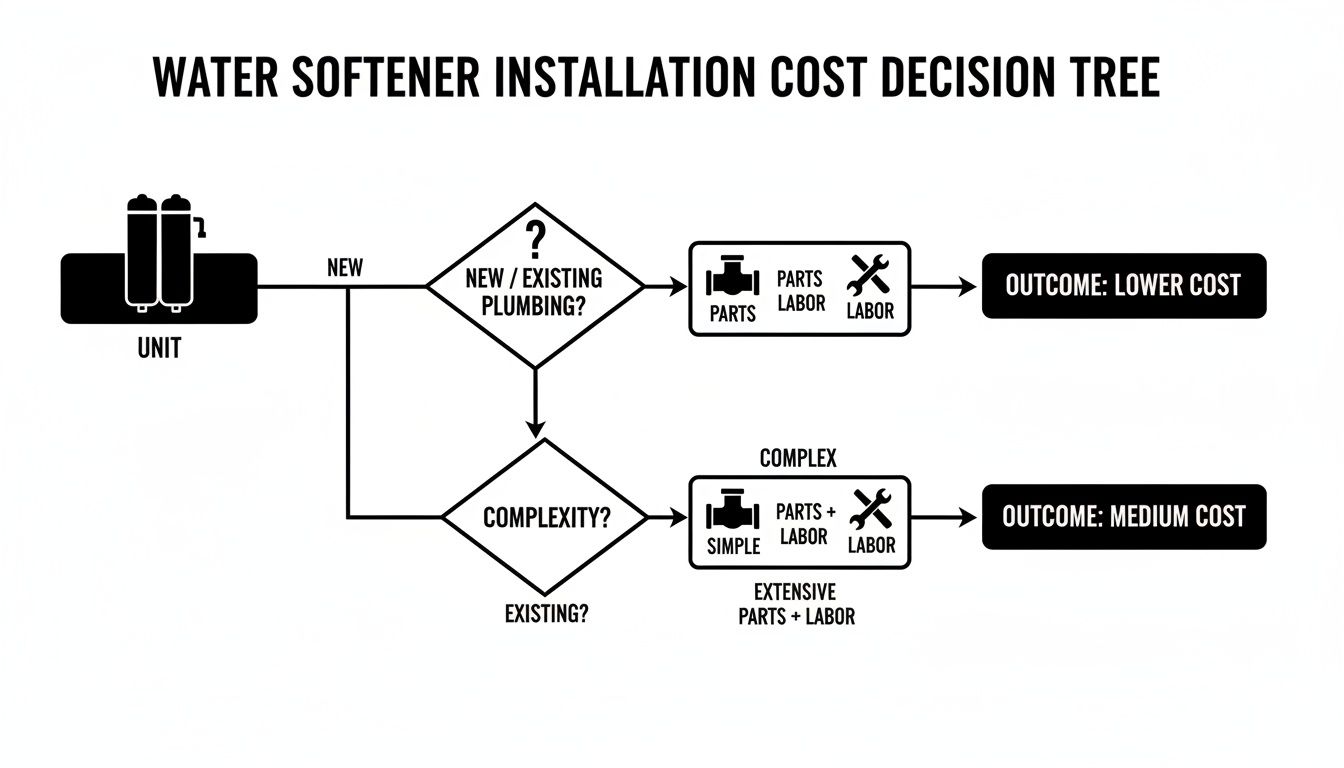
As you can see, the unit itself, the necessary parts, and the professional labor are the three pillars of your total investment.
Your Home's Plumbing and Installation Location
The current state of your plumbing is another major factor. A newer home that's already "softener-ready"—meaning it has a pre-installed plumbing loop—is the most straightforward scenario. Our technicians can get the system connected quickly, which keeps labor costs down.
Older homes, on the other hand, often need a bit more work. If we have to reroute pipes or run new lines to get the softener installed, the complexity (and the cost) goes up. Adding new piping can run anywhere from $0.50 to $8 per linear foot, and navigating the non-standardized plumbing common in older properties often takes more time and materials than a modern layout.
To give you a clearer picture, here’s how different installation factors can swing your total cost one way or the other.
Cost Impact of Key Installation Factors
| Factor | Low-Cost Scenario | High-Cost Scenario | Potential Cost Impact |
|---|---|---|---|
| Plumbing | Home is "softener-ready" with a pre-plumbed loop. | New pipes, valves, and a bypass loop must be installed. | $100 – $600+ |
| Location | Easily accessible garage with nearby drain and outlet. | Cramped crawlspace or outdoor install requiring trenching. | $150 – $500+ |
| Electrical | Standard electrical outlet is within a few feet. | New GFCI outlet must be installed by a licensed electrician. | $120 – $300+ |
| Drain Line | Simple run to an existing utility sink or standpipe. | Long or complex drain line run to a distant drain. | $50 – $200+ |
As the table shows, a few key details about your home's infrastructure can make a significant difference in the final installation price.
The physical location for the new unit matters, too. An easily accessible spot in a garage or utility room makes for a much quicker and more cost-effective job. If the work has to be done in a tight crawl space or a hard-to-reach corner of the basement, it will naturally take more time and effort.
This is precisely why we insist on a detailed, on-site assessment at Water Medic of Cape Coral. It allows us to give you a precise and transparent quote, so you know exactly what to expect before any work begins. It’s our commitment to clarity that ensures a smooth, professional installation every single time.
DIY vs. Professional Installation: Which Is Right for You?
Tackling a home improvement project yourself can be incredibly rewarding, and when looking at the cost to install a water softener, it's tempting to think about saving a few hundred bucks on labor. On the surface, it seems like a win. But when it comes to plumbing, a small mistake can turn a weekend project into a costly catastrophe.
The truth is, putting in a water softener correctly is more complex than a YouTube tutorial makes it look. It requires a real understanding of plumbing, a grasp of local building codes, and knowing the ins and outs of the specific system you bought. A single over-tightened fitting or a poorly soldered pipe might not seem like a big deal, but it can create a slow, hidden leak that causes thousands of dollars in water damage before you even notice it.
The Hidden Costs of a DIY Installation
Beyond the very real risk of a flood, going the DIY route has other pitfalls that can cost you more down the road. For starters, did you know that most manufacturers’ warranties are only valid if a professional installs the unit? If a part fails, you could find your warranty has been voided, leaving you on the hook for the full cost of a new system.
Even if you avoid a major leak, an improper setup almost always leads to an inefficient system. Some of the most common DIY mistakes we see are:
- Incorrect Calibration: If the regeneration cycle isn't programmed perfectly for your specific water hardness and household usage, you’ll either waste a ton of salt and water or, even worse, the system won't actually soften your water properly.
- Wrong Location: Sticking the unit in a bad spot can make future maintenance a nightmare. It can also violate local codes, especially when it comes to drain lines and required air gaps.
- Improper Connections: Using the wrong type of pipes or fittings doesn't just affect the softener; it can compromise your home’s entire plumbing system.
The Value of Professional Expertise
When you choose a professional installation from a team like Water Medic of Cape Coral, you’re not just paying for a few hours of labor—you're buying peace of mind. Our technicians have installed thousands of systems all over Southwest Florida. We know the unique challenges our local water presents and have seen every kind of plumbing setup imaginable.
A professional installation is your guarantee that the job is done right the first time. It protects your home, validates your warranty, and ensures your new water softener operates at peak performance from day one, maximizing its efficiency and lifespan.
Hiring us means you get a partner who is genuinely invested in your home's water quality. We take care of everything, from making sure the system is perfectly sized for your family to handling any required permits. We stand by our work, so you can rest easy knowing your investment is protected. To learn more about keeping your system running smoothly, check out our monthly maintenance plans.
In the end, the security and long-term performance you get from a professional installation almost always outweigh the short-term savings of trying to do it yourself.
Understanding the Long-Term Value of Soft Water
The price tag on a new water softener is just the beginning of the story. If you only look at the initial installation cost, you’re missing the bigger picture. A water softener isn't just an expense; it's a long-term investment in your home and, believe it or not, your bank account. The real value comes from the money you'll save year after year.
Think about the most expensive, water-dependent appliances in your home: the water heater, dishwasher, and washing machine. Every day, they're fighting a battle against the mineral scale left behind by hard water. That buildup forces them to work harder, suck up more energy, and eventually break down years sooner than they should. Soft water stops that damage before it even starts.
Calculating Your Return on Investment
Your savings kick in the moment the system is up and running. The most immediate change you'll notice is how little soap and detergent you need. Because soft water lathers so effectively, you can expect to cut your spending on these household essentials by up to 50%.
But the financial perks don't stop there. The real magic is in the less obvious savings:
- Appliance Longevity: Research shows that water heaters using soft water can maintain their original factory efficiency for as long as 15 years. In contrast, those running on hard water can lose up to 48% of their efficiency due to scale buildup.
- Fewer Repair Bills: By eliminating scale, you're protecting all the small, delicate parts inside your appliances. That means no more surprise service calls for clogged valves or fried heating elements.
- Longer-Lasting Clothes and Linens: Those hard water minerals get tangled in the fibers of your clothes and towels, leaving them stiff, scratchy, and faded. Soft water keeps fabrics feeling soft and looking bright, extending the life of your entire wardrobe.
Understanding Ongoing Costs
To get the most out of your investment, it helps to know about the minimal upkeep involved. For an ion-exchange system—the most effective choice for Southwest Florida's water—you'll need to add salt regularly. For a typical family, this usually works out to about $10 to $20 per month for salt bags.
You’ll also see a tiny bump in your utility bills from the electricity and water used during the regeneration cycle, but it’s generally a very small amount. With the global water softener market valued at around $3.3 billion in 2024, manufacturers are constantly competing to build even more efficient models, which is great news for homeowners.
A professional installation from Water Medic of Cape Coral ensures your system is perfectly dialed in for your home’s unique water hardness and usage, maximizing its efficiency right from the start.
Modern systems are built to last, but just like your car, a little preventative maintenance goes a long way. To keep your system running in peak condition for years to come, check out our professional monthly maintenance plans.
When you weigh the upfront cost against the significant long-term savings and minimal upkeep, it becomes clear that a water softener is one of the smartest upgrades you can make for your home.
Common Questions About Water Softener Installation Costs
Even with a detailed cost breakdown, you probably still have a few questions swirling around. That’s perfectly normal. Understanding the installation process and what you get long-term is just as important as the number on the initial quote.
To help clear things up, we've put together answers to the most common questions we hear from our neighbors here in Southwest Florida. We want you to feel confident that you’re not just buying a piece of equipment, but making a smart, lasting investment in your home.
How Long Does Professional Installation Take?
This is usually the first thing people ask. If your home is already "softener-ready" with a plumbing loop in place, our expert technicians can typically have everything installed and running in just 2 to 4 hours. It’s a pretty straightforward job.
Now, if your home’s plumbing needs a bit more work—like running new pipes to the right spot or adding an electrical outlet—it could take closer to a full day. We’re always upfront about this. After our initial on-site assessment, we'll give you a precise time estimate so there are no surprises.
Can a Water Softener Increase My Home's Value?
Absolutely. In a place like Southwest Florida, where hard water is a known headache, a high-quality water softener is a huge plus for potential buyers. It tells them the home's plumbing, fixtures, and expensive appliances have been protected from the crusty scale buildup that wreaks havoc on everything.
It's a powerful selling point that can make your home stand out. Buyers recognize it as a sign of a well-maintained property, and that often translates to a better offer.
What Is the Best Water Softener for Southwest Florida?
With the extremely high mineral content we see in our local water, there's really only one answer: a salt-based ion exchange water softener. This is the only type of system that physically removes the hard minerals—calcium and magnesium—from your water.
Salt-free "conditioners" might sound appealing, but they don't actually soften the water; they just change the mineral structure. To get truly soft water that protects your home, you need an ion exchange system. At Water Medic, we always start with a free water test to measure your specific hardness level. This lets us size a system perfectly for your family's needs so it runs efficiently for years.
Do I Need a Permit to Install a Water Softener?
Yes, in most local areas, including Cape Coral, a plumbing permit is required. This isn't just red tape; it's a crucial step to ensure the installation meets safety codes, especially when it comes to backflow prevention that protects the city's water supply.
Dealing with permits can be a real pain, which is why we handle it all for you. As part of our complete service, Water Medic of Cape Coral pulls all necessary permits on your behalf. You can relax knowing the job is done right, to code, and without you having to lift a finger.
If financing is a concern, we have flexible options to help make this important investment manageable. You can learn more by exploring our water softener financing solutions.